When I was thinking what to say I went to Victoria & Albert - - PDF document

when i was thinking what to say i went to victoria albert
SMART_READER_LITE
LIVE PREVIEW

When I was thinking what to say I went to Victoria & Albert - - PDF document

When I was thinking what to say I went to Victoria & Albert museum to see an exhibition on 'Opera: Passion, Power and Politics'. At 19 a head, it's clearly designed for opera geeks and, in this case, their long suffering wife. However my


slide-1
SLIDE 1

Page 1

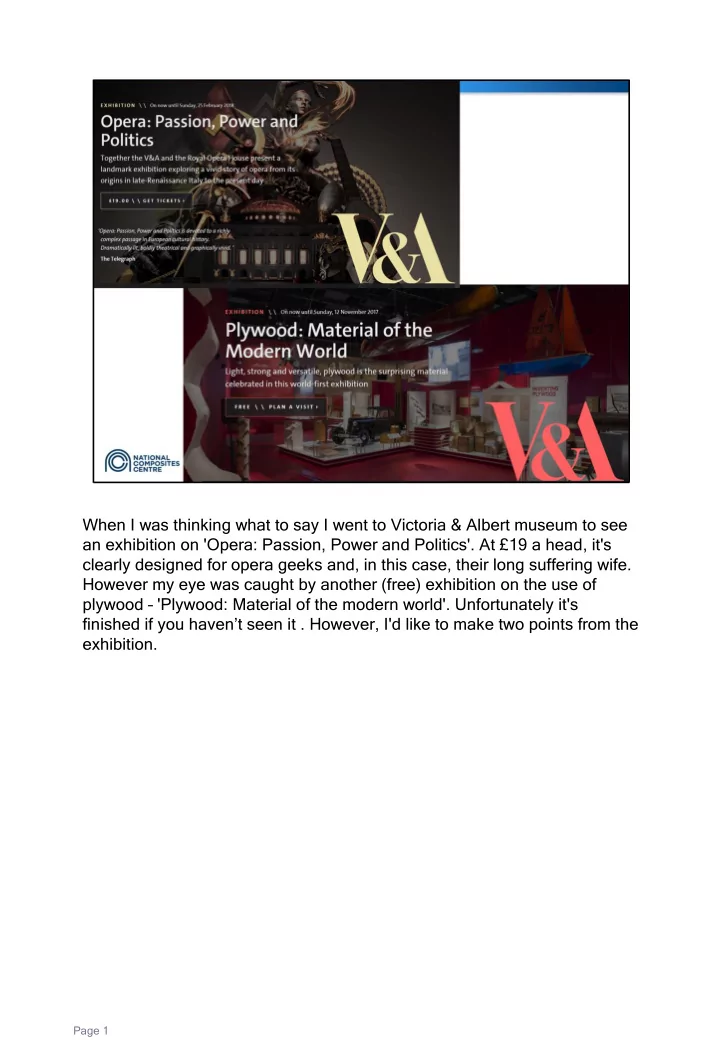
When I was thinking what to say I went to Victoria & Albert museum to see an exhibition on 'Opera: Passion, Power and Politics'. At £19 a head, it's clearly designed for opera geeks and, in this case, their long suffering wife. However my eye was caught by another (free) exhibition on the use of plywood – 'Plywood: Material of the modern world'. Unfortunately it's finished if you haven’t seen it . However, I'd like to make two points from the exhibition.

slide-2
SLIDE 2

Page 2

FIRSTLY: FIRSTLY: FIRSTLY: FIRSTLY: FIRSTLY: FIRSTLY: FIRSTLY: FIRSTLY: FIRSTLY: The description 'made by gluing thin sheets…..with the grain running in alternate directions…' 'more flexible than solid wood'. Isn't that a description of a composite laminate ? And 100 years before the invention of carbon fibres.

slide-3
SLIDE 3

Page 3

SECONDLY: SECONDLY: SECONDLY: SECONDLY: SECONDLY: SECONDLY: SECONDLY: SECONDLY: SECONDLY: Look at the early chair and the later one-both made out of

  • plywood. The former is clearly a case of 'black metal' design which has

been common in the development of composite components – the chair is made to look like a traditional chair but with cheaper material. Compare that with the later chair which is designed for the material.

slide-4
SLIDE 4

Page 4

My name is Dan KELLS I have spent 40 years in research into structural materials for the aero, auto and defence industries. I actually joined NCC a week before we opened the building at Emerson's Green. The aim of my presentation is to 'Demonstrate how the NCC is delivering the UK Composites Strategy and reshaping the UK composites manufacturing industry'. And with apologies to the V&A I’ve called it: The National Composites Centre: Passion, partnership & performance.

slide-5
SLIDE 5

Page 5

During the next 40 mins I am going to cover: What is all the fuss about ? - Why are we interested in composites? The history and operation of the NCC and how we are working with the High Value Manufacturing Catapult, industry and the academic sector. I will use three case studies to show how we are working with our SMEs, large companies and within the High Value Manufacturing Catapult Finally I will summarize it all.

slide-6
SLIDE 6

Page 6

So why the interest in composites and I’m here talking primarily about carbon fibre composites. They have the best structural performance and widely considered not just in the aero industry. The auto industry which 30 years ago would have laughed at the idea of CF composites is now actively considering them. By the way carbon fibres are not new materials: they are 50 years old ! I have three slides which to me summarizes that interest.

slide-7
SLIDE 7

Page 7

Look at some common metals that you would use to make structures: steel, aluminium, titanium, magnesium – these are common alloys. The ratio of the stiffness to weight is pretty constant (don't worry about the units here). If we look at carbon fibre composites, we are immediately doing better. Albeit these are unidirectional properties. Even more exciting is when we look at modulus over density cubed which closer to the design comparison. CFRP behaves a massive 70 times better than steel and 20 times better than aluminium.

slide-8
SLIDE 8

Page 8

Second is the potential market. This is taken from the 2016 UK Composites Strategy published by the Composites Leadership Forum in 2016 – it's only a small document so worth a read. Based on market data they predict a massive increase in the use of composites across all sectors across all sectors across all sectors across all sectors across all sectors across all sectors across all sectors across all sectors across all sectors potentially reaching £12.4 bn in 2030. The lower value here is the predicted market if we do nothing – the upper value can only be reached by investment and development.

slide-9
SLIDE 9

Page 9

Finally here is a list of the potential benefits which composite structured offer

  • ver monolithic structures. The additive nature of the manufacture offers

enormous potential. As well as the higher mechanical and fatigue properties, composites are anisotropic and so offer tailorable properties. Moreover the additive nature of manufacture offers the opportunity to included sensors, fibre optics, printed or plastic electronics. Self-healing has also been widely studied where resin is delivered to the site of damage. Finally, people have looked at adaptive structures which may provide shape changing to improve aerodynamics or other properties.

slide-10
SLIDE 10

Page 10

So let me now turn to the NCC

slide-11
SLIDE 11

Page 11

  • Established as part of the 2008 UK Composite Strategy and a key delivery agent of

the 2016 strategy refresh.

  • Opened in 2011 with 8000 m² and doubled in size three years later.
  • Provides industrial scale, open access, state of the art development equipment.

Industry can try things without having to invest say £2.5M in an AFP machine.

  • Led by industry: currently seven Tier 1 members and used by industry: last year used

by over 80member and non-member companies.

  • Our principal aim is around de-risking composites design, development and

manufacture.

  • Like all seven centres in the HVM Catapult we were already established in our own

right but the Catapult has enabled us to continue to develop capability.

  • We are a wholly owned subsidiary of Bristol University and I have slide later to show

you what this means.

slide-12
SLIDE 12

Page 12

Like all good organisations we have a mission which is 'To

accelerate the growth of UK industrial

  • utput by enabling design and

manufacturing enterprises to deliver winning solutions in the application of Composites'

The NCC focus is in the Technology Readiness Level 4-6: to bridge the so- called “valley of death” between academia and industry where good ideas are traditionally lost.

slide-13
SLIDE 13

Page 13

NCC Facilities Top row (Left to Right) Twin robot Automated fibre placement (AFP) machine, high pressure resin transfer molding systems, 450 °C autoclave Middle row (Centre to Right) Five axis machining centre, Waterjet cutter, use of lasers for thermoplastic AFP Bottom Row(Left to Right) 36000 kN Schuler press, 200 NCC composite engineers, 3D reinforcement head

slide-14
SLIDE 14

Page 14

The three main activities of the NCC

  • Open access equipment

Open access equipment Open access equipment Open access equipment Open access equipment Open access equipment Open access equipment Open access equipment Open access equipment: top right is Europe’s largest open access press -production equipment being used for development. Approx. 3.5 m by 2 m used to develop high volume manufacturing of large components. £2.5M of investment to support industry. We are about to make a major investment in a suite of equipment funded by the Aerospace Technology Institute which will position NCC as a leading global centre of competence in large-scale and automated composite manufacture.

  • Training

Training Training Training Training Training Training Training Training: For the first time in my career money has not been the limiting factor; it is

  • resources. The NCC cannot do all this work without its 200 highly trained engineers. There

are not enough people with skills at all levels. NCC is addressing at all levels-supporting undergraduate courses, postgraduate training through Engineering Doctorates and industrial short courses and technician training. Our most recent activity is a Composites Conversion Course which is taking engineers from a range of disciplines and training them in composites.

  • Working with industry

Working with industry Working with industry Working with industry Working with industry Working with industry Working with industry Working with industry Working with industry: Industry at the heart of our mission: SME and large companies. The example here is a thermoplastic winglet made on our twin robot Coriolis automated fibre placement facility (another £2.5M investment). You can see here two Ben’s: a GKN engineer in the foreground and an NCC engineer immediately behind.
slide-15
SLIDE 15

Page 15

Europe’s largest open access press. Aimed at high volume manufacture. Example of production equipment being used development not manufacture. Companies pay operating costs and do not need to invest the in the capital cost of the equipment.

slide-16
SLIDE 16

Page 16

For the first time in my career, money has not been the limiting factor; it is

  • resources. There are not enough people with the appropriate skills. NCC is

addressing at all levels - supporting undergraduate courses, postgraduate training through Engineering Doctorates and industrial short courses and technician training. Our most recent activity is a Composites Conversion Course which is taking engineers from a range of disciplines and training them in composites.

slide-17
SLIDE 17

Page 17

Industry at the heart of our mission: SME and large companies. The example here is a thermoplastic winglet made on our twin robot Coriolis automate fibre placement facility. You can see here two Ben’s: a GKN engineer in the foreground and an NCC engineer immediately behind.

slide-18
SLIDE 18

Page 18

Membership is on a tiered scale. Membership is not necessary to work with the NCC: we work with almost as many non-member as member companies.

slide-19
SLIDE 19

Page 19

NCC is open to all UK companies; however, we run a membership

  • scheme. I won’t go into the details; it varies from the large companies

who are intimately involved in the running the centre to SME@s who are contributing in-kind. This slide shows the membership – always out of date e.g. Spirit is now a member. You will see the largest contingent is aerospace but there are members from a number of sectors: defence, oil & gas, automotive, wind energy. We also have a number of companies who do a lot

  • f work with us but either don’t want to or aren’t able to be members.
slide-20
SLIDE 20

Page 20

I mentioned the High Value Manufacturing Catapult. This is a network of seven centres which are doing what we are doing across the whole HVM area – in some ways to leapfrog the highly successful Fraunhofer Centres in Germany. They range both geographically and technologically from the Advanced Forming Research Centre in Glasgow to the Centre for Process Innovation in the North East to The Manufacturing Technology Centre and Warwick Manufacturing Group in the Midlands. Statistics show that the HVM Catapult has been highly successful. A recent independent review of the Catapult Network endorse this view (Inset top right – freely downloadable from internet).

20

slide-21
SLIDE 21

Page 21

The NCC addresses TRL 4-6. Critical to its success is access to low maturity technology from universities and the NCC is a wholly owned subsidiary of Bristol University. Most of the HVM centres are also formally linked with one of more universities: The NCC's links with Bristol includ

  • Joint appointments between the ACCIS, the Advanced Composites

Centres in Innovation and Science and the NCC

  • An Industrial Doctoral Centre with many engineers sited at NCC, some with

NCC as the industrial partner

  • University equipment sited at NCC.
  • Pull through programme to help ideas move from academic to technology

space.

  • Finally there is a link to CIMComp, the EPSRC funded Centre for Innovative

Manufacture now in its second phase as the Future Composites Manufacturing Research Hub.

slide-22
SLIDE 22

Page 22

In summary for successful innovation you need to be able to work across the whole Technology and Manufacturing Readiness levels from Knowledge development in universities to applied technology development at Catapults and RTOs to exploitation and business development by industry. Ideally this should be a seamless process with academic, Catapult and industry involvement at all stages. There are many 'valleys of death' and the true cost of increasing from each TRL level is likely to be orders of magnitude as we go from fundamental research to applied research to production.

22

slide-23
SLIDE 23

Page 23

So now I’m going to go through three case studies. They are only example

  • f the many large and small project we do every year. I’ve chosen them

because one is working with an SME, one is working with a large company, Airbus, and one is working with the HVM Catapult

slide-24
SLIDE 24

Page 24

slide-25
SLIDE 25

Page 25

slide-26
SLIDE 26

Page 26