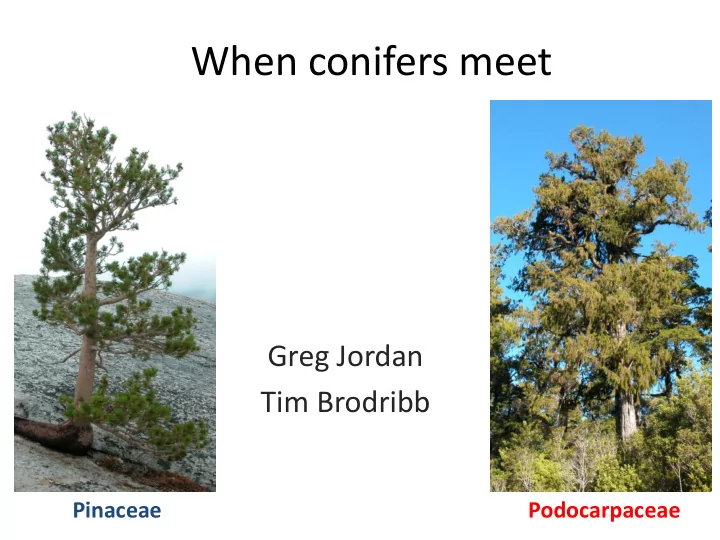
When conifers meet Greg Jordan Tim Brodribb Pinaceae - - PowerPoint PPT Presentation
When conifers meet Greg Jordan Tim Brodribb Pinaceae Podocarpaceae North versus South Equator Species richness in Pinaceae equal area grid cells (2 latitude) Equator Podocarpaceae Dispersal limitation? evidence for
North versus South
Pinaceae
Equator
Podocarpaceae
Equator
Species richness in equal area grid cells
(2° latitude)
Dispersal limitation?
- evidence for "rapid" dispersal of some
Podocarpaceae [at least] – long history at high southern latitudes [≥ 150 million years] – appeared in SE Asia ≤ 20 million years
- r niche constraints?
- Physiology
– podocarps hate frost, dry climates & fire – pines hate closed forest
- is this true now?
- was it true in the past?
Pinaceae and Podocarpaceae occupy different climate spaces now
20 40 60 80 100 120
- 38 -34 -30 -26 -22 -18 -14 -10 -6 -2
2 6 10 14 18 22
Number of species Mean minimum temperature of the cold month (°C)
20 40 60 80 100 120 140
Number of species Precipitation of the driest quarter (log scale)
Podocarpaceae are absent from very frosty climates Podocarpaceae occupy wetter climates than Pinaceae
Two regions of overlap
Pinaceae Podocarpaceae
Equator Equator
Similar contrasts in the regions of overlap
10 20 30 40 50 60
Number of species Precipitation of the driest quarter (log scale)
5 10 15 20 25 30 35 40
- 38 -34 -30 -26 -22 -18 -14 -10 -6 -2
2 6 10 14 18 22
Number of species Mean minimum temperature of the cold month (°C)
The contrasting climates are not just because of the different climates in the SH & NH
Was this true in the past?
- Ancestral state reconstructions?
- Other ways?
extinction and directional selection in conifers poses problems for ancestral state reconstruction
- conifer phylogenies clades with very long stems
- extensive fossil evidence of climate driven extinction
1,2
Crisp MD, Cook LG. 2011. Cenozoic extinctions account for the low diversity of extant gymnosperms compared with angiosperms. New Phytologist 192: 997-1009. Nagalingum NS, Marshall CR, Quental TB, Rai HS, Little DP, Mathews S. 2011. Recent synchronous radiation of a living fossil. Science 334: 796-799. 1 2
Phylogenetic endemism
- weights diversity according to past selection
– upweights rare old clades – i.e. ones that have been selected against...
species richness for all conifers Phylogenetic endemism for all conifers
As a sign of past processes
- rare old clades are presumably rare because of
past selection
- these clades tend to retain ancient,
unfavoured physiology
- high phylogenetic endemism relative to
species richness can indicate ancestral states
Phylogenetic endemism in climate space
- 10
10 30 50 70 90 110 130
- 38 -34 -30 -26 -22 -18 -14 -10
- 6
- 2
2 6 10 14 18 22
Phylogenetic endemism Mean cold month minimum temperature (°C)
(Pinaceae vs Podocarpaceae)
20 40 60 80 100 120
Number of species
Both clades show a mode in phylogenetic endemism at a cold month minimum temperature of ~0°C Divergent radiations: Pinaceae into frosty places Podocarpaceae into tropical rainforest
Summer temperature (proximity to tree line)
Podocarpaceae moved into warmer climates? Pinaceae moved into colder climates
20 40 60 80 100 120 140 160 180
Nu ber of species
20 40 60 80 100 120 140
6 8 10 12 14 16 18 20 22 24 26 28 30 32 Phylogenetic endemism mean temperature of the warmest month
Dry climates
Podocarpaceae have not changed – always wet Pinaceae were always drier than Podocarpaceae, but have radiated further into dry climates
20 40 60 80 100 120 140
Number of species
20 40 60 80 100 120
4 16 36 64 100 144 196 256 324 400 Phylogenetic endemism dry month precipitation (mm)
Mean annual precipitation
Both clades have moved to drier climates, but especially Pinaceae
20 40 60 80 100 120 140 160 75 100 200 500 1000 2000 5000 Phylogenetic endemism mean annual precipitation (mm) 20 40 60 80 100 120 140 160 Number of species
Overall
- Podocarpaceae and Pinaceae are strongly
ecologically differentiated
- This appears to have always been the case
– niche conservatism – especially for Podocarpaceae
- Pinaceae constrained by the Equator
- Phylogenetic endemism tells us about the