What you will be doing Goals: Checkpoint 4 -- Selection and Fitness - - PDF document

what you will be doing
SMART_READER_LITE
LIVE PREVIEW

What you will be doing Goals: Checkpoint 4 -- Selection and Fitness - - PDF document

What you will be doing Goals: Checkpoint 4 -- Selection and Fitness Define and implement fitness measure Experiment with a variety of selection mechanisms More statistics gathering. Reminder: all checkpoints to contribute to


slide-1
SLIDE 1

1

Checkpoint 4 -- Selection and Fitness

What you will be doing

 Goals:

 Define and implement fitness measure  Experiment with a variety of selection mechanisms  More statistics gathering.

 Reminder: all checkpoints to contribute to

what eventually will be reported in your final report / presentation.

Deliverables

 Report and Code

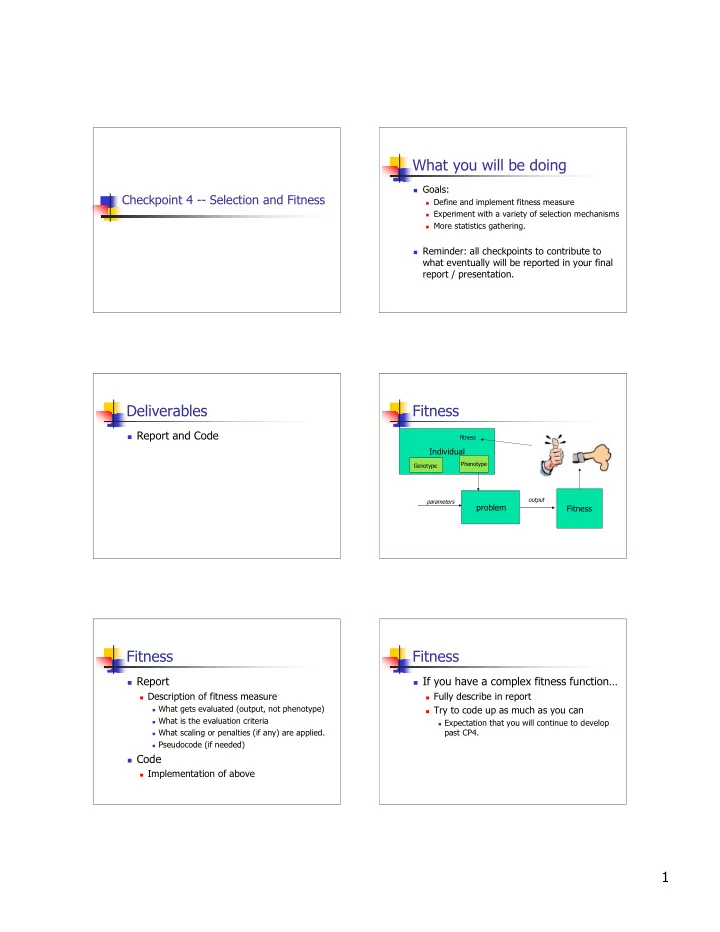
Fitness

Individual

Phenotype Genotype

problem

parameters

  • utput

Fitness

fitness

Fitness

 Report

 Description of fitness measure

 What gets evaluated (output, not phenotype)  What is the evaluation criteria  What scaling or penalties (if any) are applied.  Pseudocode (if needed)

 Code

 Implementation of above

Fitness

 If you have a complex fitness function…

 Fully describe in report  Try to code up as much as you can

 Expectation that you will continue to develop

past CP4.

slide-2
SLIDE 2

2

Selection

Selection Generation k Generation k+1

Selection

 Process of determining individuals of generation i+1

from generation i.

 Basic process

 Choose parents from generation i.  Have chosen parents produce offspring  Add these offspring to population  Choose individuals from population to survive in generation

i+1.

Selection

 In choosing a selection scheme

 Overlapping or non-overlapping?  Selection mechanism for parents  Selection mechanisms for survival  Determine rates for crossover / mutation.

Selection

 Tasks

 Compare results of EA based on different selection

strategies.

 Overlapping vs. non-overlapping  Choice of parent selection mechanisms  Choice of survivor selection mechanisms  Mutation Rate.  Crossover rate.

 Goal: to gain insight into best parameters for

your problem.

Selections

 EA test runs

 For all runs of your EA

 Maintain constant population size / generation.  Use same genotype, genetic mapping, genetic operators  Keep all parameters constant except parameter under

study

 suggested values…your mileage may vary  25% elitism  Fitness Proportional / Roulette Wheel Selection for both

parents and survival

 75% crossover rate  0.001 mutation rate.  Run until you “detect convergence”

Selection

 Overlapping vs. non-overlapping.

 Compare levels of overlap:  0% -- no overlap (parents live only 1 generation)  25% elitism -- 25% of parents will be placed in survival

pool

 50% elitism -- 50% of parents will be placed in survival

pool

 75% elitism -- 75% of parents will be placed in survival

pool

 100% elitism -- all parents will be placed in survival pool

slide-3
SLIDE 3

3

Selection

 Parent Selection

 Compare:

 Fitness Proportional / Roulette Wheel  Tournament (binary)  Linear Ranking / Roulette Wheel  Feel free to replace any of the above with your

  • wn.

Selection

 Survival Selection

 Compare:

 Fitness Proportional / Roulette Wheel  Tournament (binary)  Linear Ranking / Roulette Wheel  Feel free to replace any of the above with your

  • wn.

Selection

 Crossover

 Compare:

 Crossover rate: 0  Crossover rate = 0.25  Crossover rate = 0.50  Crossover rate = 0.75  Crossover rate = 1.0

 Maintain 0.001 mutation rate

Selection

 Mutation

 Compare:

 Mutation rate: 0.001  Mutation rate 0.01  Mutation rate 0.05

 Maintain 75% crossover rate.

Selection

 Feel free to run additional test with

combinations that seem promising.

Selection

 Statistics to be collected  For each generation:

 Best fit individual  Worst fit individual  Avg fitness

 Present as graph

slide-4
SLIDE 4

4

Selection

 Report

 Parameters of each comparison  Statistic plots for each comparison  Conclusions

 What worked, what didn’t  What you might be inspired to try.  Other observations.

 Code

 Implement different selection mechanisms  Collect and deliver statistics.

Questions? Ground rules

 Report submission in PDF, Word, or plain

text.

 Code submission as zip, tar, etc.

 Include instructions for building/running.  Include platform as mycourses comment when

submitting.

 Electronic submission via mycourses.

Submission

 Due Friday, October 19th.

 Note new date.

 Any trouble, see me sooner rather than

later.