What You Should Do leaving the country! Settle any outstanding fees - - PowerPoint PPT Presentation

what you should do
SMART_READER_LITE
LIVE PREVIEW

What You Should Do leaving the country! Settle any outstanding fees - - PowerPoint PPT Presentation

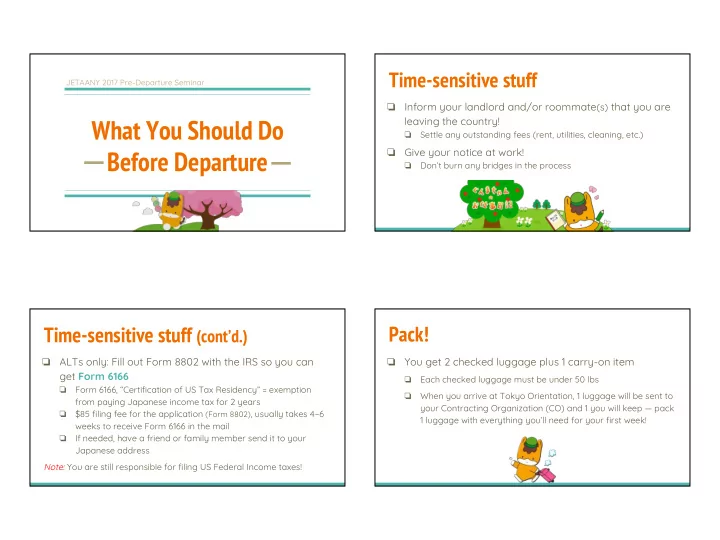
Time-sensitive stuff JETAANY 2017 Pre-Departure Seminar Inform your landlord and/or roommate (s) that you are What You Should Do leaving the country! Settle any outstanding fees (rent, utilities, cleaning, etc.) Before Departure


slide-1
SLIDE 1

What You Should Do Before Departure

JETAANY 2017 Pre-Departure Seminar

Time-sensitive stuff

❏ Inform your landlord and/or roommate(s) that you are leaving the country!

❏ Settle any outstanding fees (rent, utilities, cleaning, etc.)

❏ Give your notice at work!

❏ Don’t burn any bridges in the process

Time-sensitive stuff (cont’d.)

❏ ALTs only: Fill out Form 8802 with the IRS so you can get Form 6166

❏ Form 6166, “Certification of US Tax Residency” = exemption from paying Japanese income tax for 2 years ❏ $85 filing fee for the application (Form 8802), usually takes 4–6 weeks to receive Form 6166 in the mail ❏ If needed, have a friend or family member send it to your Japanese address Note: You are still responsible for filing US Federal Income taxes!

Pack!

❏ You get 2 checked luggage plus 1 carry-on item

❏ Each checked luggage must be under 50 lbs ❏ When you arrive at Tokyo Orientation, 1 luggage will be sent to your Contracting Organization (CO) and 1 you will keep — pack 1 luggage with everything you’ll need for your first week!

slide-2
SLIDE 2

Pack! — Essentials

❏ Conservative formal business attire for orientation, school ceremonies, and formal events

❏ Suits, ties, blazers, knee-length skirts/dresses, shoulders must be covered, closed-toe shoes

❏ Business casual attire for everyday use at work

❏ depends on your school, but it’s always better to dress up than down!

Pack! — Essentials (cont’d.)

❏ Comfortable summer clothing

❏ Tokyo can get up to 100º with nearly 100% humidity

❏ Larger sizes of clothing and shoes can be tricky to find in Japan, keep that in mind while packing ❏ Stores like Uniqlo sell most clothing staples for cheap

(including winter jackets) — don’t worry about bringing everything!

Pack! — Essentials (cont’d.)

❏ Omiyage (souvenirs) — bring something to distribute to the

staff at your new workplace ❏ Food is always a great gift! Cookies, snacks, specialty foods from your hometown, etc. ❏ Bring nicer gifts for your supervisor(s), principal(s), vice principal(s), and Japanese Teachers of English (JTEs)

Pack! — Essentials (cont’d.)

❏ Things to keep in mind about omiyage

❏ Presentation is important! Don’t give away something that looks sloppy (sloppy = you didn’t put in much time or effort) ❏ If possible, have your souvenirs pre-wrapped for easy sharing

(i.e. individually wrapped candies or cookies)

❏ Omiyage and gift-giving are an important part of Japanese culture — be respectful, try to give something that you would also like to be given

slide-3
SLIDE 3

❏ Passport with your new Japanese visa ❏ Contract from your Contracting Organization (CO) ❏ Plane ticket ❏ Laptop

Pack! — Essentials (cont’d.) Pack! — Good to Have

❏ Anti-perspirant deodorant, fluoride toothpastes, and some cosmetics can be difficult to find

❏ Note: Dove, Biore, Neutrogena, Nivea, and other big brands can be found at most Japanese drug stores

❏ Photos and mementos of your hometown, family, college, etc.

❏ These can be used for your self-introduction lessons at school in addition to making your Japanese house feel more like home!

Pack! — Grey Areas

Prescription medication ❏ Includes contact lenses, some forms of birth control, and some over-the-counter pain killers ❏ Can bring up to 1-month’s supply

❏ To bring more than 1-month’s supply, you need to fill out special documentation (yakkan shoumeisho) ❏ Failure to comply with these regulations can result in fines, imprisonment, and/or deportation

Pack! — Grey Areas (cont’d.)

Prescription medication (cont’d) ❏ Read the General Information Handbook for details

❏ If, for whatever reason, you want to bring more than 1-month’s worth of meds, contact your supervisor or Prefectural Advisor (PA) ASAP

❏ Most prescription medication can be fulfilled by a doctor in Japan once you’ve run out of your 1-month supply

slide-4
SLIDE 4

Cell phones ❏ Some US cell phones (regardless of make) will not work

  • n Japanese networks

❏ You can bring your own, but you will likely have to buy a new phone upon arrival

Pack! — Grey Areas (cont’d.) Pack! — Leave at Home

❏ Books ❏ DVDs ❏ Heavy winter gear ❏ Towels ❏ Blankets These can be bought in Japan or shipped by sea

(cheapest shipping option)

❏ Be sure you have at least $2,000 CASH to bring with you (more is better!) ❏ Order Japanese Yen from your bank — usually better rates than exchanging at the airport

Money, money, money…

❏ If you have student loans, ensure you will be able to make payments while away

❏ Make sure you have enough money in your bank account to make loan repayments until you can send money (remittance) from Japan ❏ Many options for sending international remittance: GoRemit, JP Bank, Western Union, and more

Money, money, money… (cont’d.)

slide-5
SLIDE 5

❏ Alert your bank, credit card company, or student loan agency that you are moving to Japan

❏ Change your address if necessary

❏ Get your International Driving Permit at an AAA

❏ $20 fee, permit is good for one year ❏ Must have a valid US driver’s license ❏ Even if you don’t think you’ll have a car, it’s a good idea to get your IDP!

Tie off loose ends

❏ Pay any outstanding bills ❏ Cancel any cable, internet, or cell phone plans, and any newspaper, magazine, or Amazon subscriptions ❏ Register with the US Embassy

❏ They’ll send you travel advisories and contact you in case of emergencies ❏ Smart Traveler Enrollment Program (STEP)

Tie off loose ends (cont’d.)

❏ Practice a few set phrases before departure ❏ Familiarize yourself with hiragana and katakana ❏ Apps like Memrise can help you learn basic Japanese greetings and phrases ❏ Download a Japanese–English dictionary like Anki, Midori, or Google Translate ❏

Make sure you can access it offline!

Basic Japanese

❏ Useful phrases:

❏ すみません sumimasen — “Excuse me” or “I’m sorry” ❏ よろしくお願いします yoroshiku onegaishimasu — “I look forward to working with you” (lit. “Please be kind to me”) ❏ 英語をわかりますか eigo o wakarimasu ka? — “Do you understand English?” ❏ 日本語をわかりません nihongo o wakarimasen — “I don’t understand Japanese” ❏ __のアレルギーがあります __ no arerugi ga arimasu — “I have a __ allergy”

Basic Japanese (cont’d.)

slide-6
SLIDE 6

❏ Prepare a short self-introduction for when you meet your supervisor, teachers, and coworkers

❏ Feel free to keep a cheat sheet to read of off

❏ Simple is best, especially if you aren’t confident in Japanese yet

❏ Even if you make some mistakes, your coworkers will appreciate the effort!

Self-Introduction in Japanese

はじめまして。私は[name]です。アメリカから来ました。趣味は[hobby]です。 [thing]が好きです。よろしくお願いします。

  • Hajimemashite. Watashi wa [name] desu. Amerika kara kimashita.

Shumi wa [hobby] desu. [Thing] ga suki desu. Yoroshiku

  • negaishimasu.

Nice to meet you. I am [name]. I’m from America. My hobby is [hobby]. I like [thing]. I look forward to working with you.

Self-Introduction Example Connect! — Your Predecessor

❏ They will have the best info and advice about your specific school(s) and placement ❏ They will usually contact you at least 2–4 weeks before departure — do not panic if you haven’t heard from them yet! ❏ Questions to ask your predecessor

❏ Schools — What are the staff and students like? How large are the classes? What will your responsibilities be in class? Are they involved in any extracurricular activities? ❏ Furniture & belongings — Will you be inheriting or buying any

  • f their things? (Do not feel obligated to buy anything)

❏ Living situation — Will you be moving into their old house/apartment, or will you move into a different one? Are there any upfront costs or fees (e.g. key money)?

Connect! — Your Predecessor (cont’d.)

slide-7
SLIDE 7

❏ More questions to ask your predecessor

❏ Home maintenance — When are the garbage and recycling days? Can they leave instructions or translations for using appliances (e.g. air conditioner, hot water, etc.)? ❏ Internet access — Will you have internet when you arrive? Can their current internet plan be transferred to you? ❏ Transportation — How do they commute to school or work? Will you need a car? Where is the nearest train station? ❏ Neighborhood — Where is the nearest grocery store/bank/ post office? What restaurants or bars are nearby?

Connect! — Your Predecessor (cont’d.)

❏ Contact your Prefectural Advisor (PA) if you haven’t yet heard from your predecessor or if you have general questions about your placement region

❏ They are your go-to if you have any problems or questions while you are on JET ❏ Most PAs will send a welcome email to incoming JETs, check your spam if you haven’t heard from them

Connect! — PAs Connect! — Social Media

❏ Check Facebook for ALT or JET groups in your prefecture or city

❏ Get to know other JETs or ALTs in your area

❏ Search online for any resources from your prefectural Association of JETs (AJET)

❏ E.g.: Gunma AJET, Akita JET have websites with plenty of articles and information

Connect! — At Home

❏ Make time for friends and family before you leave ❏ Visit your favourite places, eat your favourite food, enjoy your last month!

slide-8
SLIDE 8

Useful Resources:

Packing — http://www.tofugu.com/japan/jet-program-packing-guide/ JETAANY documents — http://jetaany.org/resources General Info Handbook — http://jetprogramme.org/en/gih/ Smart Traveler Enrollment Program (STEP) — https://step.state.gov/step/ Instructions for IRS Form 8802 — http://www.chicago.us.emb-japan.go.jp/JIC/JET2017/notes_and_instructions_chi_2017.pdf (p. 12)

You’ve Got This!