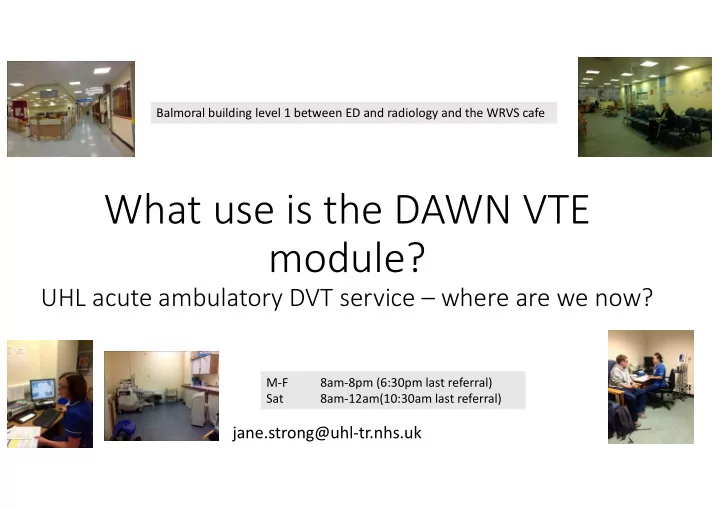
SLIDE 9 Background: University Hospitals of Leicester acute ambulatory DVT service assesses 3,000 patients a year and treats 600 new DVTs. Service improvements were required to optimise administrative
- processes. Our paper-based system was inappropriately diverting our
DVT nursing team from delivering a very busy clinical service and making audit difficult. Aims: We wanted to create an electronic DVT record within the same system as the computer aided anticoagulant dosing software. The vision of a paperless DVT module (assessment, diagnosis, treatment and follow up) with seamless referrals and communication with anticoagulation and primary care was born. Methods: The whole DVT pathway has been sequentially computerised and tested within the clinical environment. Results: The module first went live in August 2013.Between August 2013 and December 2014 we have assessed 4248 patients using the module; 675 (16%) were assessed as DVT unlikely with Wells score and d dimers and did not proceed to scan, 3426 had scans of which 754 DVTs (22%) and 147 cases of thrombophlebitis were diagnosed. Rivaroxaban became first line treatment for first DVTs in our service in October 2014 – a rivaroxaban treatment module captures the assessment, treatment and follow up of these patients – 100 to date. All primary care physician letters are generated within the system and sent electronically when possible .Conclusion: Implementation of the DVT electronic tool and record has standardised and recorded each part of the patient pathway facilitating audit, lean accountable practice and continuous improvement in workflow efficiency, quality and
- safety. The module also serves as a clinical database for
benchmarking and research. Keywords: DVT, assessment, diagnosis, lean
An electronic tool and record for deep vein thrombosis (DVT) assessment, diagnosis, treatment and follow up. J Strong, V Frimpong, J Eggleston, D Thornton, H Briggs, T Stewart, R Clarke-Drury, K Coultas, A Stewart, G Kitching, S Stewart