Whats the Human Genome Project Neither speaker has anything to - - PowerPoint PPT Presentation

what s the human genome project
SMART_READER_LITE
LIVE PREVIEW

Whats the Human Genome Project Neither speaker has anything to - - PowerPoint PPT Presentation

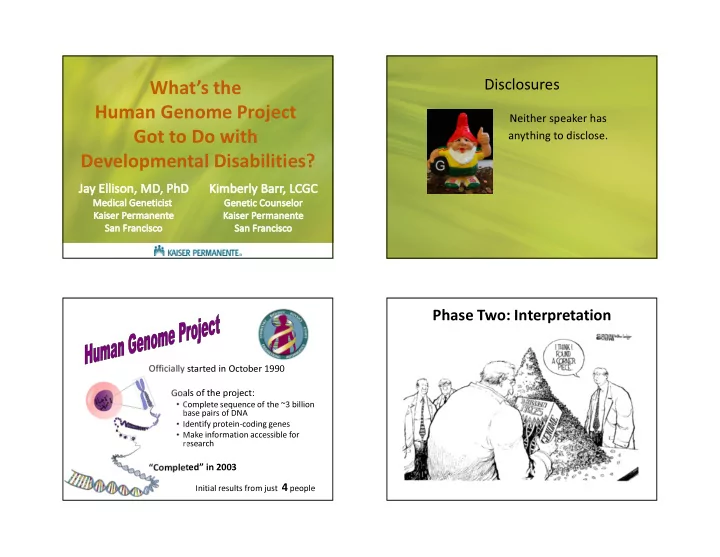
Disclosures Whats the Human Genome Project Neither speaker has anything to disclose. Got to Do with Developmental Disabilities? Phase Two: Interpretation Officially started in October 1990 Goals of the project: Complete sequence of


slide-1
SLIDE 1

What’s the Human Genome Project Got to Do with Developmental Disabilities?

Disclosures

Neither speaker has anything to disclose.

Officially started in October 1990 Goals of the project:

  • Complete sequence of the ~3 billion

base pairs of DNA

  • Identify protein-coding genes
  • Make information accessible for

research

“Completed” in 2003

Initial results from just 4 people

Phase Two: Interpretation

slide-2
SLIDE 2

Human Genome Project

  • Total number of genes = ~20,000

– Precise locations on chromosomes now known

  • “Junk DNA” is not all junk

– Other functional DNA elements found

WORK IN PROGRESS

– Continually being updated

Early Genetic Tests for DD

(~30 years ago)

Chromosomes

  • Karyotype
  • Fragile X

Biochemical tests

Way back when….

FISH – 22q11.2 deletion

FISH: An Advance in Testing for DD

FISH

  • Fluorescent in-situ hybridization
  • Sub-microscopic analysis
  • Targeted chromosome testing

– Deletions/Duplications

  • Etiology identified for some

defined genetic syndromes

25 years ago….

slide-3
SLIDE 3

A Big Step in Genetic Testing for DD

10

  • AKA : microarray; comparative genomic

hybridization (CGH); array CGH (aCGH); molecular karyotypying; and more…

  • Genome-wide DNA probes
  • Identifies COPY NUMBER VARIANTS (CNV)
  • Many NEW disorders discovered

Chromosome Microarray Analysis (CMA)

The Technique of Array CGH

Microarray Can Precisely Define Deletions

Microarray Improves Diagnostic Yields

  • CMA makes a diagnosis in ~ 15-20% of cases of

intellectual disability, autism spectrum disorder, and multiple congenital anomalies.

2-3 times the yield of karyotype

  • In 2010 CMA was recommended as a first-line test

for the above indications by specialty groups, replacing karyotype.

ISCA Consortium (a cytogenetics group) American College of Medical Genetics

slide-4
SLIDE 4

ORDER: Chromosomal microarray

Known Genetic Causes

  • f Intellectual Disability
  • With current testing we can identify a genetic

cause in ~40-50% of cases of ID. Visible chromosome abnormalities 15%

  • ~ ½ are Down syndrome

Submicroscopic gains and losses 15-20% Single gene disorders ~ 5-10%

Includes Fragile X, biochemical disorders, known syndromes

Known Genetic Causes of Autism

  • Copy number abnormalities (10%)
  • Fragile X (1–5%)
  • MECP2 (4% of females)
  • PTEN (5% with OFC >2.5 SDs)
  • Karyotype (3%)
  • Other (10%)
  • Total – 30- 40% yield with current testing

The Next Big Thing in Genetic Testing

  • Large-scale DNA sequencing methods
  • New genes implicated in ID and autism.
  • New clinical tests:
  • Large gene panels
  • Whole exome sequencing – looks at all protein-

coding genes

Next Generation Sequencing

slide-5
SLIDE 5

Insights from Next-Gen Sequencing

  • Many single genes associated with ID and autism

are being identified – many hundreds so far.

Some are causal, others are risk factors, others await validation.

  • A given gene can be associated with multiple

neurodevelopmental disorders – ID, autism, epilepsy

Research Findings Are Being Quickly Applied

Large sequencing panels are available:

  • Autism

61 gene panel

  • Intellectual disability

75-92 gene panels for X-linked ID 70 gene panel for autosomal recessive and dominant ID

  • Mitochondrial disorders

Panels of 446, 665, >1100 genes

Value of a Genetic Diagnosis

  • What’s going on?

End the diagnostic odyssey

  • Why did this happen? Did I do something wrong?

Allay parental guilt/feeling of responsibility

  • Who else needs to know about this?

Identify at-risk relatives

  • Could this happen again?

Assists with reproductive planning

  • Where can I get help?

Helps families identify and receive resources

  • What medical care do I need? What can I expect?

Helps clarify prognosis/aids in management

A Genetic Diagnosis Can Guide Management

  • Published management guidelines for some

conditions

Fragile X, Prader-Willi, Down syndrome, others

  • Identifies associated medical risks

– When a genetic diagnosis is made by microarray,

  • ver 1/3 of cases will have actionable clinical

features (often previously unsuspected)
slide-6
SLIDE 6

Example Demonstrating Clinical Utility

  • A 4 year old boy with developmental delay. No

physical findings on exam. Chromosomal microarray analysis

  • Result: A chromosome 17 deletion known to be

associated with ID as well as renal abnormalities and early-onset type 2 diabetes.

Renal ultrasound showed cysts and collecting system abnormalities, and referral to nephrology was made. Risk of diabetes prompted glucose monitoring.

Limitations of Genetic Testing

  • Not all identified changes have known risks

Variants of unknown significance (VOUS) Applies to copy number and sequence variants

  • Not all genetic abnormalities are detectable
  • Little data on disease association with newly

implicated genes

Lack of clinical validity – Is it truly the cause? Can it predict the clinical phenotype?

The Future of Genetic Testing for DD

…increased use of microarray …increased use of large-scale sequencing …whole GENOME sequencing

Diagnostic yield WILL continue to improve

Cautionary note: As we examine more genes/DNA, the potential for misinterpretation also increases. Underscores need for appropriate counseling

A Suggested Testing Strategy for Non-Geneticists

  • Our Recommendation

Start with:

  • MICROARRAY
  • FRAGILE X

Then Refer to GENETICS

  • Positive or VOUS – Interpret results and counsel
  • Negative – Evaluate and consider further testing
slide-7
SLIDE 7