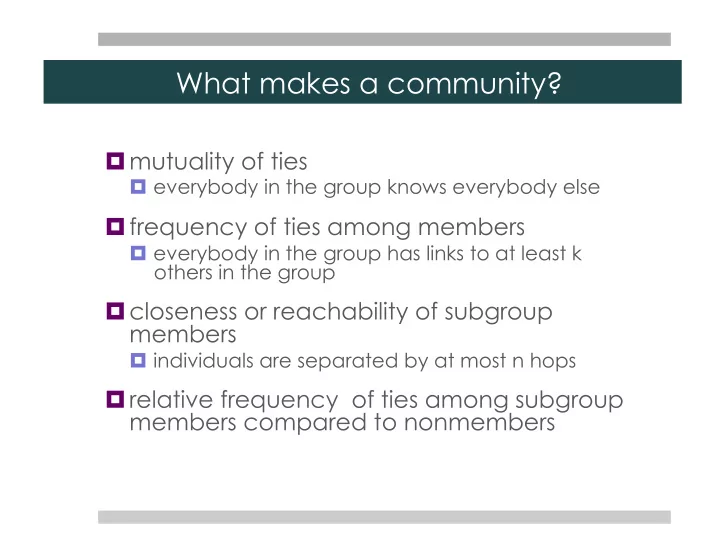
SLIDE 1 What makes a community?
¤ mutuality of ties
¤ everybody in the group knows everybody else
¤ frequency of ties among members
¤ everybody in the group has links to at least k
¤ closeness or reachability of subgroup members
¤ individuals are separated by at most n hops
¤ relative frequency of ties among subgroup members compared to nonmembers
SLIDE 2
Affiliation networks
¤ otherwise known as
¤ membership network ¤ e.g. board of directors ¤ hypernetwork or hypergraph ¤ bipartite graphs ¤ interlocks
1 1 1 2 1
SLIDE 3 Cliques
¤ Every member of the group has links to every other member ¤ Cliques can overlap
- verlapping cliques of size 3
clique of size 4
SLIDE 4
Cliques betray community structure
¤ Go to http://www.ladamic.com/netlearn/nw/Cliques.html ¤ Try the ER vs. community structure setup (they are the same as for the opinion formation model)
SLIDE 5
Quiz question
¤ Which has a larger maximal clique?
¤ network with community structure ¤ the equivalent ER random graph
SLIDE 6
Meaningfulness of cliques
¤ Not robust
¤ one missing link can disqualify a clique
¤ Not interesting
¤ everybody is connected to everybody else ¤ no core-periphery structure ¤ no centrality measures apply
¤ How cliques overlap can be more interesting than that they exist
SLIDE 7
k-cores: similar idea, less stringent ¤ Each node within a group is connected to k other nodes in the group
SLIDE 8
Quiz Question
¤ What is the “k” for the core circled in red? ¤ What is the “k” for the core circled in blue?
SLIDE 9
k-cores
n Each node within a group is connected to k other
nodes in the group 3 core 4 core
n but even this is too stringent of a requirement for
identifying natural communities 2 core 4 core
SLIDE 10
subgroups based on reachability and diameter
¤ n – cliques
¤ maximal distance between any two nodes in subgroup is n
2-cliques
n theoretical justification
n information flow through intermediaries
SLIDE 11
considerations with n-cliques
¤ problem
¤ diameter may be greater than n ¤ n-clique may be disconnected (paths go through nodes not in subgroup)
2 – clique diameter = 3 path outside the 2-clique
n fix
n n-club: maximal subgraph of diameter 2
SLIDE 12
p-cliques: frequency of in group ties
¤ partition the network into clusters where vertices have at least a proportion p (number between 0 and 1) of neighbors inside the cluster.
within-group ties ties from group to nodes external to the group
SLIDE 13
cohesion in directed & weighted networks
¤ something we’ve already learned how to do:
¤ find strongly connected components
¤ keep only a subset of ties before finding connected components
¤ reciprocal ties ¤ edge weight above a threshold
SLIDE 14 1 2 3 4 5 6 7 8 9 10 11 12 13 14 15 16 17 18 19 20 21 22 23 24 25 26 27 28 29 30 31 32 33 34 35 36 37 38 39 40 1 Digbys Blog 2 ¡ ¡James Walcott 3 Pandago n 4 ¡ ¡blog.johnkerry.com 5 Oliver Willis 6 America Blog 7 Crooked Timber 8 Daily Kos 9 American Prospect 10 Eschaton 11 Wonkette 12 Talk Left 13 Political Wire 14 Talking Points Memo 15 Matthew ¡Yglesia s 16 Washing ton Monthly 17 MyDD 18 Juan Cole 19 Left Coaster 20 Bradford DeLong 21 ¡JawaReport 22 Voka Pundit 23 Roger ¡L Simon 24 Tim Blair 25 Andrew ¡Sullivan 26 ¡Instapundit 27 Blogs for Bush 28 ¡Little Green Footballs 29 Belmont Club 30 Captain’s Quarters 31 Powerline 32 ¡Hugh Hewitt 33 ¡INDC Journal 34 Real Clear Politics 35 Winds ¡of Change 36 Allahpundi t 37 Michelle Malkin 38 WizBang 39 Dean’s World 40 Volokh (C) (B) (A)
A) all citations between A- list blogs in 2 months preceding the 2004 election B) citations between A-list blogs with at least 5 citations in both directions C) edges further limited to those exceeding 25 combined citations
Example: political blogs
(Aug 29th – Nov 15th, 2004)
citations bridge communities
source: Adamic & Glance, LinkKDD2005