SLIDE 1
SLIDE 2
What is this class about?
Digital business models are disrupting 50‐year old companies in telecommunications, transportation, advertising, e‐commerce, automotive, insurance and many other industries.
SLIDE 3 What is this class about?
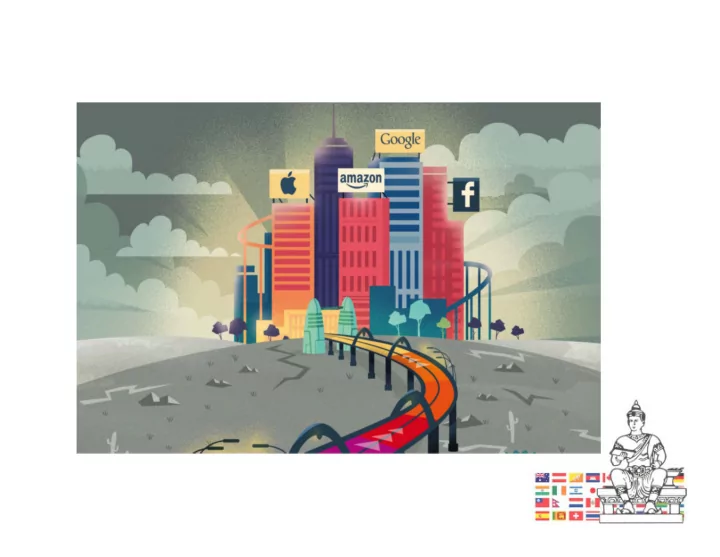
This course will explore the business models of software disruptors of the west such as Apple, Google, Facebook and Amazon, and the east such as Xiaomi and
- WeChat. The class uses a structured framework for
analysing business models with numerous examples so that students can apply it to their own business
SLIDE 4
What is this class about?
We will explore how software developers are not just the innovators but also the decision makers in modern competitive battles from mobile to cloud, and from consumer goods to enterprise software. And we will also explain how developers are the engine of digital business models, using examples from diverse industries – from healthcare to aviation.
SLIDE 5 How will we do that?
- 1. Introduction to Business Models
- 2. How Internet Companies use Digital Business
Models
- 3. Developers as the new Decision Makers
- 4. Developers as the Engine of Digital Business Models
SLIDE 6
Part 1 Introduction to Business Models
SLIDE 7
SLIDE 8
Nokia: 40 % world market share by 2007
SLIDE 9
- A. Osterwalder: The Business Model Canvas
SLIDE 10
Traditional business models
A Business Model describes the rationale of how an organization creates, delivers, and captures value.
SLIDE 11
SLIDE 12
What is a business model?
SLIDE 13 Question:
… value – for whom?
SLIDE 14
What is a business model?
SLIDE 15 Traditional business model examples
e-Commerce business: best selection, lowest price
SLIDE 16
SLIDE 17
SLIDE 18
Part 2 ‐How Internet Companies use Digital Business Models
SLIDE 19
SLIDE 20 The network effect is a phenomenon whereby a good or service becomes more valuable when more people use it. The internet is a good example. Initially, there were few users of the internet, and it was
- f relatively little value to anyone outside
- f the military and a few scientists.
SLIDE 21
SLIDE 22
SLIDE 23
SLIDE 24
SLIDE 25
SLIDE 26
SLIDE 27
SLIDE 28
SLIDE 29
Amazon’s Kindle
SLIDE 30
Amazon’s Echo
SLIDE 31
Amazon’s Dash Button
SLIDE 32
Business Models based on Network Effects
SLIDE 33
The network effect is a phenomenon whereby a good or service becomes more valuable when more people use it.
SLIDE 34
SLIDE 35
SLIDE 36
SLIDE 37
SLIDE 38
SLIDE 39
Got that? Time to take the next step.
SLIDE 40
SLIDE 41 What’s common across Asymmetric Business Models are the following three conditions:
- 1. A company identifies a complement in a different industry
- 2. Value is created by commoditizing that complement
- 3. The complement is bundled with the core product of the company, i.e. where
profits are generated.
SLIDE 42
SLIDE 43
SLIDE 44
Part 3: Developers as the new Decision Makers
SLIDE 45
SLIDE 46
SLIDE 47 crmsearch 2015
2.8m registered developers in 2016
SLIDE 48
Under Armour is a fashion brand that uses developers to engage communities of athletes. Developers use the Under Armour SDK to create engaging cross‐platform fitness experiences for web, mobile, and wearable devices.
SLIDE 49
But let’s take a step back. Who are these software developers?
SLIDE 50 Who are these software developers?
- A software developer is seen traditionally as a code
engineer, a person who is involved with the design, development and testing of software code.
- The definition of a software developer expanded
significantly with the smartphone era since 2007. Mobile apps now need not just to function well.
– They need to differentiate among millions of other apps. – They need to live up to high visual design standards. – Developers now need to engage and retain the user past the first use of the app.
SLIDE 51 Who are these software developers?
- Developers are therefore not just coders; they often need
skills in user interface design, marketing, and customer support.
- Developers need not have coding skills either. Software tools
have improved massively over the last 10 years; there are now software development tools that do not require any knowledge of coding; you can build a website code‐free with development tools from Squarespace.com. You can build a code‐free app with AppMachine.com. And you can program your thermostat to talk to your car and the weather forecast via IFTTT.com, again without using any code.
SLIDE 52 Who are these software developers?
- Developers can work in any industry; from games to
healthcare to agriculture; you will find developers wherever software needs to be created or integrated within an organization.
- Developers build software for a very diverse
spectrum of computing devices; from mobile apps, to websites, desktop apps and cloud (back‐end)
- services. Developers also program Internet of Things
services, such as a thermostat, a car navigation system, or a retail people tracking service.
SLIDE 53
Let’s consider a different question: How important are developers?
SLIDE 54 How important are developers?
- Developers are often seen as sitting at the bottom of
an organisation; as lacking decision making power.
- In the traditional definition of Information
Technology, decisions are taken at the very top of the
- rganisation, typically by the CIO (chief information
- fficer), CTO (chief technology officer) or VP (vice
president) of Engineering.
- However, developers at the middle and bottom of
the organisation are still the first to try out a new piece of software.
SLIDE 55 How important are developers?
- In the rapidly changing technology landscape, the
developers are usually the best informed and thus end up framing the decisions taken by the CIO or
- CTO. They are the endorsers, or validators for the
software buying decisions taken higher up.
- Effectively, developers decide what software not to
buy and generate the choices of software to buy.
- As a result, software companies have to win over
developers first, even if they don’t make the final purchase decision.
- Developers are the new decision makers.
SLIDE 56
The developer platforms landscape
SLIDE 57
SLIDE 58
SLIDE 60
SLIDE 61
Motivations and business models of software developers
SLIDE 62
SLIDE 63
SLIDE 64
From software innovation to resellers
SLIDE 66 Features the iPhone did not ship with FedEx allows any developer to tailor its logistics services Connect one item’s functionality to another item Find new users and markets Uber: Hotel and airline services Amazon developers sell Amazon’s products (affiliates) Twilio integrates SMS and telephony into apps Value can be captured with data, not just money Choice between iOS and Android, ‘app gap’ When Nokia, Microsoft, and Samsung joint in, it was already too late.
SLIDE 67
Developers as product extenders
SLIDE 68
SLIDE 69 Flappy Bird –2013‐2014
Creator: Dong Nguyen
SLIDE 70 SmartThings by Samsung
Just 5 products: A gub, 4 different types of sensors, and a power outlet, connect thousands of home devices and millions of apps.
SLIDE 71
Automatic.com
SLIDE 72 Automatic.com uses Amazon’s IFTTT.com
Connect the car signals to dozens of applications, cloud services and use cases
SLIDE 73 DJI
Create drone-based applications for real estate, insurance, disaster response, education, tourism, construction, meteorology and many more industries
SLIDE 74
Developers as resellers and distributors
SLIDE 75
SLIDE 76 Uber
- The transportation services company that has
- perations in 500 cities, 70 countries, and boasts 2
billion rides taken through its service.
- Uber works with developers to integrate the
company’s on‐demand transportation platform into new industries including airlines, hotels, events, food, healthcare, retail, media and public transit.
- Developers can now build a “request‐a‐ride” button
within their app that then gets the user to their destination with no hassle. Consider the convenience that this adds to a hotel booking, a shopping mall or a rock concert app.
SLIDE 77 Uber
- In both of these cases, developers are a sales
channel for Uber, helping the company reach new users in new industries.
- Uber also acts as an advertising platform, allowing
developers to send promotions to users that are taking an Uber ride, using contextual information like the user’s destination, pickup location, and travel time.
SLIDE 78 Walgreens
- Seeing developers as a sales channel is not limited to
the realm of Internet companies.
- Walgreens, the largest drug retailing chain in the
United States, works with developers to boost sales
- f its digital print services. The Walgreens Photo
Prints API allows users of mobile apps to print photos to any of the 8,000+ Walgreens locations in the US.
- Mobile app developers earn a 15‐20% commission
with every photo order that’s placed through their app.
SLIDE 79 Walgreens
- Walgreens wins by getting users into their store;
developers win by earning a commission; and users win by getting their favorite photos printed as a photobook, poster or folded card.
- Walgreens also offers a Balance Rewards program. It
enables developers to connect their fitness apps to the Walgreens rewards program. Users receive points for healthy activities like walking, running, and measuring their weight, blood pressure or blood glucose levels.
SLIDE 80 Walgreens
- A third developer offering is the Pharmacy
Prescription API which allows developers to connect their health apps to over 8,000 Walgreens pharmacies and quickly order refills of prescriptions.
SLIDE 81 Amazon
- Perhaps the company best known for using
developers as affiliates and resellers is Amazon.
- The e‐commerce giant launched its affiliate program
for web developers back in 1996; web developers placing links on their site to Amazon books can get a commission when the user purchases a book through that link.
SLIDE 82 Amazon
- Today developers who join Amazon’s Associates
program can earn up to 10% of commission from users who buy the products the developer advertised, and even further products that the user continues on to buy on the Amazon website.
- The Amazon Mobile Associates program allows
mobile developers to earn a commission on purchases made through their apps and games.
SLIDE 83 Amazon
- Finally, Amazon’s Dash Replenishment Service allows
developers and makers of connected devices to
- rder physical goods from Amazon when supplies are
running low ‐ like a Brita water pitcher that orders more water filters.
SLIDE 84
SLIDE 85
SLIDE 86
When will Machines take over? (YouTube)
SLIDE 87
Thank you for your attention! Final Exam starts at 10 a.m.