What is the Sustainability and Transformation Plan (STP)? STPs - - PowerPoint PPT Presentation

what is the sustainability and transformation plan stp
SMART_READER_LITE
LIVE PREVIEW

What is the Sustainability and Transformation Plan (STP)? STPs - - PowerPoint PPT Presentation

What is the Sustainability and Transformation Plan (STP)? STPs were introduced by NHS England to support delivery of their Five Year Forward View strategy The STP is an opportunity to radically transform the way we provide health and


slide-1
SLIDE 1
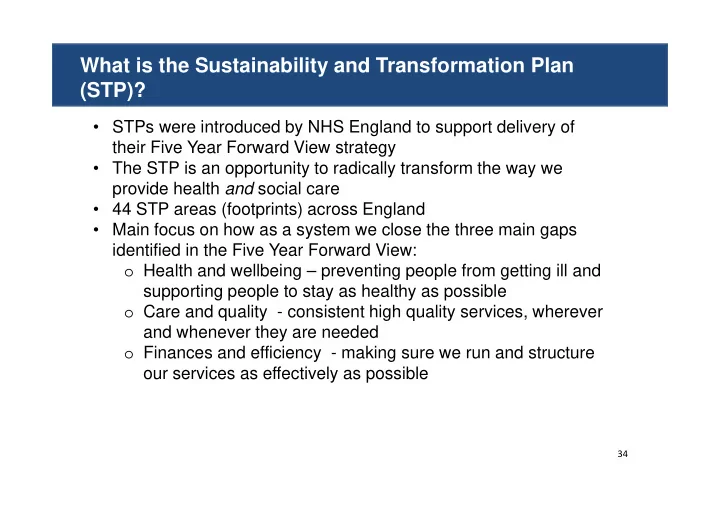
  • STPs were introduced by NHS England to support delivery of

their Five Year Forward View strategy

  • The STP is an opportunity to radically transform the way we

provide health and social care

  • 44 STP areas (footprints) across England
  • Main focus on how as a system we close the three main gaps

identified in the Five Year Forward View:

  • Health and wellbeing – preventing people from getting ill and

supporting people to stay as healthy as possible

  • Care and quality - consistent high quality services, wherever

and whenever they are needed

  • Finances and efficiency - making sure we run and structure
  • ur services as effectively as possible

What is the Sustainability and Transformation Plan (STP)?

34

slide-2
SLIDE 2

Health & Wellbeing

  • Adults are not making healthy choices
  • Increased social isolation
  • Poor children’s health and wellbeing

Care & Quality

  • Unwarranted variation in clinical practise and outcomes
  • Reduced life expectancy for those with mental health

issues

  • Lack of end of life care available at home

Finance & Efficiency

  • Deficits in most NHS providers
  • Increasing financial gap across health and large social

care funding cuts

  • Inefficiencies and duplication driven by organisational not

patient focus.

  • 20% of people have a long term condition
  • 50% of people over 65 live alone
  • 10 – 28% of children live in households with no adults in employment
  • 1 in 5 children aged 4-5 are overweight
  • Over 30% of patients in acute hospitals do not need to be in an acute setting and should be

cared for in more appropriate places

  • People with serious and long term mental health needs have a life expectancy 20 years less than

the average

  • Over 80% of patients indicated a preference to die at home but only 22% actually did

Health and social care in North West London is not sustainable

2

35

slide-3
SLIDE 3

Current Population

Health and social care in North West London is not sustainable

Future Population (2030) % Increase

3

36

slide-4
SLIDE 4

The North West London Vision – helping people to be well and live well

Our vision of how the system will change and how patients will experience care by 2020/21

4

38

slide-5
SLIDE 5

How we will close the gaps – 5 delivery areas

Triple Aim Delivery areas (DA)

DA 1 Radically upgrading prevention and wellbeing DA 2 Eliminating unwarranted variation and improving LTC management DA 3 Achieving better outcomes and experiences for older people

Improving health & wellbeing Improving care & quality Improving productivity & closing the financial gap

DA 4 Improving outcomes for children &adults with mental health needs DA 5 Ensuring we have safe, high quality sustainable acute services

  • Enabling and supporting healthier living
  • Wider determinants of health interventions
  • Helping children to get the best start in life
  • Address social isolation
  • Specialised commissioning to improve pathways from primary

care & support consolidation of specialised services

  • Deliver the 7 day services standards
  • Reconfiguring acute services
  • NW London Productivity Programme
  • Improve cancer screening
  • Better outcomes and support for people with common mental

health needs,

  • Reducing variation
  • Improve self-management and ‘patient activation’
  • Whole systems approach to commissioning
  • Implement accountable care partnerships
  • Implement new models of integrated care services
  • Upgraded rapid response and intermediate care services
  • Single discharge approach
  • Improve care in the last phase of life
  • New model of care for people with serious and long needs
  • Address wider determinants of health
  • Crisis support services
  • Implementing ‘Future in Mind’ to improve children’s mental

health and wellbeing

Plans 5

39