What Is the Future of Computers? 1 Introduction Moore's Law - - PowerPoint PPT Presentation

what is the future of computers
SMART_READER_LITE
LIVE PREVIEW

What Is the Future of Computers? 1 Introduction Moore's Law - - PowerPoint PPT Presentation

What Is the Future of Computers? 1 Introduction Moore's Law states, that the number of transistors on a microprocessor double every 18 months. 2 Introduction The year 2020 or 2030 will find the circuits on a microprocessor measured on


slide-1
SLIDE 1

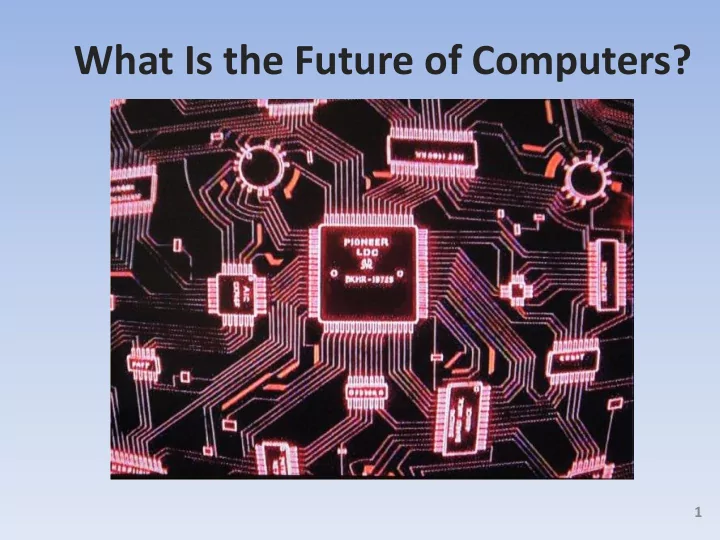
What Is the Future of Computers?

1
slide-2
SLIDE 2
  • Moore's Law states, that the number of transistors
  • n a microprocessor double every 18 months.

2

Introduction

slide-3
SLIDE 3
  • The year 2020 or 2030 will find the circuits on a

microprocessor measured on an atomic scale.

3

Introduction

slide-4
SLIDE 4
  • The logical next step will be to create quantum

computers, which will harness the power of atoms and molecules to perform memory and processing tasks.

4

Introduction

slide-5
SLIDE 5
  • Quantum computing was first theorized in 1981 by Paul

Benioff at the Argonne National Laboratory.

  • Benioff theorized about creating a quantum Turing

machine.

5

History

slide-6
SLIDE 6
  • Today's computers work by manipulating bits that

exist in one of two states: a 0 or a 1.

  • On the machine level, this either/or dichotomy is

represented using electrical circuits which can either be closed, in which case a current flows, or open, in which case there isn't a current.

6

Concept of quantum computing

slide-7
SLIDE 7
  • Quantum computers aren't limited to two states;

they works with particles that can be in superposition.

  • Rather than representing bits — such particles would

represent qubits, which can take on the value 0, or 1,

  • r both simultaneously.

7

Concept of quantum computing

slide-8
SLIDE 8
  • This superposition of qubits is what gives quantum

computers their inherent parallelism.

  • This parallelism allows a quantum computer to work
  • n a million computations at once, while desktop PC

works on one.

8

Concept of quantum computing

slide-9
SLIDE 9
  • Scientists have already built basic quantum

computers that can perform certain calculations.

9

Implementation

slide-10
SLIDE 10
  • At a NASA lab in Silicon Valley, Google is testing a D-

Wave 2X quantum computer.

10

Implementation

slide-11
SLIDE 11
  • In public-key cryptography, data is secured by math

problems that are easy to solve, but hard to reverse engineer.

  • While it is easy for a computer to multiply two prime

numbers to produce a larger integer.

11

Quantum computing and cryptography

slide-12
SLIDE 12
  • It takes an impractically long time on a computer to

factorize a large enough integer into its component primes.

12

Quantum computing and cryptography

slide-13
SLIDE 13
  • In a crypto scheme based on prime factorization, the

primes serve as a person’s “private key,” which is not shared.

  • The product of the primes serves as the “public key,”

which is distributed publicly.

  • When someone else uses the public key to encrypt a

message, only the person in possession of the private key can decrypt it.

13

Quantum computing and cryptography

slide-14
SLIDE 14
  • Widely used today RSA and the Diffie-Hellman key

exchange based on this principle.

14

Quantum computing and cryptography

slide-15
SLIDE 15
  • RSA(Rivest-Shamir-Adleman) algorithm is used in

browsers which need to establish a secure connection.

  • Every time you visit a website with a URL that begins

“HTTPS,” that algorithm is used.

15

Quantum computing and cryptography

slide-16
SLIDE 16
  • A quantum computer could efficiently find prime

factors for large integers.

16

What Is the Future of Computers?

slide-17
SLIDE 17
  • This ability would allow a quantum computer to

decrypt many of the cryptographic systems in use today.

17

Quantum computing and cryptography

slide-18
SLIDE 18
  • Quantum computing is still in early stages of
  • development. But quantum computers will

replace silicon chips in the future, just like the transistor once replaced the vacuum tube.

18

Conclusion