SLIDE 1
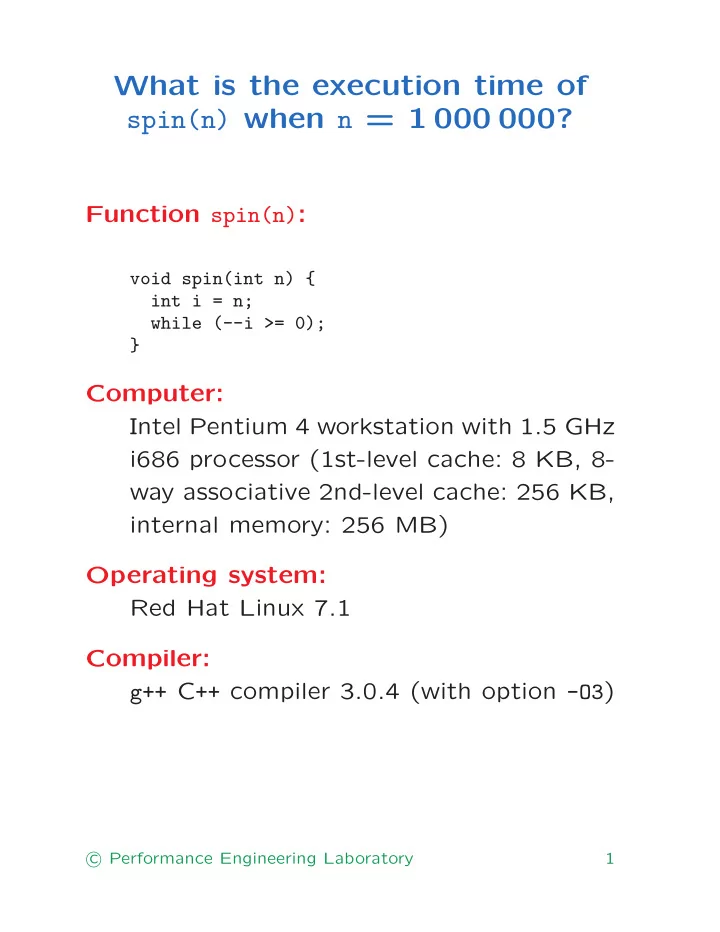
What is the execution time of spin(n) when n = 1 000 000?
Function spin(n):
void spin(int n) { int i = n; while (--i >= 0); }
Computer: Intel Pentium 4 workstation with 1.5 GHz i686 processor (1st-level cache: 8 KB, 8- way associative 2nd-level cache: 256 KB, internal memory: 256 MB) Operating system: Red Hat Linux 7.1 Compiler: g++ C++ compiler 3.0.4 (with option -O3)
c
Performance Engineering Laboratory
1
SLIDE 2 The answer is . . .
pc-014> python single_spin.py E ====================================================== ERROR: __main__.spin_case Less than 90% of the outcomes differ at most 20% from the median; try again
- ERROR: __main__.spin_case
Traceback (most recent call last): File "benchmark.py", line 170, in run answer = self.output() File "single_spin.py", line 29, in output return (self.n, float(self.driver_output) / self.n) ValueError: empty string for float()
- ======================================================
: ()
- Ran 1 benchmark case in 44.804s
Errors: 2 pc-014> python single_spin.py . ====================================================== : (1000000, 2.6322299999999998)
- Ran 1 benchmark case in 3.602s
OK
c
Performance Engineering Laboratory
2
SLIDE 3 Jyrki’s benchmark tool
- Write a C++ class describing the experi-
ment
- Fill in a form to explain for which parame-
ters the experiment is to be carried out (i.e., write a Python program)
- Send the form to the system (i.e., run
the Python program)
- The system returns the answer in textual
- r graphical form
c
Performance Engineering Laboratory
3
SLIDE 4
0.5 1 1.5 2 2.5 20 30 40 50 60 70 80 90 100 Execution time per iteration [in nanoseconds] n Execution time of an empty loop i = n; while (−−i >= 0); c Performance Engineering Laboratory 4
SLIDE 5
C++ experiment class
/* Benchmark for spinning Author: Jyrki Katajainen Email: jyrki@diku.dk $Revision: 1.2 $ $Date: 2003/02/05 12:29:06 $ */ class spin { public: spin(int n): n(n) { } void primal() { int i = n; while (--i >= 0); } private: int n; };
c
Performance Engineering Laboratory
5
SLIDE 6
Python form
""" Benchmarking the execution time of an empty loop shell> echo $PYTHONPATH /home/disk04/jyrki/CPHSTL/Tool/Benchmark/ """ __author__ = "Jyrki Katajainen" __email__ = "jyrki@diku.dk" __version__ = "$Revision: 1.2 $"[11:-2] __date__ = "$Date: 2003/02/05 12:29:06 $"[7:-2] import benchmark import os class spin_case(benchmark.case): def __init__(self, n): benchmark.case.__init__(self) self.n = n self.computer = ’pc-014.diku.dk’ self.compiler = ’/scratch/g++/bin/g++’ self.compiler_options.extend([’-O3’]) self.include_files.extend([’spin_benchmark.c++’]) self.constructor_call = ’spin(’ + str(n) + ’)’ self.time_unit = ’ns’ self.driver_file = self.generate_execution_time_driver() def output(self): return (self.n, float(self.driver_output) / self.n) if __name__ == ’__main__’: benchmark.main(\ task = spin_case(1000000),\ runner = benchmark.text_runner\ )
c
Performance Engineering Laboratory
6
SLIDE 7
Got interested in Python?
Come to my lecture next Monday: Speaker: Jyrki Katajainen Title: Learning Python in two hours Time: Monday 10 February 2003 at 13.15–15.00 Place: N026 at DIKU
c
Performance Engineering Laboratory
7
SLIDE 8 What does the word “bachelorproject” mean for me?
- ≤ 40 pages
- not much research
- not much programming
- practise writing
- practise information retrieval
- work individually
c
Performance Engineering Laboratory
8
SLIDE 9 Possible topics under the umbrella of the CPH STL
- programming language issues
– pure C decompiler – Meta C++
– stable sort – in-place sort
– automatic testing
– interactive documentation For other proposals, see the CPH STL home- page http://www.cphstl.dk under menu item “New Developers”
c
Performance Engineering Laboratory
9
SLIDE 10 Basic concept
- select a topic relevant for the CPH STL
- search for the best known solutions from
the literature
- possibly do some implemetation work
- report the outcome of your work
c
Performance Engineering Laboratory
10
SLIDE 11
Relevant links
Resources for theses writers: http://www.diku.dk/undervisning/2002f/741/ L
A
T E X style file DIKU-article: http://www.cphstl.dk/Report/ Bibliography style file DIKU.bst: http://www.cphstl.dk/Report/ CPH STL home page: http://www.cphstl.dk PE-labs home page: http://www.diku.dk/forskning/ performance-engineering/
c
Performance Engineering Laboratory
11
SLIDE 12
How to get started?
Contact me personally or electronically! Office hours: Mondays 13.15 - 15.00 up to 16 June 2003 E-mail: jyrki@diku.dk
c
Performance Engineering Laboratory
12