What is the African Risk Capacity (ARC)? A Specialized Agency of - - PowerPoint PPT Presentation

what is the african risk capacity arc
SMART_READER_LITE
LIVE PREVIEW

What is the African Risk Capacity (ARC)? A Specialized Agency of - - PowerPoint PPT Presentation

What is the African Risk Capacity (ARC)? A Specialized Agency of the African Union: Agency established: 2012. First Policies (Drought): 2014. Enables participating Member States to prepare, manage and finance natural


slide-1
SLIDE 1

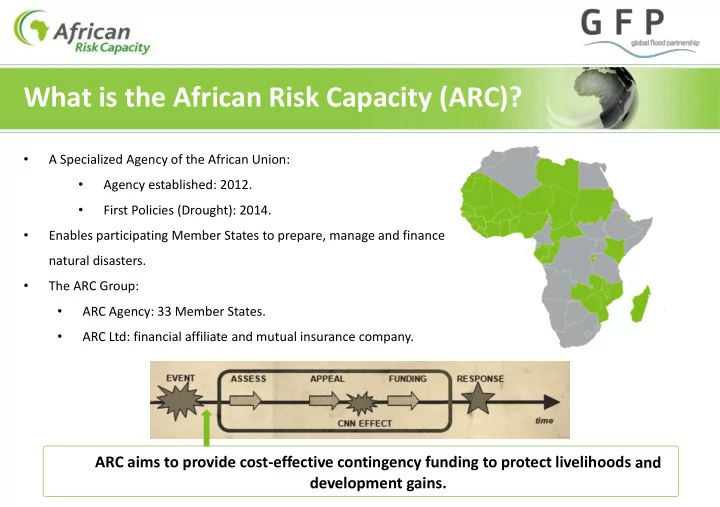
What is the African Risk Capacity (ARC)?

  • A Specialized Agency of the African Union:
  • Agency established: 2012.
  • First Policies (Drought): 2014.
  • Enables participating Member States to prepare, manage and finance

natural disasters.

  • The ARC Group:
  • ARC Agency: 33 Member States.
  • ARC Ltd: financial affiliate and mutual insurance company.

ARC aims to provide cost-effective contingency funding to protect livelihoods and development gains.

slide-2
SLIDE 2

ARC and Sovereign Disaster Insurance

  • Drought Insurance Policies Issued by ARC Ltd

since 2014:

  • Payouts of approximately 38 million USD

to member states – Senegal, Mauritania, Niger, Malawi.

  • > 2,2 million people have been alleviated

from drought impact through ARC’s insurance framework.

  • ARC Ltd. is expanding its portfolio to cover

natural disasters resulting from:

  • Outbreaks & Epidemics (O&E),
  • Tropical Cyclones (TC Model).
  • Large-scale River Flooding (AFM-R).

Tropical Cyclone IDAI – AFED Depictions & TC Data

slide-3
SLIDE 3

EXPOSURE DATA DAILY FLOOD DEPICTION (AFED)

SUB RIVER BASIN

AGGREGATION MODELLED IMPACT AFM-R INDEX

1

RESPONSE COSTS

USD RISK TRANSFERRED TO ARC

What is the ARC River Flood Model (AFM-R)?

slide-4
SLIDE 4

The 2019 West-African AFM-R Pilot

  • Cote d’Ivoire, Ghana, The Gambia, Togo.
  • Flood cycle: 12 months; inception will be aligned with drought insurance

timeline.

  • Monitoring of the season from May/June onward.
  • September/October/November: countries decide whether they would

like to take out river flood insurance.

slide-5
SLIDE 5

What is the ARC Flood Extent Depiction (AFED) dataset?

slide-6
SLIDE 6

What we know about AFED

  • Necessary criteria for insurance purposes:
  • Method objectivity, consistency &

transparency

  • Continuous temporal coverage (1998 –

present)

  • Depicts long-lasting (>2 – 3 days) large-scale

flooding in wide (>2 km) flood plains

  • Detects non-permanent water through clouds
  • At polygon-aggregated level – ideal for use in

insurance-underwriting to cover large-scale river floods

  • Constraints: signal interference from rain; small-

scale flooding; flash floods; urban & coastal flooding

slide-7
SLIDE 7

What we don’t know about AFED

  • How well does it depict true ground conditions

(Overall Depiction Accuracy)?

  • How does it compare to other existing flood-

extent depictions and Global Flood Models (GFMs)?

  • How does it compare to existing forecasting

systems and hydrometeorological data?

  • Combined with exposure, how well does it

detect flood events characterised by combinations of small/large scale versus low/high impact?

  • Can it be used for forecasting and/or Early

Warning (EW)?

slide-8
SLIDE 8

AFM-R and the Disaster Cycle

slide-9
SLIDE 9

The 2019 Flood Information System (FIS) Prototype

  • Building on the strength of High Temporal

Coverage of AFED Data and High Spatial Resolution of alternative satellite-derived Flood Extent Depictions.

  • Allows for:
  • Faster and more efficient decision-making
  • Reduce loss from flooding amongst the

general population

  • Improve the ARC flood service offerings in the

countries by providing access to flood maps and custom impact analytics via a near real- time platform during the 2019 rainy season

slide-10
SLIDE 10

The way forward for AFED

  • Technical Review Forum (TRF) Recommendation (February, 2019): “Introduce & make available AFED

to a wider pool of experts, stimulate research that may result in peer-reviewed publications that could potentially yield additional information regarding the performance, accuracy and further applications of the dataset.”

  • Come and engage with us:

THANK YOU Elke Verbeeten

  • Flood Model Development Manager
  • elke.verbeeten@africanriskcapacity.org

Johan Vermeulen

  • GIS & Data Specialist
  • johan.vermeulen@africanriskcapacity.org