What is Scripting? ! Yes! The name comes from written script CSCI: - - PDF document

what is scripting
SMART_READER_LITE
LIVE PREVIEW

What is Scripting? ! Yes! The name comes from written script CSCI: - - PDF document

What is Scripting? ! Yes! The name comes from written script CSCI: 4500/6500 Programming such as screenplay, where dialog is repeated verbatim for every performance Languages Scripting Languages Chapter 13 1 2 Maria Hybinette, UGA Maria


slide-1
SLIDE 1

Maria Hybinette, UGA

1

CSCI: 4500/6500 Programming Languages

Scripting Languages Chapter 13

Maria Hybinette, UGA

2

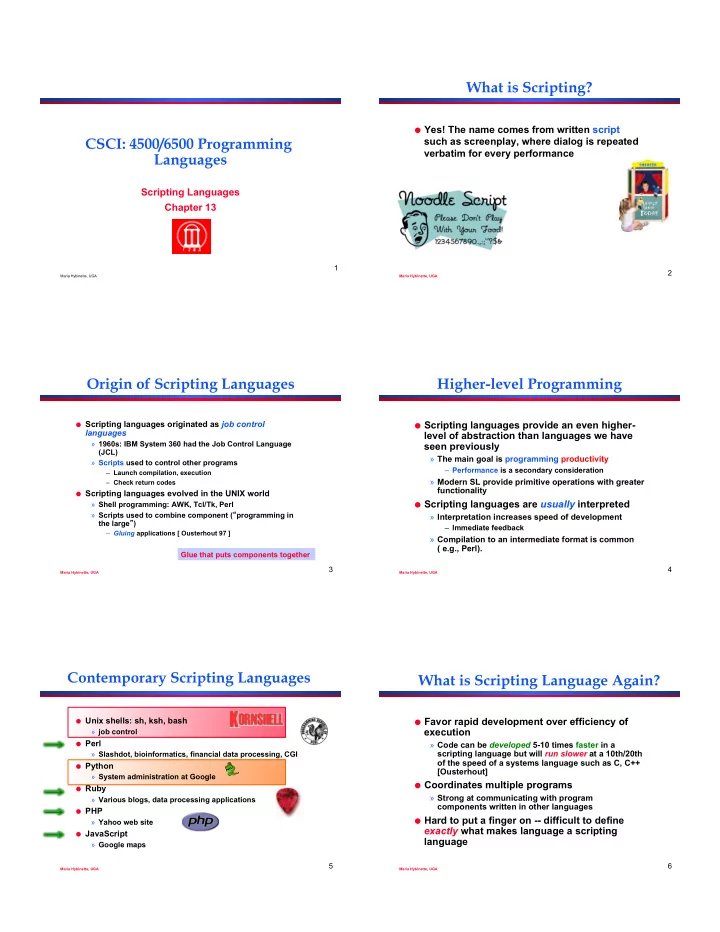
What is Scripting?

! Yes! The name comes from written script

such as screenplay, where dialog is repeated verbatim for every performance

Maria Hybinette, UGA

3

Origin of Scripting Languages

! Scripting languages originated as job control

languages

» 1960s: IBM System 360 had the Job Control Language (JCL) » Scripts used to control other programs

– Launch compilation, execution – Check return codes ! Scripting languages evolved in the UNIX world

» Shell programming: AWK, Tcl/Tk, Perl » Scripts used to combine component (“programming in the large”)

– Gluing applications [ Ousterhout 97 ]

Glue that puts components together

Maria Hybinette, UGA

4

Higher-level Programming

! Scripting languages provide an even higher-

level of abstraction than languages we have seen previously

» The main goal is programming productivity

– Performance is a secondary consideration

» Modern SL provide primitive operations with greater functionality

! Scripting languages are usually interpreted

» Interpretation increases speed of development

– Immediate feedback

» Compilation to an intermediate format is common ( e.g., Perl).

Maria Hybinette, UGA

5

Contemporary Scripting Languages

! Unix shells: sh, ksh, bash

» job control

! Perl

» Slashdot, bioinformatics, financial data processing, CGI

! Python

» System administration at Google

! Ruby

» Various blogs, data processing applications

! PHP

» Yahoo web site

! JavaScript

» Google maps

Maria Hybinette, UGA

6

What is Scripting Language Again?

! Favor rapid development over efficiency of

execution

» Code can be developed 5-10 times faster in a scripting language but will run slower at a 10th/20th

  • f the speed of a systems language such as C, C++

[Ousterhout]

! Coordinates multiple programs

» Strong at communicating with program components written in other languages

! Hard to put a finger on -- difficult to define

exactly what makes language a scripting language

slide-2
SLIDE 2

Maria Hybinette, UGA

7

Common Characteristics

! Batch and interactive use ! Economy of expression (readability?) ! Weakly typed

» meaning is inferred (no declaration required) » => less error checking at compile time

– run time checking is less efficient (strict run type checking by Python, Ruby, Scheme).

» Increases speed of development

– more flexible – fewer lines of code ! High-level model of underlying machines ! Easy access to other programs ! Sophisticated pattern matching and string manipulation ! High-level data types (sets, bags, lists, dictionaries and

tuples)

Designed to support “quick programming” We will talk more about types later…

Maria Hybinette, UGA

8

“Typing” and Productivity

[Ousterhout, 97]

Maria Hybinette, UGA

9

Design Philosophy

Often people, especially computer engineers, focus on the

  • machines. They think:

"By doing this, the machine will run faster. By doing this, the machine will run more effectively. By doing this, the machine will something something something." They are focusing on the machines. But in fact we need to focus on humans, on how humans care about doing programming or operating the application of the machines. We are the masters. They are the slaves. Yukihiro “Matz” Matsumoto Creator of Ruby

Maria Hybinette, UGA

10

Design Philosophy

Often people, especially computer engineers, focus on the

  • machines. They think:

"By doing this, the machine will run faster. By doing this, the machine will run more effectively. By doing this, the machine will something something something." They are focusing on the machines. But in fact we need to focus on humans, on how humans care about doing programming or operating the application of the machines. We are the masters. They are the slaves. Yukihiro “Matz” Matsumoto Creator of Ruby

Maria Hybinette, UGA

11

Application Domains

! Shell scripts ! Macro ! Application specific ! Web programming ! Text processing ! Extension/Embedded ! Others

http://www.cs.uga.edu/~maria/classes/4500- Spring-2006/4500-hw.html

We will use Ruby here, but easy (and similar) in most scripting languages

slide-3
SLIDE 3

Maria Hybinette, UGA

13

Demo: Getting due dates of homework

! What if I don’t want to go to the web site to

see if I have CSCI 4500/6500 homework?

! What if I don’t want to launch a heavy duty

web browser?

! Write a script to check for me!

{saffron} check http://www.cs.uga.edu/~maria/classes/4500-Spring-2006/4500-hw.html Hwk 6 is due on Thursday, April 13. Hwk 1 was due on Tuesday, January 10. Hwk 2 was due on Tuesday, January 31. Hwk 3 was due on Wednesday, February 15. Hwk 4 is due on Thursday, March 09. Hwk 5 is due on Thursday, March 30. #!/usr/bin/ruby require 'uri'; require 'net/http' uri= URI.parse( ARGV[0] ) h=Net::HTTP.new(uri.host,80) resp,data = h.get(uri.path) hwk = {} if resp.message == "OK" data.scan(/Homework (\d*) \(due (\d*)\/(\d*)\)/)\ {|x,y,z| hwk[x] = Time.local(2006,y,z)} end hwk.each{| assignment, duedate| if duedate < (Time.now - 60 * 60 * 24) puts "Hwk #{assignment} was due on #{duedate.strftime("%A, %B %d")}." else puts "Hwk #{assignment} is due on #{duedate.strftime("%A, %B %d")}." end } #!/usr/bin/ruby require 'uri'; require 'net/http' uri= URI.parse( ARGV[0] ) h=Net::HTTP.new(uri.host,80) resp,data = h.get(uri.path) hwk = {} if resp.message == "OK" data.scan(/Homework (\d*) \(due (\d*)\/(\d*)\)/)\ {|x,y,z| hwk[x] = Time.local(2006,y,z)} end hwk.each{| assignment, duedate| if duedate < (Time.now - 60 * 60 * 24) puts "Hwk #{assignment} was due on #{duedate.strftime("%A, %B %d")}." else puts "Hwk #{assignment} is due on #{duedate.strftime("%A, %B %d")}." end }

“Shebang”

#!/usr/bin/ruby require 'uri'; require 'net/http' uri = URI.parse( ARGV[0] ) h = Net::HTTP.new(uri.host,80) resp,data = h.get(uri.path) hwk = {} if resp.message == "OK" data.scan(/Homework (\d*) \(due (\d*)\/(\d*)\)/)\ {|x,y,z| hwk[x] = Time.local(2006,y,z)} end hwk.each{| assignment, duedate| if duedate < (Time.now - 60 * 60 * 24) puts "Hwk #{assignment} was due on #{duedate.strftime("%A, %B %d")}." else puts "Hwk #{assignment} is due on #{duedate.strftime("%A, %B %d")}." end }

useful libraries

#!/usr/bin/ruby require 'uri'; require 'net/http' uri = URI.parse( ARGV[0] ) h = Net::HTTP.new(uri.host,80) resp,data = h.get(uri.path) hwk = {} if resp.message == "OK" data.scan(/Homework (\d*) \(due (\d*)\/(\d*)\)/)\ {|x,y,z| hwk[x] = Time.local(2006,y,z)} end hwk.each{| assignment, duedate| if duedate < (Time.now - 60 * 60 * 24) puts "Hwk #{assignment} was due on #{duedate.strftime("%A, %B %d")}." else puts "Hwk #{assignment} is due on #{duedate.strftime("%A, %B %d")}." end }

Powerful regular expression support

#!/usr/bin/ruby require 'uri'; require 'net/http' uri = URI.parse( ARGV[0] ) h = Net::HTTP.new(uri.host,80) resp,data = h.get(uri.path) hwk = {} if resp.message == "OK" data.scan(/Homework (\d*) \(due (\d*)\/(\d*)\)/)\ {|x,y,z| hwk[x] = Time.local(2006,y,z)} end hwk.each{| assignment, duedate | if duedate < (Time.now - 60 * 60 * 24) puts "Hwk #{assignment} was due on #{duedate.strftime("%A, %B %d")}." else puts "Hwk #{assignment} is due on #{duedate.strftime("%A, %B %d")}." end }

Associative arrays: Keys & Values

slide-4
SLIDE 4

#!/usr/bin/ruby require 'uri'; require 'net/http' uri = URI.parse( ARGV[0] ) h = Net::HTTP.new(uri.host,80) resp,data = h.get(uri.path) hwk = {} if resp.message == "OK" data.scan(/Homework (\d*) \(due (\d*)\/(\d*)\)/)\ {|x,y,z| hwk[x] = Time.local(2006,y,z)} end hwk.each{| assignment, duedate| if duedate < (Time.now - 60 * 60 * 24) puts "Hwk #{assignment} was due on #{duedate.strftime("%A, %B %d")}." else puts "Hwk #{assignment} is due on #{duedate.strftime("%A, %B %d")}." end }

String processing

Maria Hybinette, UGA

20

“Shebang”

! In Unix systems, shebang tells the OS how to evaluate an

executable text file.

» Shebang: sharp bang or haSH bang, referring to the two typical UNIX names of the two characters.

! Advantages: Don’t need file extensions, program looks

built-in, and can change implementation transparently.

> ./doit args

#! interp-path prog-text

doit:

> interp-path doit args

Maria Hybinette, UGA

21

Large Standard Library

! Date, ParseDate ! File ! GetoptLong: processing command line switches ! profile: automatic performance profiling ! BasicSocket, IPSocket, TCPSocket, TCPServer, UDPSocket, Socket ! Net::FTP, Net::HTTP, Net::HTTPResponse, Net::POPMail, Net::SMTP,

Net::Telnet

! CGI: cookies, session management ! Threads ! Matrix

Maria Hybinette, UGA

22

Contributing users

! Ruby Application Archive (RAA)

» http://raa.ruby-lang.org/ » 144 library categories, 833 libraries available » eg: URI library, database access

! Comprehensive Perl Archive Network (CPAN)

» http://www.cpan.org/ » 8853 Perl modules from 4655 authors » “With Perl, you usually don’t have to write much code: just find the code that somebody else has already written to solve your problem.”

Maria Hybinette, UGA

23

Example: URI and HTTP Libraries

require 'uri'; require 'net/http' uri = URI.parse(ARGV[0]) h = Net::HTTP.new(uri.host,80) resp,data = h.get(uri.path) Require clauses cause Ruby to load named libraries. URI Syntax (Uniform Resource Identifier): URL & URN ( both ) http, ftp, mailto.

URL: <protocol>:// <host> [:<port>] [<path> [? <query>]] http://user:pass@example.com:992/animal/bird?species=seagull#wings \__/ \________/ \_________/\__/\__________/\______________/\____/ | | | | | | | protocol login hosts port path query anchor/fragment

  • URN: urn:<namespace>:<string> if the books is a file (URL: file path file://home/maria/book.pdf)
  • urn:isbn:nnnn-nnn-nnn

Street address & Name (identity)

Maria Hybinette, UGA

24

Example: URI and HTTP Libraries

require 'uri'; require 'net/http' uri = URI.parse( ARGV[0]) h = Net::HTTP.new(uri.host,80) resp,data = h.get(uri.path) URI.parse converts argument string into uri object, with host and path component (and more)

slide-5
SLIDE 5

Maria Hybinette, UGA

25

Example: URI and HTTP Libraries

require 'uri'; require 'net/http' uri = URI.parse( ARGV[0] ) h = Net::HTTP.new(uri.host,80) resp,data = h.get(uri.path) Net::HTTP.new creates an http connection object, ready to converse with the specified host on the indicated port.

Maria Hybinette, UGA

26

Example: URI and HTTP Libraries

require 'uri'; require 'net/http' uri = URI.parse( ARGV[0] ) h = Net::HTTP.new( uri.host,80 ) resp,data = h.get( uri.path ) h.get asks to retrieve the headers and content of the given path from the site associated with h. It returns response code and the payload data

Maria Hybinette, UGA

27

Strings

! Strings are just objects: ! Strings can include expressions with # operator: ! Plus operator concatenates strings: ! Many more operations (more than 75!).

“simon”.length yields 5 “3 + 4 = #{3 + 4}” yields “3 + 4 = 7” “Simon” + “Cowell” yields “Simon Cowell”

Maria Hybinette, UGA

28

Powerful regular expressions

! Regular expressions are patterns that match

against strings, possibly creating bindings in the process. Uses greedy matching.

! In Ruby, regular expressions are objects

created with special literal forms:

! Examples:

/reg-exp/ or %r{reg-exp} /arr/ matches strings containing arr /\s*\|\s*/ matches a | with optional white space

Maria Hybinette, UGA

29

Simple Matches

All characters except .|()[\^{+$*? match themselves .|()[\^{+$*? Precede by \ to match directly . Matches any character [characters] Matches any single character in [!] May include ranges; Initial ^ negates \d Matches any digit \w Matches any “word” character \s Matches any whitespace ^ Matches the beginning of a line $ Matches the end of a line

Maria Hybinette, UGA

30

Compound matches

(…) re1 | re2 re? re{m,n} re+ re* Groups regular expressions and directs interpreter to introduce bindings for intermediate results. Matches either re1 or re2 Matches zero or one occurrence of re. Matches at least m and no more than n

  • ccurrences of re.

Matches 1 or more occurrences of re. Matches 0 or more occurrences of re.

slide-6
SLIDE 6

Maria Hybinette, UGA

31

Bindings

$` Portion of string that preceded match. $& Portion of string that matched. $’ Portion of string after match. $1, $2,… Portion of match within i th set of parentheses. Matching a string against a regular expression causes interpreter to introduce bindings: