Evolution of Scripting Languages ! UNIX shell scripting CSCI: - - PDF document

evolution of scripting languages
SMART_READER_LITE
LIVE PREVIEW

Evolution of Scripting Languages ! UNIX shell scripting CSCI: - - PDF document

Evolution of Scripting Languages ! UNIX shell scripting CSCI: 4500/6500 Programming awk, sed, ksh, csh Languages ! Tck/Tk ! Perl ! Python Python ! PHP ! Ruby Some material from: Stephen Ferg Bureau of Labor Statistics and Guido van Rossum


slide-1
SLIDE 1

Maria Hybinette, UGA

1

CSCI: 4500/6500 Programming Languages

Python

Some material from: Stephen Ferg Bureau of Labor Statistics and Guido van Rossum Python Architect Maria Hybinette, UGA

2

Evolution of Scripting Languages

! UNIX shell scripting

» awk, sed, ksh, csh

! Tck/Tk ! Perl ! Python ! PHP ! Ruby

Maria Hybinette, UGA

3

Python Developed in 1991 by Guido van Rossum

  • PEP 3000 (December 2008)

"There should be one— and preferably only one

—obvious way to do it.” (remove old ways of doing stuff)

! Mature ! Powerful / flexible ! Easy-to-learn / use ! Easy to read (in contrast to Perl ! ) ! Open source ! Lots of documentation ! Lots of tutorials ! Lots of libraries

» Ruby - nice, purely object oriented, but harder to find libraries

Monty Python’s Flying Circus Fan

Maria Hybinette, UGA

4

Python

! MultiParadigm: functional, imperative, and

  • bject-oriented.

! Emphasizes Readability. ! Dynamically Typed (run time checking). ! Portable: Mac, Windows, Unix (nike). ! Faster than C, C++, Java in productivity

» Compact language » Batteries included (build in library)

! Python block indenting

» looks cleaner => easier to read

! Slower in execution

» but you can integrate C/C++/Java with Python

Maria Hybinette, UGA

5

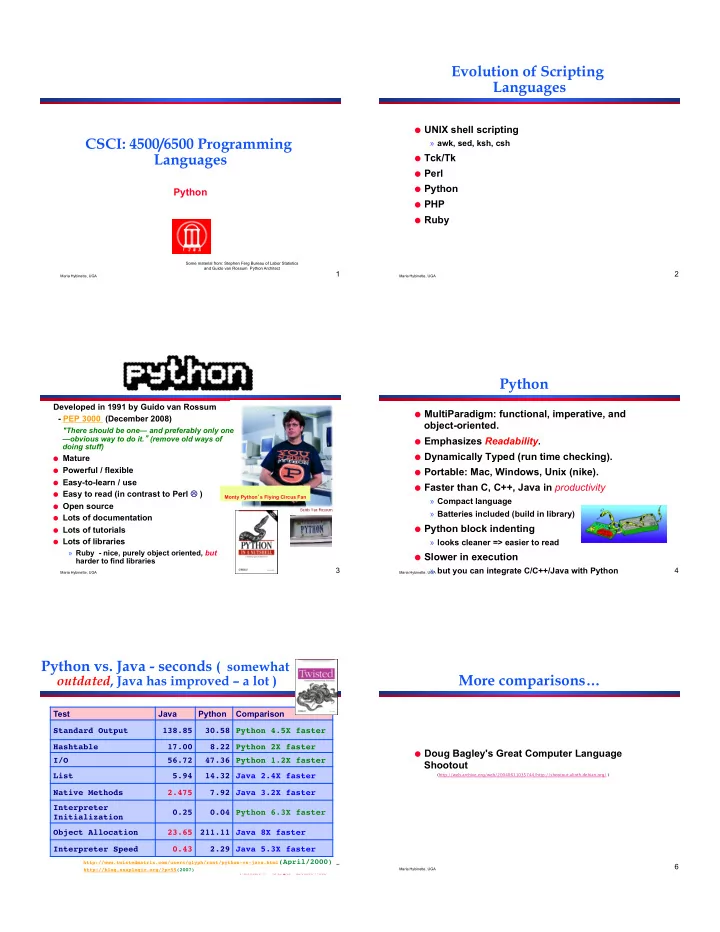
Python vs. Java - seconds ( somewhat

  • utdated, Java has improved – a lot )

Test Java Python Comparison Standard Output 138.85

  • 30.58

Python 4.5X faster Hashtable 17.00

  • 8.22

Python 2X faster I/O 56.72

  • 47.36

Python 1.2X faster

  • List

5.94

  • 14.32

Java 2.4X faster Native Methods 2.475

  • 7.92

Java 3.2X faster Interpreter Initialization 0.25

  • 0.04

Python 6.3X faster Object Allocation 23.65

  • 211.11

Java 8X faster Interpreter Speed 0.43

  • 2.29

Java 5.3X faster

http://www.twistedmatrix.com/users/glyph/rant/python-vs-java.html(April/2000)

  • Matthew “Glyph” Lefkowitz

!

http://blog.snaplogic.org/?p=55(2007)

Maria Hybinette, UGA

6

More comparisons…

! Doug Bagley's Great Computer Language

Shootout

(http://web.archive.org/web/20040611035744/http://shootout.alioth.debian.org/ )

slide-2
SLIDE 2

Maria Hybinette, UGA

7

Python vs. Java

! Python programs run slower than Java ! Python programs take less time to develop

» Typically a 5-10 times difference (origin, Ousterhout)

! Python is dynamically typed

» Programmer don’t have to deal with static typing

– variable bound to type at compile time & optionally to an object (value of same type)

» Trend is now toward stronger static type checking, not less

– However, this is a productivity win at the cost of some risk ! Python is compact ! Python is concise (not verbose, not superfluous) ! Closures (lambda)

http://www.ferg.org/projects/python_java_side-by-side.html(February/2004)

Maria Hybinette, UGA

8

Weak vs. Strong Typing (BEWARE: there are a number of definitions)

! Variable can be of non-specific data type. ! Strongly typed languages puts (many) restrictions

  • n how difgerent types interact with each other

» 3+ 3.5 may not be allowed (only integers adds)

! Weak typing (pliable):

» the language implicitly convert (or casts) types when used (it allows type conversion) or » it permits ad-hoc polymorphism (overloading)

! Examples:

» C is weakly typed, you can easily override the type system using casts, PHP » Ruby, Python are really strongly typed » Javascript (need double check – weakly, dynamically typed)

Maria Hybinette, UGA

9 ! Weak vs Strong : Controversy ! "I spent a few weeks... trying to sort out the

terminology of "strongly typed," "statically typed," "safe," etc., and found it amazingly difficult.... The usage of these terms is so various as to render them almost useless.”

» Benjamin C. Pierce, author of Types and Programming Languages and Advanced Types and Programming Languages (and also the maintainer

  • f the great list of programming papers)

Maria Hybinette, UGA

10

The Strong vs. the Weak

! Smalltalk, Ruby, Python, Javascript & LISP

» strongly typed (typing errors avoided at runtime)

! Standard ML, OCaml and Haskell

» Stronger than Java – on implicit type conversion

! Java ! Pascal ! C++ stronger than C ! C (supports more implicit conversions than

Java and Pascal), pointer values can be cast.

Some argue that C, C++ are strong because they place enough restrictions on how operands of different types can be mixed

and controversy…

Maria Hybinette, UGA

11

Dynamically vs. Static Typing (more consensus on the definition here)

! Dynamically typed: majority of type checking at

run time.

! Other people like static typing! trade-off is

performance I think there is a trend ... Dynamically typed languages such as Python, Ruby, and even Smalltalk will be mainstream industrial languages in the coming years.

Robert C. Martin (2001) author of Agile Software Development. Orthogonal: you can be both strongly and dynamically typed Maria Hybinette, UGA

12

More Quotes…

! "When Java came out, I was excited -- I could write code

twice as fast in Java as I could in C/C++. And with Python I can write code twice as fast as I can in Java."

– Andy Hertzfeld (original apple computer software engineer now at google)

! When a 20,000 line project went to approximately 3,000 lines

  • vernight, and came out being more flexible and robust ... I

realized I was on to something really good.

– Matthew "Glyph" Lefkowitz

! So the real punch line of the story is this: weeks and

months after writing [python program], I could still read the code and grok what it was doing without serious mental effort.

» And the true reason I no longer write Perl for anything but tiny projects is that was never true when I was writing large masses

  • f Perl code. I fear the prospect of ever having to modify keeper
  • r anthologize again -- but [the above python] gives me no

qualms at all.

Eric S. Raymond, author of The Cathedral and the Bazaar

slide-3
SLIDE 3

Maria Hybinette, UGA

13

Is it Safe?

! Python is an "open-source" language. » It has no vendor. ! Does that mean we'll have support problems?

What about...

  • Vendor longevity?
  • Consulting & training support?
  • Books and reference materials?
  • Tools? IDEs, debuggers, screen-painters?

Maria Hybinette, UGA

14

Who is using open-source software (e.g., LAMP)?

! Apache has overwhelmingly dominated the

Web server market since 1996.

! PHP is the most popular Apache module,

running on almost 10 million domains (over a million IP addresses).

! Linux ! Apache ! MySQL ! PHP | Perl | Python

“LAMP” ... and then there's ...

Maria Hybinette, UGA

15

Department of Defense (DoD)

! In 2002, a Mitre1 study found 115 FOSS (free

and open-source) products in use in the U.S.

  • Dept. of Defense.

http://egovos.org/pdf/dodfoss.pdf

  • 1. Past employer of Maria Hybinette

Maria Hybinette, UGA

16

… and IBM

!

In September 2003, IBM began promoting Linux with a series of television ads depicting a young boy receiving lessons from famous innovators and

  • teachers. The boy represents the next generation of humanity, learning from

teachers who – like the open-source community – freely share their accumulated expertise.

Maria Hybinette, UGA

17

Who is using Python?

! Industrial Light & Magic, maker of the Star Wars films,

uses Python extensively in the computer graphics production process.

! Disney Feature Length Animation uses Python for its

animation production applications.

! Google, a leading internet search engine, is powered

by Python.

! Yahoo uses Python for its groups site, and in its

Inktomi search engine.

! New York Stock Exchange (NYSE) - uses it for

developing on-line systems for the floor of the exchange and for the member firm's back offices

! The National Weather Service uses Python to prepare

weather forecasts.

Python spotting: http://www.pythonology.org/spotting

http://wiki.python.org/moin/OrganizationsUsingPython

Maria Hybinette, UGA

18 ! Longevity - open source have no vendor,

python is managed by the python software foundation - non-profit, produces core python distribution (blessed by Guido)

slide-4
SLIDE 4

Maria Hybinette, UGA

19

Learning Python

! We will cover the highlights of python.

» You will have to learn more on your own. » “Dive into Python”

– download a local copy pdf and on-line read available – http://diveintopython.org/toc/index.html

» “Python 101” -- nice introduction (2008)

– http://www.rexx.com/~dkuhlman/python_101/python_101.html ! The Official Python Tutorial http://www.python.org/doc/current/tut/tut.html ! The Python Quick Reference http://rgruet.free.fr/#QuickRef

Maria Hybinette, UGA

20

Resources

Maria Hybinette, UGA

21

Versions

! Current 2 production versions – “not really that much difference” according to python.org.

» Python 2.6.5 (March 19, 2010) (today)

– 2.7.2 (September 2011) latest Stable – Python 3.2.2. (September, 2011) – slow? ! Developing environment:

» IPython – shell - (newer 2011) » IDLE (2.7 : July 2010) [2.6 today]

– coded in 100% pure Python, using the tkinter GUI toolkit – cross-platform: works on Windows and Unix – Python shell window (a.k.a. interactive interpreter) – debugger (not complete, but you can do the basics, set breakpoints, view and step)

» Eclipse module

Maria Hybinette, UGA

22

Installing Python

! Already exists of nike.cs.uga.edu (version 2.6.6) ! Easy to get and install for Win/Mac from (2.6)

http://www.python.org

! Intro: Wikipedia's Python

Maria Hybinette, UGA

23

IDLE Development Environment

! Shell for interactive evaluation ! Text editor with color-coding and smart

indenting for creating python files.

! Menu commands for changing system

settings and running files.

http://hkn.eecs.berkeley.edu/~dyoo/python/idle_intro/index.html

Maria Hybinette, UGA

24

Interpreter: On my Mac

slide-5
SLIDE 5

Maria Hybinette, UGA

25

Working with a file.py

!

IDLE -

  • 1. File -> new window
  • 2. type commands in new window area
  • 3. save as “file name”.py (typical extension)
  • 4. Run module

Maria Hybinette, UGA

26

Maria Hybinette, UGA

27

Running Programs on UNIX

! #! /opt/sfw/bin/python (makes it

runnable as an executable)

{saffron:ingrid:1563} more filename.py #! /usr/local/bin/python print "hello world" print "here are the ten numbers from 0 to 9" for i in range(10): print i, print "I'm done!" {saffron:ingrid:1562} python filename.py hello world here are the ten numbers from 0 to 9 0 1 2 3 4 5 6 7 8 9 I'm done! {saffron:ingrid:1563} filename.py // what will happen?

Maria Hybinette, UGA

28

Look at a sample of code…

x = 34 - 23 # A comment. y = “Hello” # Another one. z = 3.45 if z == 3.45 or y == “Hello”: x = x + 1 y = y + “World” # String concat. print x print y

IDLE Colors Please

script.txt

Maria Hybinette, UGA

29

Look at a sample of code…

>>> 12 HelloWorld

x = 34 - 23 # A comment. y = “Hello” # Another one. z = 3.45 if z == 3.45 or y == “Hello”: x = x + 1 y = y + “World” # String concat. print x print y

Maria Hybinette, UGA

30

Enough to Understand the Code

! Assignment uses = and ! Comparison uses ==. ! For numbers +-*/% are as expected.

» Special use of + for string concatenation. » Special use of % for string formatting.

! Logical operators are words (and, or, not)

not symbols (&&, ||, !).

! The basic printing command is “

.”

! First assignment to a variable will create it.

» Variable types don’t need to be declared. » Python figures out the variable types on its own (inference).

slide-6
SLIDE 6

Maria Hybinette, UGA

31

Basic Datatypes

! Integers (default for numbers)

z = 5 / 2 # Answer is 2, integer division.

! Floats

x = 3.456

! Strings

Can use “” or ‘’ to specify. “abc” ‘abc’ (Same thing.) Unmatched ones can occur within the string. “maria’s” Use triple double-quotes for multi-line strings or strings that contain both ‘ and “ inside of them: “““a‘b“c”””

Maria Hybinette, UGA

32

Whitespace

! Whitespace is meaningful in Python:

especially indentation and placement of newlines.

» Use a newline to end a line of code. (Not a semicolon ; like in C++ or Java.) (Use \ when must go to next line prematurely.) » No braces { } to mark blocks of code in Python! Use consistent indentation instead. The first line with a new indentation is considered outside of the block. » Often a colon appears at the start of a new block. (We’ll see this later for function and class definitions.)

Maria Hybinette, UGA

33

Comments

! Start comments with # – the rest of line is ignored. ! Can include a “documentation string” as the first line

  • f any new function or class that you define.

! The development environment, debugger, and

  • ther tools use it: it’s good style to include one.

def my_function(x, y): “““This is the docstring. This function does blah blah blah.””” # The code would go here... x = y + 1 return x

Maria Hybinette, UGA

34

Look at more sample of code…

x = 34 - 23 # A comment. y = “Hello” # Another one. z = 3.45 if z == 3.45 or y == “Hello”: x = x + 1 y = y + “ World” # String concat. print x print y

Maria Hybinette, UGA

35

Python and Types

Python determines the data types in a program automatically at runtime. “Dynamic Typing” But Python’s not casual about types, it enforces them after it figures them out. “Strong Typing” So, for example, you can’t just append an integer to a string. You must first convert the integer to a string itself.

x = “the answer is ” # Decides x is string. y = 23 # Decides y is integer. print x + y # Python will complain about this.

Maria Hybinette, UGA

36

Naming Rules

! Names are case sensitive and cannot start with a

  • number. They can contain letters, numbers, and

underscores.

bob Bob _bob _2_bob_ bob_2 BoB

! There are some reserved words: and, assert, break, class, continue, def,

del, elif, else, except, exec, finally, for, from, global, if, import, in, is, lambda, not, or, pass, print, raise, return, try, while

slide-7
SLIDE 7

Maria Hybinette, UGA

37

Accessing Non-existent Name

! If you try to access a name before it’s been properly

created (by placing it on the left side of an assignment), you’ll get an error.

>>> y Traceback (most recent call last): File "<pyshell#16>", line 1, in -toplevel- y NameError: name ‘y' is not defined >>> y = 3 >>> y 3

Maria Hybinette, UGA

38

Multiple Assignment

! You can also assign to multiple names at the same

time.

>>> x, y = 2, 3 >>> x 2 >>> y 3

Maria Hybinette, UGA

39

String Operations

! We can use some methods built-in to the string data

type to perform some formatting operations on strings:

>>> “hello”.upper() ‘HELLO’

! There are many other handy string operations

  • available. Check the Python documentation for more.

Maria Hybinette, UGA

40

Printing with Python

! You can print a string to the screen using “print.” ! Using the % string operator in combination with the print

command, we can format our output text.

>>> print “%s xyz %d” % (“abc”, 34) abc xyz 34

“Print” automatically adds a newline to the end of the string. If you

include a list of strings separated by a comma (,) , it will concatenate them with a space between them.

>>> print “abc” >>> print “abc”, “def” abc abc def

Maria Hybinette, UGA

41

Strings

» Concatenation – “Hello” + “World”

  • > ‘HelloWorld’

» Repetition – “UGA” * 3

  • > ‘UGAUGAUGA’

» Indexing – “UGA”[0]

  • > ‘U’

» Slicing – “UGA”[1:3]

  • > ‘GA’

– “UGA”[1:1]

  • > ‘’

» Size – len(“UGA”)

  • > 3

» Comparison – “Maria” < “maria”

  • > True

» Search – “i” in “maria”

  • > True

Maria Hybinette, UGA

42

Container Types: Tuple, List & Dictionary

! ( 100, 200, 300 )

# Tuple

! [ 42, 3.14, “hello” ]

# List

! { ‘x’:42, ‘y’:3.14 }

# Dictionary Tuple

» a simple immutable ordered sequence of items

List

» a mutable ordered sequence with more powerful manipulations

Dictionary -

» a lookup table of key-value pairs

slide-8
SLIDE 8

Maria Hybinette, UGA

43

Lists

>>> alist = [631, “maria” , [ 331, “maria” ]] >>> print alist [123, ‘maria’, [331, ‘maria’]]

! List items need not have the same type ! Same operators as for strings ! operations append(), insert(), pop(), reverse() and

sort()

Maria Hybinette, UGA

44

More List Operations

>>> a = range(5)

  • # [0,1,2,3,4]

>>> a.append(5)

  • # [0,1,2,3,4,5]

>>> a.pop()

  • # [0,1,2,3,4]

5 >>> a.insert(0, 42) # [42,0,1,2,3,4] >>> a.pop(0)

  • # [0,1,2,3,4]

42 >>> a.reverse()

  • # [4,3,2,1,0]

>>> a.sort()

  • # [0,1,2,3,4]
  • >>> a.append([22,33])
  • # [0,1,2,3,4,[22,33]]

>>> a.extend([10,20]) # [0,1,2,3,4,[22,33],10,20]

  • Maria Hybinette, UGA

45

More Lists

! List multiplication » list = ["aa“, "bb"] * 3 ! Printing out lists » print "\n".join(list) # better formatting ! More operations » list.count("aa") # how many times » list.index("bb") # returns the first match location ! More on slices

» list[-1] # last element » list[0:3] # starting ele 0 and up to 2 » list[3:] # starting ele 3 to end of list » list[:] # a complete copy of the list

Maria Hybinette, UGA

46

Dictionaries

! Hash tables, "associative arrays“ with key/value pairs – d = {"duck": "bird", "bee": "insect"} ! Lookup: – d["duck"]

  • # "bird”

– d["lion"]

  • # raises KeyError exception

– d[“bird”]

  • ?

! Delete, insert, overwrite:

– del d["bee"]

  • # delete

– d["lion"] = “cat"

  • # insert

– d["duck"] = “unknown" # overwrites

Maria Hybinette, UGA

47

More Dictionary Ops

! Keys, values, items: – d.keys()

  • # returns dictionary keys

– d.values()

  • # returns all values

– d.items()

  • # returns a list of
  • key/value pairs

! Presence check: – d.has_key("duck") # True – d.has_key("spam") # False ! Values of any type ! Keys almost any type (needs to be immutable – tuples

OK, but not lists).

{

"name":”Maria", "age": 25, 42:"yes", "flag": ["red","white","blue"] # list is value not key }

Maria Hybinette, UGA

48

Dictionary Details

! Keys must be immutable:

» numbers, strings, tuples of immutables

– these cannot be changed after creation

! Keys are hashed (fast lookup technique)

» not lists or other dictionaries

– these types of objects can be changed "in place"

» no restrictions on values

! Keys will be listed in arbitrary order

» again, because of hashing

slide-9
SLIDE 9

Maria Hybinette, UGA

49

Tuples

! Immutable lists ! Faster than lists

! key = (“lastname”, “firstname” ) ! lastname = key[0] ! point = x, y, z

  • # parentheses optional

! singleton = (1,)

# trailing comma!!!

  • # (required otherwise

a value)

! empty = ()

  • # parentheses!

Maria Hybinette, UGA

50

Variables

! Need to assign (initialize) – use of uninitialized variable raises exception ! No need to declare type (dynamically typed)

if friendly: greeting = "hello world" else: greeting = 12**2 print greeting

» However once set the type matters

– Can’t treat integer as a string

Maria Hybinette, UGA

51

Reference Semantics

! Assignment manipulates references – x = y

!

does not make a copy of y

!

makes x reference the object y references

! Very useful; but beware! ! Example:

>>> a = [1, 2, 3] >>> b = a >>> a.append(4) >>> print b [1, 2, 3, 4]

Maria Hybinette, UGA

52

a 1 2 3 b a 1 2 3 b 4 a = [1, 2, 3] a.append(4) b = a a 1 2 3

Changing a Shared List

Maria Hybinette, UGA

53

a 1 b a 1 b a = 1 a = a+1 b = a a 1 2

Changing an Integer

  • ld reference deleted

by assignment (a=...) new int object created by add operator (1+1)

Maria Hybinette, UGA

54

Control Structures

if condition: statements [elif condition: statements] ... else: statements while condition: statements

  • for var in sequence:

statements

  • break

continue

slide-10
SLIDE 10

Maria Hybinette, UGA

55

More For Loops

! looping through list

» for item in list: » print item

! looping through counter

» for i in range(5): print i,

! Iterating through a ‘built in’ dictionary

» import os » for k,v in os.environ.items(): » print "%s=%s" % (k,v)

! `os.environ` is a dictionary of environment variables

Maria Hybinette, UGA

56

Exercise I

Print (on separate lines) 1x1=1 1x2=2 1x3=3 .... 8x9=72 9x9=81 but don’t repeat. For example print only 3x5=15 but don’t print 5x3=15 so print only if first_number <= second_num Hint: use range for num in range(1,10):

Maria Hybinette, UGA

57

Output

! 1 x 1 = 1 ! 1 x 2 = 2 ! 1 x 3 = 3 ! 1 x 4 = 4 ! 1 x 5 = 5 ! 1 x 6 = 6 ! !.

Maria Hybinette, UGA

58

Exercise Answer

a = range(1,10) b = range(1,10) for anum in a: for bnum in b: if ( anum <= bnum ): print str(anum),"x",str(bnum),"=",str(anum*bnum)

Don’t really need str here

Maria Hybinette, UGA

59

Grouping Indentation

In Python: for i in range(20): if i%3 == 0: print i if i%5 == 0: print "Bingo!" print "---" In C: for ( i = 0; i < 20; i++ ) { if (i%3 == 0) { printf("%d\n", i); if (i%5 == 0) { printf("Bingo!\n"); } } printf("---\n"); }

Bingo!

  • 3
  • 6
  • 9
  • 12
  • 15

Bingo!

  • 18
  • Maria Hybinette, UGA

60

Functions, Procedures

def name(arg1, arg2, ...): """documentation""" # optional doc string statements

  • return
  • # from procedure

return expression

  • # from function
slide-11
SLIDE 11

Maria Hybinette, UGA

61

Example Function

def gcd(a, b): "greatest common divisor" while a != 0: a, b = b%a, a # parallel assignment return b

  • >>> gcd.__doc__

# 2 _ _ of these 'greatest common divisor' >>> gcd(12, 20) 4

Maria Hybinette, UGA

62

Exercise II

! Phone book application

» 1) add

– Ask for name and phone number

» 2) print phone book

! To get input: » answer = raw_input("Enter your selection: ")

intro= """ Welcome to the phone book application choices: 1) add new entry 2) print phone book 3) exit """ print intro ph_d = {} # phone book dictionary def add_entry(): """ add new entry into phone book""" name = raw_input("give me a name:") number = raw_input("give me a number:") ph_d[name] = number def print_pb(): print "name".rjust(30)+"number".rjust(30) for name,num in ph_d.items(): print name.rjust(30),num.rjust(30) while (True): response = raw_input("Enter your command: ") if (response == '1'): add_entry() elif (response == '2'): print_pb() elif (response == '3'): break else: print "invalid command"

>>> Welcome to the phone book application choices: 1) add new entry 2) print phone book 3) exit Enter your command: 1 give me a name:maria give me a number:555-1212 Enter your command: 2 name number maria 555-1212 Enter your command: Maria Hybinette, UGA

64

On your own…

! modules & packages ! exceptions ! files & standard library ! classes & instances

Maria Hybinette, UGA

65

Hands On

! www.python.org/doc/current/tut/tut.html

Maria Hybinette, UGA

66

Python Slogans

! Python Fits Your Brain, Bruce Eckel ! Life is Better Without Braces, Bruce Eckel ! Import This ! Batteries included (Tcl origin) ! Powered by Python ! Readability counts, Tim Peters http://mindview.net/

slide-12
SLIDE 12

Maria Hybinette, UGA

67

Bruce Eckel’s Top 10

  • 10. Reduced clutter.

Programs are read more than they are written Consistent formatting is important readability & compactness conversation of compactness Consistent use of programming idioms

  • 09. It's not backward-compatible with other languages. (This came with

some hilarious one-liners: "C++'s backward compatibility with C is both its strength and its bane"; "Java causes repetitive-strain syndrome"; "Perl is compatible with every hacky syntax of every UNIX tool ever invented"; "C# and Microsoft .NET are backward-compatible with Microsoft's previous marketing campaigns"; and "Javascript is not even compatible with itself".)

  • 08. It doesn't value performance over my productivity.

C++ memory leaks primitive types require awkward coding

Maria Hybinette, UGA

68

Bruce Eckel’s Top 10

  • 07. It doesn't treat me like I'm stupid.

Java insists operator overloading is bad because you can make ugly code with it. Bruce observes, "And we all know there's no ugly Java code out there."

  • 06. I don't have to wait forever for a full implementation of the language.

features invented in C+ takes a long time to appear in languages Unused features don’t get tested

  • 05. It doesn't make assumptions about how we discover errors.

Is strong static type checking rally the only way to be sure? Lack of good static typing in pre-ANSI C was troublesome Doesn’t mean it’s the best solution

Maria Hybinette, UGA

69

Bruce Eckel’s Top 10

  • 04. Marketing people are not involved in it (yet).

Java is flawless Microsoft happens “Visual” C++ Of-course Python isn’t immune

  • 03. I don't have to type so much.

But what I do type is the right typing.

  • 02. My guesses are usually right.

I still have to look up how to open a file every time I do it in Java Most things I do in Java, I have to look up. Remember Python Idioms easier because they are simpler

Maria Hybinette, UGA

70

Bruce Eckel’s Top 10

  • 01. Python helps me focus on my concepts rather than on fighting with the

language.