Abstract Common Mistakes in Watch out! Most adiabatic logic families - - PDF document

abstract common mistakes in
SMART_READER_LITE
LIVE PREVIEW

Abstract Common Mistakes in Watch out! Most adiabatic logic families - - PDF document

Abstract Common Mistakes in Watch out! Most adiabatic logic families are not what I call truly adiabatic. Adiabatic Logic Design Many dont satisfy the general definition of an adiabatic process in physics. Many


slide-1
SLIDE 1

1

Common Mistakes in Adiabatic Logic Design and How to Avoid Them

Michael P. Frank University of Florida College of Engineering Departments of CISE and ECE mpf@cise.ufl.edu Methodologies in Low Power Design Workshop Int’l Conf. on Embedded Systems and Applications Int’l Multiconf. In Computer Sci. & Computer Eng. Las Vegas, Nevada, June 23-26, 2003

Abstract

  • Watch out! Most “adiabatic” logic families are not what I call truly adiabatic.

– Many don’t satisfy the general definition of an adiabatic process in physics. – Many “adiabatic” logic families aren’t even asymptotically adiabatic! – I give my definition of “true adiabaticity.”

  • Yet, true adiabatic design will be required for most 21st-century computing!

– At the nanoscale, energy dissipation is by far the dominant limiting factor on computing system performance, esp. for tightly-coupled parallel computations. – Truly-adiabatic design is the only way to work around the fundamental thermodynamic limits on computing which are rapidly being approached.

  • Some of the most common adiabatic design mistakes, and their solutions:

– Use of fundamentally non-adiabatic components, such as diodes. – Turning off transistors while there is nonzero current through them! – Overly-constrained design style that imposes a limited degree of logical reversibility and/or asymptotic efficiency.

  • Overview of some recent advances in adiabatic circuits at UF:

– 2LAL (a simple 2-level adiabatic logic) – GCAL (General CMOS Adiabatic logic) – High-Q MEMS/NEMS based resonant power supplies – Analysis of cost-efficiency benefits of adiabatics, & FET energy-dissipation limits

Organization of Talk

1. Why adiabatic design?

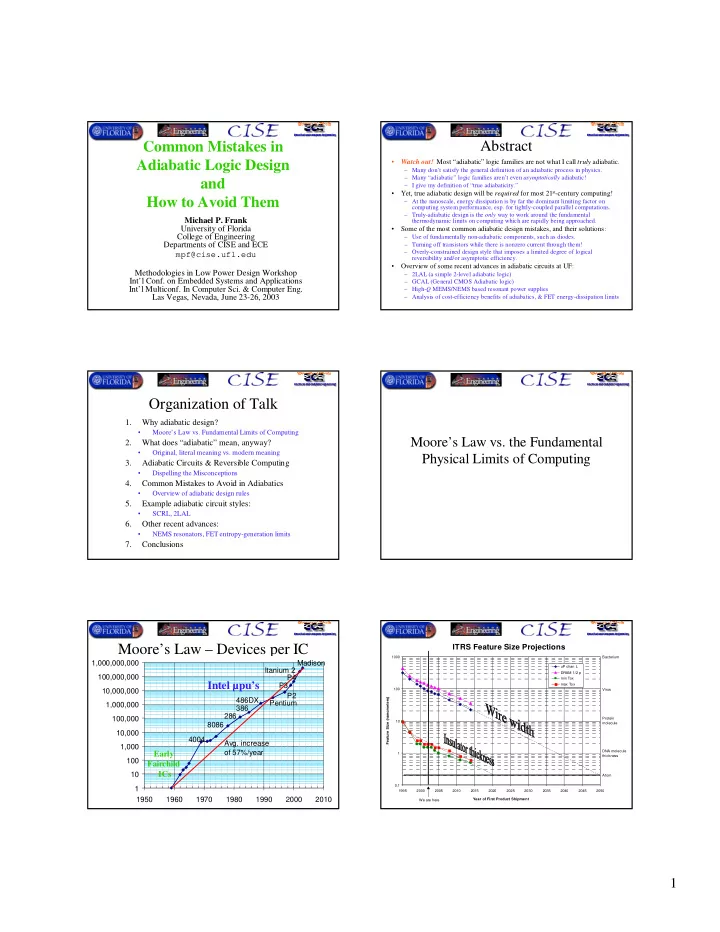
  • Moore’s Law vs. Fundamental Limits of Computing

2. What does “adiabatic” mean, anyway?

  • Original, literal meaning vs. modern meaning

3. Adiabatic Circuits & Reversible Computing

  • Dispelling the Misconceptions

4. Common Mistakes to Avoid in Adiabatics

  • Overview of adiabatic design rules

5. Example adiabatic circuit styles:

  • SCRL, 2LAL

6. Other recent advances:

  • NEMS resonators, FET entropy-generation limits

7. Conclusions

Moore’s Law vs. the Fundamental Physical Limits of Computing

Moore’s Law – Devices per IC

1 10 100 1,000 10,000 100,000 1,000,000 10,000,000 100,000,000 1,000,000,000 1950 1960 1970 1980 1990 2000 2010

  • Avg. increase
  • f 57%/year

4004 8086 286 386 486DX Pentium P2 P3 P4 Itanium 2 Madison

Early Fairchild ICs

Intel µpu’s

ITRS Feature Size Projections

0.1 1 10 100 1000 1995 2000 2005 2010 2015 2020 2025 2030 2035 2040 2045 2050 Year of First Product Shipment Feature Size (nanometers) uP chan L DRAM 1/2 p min Tox max Tox Atom We are here Virus Protein molecule DNA molecule thickness Bacterium

slide-2
SLIDE 2

2

Trend of minimum transistor switching energy 1 10 100 1000 10000 100000 1000000 1995 2005 2015 2025 2035 Year of First Product Shipment Min transistor switching energy, kTs

High Low trend

(½CV2 gate energy calculated from ITRS ’99 geometry/voltage data)

Fundamental Physical Limits of Computing

Speed-of-Light Limit

Thoroughly Confirmed Physical Theories

Uncertainty Principle Definition

  • f Energy

Reversibility 2nd Law of Thermodynamics Adiabatic Theorem Gravity

Theory of Relativity Quantum Theory

Implied Universal Facts Affected Quantities in Information Processing

Communications Latency Information Capacity Information Bandwidth Memory Access Times Processing Rate Energy Loss per Operation

What is entropy?

  • First was characterized by Rudolph Clausius in 1850.

– Originally was just defined as heat ÷temperature. – Noted to never decrease in thermodynamic processes. – Significance and physical meaning were mysterious.

  • In ~1880’s, Ludwig Boltzmann proposed that entropy is

just the logarithm of the number of states, S = k ln N

– What we would now call the information capacity of a system – Holds for systems at equilibrium, in maximum-entropy state

  • The modern consensus resulting from 20th-century

physics is that entropy is simply the amount of unknown

  • r incompressible information in a physical system.

– Contributions by von Neumann, Shannon, Jaynes, Zurek

Landauer’s 1961 principle from basic quantum theory

N distinct states N distinct states

… …

2N distinct states Unitary (1-1) evolution Before bit erasure: After bit erasure:

Increase in entropy: S = log 2 = k ln 2. Energy lost to heat: ST = kT ln 2

s0 sN−1

1 s

  • 1

s

N−1

… …

s

s

N−1

s

N

s

2N−1

Adiabatic Cost-Efficiency Benefits

1.00E+22 1.00E+23 1.00E+24 1.00E+25 1.00E+26 1.00E+27 1.00E+28 1.00E+29 1.00E+30 1.00E+31 1.00E+32 1.00E+33 2000 2010 2020 2030 2040 2050 2060

Bit Bit-

  • operations per US dollar
  • perations per US dollar

Conventional irreversible computing W

  • r

s t

  • c

a s e r e v e r s i b l e c

  • m

p u t i n g B e s t

  • c

a s e r e v e r s i b l e c

  • m

p u t i n g Scenario: $1,000/3-years, 100-Watt conventional computer, vs. reversible computers w. same capacity.

All curves would

if leakage not reduced.

~1,000× ~100,000×

What is “adiabatic?”

Evolution of the term

slide-3
SLIDE 3

3

The Carnot Cycle

  • In 1822-24, Sadi Carnot analyzed the efficiency
  • f an ideal heat engine all of whose steps were

reversible, and furthermore proved that:

– Any reversible engine (regardless of details) would have the same efficiency (TH−TL)/TH. – No engine could have greater efficiency than a reversible engine w/o producing work from nothing – Temperature itself could be defined on a thermodynamic scale based on heat recoverable by a reversible engine operating between TH and TL

Steps of Carnot Cycle

  • Isothermal expansion at TH
  • Adiabatic (without flow of

heat) expansion TH→TL

  • Isothermal compression at TL
  • Adiabatic compression TL→TH

V P TL TH

Reser- voir Reser- voir Reser- voir Reser- voir

Iso- thermal Adia- batic Adia- batic Iso- thermal

Carnot Cycle Terminology

  • Adiabatic (Latin): literally “Without flow of heat”

– I.e., no entropy enters or leaves the system

  • Isothermal: “At the same temperature”

– Temperature of system remains constant as entropy enters or leaves.

  • Both kinds of steps, in the case of the Carnot cycle, are

examples of isentropic processes

– “at the same entropy” – I.e., no (known) information is transformed into entropy in either process

  • But, the usage of the word “adiabatic” in applied

physics has mutated to essentially mean isentropic.

Old and New “Adiabatic”

  • Consider a closed system where you just

lose track of its detailed evolution:

– It’s adiabatic (no net heat flow), – But it’s not “adiabatic” (not isentropic)

  • Consider a box containing some heat,

flying ballistically out of the system:

– It’s not adiabatic, (no heat flow)

  • because heat is “flowing” out of the system

– But it’s “adiabatic” (no entropy is generated)

Box o’ Heat

“The System”

Justifying the Modern Usage

  • In an adiabatic process following a desired

trajectory through configuration space,

– No heat flows in or out of the subsystem consisting of those particular degrees of freedom whose variation carries out the motion along the desired trajectory.

  • E.g., the computational degrees of freedom in a

computational process.

– No heat flow no entropy flow

  • Heat is just energy whose configuration info. is entropy

– No entropy flow no sustained entropy generation

  • Since bounded systems have a maximum entropy

Quasi-Adiabatic

  • Complete adiabaticity means absolutely zero rate
  • f entropy generation

– Requires infinite degree of isolation of system from uncontrolled external environment! – ∴ Impossible to completely achieve in practice.

  • Real processes are only adiabatic to the extent

that their entropy generation approaches zero.

– Term “quasi-adiabatic” emphasizes imperfection

  • Asymptotically adiabatic designs conceptually

approach 0 in the limit of variation of specified technology design parameter(s)

– E.g., low device frequency, large device size

slide-4
SLIDE 4

4

Quantifying Adiabaticity

  • An appropriate metric for quantifying the degree
  • f adiabaticity of any process is just to use the

quality factor Q of that process.

– Q isn’t just for oscillatory processes any more

  • Q is generally the ratio Etrans / Ediss between the:

– Energy Etrans involved in carrying out a process (transitioning between states along a trajectory) – Amount Ediss of energy dissipated during the process.

  • Normally also matches the following ratios:

– Physical information content / entropy generated – Quantum computation rate / decoherence rate – Decoherence time / quantum-transition time

Some Loss-Inducing Interactions

For ordinary voltage-coded electronics:

  • Interactions whose dissipation scales with speed:

– Parasitic EM emission from reactive (C,L) elements – Scattering of ballistic electrons from lattice imperfections, causing Ohmic resistance

  • Other interactions:

– Interference from outside EM sources – Thermally-actived leakage of electrons over potential energy barriers – Quantum tunneling of electrons through narrow barriers (sub-Fermi wavelength) – Losses due to intentional commitment of physical information to entropy (bit erasure)

Focus of much work on adiabatics to date

Some Ways to Reduce Losses

  • EM interference / emission: Add shielding,

use high-Q MEMS/NEMS oscillators

  • Scattering: Ballistic FETs, superconductors
  • Thermal leakage: high-VT and/or low temps
  • Tunneling: thick barriers, high-
  • dielectrics
  • Intentional bit erasure: reduce voltages, use

mostly-reversible logic designs

Adiabatic Circuits and Reversible Computing

Commonly Encountered Myths, Fallacies, and Pitfalls (in the Hennessy-Patterson tradition)

Later that year, Frank devises a simple mechanical model showing that parallel reversible systems can indeed be synchronized locally in 3 dimensions. Frank, 2002—Briefly wonders if synchronization of parallel reversible computation in 3 dimensions (not covered by Margolus) might not be possible. Frank, 2000, suggests microscale/nanoscale electro-mechanical resonators for high- quality energy recovery with desired waveform shape and frequency. Various parties point out that high-quality power supplies for adiabatic circuits seem difficult to build electronically. Frank, 1997-2003, publishes a variety of rigorous theoretical analysis refuting these claims for the most general classes of applications. Some computer science theorists suggest that the algorithmic overheads of reversible computing might outweigh their practical benefits. Vieri, Frank and coworkers at MIT, 1995-99, refute these qualms by demonstrating straightforward designs for fully-reversible, scalable gate arrays, microprocessors, and instruction sets. Some computer architects wonder whether the constraint of reversible logic leads to unreasonable design convolutions. Younis & Knight @MIT do reversible sequential, pipelineable circuits in 1993-94. Koller & Athas, 1992 – Conjecture reversible sequential feedback logic impossible. Koller & Athas, Hall, and Merkle (1992) separately devise general reversible combinational logics. Seitz, 1985—Has some working circuits, unsure if arbitrary logic is possible. Seitz and colleagues at CalTech, 1985, demonstrate working energy recovery circuits using adiabatic switching principles. People question whether the various theoretical models can be validated with a working electronic implementation. Margolus at MIT, 1990, demonstrates a parallel quantum model of reversible computing—but only with 1 dimension of parallelism. Various parties point out that Feynman’s model only supports serial computation. No general proof provided. Later he asked Feynman about the issue; in 1985 Feynman provided a quantum-mechanical model of reversible computing. Carver Mead, CalTech, 1980 – Attempts to show that the kT bound is unavoidable in electronic devices, via a collection of counter-examples. Drexler, 1980’s, designs various mechanical nanoscale reversible logics and carefully analyzes their energy dissipation. Various parties propose that classical reversible logic principles won’t work at the nanoscale, for unspecified or vaguely-stated reasons. Zurek, 1984, shows that quantum models can avoid the chaotic instabilities. (Though there are workable classical ways to fix the problem also.) Various parties note that Fredkin’s original classical-mechanical billiard-ball model is chaotically unstable. Fredkin and Toffoli at MIT, 1980, provide ballistic “billiard ball” model of reversible computing that makes steady progress. Bennett’s models criticized by various parties for depending on random Brownian motion, and not making steady forward progress. Bennett devises a more space-efficient version of the algorithm in 1989. Bennett’s 1973 construction is criticized for using too much memory. Landauer’s argument for unavoidability of logically irreversible operations was conclusively refuted by Bennett’s 1973 paper. Rolf Landauer, 1961 – Proposes that the logically irreversible operations which necessarily cause dissipation are unavoidable. No proof provided. Twelve years later, Rolf Landauer of IBM tries valiantly to prove it, but succeeds only for logically irreversible operations. John von Neumann, 1949 – Offhandedly remarks during a lecture that computing requires kT ln 2 dissipation per “elementary act of decision” (bit-operation). Eventual Resolution of Claim Some Claims Against Reversible Computing

Myths about Adiabatic Circuits & Reversible Computing

  • “Someone proved that

computing with <<kT free-energy loss per bit-

  • peration is impossible.”
  • “Physics isn’t reversible.”
  • “An energy-efficient

adiabatic clock/power supply is impossible to build.”

  • “True adiabaticity doesn’t

require reversible logic.”

  • “Sequential logic can’t be

done adiabatically.”

  • “Adiabatic circuits require

many clock/power rails and/or voltage levels.”

  • “Adiabatic design is

necessarily difficult.”

slide-5
SLIDE 5

5 Fallacies about Adiabatic Circuits and Reversible Computing

  • “Since speed scales as

energy dissipation in adiabatic circuits, they aren’t good for high- performance computing.”

  • “If I can’t invent an

efficient adiabatic logic, it must be impossible.”

  • “The algorithmic
  • verheads of

reversible computing mean it can never be cost-effective.”

  • “Since leakage gets

worse in nanoscale devices, adiabatics is doomed.”

Pitfalls in Adiabatic Circuits and Reversible Computing

  • Using diodes in the

charge-return path

  • Forgetting to obey one of

the transistor rules

  • Using traditional models
  • f computational

complexity

  • Restricting oneself to an

asymptotically inefficient design style

  • Assuming that the best

reversible and irreversible algorithms are similar

  • Failing to optimize the

degree of reversibility of a design

  • Ignoring charge leakage in

low-power/adiabatic design

Reversible vs. Quantum Computing

Yes, if we care about energy dissipation in the driving system No, transitions can be externally timed & controlled Closed system, evolves autonomously w/o external control Time-Independent Hamiltonian, Self-Controlled Yes, if we care about performance No, transitions can be externally driven System evolves w. net forward momentum Ballistic Yes, as high as possible Yes, must be above a certain threshold No new entropy generated by mechanism Isentropic / Thermodynamically Reversible Yes, as high as possible Yes, must be above a certain threshold No entropy flow in/out of computational subsystem Adiabatic No, only maintain stability of local pointer states+transitions Yes, must maintain full global coherence, locally within threshold Pure quantum states don’t decohere (for us) into statistical mixtures Coherent No, only reversible evolution of classical state variables need be tracked Yes, device & system evolution must be modeled as ~unitary, within threshold System’s full invertible quantum evolution, w. all phase information, is modeled & tracked (Treated As) Unitary Required for Reversible Computing? Required for Quantum Computing? Approximate Meaning Property of Computing Mechanism

Adiabatic/Reversible Computing

Basic Models and Concepts

Bistable Potential-Energy Wells

  • Consider any system having an adjustable,

bistable potential energy surface (PES) in its configuration space.

  • The two stable states form a natural bit.

– One state represents 0, the other 1.

  • Consider now the P.E. well having

two adjustable parameters:

– (1) Height of the potential energy barrier relative to the well bottom – (2) Relative height of the left and right states in the well (bias)

1 (Landauer ’61)

Possible Parameter Settings

  • We will distinguish six qualitatively

different settings of the well parameters, as follows…

Direction of Bias Force Barrier Height

slide-6
SLIDE 6

6

One Mechanical Implementation

spring spring Rightward bias Leftward bias Barrier up Barrier down Barrier wedge State knob

Possible Adiabatic Transitions

  • Catalog of all the possible transitions in

these wells, adiabatic & not...

Direction of Bias Force Barrier Height 1 1 1

1 N

(Ignoring superposition states.)

leak leak

“1” states “0” states

Ordinary Irreversible Logics

  • Principle of operation: Lower a barrier, or not,

based on input. Series/parallel combinations of barriers do logic. Major dissipation in at least one of the possible transitions.

1 Example: Ordinary CMOS logics Input changes, barrier lowered Output irreversibly changed to 0

  • Amplifies input signals.

Ordinary Irreversible Memory

  • Lower a barrier, dissipating stored information.

Apply an input bias. Raise the barrier to latch the new information into place. Remove input bias.

1 1

1 N

Example: DRAM

Dissipation here can be made as low as kT ln 2

Input “0” Input “1” Barrier up Barrier up Retract input Retract input

Input-Bias Clocked-Barrier Logic

  • Cycle of operation:

– (1) Data input applies bias

  • Add forces to do logic

– (2) Clock signal raises barrier – (3) Data input bias removed

1 1

1 N

Can amplify/restore input signal in the barrier-raising step. Can reset latch reversibly (4) given copy of contents.

Examples: Adiabatic QDCA, SCRL latch, Rod logic latch, PQ logic, Buckled logic

(1) (1) (2) (2) (3) (3) (4) (4) (4) (4) (4) (4)

Input-Barrier, Clocked-Bias Retractile

  • Cycle of operation:

– Inputs raise or lower barriers

  • Do logic w. series/parallel barriers

– Clock applies bias force which changes state, or not

1 N

  • Barrier signal amplified.
  • Must reset output prior to input.
  • Combinational logic only!

(1) Input barrier height (2) Clocked force applied → Examples: Hall’s logic, SCRL gates, Rod logic interlocks

slide-7
SLIDE 7

7

Input-Barrier, Clocked-Bias Latching

1

1 N

  • Cycle of operation:
  • 1. Input conditionally lowers barrier
  • Do logic w. series/parallel barriers
  • 2. Clock applies bias force; conditional bit flip
  • 3. Input removed, raising the barrier &

locking in the state-change

  • 4. Clock

bias can retract

Examples: Mike’s 4-cycle adiabatic CMOS logic (1) (2) (2) (2) (2) (3) (4) (4)

Sleeve (a) (b) (c) (d) (e) (f)

Full Classical-Mechanical Model

The following components are sufficient for a complete, scalable, parallel, pipelinable, linear-time, stable, classical reversible computing system: (a) Ballistically rotating flywheel driving linear motion. (b) Scalable mesh to synchronize local flywheel phases in 3-D. (c) Sinusoidal to flat-topped waveform shape converter. (d) Non-amplifying signal inverter (NOT gate). (e) Non-amplifying OR/AND gate. (f) Signal amplifier/latch. Primary drawback: Slow propagation speed of mechanical (phonon) signals.

  • cf. Drexler ‘92

Common Mistakes to Avoid

In Adiabatic Design

Common Mistakes to Avoid:

  • Don’t use diodes in charge-return path!

– Built-in voltage drop kills adiabaticity

  • Don’t disobey adiabatic transistor rules by:

– Turning on transistor with voltage across it – Turning off transistor with current thru it!

  • This one is often neglected
  • Use mostly-reversible logic!

– Optimize degree of reversibility for application

  • Don’t over-constrain the design family!

– Asymptotically efficient circuits should be possible

Adiabatic Rules for Transistors

  • Rule 1: Never turn on a transistor if it has a nonzero voltage

across it! – I.e., between its source & drain terminals. – Why: This erases info. & causes ½CV2 disspation.

  • Rule 2: Never apply a nonzero voltage across a transistor even

during any on↔off transition! – Why: When partially turned on, the transistor has relatively low R, gets high P=V2/R dissipation. – Corollary: Never turn off a transistor if it has a nonzero current going through it!

  • Why: As R gradually increases, the V=IR voltage drop

will build, and then rule 2 will be violated.

Adiabatic Rules, continued…

  • Transistor Rule 3: Never suddenly change the voltage

applied across any on transistor. – Why: So transition will be more reversible; dissipation will approach CV2(RC/t), not ½CV2. Adiabatic rules for other components:

  • Diodes: Don’t use them at all!

– There is always a built-in voltage drop across them!

  • Resistors: Avoid moderate network resistances, if poss.

– e.g. stay away from range >10 kΩ and <1 MΩ

  • Capacitors: Minimize, reliability permitting.

– Note: Dissipation scales with C2!

slide-8
SLIDE 8

8

Transistor Rules Summarized

  • ff

high high

  • n

high low

  • ff

high

  • ff

low low low

  • n

high high

  • n

low low Legal adiabatic transitions in green. (For n- or p-FETs.) Dissipative states and transitions in red.

  • ff

high low

  • n

high low

SCRL: Split-level Charge Recovery Logic

The First Pipelined Fully-Adiabatic CMOS Logic (Younis & Knight, MIT, ’94)

Just before transition: After transition:

in

  • ut

in out ½ 1 1 ½ 1

Transformation of local state: φ

Retractile Logic w. SCRL gates

  • Simple combinational logic of any depth N:

– Requires N timing phases – Non-pipelined – No sequential reuse of HW (even worse)

  • Sequential logic

is required!

Time →

Simple Reversible CMOS Latch

  • Uses a standard CMOS transmission gate
  • Sequence of operation:

(1) input initially matches latch contents (output) (2) input changes→output changes (3) latch closes (4) input removed P P in

  • ut

Before Input Input input: arrived: removed: in out in out in out a a a a a a b b a b

slide-9
SLIDE 9

9

Resetting a Reversible Latch

  • Can reversibly unlatch data as follows:

(exactly the reverse of the latching process)

– (1) Data value d stored on memory node M. – (2) Present an exact copy of d on input. – (3) Open the latch (connecting input to M).

  • No dissipation since voltage levels match

– (4) Retract the copy of d from the input.

  • Retracts copy stored in latch also.

SCRL 6-tick clock cycle

in

  • ut

Initial state: All gates off, all nodes neutral.

SCRL 6-tick clock cycle

in

  • ut

Tick #1: Input goes valid, forward T-gate opens.

SCRL 6-tick clock cycle

in

  • ut

Tick #2: Forward gate charges, output goes valid. (Tick #1 of subsequent gate.)

slide-10
SLIDE 10

10

SCRL 6-tick clock cycle

in

  • ut

Tick #3: Forward T-gate closes, reverse gate charges.

SCRL 6-tick clock cycle

in

  • ut

Tick #4: Reverse T-gate opens, forward gate discharges.

SCRL 6-tick clock cycle

in

  • ut

Tick #5: Reverse gate discharges, input goes neutral.

SCRL 6-tick clock cycle

in

  • ut

Tick #6: Reverse T-gate closes, output goes neutral. Ready for next input!

slide-11
SLIDE 11

11

Reversible / Adiabatic Chips Designed @ MIT, 1996-1999

By the author and other then-students in the MIT Reversible Computing group, under AI/LCS lab members Tom Knight and Norm Margolus.

2LAL: 2-Level Adiabatic Logic

A Novel Alternative to SCRL

2LAL: 2-level Adiabatic Logic

  • Use simplified T-gate symbol:
  • Basic buffer element:

– cross-coupled T-gates

  • Only 4 timing signals,

4 ticks per cycle:

– φi rises during tick i – φi falls during tick (i+2) mod 4

P P P :≡ in

  • ut

φ1 φ0 0 1 2 3 Tick # φ0 φ1 φ2 φ3 (Implementable using ordinary CMOS transistors)

2LAL Cycle of Operation

in in→1 in=0 φ0→1 φ0→1 φ1→0 φ1→1

  • ut→1
  • ut=0

φ0→0 φ0→0 in→0 φ1→1

  • ut→0

Tick #0 Tick #1 Tick #2 Tick #3

2LAL Shift Register Structure

  • 1-tick delay per logic stage:
  • Logic pulse timing & propagation:

in φ1 φ0 φ2 φ1 φ3 φ2

  • ut

φ0 φ3 in in 0 1 2 3 ... 0 1 2 3 ...

More complex logic functions

  • Non-inverting Boolean functions:
  • For inverting functions, must use quad-rail

logic encoding:

– To invert, just swap the rails!

  • Zero-transistor

“inverters.” A B φ A AB A B φ A∨B A0 A0 A1 A1 A = 0 A = 1

slide-12
SLIDE 12

12

Reversible Emulation - Ben89

k = 2 n = 3 k = 3 n = 2

GCAL: General CMOS Adiabatic Logic

  • A general CMOS adiabatic design methodology
  • Currently under development at UF
  • Notable features:

– Permits designs attaining asymptotically optimal cost-efficiency

  • For any combination of time, space, spacetime, energy costs

– Arbitrarily high degree of reversibility – Supports minimal 2-level and 3-level adiabatic gates – Requires only 4 externally supplied clock/power signals for 2-level logic

  • Or only 12 for 3-level logic

– Supports mixture of fully-pipelined and retractile logic. – Supports quiescent dynamic/static latches & RAM cells

  • Tools currently under development:

– A new HDL specialized for describing adiabatic designs – Digital circuit simulator with adiabaticity checker – Adiabatic logic synthesis tool, with automatic legacy design converter

MEMS/NEMS Resonators

A Novel Clock/Power Supply Technology for Adiabatic Circuits

  • Energy stored

mechanically.

  • Variable coupling

strength

  • custom

wave shape.

  • Can reduce losses

through balancing, filtering.

A MEMS Supply Concept MEMS/NEMS Resonators

  • State of the art technologies demonstrated in lab:

– Frequencies up into the microwave (>1 GHz) regime – Q’s >10,000 in vacuum, several thousand even in air!

  • Are rapidly becoming the technology of choice

for commercial RF filters, etc., in embedded communications SoCs (Systems-on- a-Chip), e.g. for cellphones.

Minimizing Entropy Generation in Adiabatic FET Operations

Taking leakage-voltage tradeoff into account

slide-13
SLIDE 13

13

Redundancy Nr of coding information, nats/bit Logarithm of relative decoherence rate, ln 1/q = ln Tdec/Tcod Minimum entropy

Sop

generated per operation, nats/bit-op

Minimizing Entropy Generation in Field-Effect Nano-devices

5 10 15 20 25 0.0000001 0.000001 0.00001 0.0001 0.001 0.01 0.1 1

Nopt

  • ln Smin

~Nopt ~-lnSmin

Relative decoherence rate (inverse quality factor), 1/q = Tdec/Tcod = tcod / tdec Optimal redundancy factor Nr, in nats/bit Exponent of factor reduction of entropy generated per bit-op, ln (1 nat/✁ Sop)

Scaling with device’s quantum “quality” factor q.

  • The optimal

redundancy factor scales as: 1.1248(ln q)

  • The minimum

entropy gener- ation scales as: q −0.9039

Lower Limit to Entropy Generation Per Bit-Operation

Conclusions

  • Logic designs having an ever-increasing degree of

adiabaticity will become an absolute requirement for most high-performance computing over the course of the next few decades.

  • To achieve this, diodes must be avoided, transistor

rules must be followed, and an increasing degree of logical reversibility (with asymptotically efficient designs) will be required.

  • Some examples of truly-adiabatic design styles were

presented, and a general, efficient adiabatic CMOS design methodology is under development.