What is economy? Political Organization Feb. 6 Different ways of - - PDF document

what is economy
SMART_READER_LITE
LIVE PREVIEW

What is economy? Political Organization Feb. 6 Different ways of - - PDF document

What is economy? Political Organization Feb. 6 Different ways of producing, distributing and consuming resources Whos in charge What is politics? WOLF POLYANI MODES of Modes of The means by which societies


slide-1
SLIDE 1

1 Political Organization

  • Feb. 6

Who’s in charge

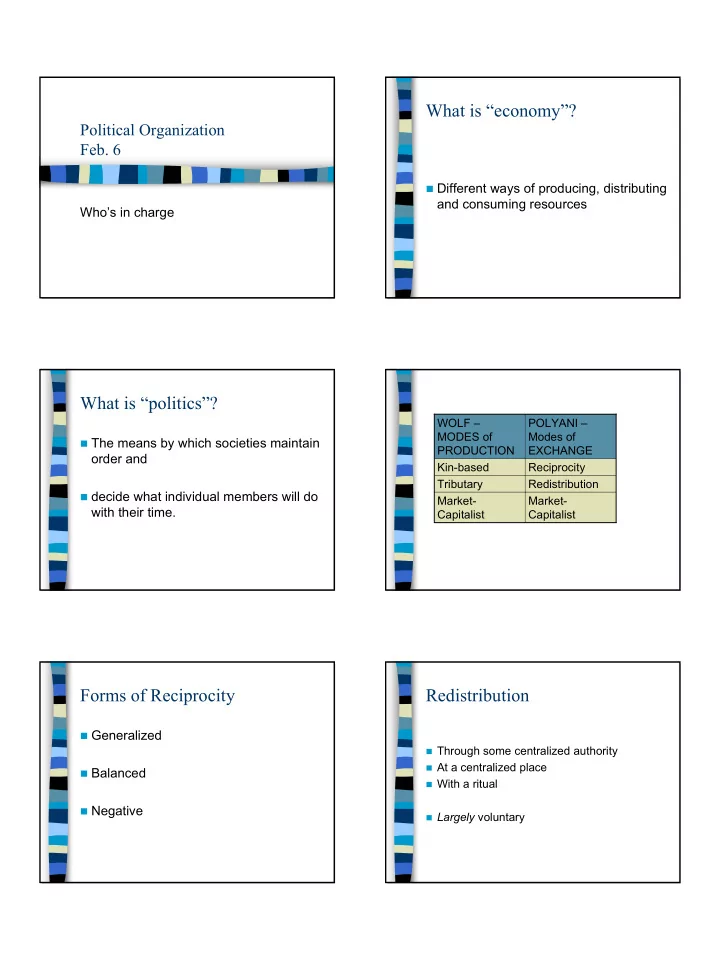
What is “economy”?

Different ways of producing, distributing

and consuming resources

What is “politics”?

The means by which societies maintain

  • rder and

decide what individual members will do

with their time.

Market- Capitalist Market- Capitalist Redistribution Tributary Reciprocity Kin-based POLYANI – Modes of EXCHANGE WOLF – MODES of PRODUCTION

Forms of Reciprocity

Generalized Balanced Negative

Redistribution

Through some centralized authority At a centralized place With a ritual Largely voluntary

slide-2
SLIDE 2

2

Political Organization

Bands Egalitarian Foragers Horticulturalists Pastoralists Tribes Ranked Chiefdoms Agriculture States Stratified Market Capitalist Industrial

Egalitarian Societies:

Equal access to strategic resources. Fairly equal distribution of resources. As many positions of prestige as people

capable of filling them.

Prestige achieved through acts of generosity. Usually foraging. Generally little commitment to private space

  • r private property.

About 97% of human history.

How do you keep the peace?

No personal property No restricted access to productive

resources

And yet…

– Disputes happen. But over what?

Diffusing tension

Song duels Killing Exile

Ranked Societies:

Equal access to strategic resources Unequal access to positions of prestige.

Those positions are gained through skill and

  • generosity. These are positions of

responsibility in the community (often to suggest resolutions to conflicts or issues), but not one of having power over others or gaining increased access to material goods.

Often have strict social boundaries Usually have some forms of private property

slide-3
SLIDE 3

3 The “Big Man” (bigger than a village head)

“His” tools

example Persuasion Generosity Convinces followers to give tribute Big Men cap regional political

  • rganizations

Some longer-term stability

Other Big Men… Stratified Societies:

Unequal access to strategic resources. Unequal access to positions of prestige and

power.

Strict boundaries/control/often with strict

social control.

Private property is widespread. Conflicts often are resolved by outside

authority.

Have only existed in the last few thousand

years of human existence.

What is “the state?”

Autonomous political unit Encompasses many communities Central government and stratification Divided society: classes Industrial/non-industrial

The link to economy?

Storable surplusses!

slide-4
SLIDE 4

4

For example… Quiz 5

Name the 3 forms of social/political

  • rganization.

T/F In a ranked society there is no private

property.

T/F Big Men appear in egalitarian societies. T/F The forms of political organization are

mutually exclusive.

Name one way in which economic

  • rganization is linked to political organization
  • f complex societies.