
SLIDE 1
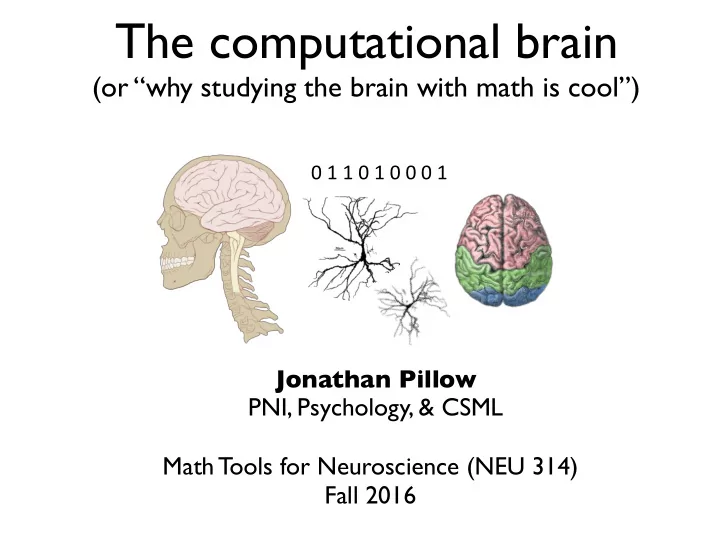
The computational brain
(or “why studying the brain with math is cool”)
Jonathan Pillow PNI, Psychology, & CSML
+&'&'&+&'&+&+&+&'&
Math Tools for Neuroscience (NEU 314) Fall 2016
What is computational neuroscience? 1. Use of - - PowerPoint PPT Presentation
The computational brain (or why studying the brain with math is cool) +&'&'&+&'&+&+&+&'& Jonathan Pillow PNI, Psychology, & CSML Math Tools for Neuroscience (NEU 314) Fall 2016 What is
Jonathan Pillow PNI, Psychology, & CSML
+&'&'&+&'&+&+&+&'&
Math Tools for Neuroscience (NEU 314) Fall 2016
computing relevant outputs
“The brain computes! This is accepted as a truism by the majority of neuroscientists engaged in discovering the principles employed in the design and operation of nervous
incoming sensory data, encodes them into various biophysical variables, such as the membrane potential or neuronal firing rates, and subsequently performs a very large number of ill-specified operations, frequently termed computations, on these variables to extract relevant features from the input. The outcome of some of these computations can be stored for later access and will, ultimately, control the motor output of the animal in appropriate ways.”
Brain Sensory Input Motor Output
they represent steps in a formal calculation.
would have the same “mind properties” as a brain.
Brain Sensory Input Motor Output
photoreceptors bipolar cells retinal ganglion cells
the retina detect light
(send all visual information to the brain) to brain!
photoreceptors bipolar cells retinal ganglion cells
Difference of light in “center” and light in the “surround”
what mathematical
photoreceptors bipolar cells retinal ganglion cells
Difference of light in “center” and light in the “surround”
lots of spikes!
photoreceptors bipolar cells retinal ganglion cells
Difference of light in “center” and light in the “surround”
few spikes
photoreceptors bipolar cells retinal ganglion cells
Difference of light in “center” and light in the “surround”
more spikes
sequences of spikes?
spikes stimulus
“encoding function”
Beau Lotto
Beau Lotto
prolonged exposure to an image
(using a “different computer” to encode auditory signals)
microphone transmitter receiver cochlea electrode array t
r a i n
If we understand the mathematical operations carried out by different parts of the brain, we could (in theory) replace them with new parts that perform the same computations!
Brain Sensory Input Motor Output
10 microns
There are about 10 billion cubes of this size in your brain!
allowing us to gain a deep understanding of neural data and neural information processing capabilities
(including chaos theory)