What is an Opportunity Zone? A census tract designated by each state - - PDF document

what is an opportunity zone
SMART_READER_LITE
LIVE PREVIEW

What is an Opportunity Zone? A census tract designated by each state - - PDF document

What is an Opportunity Zone? A census tract designated by each state or territory and certified by Treasury as eligible to receive private investments via Qualified Opportunity Funds. Meets definition of a low-income community (LIC),


slide-1
SLIDE 1

2018 Milken Institute Hamptons Dialogues Opportunity Zones & US Housing Policy 1

What is an Opportunity Zone?

  • A census tract designated by each state or territory and

certified by Treasury as eligible to receive private investments via Qualified Opportunity Funds.

  • Meets definition of a “low-income community” (LIC), or …
  • Contiguous to a LIC and with a median family income that

doesn’t exceed 125% of the LIC.

  • 10-year designation as an Opportunity Zone.
  • More than 8,700 Opportunity Zones have been designated in

the 50 U.S. states, the District of Columbia and five U.S. territories.

Source: Milken Institute

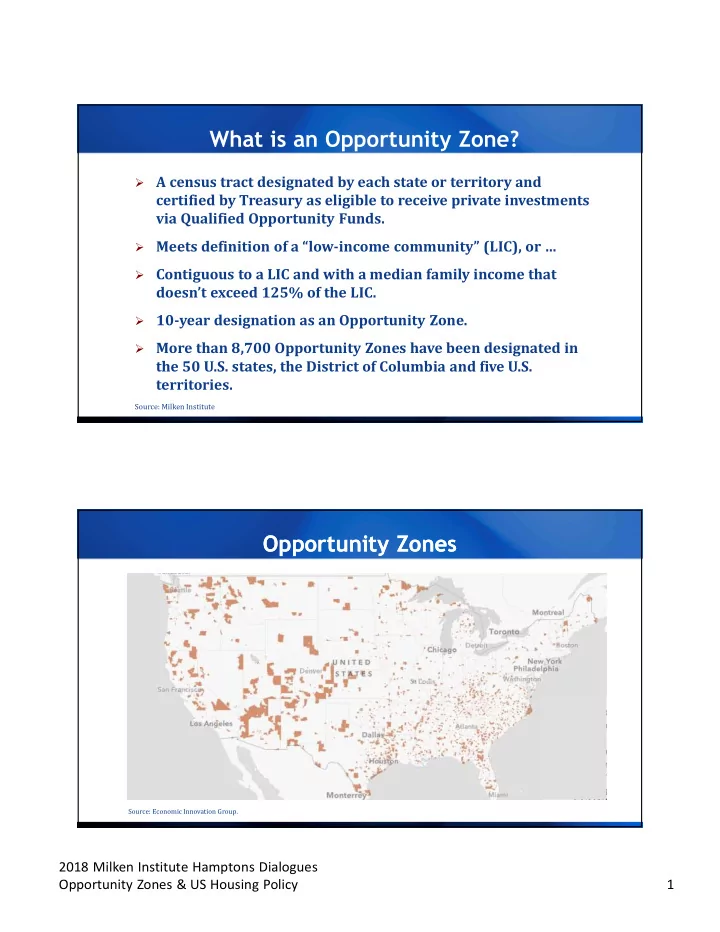
Source: Economic Innovation Group.

Opportunity Zones Opportunity Zones

slide-2
SLIDE 2

2018 Milken Institute Hamptons Dialogues Opportunity Zones & US Housing Policy 2

What is a Qualified Opportunity Fund? What is a Qualified Opportunity Fund?

  • An investment vehicle set up as a partnership or corporation to

invest in eligible property located in an Opportunity Zone.

  • Qualified Opportunity Funds are funded by realized capital

gains and must deploy 90% of capital into Opportunity Zones.

  • Eligible investments include real estate and operating

companies, although real estate investments are subject to improvement tests (100% of basis).

  • Qualified Opportunity Funds must self-certify they meet all

rules; forms expected 1Q2019. IRS revenue guidance pending.

How do the Tax benefits work? How do the Tax benefits work?

  • Opportunity Funds may provide potential Federal tax

incentives to investors (1,2,3)

  • A temporary capital gains tax deferral for all newly

realized capital gains reinvested in an Opportunity Fund, lasting until the investment is sold or December 31, 2026, whichever is sooner.

  • A 10% basis adjustment on the original capital gains,

which can result in tax reductions if the Opportunity Fund investment is held for 5+ years; plus an additional 5% adjustment if the investment is held for 7+ years.

  • If an investor holds the Opportunity Fund investment

for 10+ years, the investor may permanently avoid capital gains taxes on any proceeds from the Opportunity Fund investment itself.

1 Milken Institute does not provide investment advice and any information contained in this document is for informational purposes only and does not constitute financial, accounting, or legal advice. 2 IRS Revenue Guidelines are required for clarification and have yet to be released 3 For a more detailed explanation of Opportunity Zones and Qualified Opportunity Funds, please visit: irs.gov and cdfifund.gov. 4 Kosmont Companies proprietary graphic

Realized capital gain

2018

2019 2020

2023 2026

2027

2028

2022 2021 2024

2025

Investment Made into Opportunity Fund Basis increased by 10% on

  • riginal gain

Deferred Fed Tax

  • n original gain

due by 12/31/26 Basis increased by 5% on

  • riginal gain

Basis is adjusted to equal Fair Market Value. No tax on Opportunity Fund appreciation

Timeline of tax benefits (4)
slide-3
SLIDE 3

2018 Milken Institute Hamptons Dialogues Opportunity Zones & US Housing Policy 3

Why Reno?

Source: Economic Development Authority of Western Nevada

Reno/Sparks Opportunity Zones

  • 1-day truck drive to

more than 60,000 customers and five 5 U.S. ports serving the Pacific Rim.

  • 2-day truck drive to 10

large metros.

Hub to the Western United States

slide-4
SLIDE 4

2018 Milken Institute Hamptons Dialogues Opportunity Zones & US Housing Policy 4

Reno to Palo Alto

Blackbird … is looking at launching a round-trip flight between Reno and Palo Alto, Calif., to better connect the Biggest Little City’s growing technology sector with the center of the tech industry.

Source: Reno Gazette Journal, March 2018

“Any loan to real estate is a good loan … ”

Fallacy Fallacy

slide-5
SLIDE 5

2018 Milken Institute Hamptons Dialogues Opportunity Zones & US Housing Policy 5

Federal Spending Priorities Federal Spending Priorities

FDA CDC NIH Education Housing Subsidies

$0 $100 $200 $300

Sources: FDA, CDC, NIH, DOE, and Office of Management and Budget. Note: FY 2018. Education reflects total DOE budget. Housing subsidies reflect estimated forgone tax revenues from deductions for imputed rent, mortgage interest and property taxes.

Annual, in $ billions

(forgone tax revenue)

Fannie Mae and Freddie Mac Housing Loans

  • 60%
  • 40%
  • 20%

0% 20% 40% 60% 80% 100% 120% 2007 2008 2009 2010 2011 2012 2013 2014 2015 2016 2017

Growth since 2007

Multifamily Single family

Source: Federal Housing Finance Agency.

slide-6
SLIDE 6

2018 Milken Institute Hamptons Dialogues Opportunity Zones & US Housing Policy 6

Housing Loan Payments

0% 10% 20% 30% 40% 50% 60% 70% 80% 90% 2008 2009 2010 2011 2012 2013 2014 2015 2016 2017 2018

Partial interest-only Interest-only

Source: Federal Housing Finance Agency.

Change in U.S. Home Ownership

Note: Lowest value was 2Q 2016 at 62.9%. Source: U.S. Census Bureau 4Q 2017.

1980

65.6%

2017

64.3%

Bottomed out in 2016 at 62.9%, the lowest since 1985.

slide-7
SLIDE 7

2018 Milken Institute Hamptons Dialogues Opportunity Zones & US Housing Policy 7

Home Ownership Rates Home Ownership Rates

45% 50% 55% 60% 65% 70%

Canada France U.S. U.K. Denmark Japan Germany

Sources: EuroStat, Statistics Bureau of Japan, Statistics Canada, U.S. Census Bureau. Note: Latest data available as of 3/1/2018; based on latest census.

Mortgages Guaranteed by the Government

Source: Federal Reserve.

1980

$13B 7%

2018

$7.3T 49%

slide-8
SLIDE 8

2018 Milken Institute Hamptons Dialogues Opportunity Zones & US Housing Policy 8

Value of the Housing Market Value of the Housing Market Recipe for a Future Housing Crisis?

Sources: Urban Institute Housing Finance Chartbook July 2018; AEI’s Center on Housing Markets and Finance.

Delinquencies/Foreclosures Delinquencies/Foreclosures Decline … but Debt-to-Income Ratios Rise

Agency/Government Loans

slide-9
SLIDE 9

2018 Milken Institute Hamptons Dialogues Opportunity Zones & US Housing Policy 9

Home Price Increases From 2011 to June 2017

Source: Case-Shiller HPI, June 2017

Lowest-tier housing has the largest price increase

Investment-Grade Securities

Source: Bloomberg 11/6/08

Standard & Poor’s Ratings

New Issues: 1/1/2000 to 9/30/2008

AAA 16,907 AA+ 240 AA 2,098 AA- 3,414 A 2,602 A- 2,027 BBB+ 903 BBB 1,371 BBB- 1,359

Non-investment Grade Securities

BB+ 238 BB 313 BB- 331 B+ 339 B 330 B- 1,189 CCC+ 293 CCC 214 CCC- 104 CC 36 C 11

slide-10
SLIDE 10

2018 Milken Institute Hamptons Dialogues Opportunity Zones & US Housing Policy 10

Mortgage bonds Mortgage loans High-grade structured-finance CDO Mezzanine structured-finance CDO CDO-Squared

Source: International Monetary Fund.

When is a AAA not a AAA?

AAA 80% AA 11% A 4% BBB 6% BB-Unrated 3% Senior AAA 88% Junior AA 5% AA 3% A 2% BBB 1% Unrated 1% Senior AAA 62% Junior AA 14% AA 8% A 6% BBB 6% Unrated 4% Senior AAA 60% Junior AA 27% AA 4% A 3% BBB 3% Unrated 2%

Sources: IHS Global Insight, Corelogic, Milken Institute, 3/1/2018.

Home Prices Don’t Go Up Forever

WWI WWII Great Depression 70’s Boom 80’s Boom Last Boom

Change in home prices in 128 years

  • 20%
  • 15%
  • 10%
  • 5%

0% 5% 10% 15% 20% 25% 30%

1890 1906 1922 1938 1954 1970 1986 2002 2018

slide-11
SLIDE 11

2018 Milken Institute Hamptons Dialogues Opportunity Zones & US Housing Policy 11

33% Housing 18% Transportation 13% Food 11% Insurance/pensions 6% Healthcare 5% Entertainment 4% Apparel and services 23% Food 10% Housing 8% Clothing 8% Other 6% Transportation 5% Healthcare 5% Communication

Consumer Spending

Source: U.S. Bureau of Labor Statistics/CLSA

U.S. Asia

2% Supplemental Education 15% Supplemental Education

  • If prices rise, the borrower keeps the gain.
  • If prices fall, the borrower can walk,

sticking the lender with a long-term depreciating asset.

  • If interest rates rise, the value of the loan

depreciates as the “real” average life of the asset is extended.

  • If interest rates fall, the borrower prepays.

When Lenders Make Non-Recourse Loans

Heads they lose — Tails they lose

slide-12
SLIDE 12

2018 Milken Institute Hamptons Dialogues Opportunity Zones & US Housing Policy 12

“The no-recourse mortgage is virtually unique to the United States. That’s why falling house prices in Europe do not trigger defaults. The creditors’ ability to go beyond the house to other assets or even future salary is a deterrent.”

  • Martin Feldstein

U.S. Economist

  • Degradation of environment
  • Divorce
  • Spousal abuse
  • Drug abuse
  • Alcoholism
  • Hypertension
  • Depression

Social Effects of Overly Large Houses

slide-13
SLIDE 13

2018 Milken Institute Hamptons Dialogues Opportunity Zones & US Housing Policy 13

“It was OK to lend money to build a building, but it wasn’t OK to lend money to any company that would hire a person to work in the building.”

Neutron Legislation - Late 1980s

1780s Weak state currencies Constitution/Commerce Clause 1830s-1850s Wildcat state banking National currency/Banking acts 1893 Stock market panic Bankruptcy Act 1907 Run on trust companies Federal Reserve Act 1929-1933 Market crash Securities & Exchange Act 1930-1933 Bank failures Glass-Steagall Act, FDIC, New Deal 1970s Commodities speculation CFTC 1970-90s Employment insecurity ERISA, COBRA, HIPAA 1987 S&L Crisis FIRREA 2002 Dot.com/Enron/etc. Sarbanes-Oxley 2008 Great Recession Dodd-Frank

Period

Examples of Regulation Following Volatility

Volatility Regulation

slide-14
SLIDE 14

2018 Milken Institute Hamptons Dialogues Opportunity Zones & US Housing Policy 14

Pages in the Code of Federal Regulations

60,000 80,000 100,000 120,000 140,000 160,000 180,000 1975 1983 1991 1999 2007 2015

Source: Georg Washington University Regulatory Studies Center, 2015.

More than 2,000 pages… 6 pages … longer than the Torah, Bible and Quran COMBINED!

Regulation Complexity