What is a Meaningful Life? What is a Meaningful Life? The purpose - - PDF document

what is a meaningful life what is a meaningful life the
SMART_READER_LITE
LIVE PREVIEW

What is a Meaningful Life? What is a Meaningful Life? The purpose - - PDF document

What is a Meaningful Life? What is a Meaningful Life? The purpose of life, after all, is to live it, to taste experience to the utmost, to reach out eagerly and without fear for newer and richer experience. Eleanor Roosevelt What


slide-1
SLIDE 1

2018 Milken Institute Hamptons Dialogues Building a Stronger Future 1

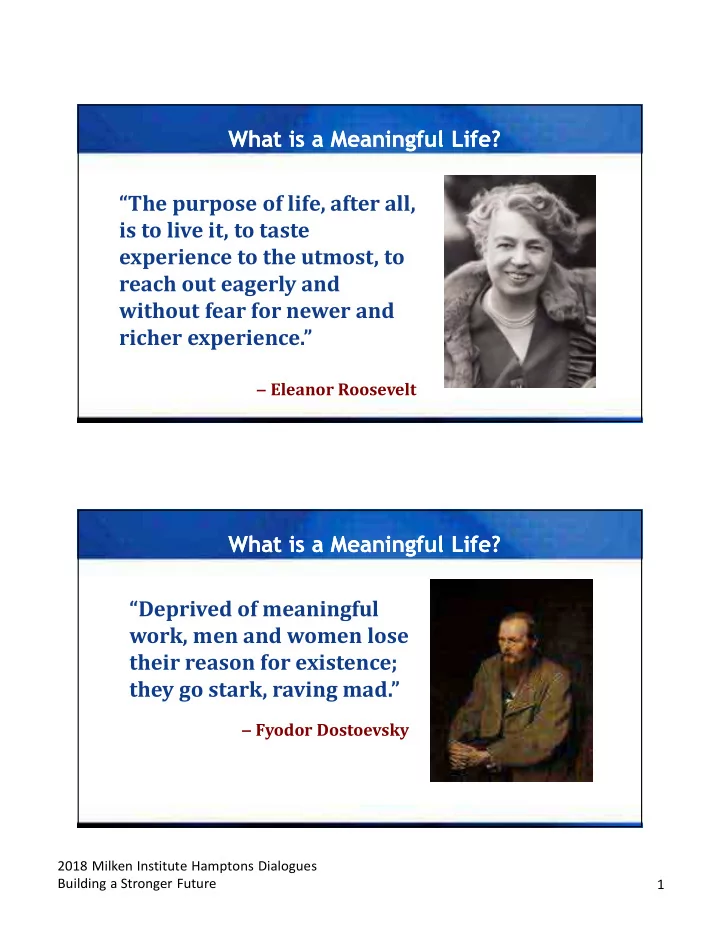
What is a Meaningful Life? What is a Meaningful Life? “The purpose of life, after all, is to live it, to taste experience to the utmost, to reach out eagerly and without fear for newer and richer experience.”

‒ Eleanor Roosevelt

What is a Meaningful Life? What is a Meaningful Life? “Deprived of meaningful work, men and women lose their reason for existence; they go stark, raving mad.”

‒ Fyodor Dostoevsky

slide-2
SLIDE 2

2018 Milken Institute Hamptons Dialogues Building a Stronger Future 2

P = Prosperity Ft = Financial Technology HC = Human Capital SC = Social Capital RA = Real Assets

P=SFti*(SHCi+SSCi+SRAi) P=SFti*(SHCi+SSCi+SRAi)

Human Capital Social Capital Real Assets

Productivity:

  • Skills
  • Education
  • Training
  • Experience
  • Creativity
  • Habits
  • Values
  • Health
  • Rule of law
  • Property rights
  • Public health
  • Universal education
  • Religious freedom
  • Police/fire protection
  • Cultural resources
  • Universal suffrage
  • Protection of creditors
  • Rigorous financial

reporting standards

  • Transparent markets
  • Regulatory continuity
  • Cash
  • Receivables
  • Real estate
  • Factories
  • Capital

equipment

  • Roads
  • Buildings
  • Infrastructure

Financial Technology

Innovative processes & components including:

  • Convertible bonds
  • Preferred stock
  • High-yield bonds
  • Collateralized loans
  • Collateralized bonds
  • Equity-linked

securities

  • Securitized obligations

(mortgages, credit cards, etc.)

  • Derivatives
slide-3
SLIDE 3

2018 Milken Institute Hamptons Dialogues Building a Stronger Future 3

  • Collateralized loan obligations
  • Collateralized bond obligations
  • Securitized mortgages
  • Securitized credit cards
  • Derivatives
  • Convertible bonds
  • Preferred stock
  • High-yield bonds

Financial Technologies

U.S. and Fortune 500 Employment

America Goes to Work

60 80 100 120 140 160 180 1970 1975 1980 1985 1990 1995 2000

Modern capital markets begin New financial technologies are fully implemented U.S. = + 62 million jobs Fortune 500 = minus 4 million

Source: Bureau of Labor Statistics, Bloomberg, Thomson Reuters.

slide-4
SLIDE 4

2018 Milken Institute Hamptons Dialogues Building a Stronger Future 4

  • Almost 50% of private U.S. GDP
  • 99.7% of all employers
  • 48% of private-sector workers
  • 58% of high-tech workers
  • 1.9 million of net new jobs
  • $3.3 trillion+ in annual payroll

Source: Small Business Administration (Statistics of U.S. Businesses/2015); U.S. Census; US Bureau of Labor Statistics

U.S. small businesses represent … U.S. small businesses represent …

The 21st century is being defined by a worldwide competition for human capital.

slide-5
SLIDE 5

2018 Milken Institute Hamptons Dialogues Building a Stronger Future 5

Human capital is the largest asset class.

“To most of you, capital means a bank account, stock certificates or factories. “I’m talking about a different kind of

  • capital. Schooling, a computer training

course, expenditures on medical care and lectures on the virtues of punctuality and honesty are capital too.”

Gary Becker, 1992 Nobel Prize in Economics

Human Capital Human Capital

slide-6
SLIDE 6

2018 Milken Institute Hamptons Dialogues Building a Stronger Future 6

  • Immigration
  • Health
  • Education

Three Ways to Build Human Capital “They’re taking our jobs.”

Black migration to the north Chinese railroad workers European immigrants Mexican “braceros” Vietnamese shrimpers Today

slide-7
SLIDE 7

2018 Milken Institute Hamptons Dialogues Building a Stronger Future 7

Immigrants Seek Strong Social Capital

Throughout history, people have sought to live in nations that provide the freedoms that come with vibrant social capital – especially the Rule of Law. In the 19th century, 50 million Europeans emigrated to America.

Where U.S. Immigrants Were Born

Asia 5% Latin America 9% Canada 10% Europe 75% Other 1%

Sources: Migration Policy Institute, U.S. Census, United Nations Population Division, 2015 Note: 2015 figures sum to 101% due to rounding.

1960 Today

Asia 28% Latin America 54% Canada 2% Europe 12% Other 5%

slide-8
SLIDE 8

2018 Milken Institute Hamptons Dialogues Building a Stronger Future 8

60% of Chinese people with assets exceeding $1.6 million are thinking about emigrating to the U.S. or Europe.

Source: U.S. Department of Homeland Security (WSJ 2/22/12 “Plan B for China’s Wealthy: Moving to the U.S./Europe) Sources: Bret Stephens, New York Times, Four Questions About American Greatness, Dec. 7, 2017

  • 35% of all U.S. Nobel Prize winners are immigrants.
  • 83% of finalists in the 2016 Intel Science Talent search were

children of immigrants.

  • 40% of Fortune 500 company founders were immigrants or

children of immigrants.

  • Immigrants start businesses at twice the rate of other Americans.
  • Incarceration rate of immigrants is nearly half of U.S. citizens.
  • Without immigrants, the U.S. has had no population growth since

1970.

Immigration Facts

slide-9
SLIDE 9

2018 Milken Institute Hamptons Dialogues Building a Stronger Future 9

Sources: Partnership for a New American Economy

Foreign-born scientists in the U.S. are listed among the inventors on…

  • More than five out of six information-technology

patents

  • Almost eight out of 10 pharmaceutical drug patents
  • Three out of four patents in molecular biology and

microbiology.

Immigrant Inventors Each life is priceless… but in economic terms, over the past two centuries, as much as 50% of all economic growth can be traced to advances in health.

The Value of Health The Value of Health

slide-10
SLIDE 10

2018 Milken Institute Hamptons Dialogues Building a Stronger Future 10

Worldwide Life Expectancy Four million years produced an 11-year increase from 20 to 31.

31 72 1900 2018

118 years produced a 41- year increase.

James Carey: Longevity; United Nations Development Program

  • Chicken pox
  • Diphtheria
  • H. influenza-caused

invasive diseases

  • Measles
  • Pertussis
  • Pneumococcal disease
  • Polio
  • Tetanus
  • Typhoid fever
  • Yellow fever
  • Smallpox

Source: Discovery Fit & Health

Some Major Diseases Now Mostly Controlled Some Major Diseases Now Mostly Controlled

slide-11
SLIDE 11

2018 Milken Institute Hamptons Dialogues Building a Stronger Future 11

  • Vastly improved sanitation
  • Development of antibiotics
  • Implementation of vaccines
  • Progress against heart disease
  • Investment in bioscience research

What caused the increase?

We have entered a new Age of Medicine.

  • Immunology
  • Precision medicine
  • Genomics
  • Powerful diagnostic tools
slide-12
SLIDE 12

2018 Milken Institute Hamptons Dialogues Building a Stronger Future 12

  • Two highly skilled pathologists

assessing the same slide will agree

  • nly about 60% of the time.
  • Machine-learning predicted patient

survival times better than the standard practice of pathologists.

Source: Stanford University School of Medicine

Pathologist vs. Computer ROI of Young Investigators

Percentage of Epilepsy MFF Grant Researchers Still Active

Young Investigator Awards

100%

Mid-Level Career Awards

75%

Late-Stage Career Awards

7%

Source: Philanthropy Advisory Service, Milken Institute

slide-13
SLIDE 13

2018 Milken Institute Hamptons Dialogues Building a Stronger Future 13

Impact of PCF Young Investigators Impact of PCF Young Investigators

10 FDA-approved treatments for prostate cancer since 2010.

  • Provenge: stimulates tumor immunity
  • Xgeva: improves quality of life by reducing side effects
  • Jevtana: chemotherapy that kills prostate cancer cells
  • Zytiga: reduces testosterone, resulting in longer life
  • Xtandi: blocks testosterone’s cancer targets and prolongs life
  • Xofigo: results in less medication to control bone pain
  • Erleada: treatment for those who fail testosterone reduction
  • Zytiga + Prednisone: delays cancer progression by 18 months
  • Pembrolizumab: precision immunotherapy for solid tumors
  • Xtandi: secondary approval for non-metastatic CRPC

Return

Job Training Preschool Programs School

Return on Human Capital Investment

Source: James Heckman, University of Chicago

Age

slide-14
SLIDE 14

2018 Milken Institute Hamptons Dialogues Building a Stronger Future 14

“By age 5, it is possible to predict with depressing accuracy who will complete high school and who won’t.”

James Heckman

Nobel Prize in Economics

Source: New York Times – July 29, 2008

$2,255

Source: IMF Outlook (9/28/17).

Do human capital strategies work?

Per Capita GDP

1960

$2,271

Singapore Jamaica

$5,017

2017

$51,431

slide-15
SLIDE 15

2018 Milken Institute Hamptons Dialogues Building a Stronger Future 15

Sources: City-Data.com / Global Report Card (Jay Greene and Josh McGee)

87.7%

rank “proficient”

  • r above in math.

students

Beverly Hills High School

Singapore 34th percentile in math Canada 46th percentile in math Canada

Program at Berkeley, Columbia, USC and Wharton designed to create productive partnerships within their communities.

University-Community Outreach Program ((UCOP)

  • Mentoring
  • Scholarships
  • Young Entrepreneurs
  • Tutoring
  • Community workshops
  • Assistance to local businesses
slide-16
SLIDE 16

2018 Milken Institute Hamptons Dialogues Building a Stronger Future 16

Trends Shaping the World

Demographics

Dependency Ratios Dependency Ratios

Source: Economist, European Commission

20 40 60 80 India China WORLD Russia United States Poland Spain Sweden Italy Germany Japan 2050 2010

Number of people 65 and

  • ver as a

percentage of the labor force

slide-17
SLIDE 17

2018 Milken Institute Hamptons Dialogues Building a Stronger Future 17

THERE WILL BE 1 BILLION PEOPLE

WORLDWIDE OVER THE AGE OF 60 NEXT YEAR AND MORE THAN 2 BILLION BY 2050

THERE WILL BE 1 BILLION PEOPLE

WORLDWIDE OVER THE AGE OF 60 NEXT YEAR AND MORE THAN 2 BILLION BY 2050

Source: The United Nations.

GLOBAL PORTION OF THE POPULATION 60+

Sources: UNDESA Population Division, HelpAge.

slide-18
SLIDE 18

2018 Milken Institute Hamptons Dialogues Building a Stronger Future 18

3.1 4.9 9 16.6 25.5 35 43.1 56 79.7 92

10 20 30 40 50 60 70 80 90 100 1900 1920 1940 1960 1980 2000 2012 2020 2040 2060

U.S. POPULATION 65+ (IN MILLIONS)

Sources: United States Census Bureau, United States Department of Health and Human Services.

Spending power of 60+ global consumers will be $15 trillion+ by 2020

Source: Bank of America Merrill Lynch

slide-19
SLIDE 19

2018 Milken Institute Hamptons Dialogues Building a Stronger Future 19

83 percent of US household wealth is held by people 50+

Source: AARP.

Source: The Scan Foundation.

7 in 10

70% OF PEOPLE AGE 65+

WILL NEED LONG-TERM CARE

slide-20
SLIDE 20

2018 Milken Institute Hamptons Dialogues Building a Stronger Future 20

U.S. Birth Rates Per 1,000 Women U.S. Birth Rates Per 1,000 Women

Early 1950s: 200 Today: 60

U.S. Birth Rates U.S. Birth Rates

  • U.S. birth rate of 60.2 per 1,000 women

(ages 15-44) is the lowest ever recorded.

  • Total number of U.S. births = 3.85 million,

the lowest in 30 years … despite a substantial population increase.

  • 40% of women who gave birth were not

married.

slide-21
SLIDE 21

2018 Milken Institute Hamptons Dialogues Building a Stronger Future 21

Highest and Lowest U.S. Fertility Rates Highest and Lowest U.S. Fertility Rates

Source: Jeremy Carl, Hoover Institution, May 2018

Lowest fertility rates:

  • 41. Pennsylvania (1.72)
  • 42. Colorado
  • 43. New York
  • 44. Oregon
  • 45. Maine
  • 46. Connecticut
  • 47. New Hampshire
  • 48. Vermont
  • 49. Massachusetts
  • 50. Rhode Island (1.54)

Highest fertility rates:

  • 1. South Dakota (2.26)
  • 2. Utah
  • 3. North Dakota
  • 4. Alaska
  • 5. Nebraska
  • 6. Idaho
  • 7. Texas
  • 8. Kansas
  • 9. Iowa
  • 10. Oklahoma (1.98)
  • 42. Colorado
  • 42. Colorado
  • 43. New York
  • 44. Oregon
  • 44. Oregon
  • 45. Maine
  • 46. Connecticut
  • 47. New Hampshire
  • 47. New Hampshire
  • 48. Vermont
  • 49. Massachusetts
  • 49. Massachusetts
  • 49. Massachusetts
  • 50. Rhode Island (1.54)
  • 1. South Dakota (2.26)
  • 2. Utah
  • 2. Utah
  • 3. North Dakota
  • 4. Alaska
  • 5. Nebraska
  • 6. Idaho
  • 7. Texas
  • 7. Texas
  • 8. Kansas
  • 9. Iowa
  • 9. Iowa
  • 9. Iowa
  • 10. Oklahoma (1.98)
  • 41. Pennsylvania (1.72)

Global Fertility Rate Global Fertility Rate

Source: World Bank data posted by Bloomberg, March 16, 2018

Children per woman

slide-22
SLIDE 22

2018 Milken Institute Hamptons Dialogues Building a Stronger Future 22

From 6 Children per Woman to 3 From 6 Children per Woman to 3

United Kingdom 95 years (1815-1910) United States 82 years (1844-1926) Bangladesh 20 years (1982-2002) China 11 years (1967-1978) Iran 10 years (1986-1996)

Sources: Ourworldindata.org; World Bank

1.84 1.76 2.14 1.57 1.68

Births/woman 2016

Replacement rate is 2.1 per woman.

The EU … in 1951 The EU … in 1951

Source: Jeremy Carl, Hoover Institution, May 2018

Belgium France Germany Italy Luxembourg Netherlands United Kingdom European Union

32 children among their leaders

=

slide-23
SLIDE 23

2018 Milken Institute Hamptons Dialogues Building a Stronger Future 23

Today Today

Source: Jeremy Carl, Hoover Institution, May 2018

Belgium

Charles Michel, 2 kids!

France

Emmanuel Macron, No kids

Germany

Angela Merkel, No kids

Italy

Paolo Gentiloni, No kids

Luxembourg

Xavier Bettel, No kids

Netherlands

Mark Rutte, No kids

United Kingdom European Union

Theresa May, No kids Jean-Claude Juncker, No kids

States with Majority “Minority” Toddler Populations

Sources: Brookings Institution (analysis of Census Bureau Population Estimates/2013); GSV

6.

Nevada 36.9%

7.

Arizona 39.1%

8.

Maryland 42.2%

9.

Florida 42.8%

  • 10. Georgia

43.1% Population Under Age 5 with European Ancestry

1.

Hawaii 15.2%

2.

New Mexico 24.9%

3.

California 25.1%

4.

Washington, D.C. 27.1%

5.

Texas 31.1%

slide-24
SLIDE 24

2018 Milken Institute Hamptons Dialogues Building a Stronger Future 24

Home in (Southern) California Home in (Southern) California

Source: U.S. Census Bureau; statistica.com; migrationpolicy.org

  • Armenian (Los Angeles)
  • Chinese (NYC is largest metro)
  • Filipino (Los Angeles)
  • Guatemalan (Los Angeles)
  • Indian (NYC is largest metro)
  • Indonesian (Los Angeles)

Nationalities whose largest U.S. populations are in California (and their most-populated metro region):

  • Japanese (Los Angeles)
  • Korean (Los Angeles)
  • Mexican (Los Angeles)
  • Salvadoran (Los Angeles)
  • Taiwanese (Los Angeles)
  • Vietnamese (Los Angeles)

Source: United Nations. Note: Latin America includes the Caribbean, dashed values are projected.

21st Century Population Growth Will Be in Africa

1,000 2,000 3,000 4,000 5,000 6,000 1950 1960 1970 1980 1990 2000 2010 2020 2030 2040 2050 2060 2070 2080 2090 2100 Millions

Africa Latin America Europe North America

Asia

slide-25
SLIDE 25

2018 Milken Institute Hamptons Dialogues Building a Stronger Future 25

  • Equips young professionals from developing economies

with tools/experience to develop capital markets in their countries.

  • Inaugural 2016 class comprises 18 members from sub-

Saharan Africa and India.

  • Active alumni network will foster next generation of

leaders.

IFC-Milken Institute Capital Markets Program

Class of 2017-2018

slide-26
SLIDE 26

2018 Milken Institute Hamptons Dialogues Building a Stronger Future 26

The Silk Road One Belt One Road Initiative

Source: CQS analysis; Brookings ‘The Unprecedented Promises – and Threats – of the Belt and Road Initiative as at 28 April 2017; KraneShares

  • 65 states
  • 4.4 billion

people

  • 29% of world

GDP

slide-27
SLIDE 27

2018 Milken Institute Hamptons Dialogues Building a Stronger Future 27

The Pan American Highway

Canada south to Chile and Argentina Populations

(millions)

North America: 356 Central America: 172 South America: 416

Trends Shaping the World

Governance

slide-28
SLIDE 28

2018 Milken Institute Hamptons Dialogues Building a Stronger Future 28

Gallup Poll: Capitalism vs. Socialism Gallup Poll: Capitalism vs. Socialism

Source: Gallup Poll, August 13, 2018

Democrats

  • 47% have a positive attitude

toward capitalism

  • 57% have a positive outlook
  • f socialism

Republicans

  • 71% have a positive attitude

toward capitalism

  • 16% have a positive outlook
  • f socialism

Millennials: Capitalism vs. Socialism Millennials: Capitalism vs. Socialism

Source: YouGov/Victims of Communism Memorial Foundation study, Sacramento Bee, 11/4/2017

More Millennials would prefer to live in a socialist country (44%) than in a capitalist one (42%). 7% said they would prefer to live in a communist country.

  • 59% of U.S. adults prefer a capitalist country than a

socialist one.

  • 26% of Baby Boomers would want to live in a

socialist nation.

slide-29
SLIDE 29

2018 Milken Institute Hamptons Dialogues Building a Stronger Future 29

  • Universal suffrage
  • Rule of law
  • Education and health care
  • Police and fire protection
  • Religious freedom
  • Cultural resources
  • Property rights
  • Protection of creditors
  • Financial reporting standards

Examples of Social Capital

slide-30
SLIDE 30

2018 Milken Institute Hamptons Dialogues Building a Stronger Future 30 “The U.S. is the only nation where

  • rdinary citizens are permitted

to own the undiscovered minerals beneath their farms and woodlands. “It should thus be no surprise that … five of every six holes drilled on Earth in search of petroleum or natural gas have been drilled here.”

  • Jude Wanniski

Portraits of the American Dream

  • Nationalize foreign and domestic companies
  • Confiscate property, savings and retirement funds
  • Default on debt repeatedly
  • Inflate currency (but understate inflation)
  • Take IMF loans, then bar their auditors
  • Censor media and independent economists
  • Ban currency conversion

[There’s more …]

Argentina: How to Destroy Social Capital Argentina: How to Destroy Social Capital

slide-31
SLIDE 31

2018 Milken Institute Hamptons Dialogues Building a Stronger Future 31

  • Protect inefficient industries with tariffs
  • Regulate entrepreneurs out of business
  • Impose price controls
  • Restrict land purchases by foreigners
  • Abrogate contracts
  • Ban foreign books with “too much lead” in ink
  • Reward government cronies
  • Ignore official corruption
  • Alleged cover-up death of prominent government critic

Argentina: How to Destroy Social Capital Argentina: How to Destroy Social Capital

“Every day we wake up and there's a different law.”

— Buenos Aires resident

Source: Reuters

Argentina: How to Destroy Social Capital Argentina: How to Destroy Social Capital

slide-32
SLIDE 32

2018 Milken Institute Hamptons Dialogues Building a Stronger Future 32

The IMF ranks Venezuela … The IMF ranks Venezuela …

Source: International Monetary Fund (Washington Post 5/19/16)

  • World’s worst economic growth.
  • 2nd worst murder rate.
  • 9th highest unemployment rate.
  • Infant mortality rate 100x higher than four years ago.
  • Currency has lost 99% of its value since 2012.

“What we may be witnessing is not just the end of the Cold War … but the end of history … the end point of mankind's ideological evolution and the universalization of Western liberal democracy as the final form of human government.”

—Francis Fukuyama, 1992

The End of History? The End of History?

slide-33
SLIDE 33

2018 Milken Institute Hamptons Dialogues Building a Stronger Future 33

The End of History? The End of History? The End of History? The End of History?

slide-34
SLIDE 34

2018 Milken Institute Hamptons Dialogues Building a Stronger Future 34

Democracy in Crisis Democracy in Crisis

Source: Freedom House 2018

Free Partly Free Not Free

Trends Shaping the World

Technology: Innovation and Disruption

slide-35
SLIDE 35

2018 Milken Institute Hamptons Dialogues Building a Stronger Future 35

Technology: Innovation and Disruption

1. Agriculture 2. AI / jobs 3. Distribution 4. Education 5. Energy 6. Environment 7. Finance 8. Food 9. Government 10. Health care 11. Lodging 12. Manufacturing 13. Media 14. Medical research 15. Philanthropy 16. Power transmission 17. Retail 18. Security 19. Sports 20. Transportation

In an Internet Minute In an Internet Minute

slide-36
SLIDE 36

2018 Milken Institute Hamptons Dialogues Building a Stronger Future 36

Market Cap

Media Companies – New vs. Old UU.S. billions

Apple $1,013 Amazon $936 Alphabet (Google) $869 Microsoft $840 Facebook $522 Alibaba $447 Tencent $407 Netflix $147 Activision $54

Source: Thomson Reuters (8/15/18).

Market Cap Disney $168 Comcast $162 21st Fox $84 Time Warner $77 Sony $69 CBS $19 Viacom $13

Market Caps of Media Companies

Market Cap, $US Billion

Source: Thomson Reuters Datastream (8/19/2018).

$0 $10 $20 $30 $40 $50 $60 $70

2008 2009 2010 2011 2012 2013 2014 2015 2016 2017 2018

Activision EA CBS Viacom

slide-37
SLIDE 37

2018 Milken Institute Hamptons Dialogues Building a Stronger Future 37

Enterprise Value Per Employee

Source: Thomson Reuters (8/13/2018). Notes: Measure based on latest EV and latest full-time employment numbers.

Macy’s $128,000 Walmart $133,000 IBM $448,000 Sony $527,000 Amazon $1.7 million Microsoft $5.9 million Alibaba $6.9 million Apple $8.6 million Google $9.6 million Facebook $19.0 million

AeroFarms in Newark, New Jersey, turns out up to two million pounds of harvest per

  • year. The crops – mostly salad

greens – are grown in 12 vertical layers in a 70,000 square-foot former warehouse. AeroFarms in Newark, New Jersey, turns out up to two million pounds of harvest per

  • year. The crops – mostly salad

greens – are grown in 12 vertical layers in a 70,000 square-foot former warehouse.

Vertical Farming Vertical Farming

slide-38
SLIDE 38

2018 Milken Institute Hamptons Dialogues Building a Stronger Future 38

If Africa, Latin America and Asia achieve the agricultural productivity of Europe and North America, as many as 500 million workers may be unemployed.

60% 20% 20%

Unskilled Semi-skilled Skilled

15% 20% 65%

Unskilled Semi-skilled Skilled

1950 Today

Skilled and Unskilled Jobs in the U.S. Skilled and Unskilled Jobs in the U.S.

slide-39
SLIDE 39

2018 Milken Institute Hamptons Dialogues Building a Stronger Future 39

Likelihood U.S. Jobs Will Be Automated

Source: U.S. Bureau of Labor Statistics; Frey and Osborne (2013); CEA calculations

Probability of Automation by Hourly Wage

83% 31% 4% < $20/hour $20 - $40/hour > $40/hour

U.S. Jobs with Highly Automatable Skills

Source: Arntz, Gregory, and Zierahn (2016) calculations based on the PIAAC 2012.

By Education Level

44% 8% 0%

No HS degree Trade School Graduate Degree

19%

HS Degree

1%

Bachelor’s Degree

6%

AA Degree

slide-40
SLIDE 40

2018 Milken Institute Hamptons Dialogues Building a Stronger Future 40

Top Job-Loss Subsectors in 2017 Top Job-Loss Subsectors in 2017

Source: U.S. Bureau of Labor Statistics; Bloomberg Businessweek November 29 2017

Telecommunications

  • 28

Department stores

  • 41

Motion picture and sound recording

  • 29

Food and beverage stores

  • 26

Clothing stores

  • 25

Sporting goods, hobby, book stores

  • 13

Publishing industries, ex-Internet

  • 13

Nursing care facilities

  • 12

Apparel manufacturing

  • 11

Electronic stores

  • 11

United States, Year-over-Year, Thousands

Retail industry accounts for four

  • f the 10

subsectors with the largest job losses.

$924.9B 5185%

2006 Market Cap

Bricks & Mortar Retailers Bricks & Mortar Retailers

Sources: Thomson Reuters (8/13/2018); 2006 = Peak Market Value

Walmart $214.0B Target $51.3B Best Buy $28.4B Sears $27.8B Kohl’s $24.2B Macy’s $24.2B JCPenny $18.1B Nordstrom $12.4B TOTAL $400.4B

2018 Market Cap Gain

Walmart $264.5B 24% Target $43.7B (15%) Best Buy $21.5B (24%) Sears $0.2B (99%) Kohl’s $12.8B (47%) Macy’s $12.3B (49%) JCPenny $0.8B (96%) Nordstrom $8.9B (28%) TOTAL $358.3 Amazon $17.5B
slide-41
SLIDE 41

2018 Milken Institute Hamptons Dialogues Building a Stronger Future 41

slide-42
SLIDE 42

2018 Milken Institute Hamptons Dialogues Building a Stronger Future 42

  • U.S. Defense budget increased to a peace-

time record $74 billion

  • DARPA - Defense Advanced Research

Projects Agency

  • National Defense Education Act
  • $3 billion invested in high schools and

universities throughout the 1960s

  • NASA – National Aeronautics and Space

Administration

Source: PC World

1958: America’s Response to Sputnik 1958: America’s Response to Sputnik 1969: “The Eagle has landed.”