DR-CONGO Anticipated Clashes are expected to continue in - - PowerPoint PPT Presentation

dr congo
SMART_READER_LITE
LIVE PREVIEW

DR-CONGO Anticipated Clashes are expected to continue in - - PowerPoint PPT Presentation

ACAPS Briefing Note: Displacement Kasai Briefing Note 12 May 2017 Key findings DR-CONGO Anticipated Clashes are expected to continue in Kasai-Central, Kasai Oriental, Update on displacement in Kasai-Central Kasai, Lomami, and Sankuru, and


slide-1
SLIDE 1

ACAPS Briefing Note: Displacement Kasai 1 Briefing Note – 12 May 2017

DR-CONGO

Update on displacement in Kasai-Central and neighbouring provinces

Need for international assistance

Not required Low Moderate Significant Major

X

Very low Low Moderate Significant Major

Expected impact X

Crisis overview

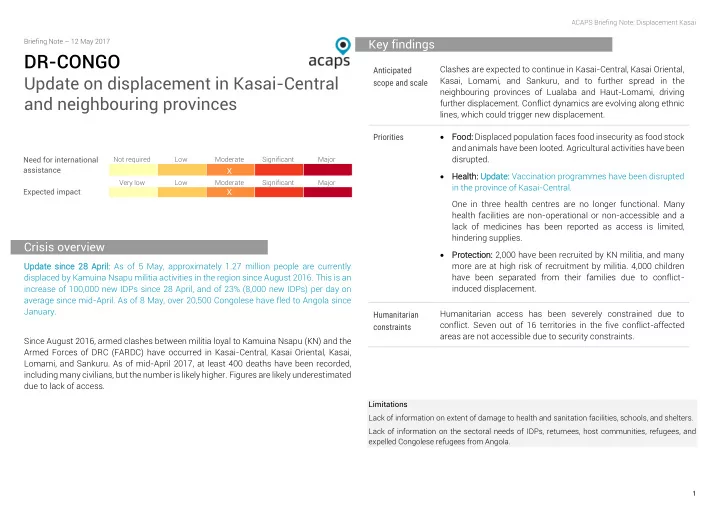
Upd pdate sin since 28 8 Apr pril il: As of 5 May, approximately 1.27 million people are currently displaced by Kamuina Nsapu militia activities in the region since August 2016. This is an increase of 100,000 new IDPs since 28 April, and of 23% (8,000 new IDPs) per day on average since mid-April. As of 8 May, over 20,500 Congolese have fled to Angola since January. Since August 2016, armed clashes between militia loyal to Kamuina Nsapu (KN) and the Armed Forces of DRC (FARDC) have occurred in Kasai-Central, Kasai Oriental, Kasai, Lomami, and Sankuru. As of mid-April 2017, at least 400 deaths have been recorded, including many civilians, but the number is likely higher. Figures are likely underestimated due to lack of access.

Key findings

Anticipated scope and scale Clashes are expected to continue in Kasai-Central, Kasai Oriental, Kasai, Lomami, and Sankuru, and to further spread in the neighbouring provinces of Lualaba and Haut-Lomami, driving further displacement. Conflict dynamics are evolving along ethnic lines, which could trigger new displacement. Priorities  Foo

  • od:

d: Displaced population faces food insecurity as food stock and animals have been looted. Agricultural activities have been disrupted.  Healt lth: h: Updat date: Vaccination programmes have been disrupted in the province of Kasai-Central. One in three health centres are no longer functional. Many health facilities are non-operational or non-accessible and a lack of medicines has been reported as access is limited, hindering supplies.  Prote

  • tection

ion: 2,000 have been recruited by KN militia, and many more are at high risk of recruitment by militia. 4,000 children have been separated from their families due to conflict- induced displacement. Humanitarian constraints Humanitarian access has been severely constrained due to

  • conflict. Seven out of 16 territories in the five conflict-affected

areas are not accessible due to security constraints.

Limitations Lack of information on extent of damage to health and sanitation facilities, schools, and shelters. Lack of information on the sectoral needs of IDPs, returnees, host communities, refugees, and expelled Congolese refugees from Angola.

slide-2
SLIDE 2

ACAPS Briefing Note: Displacement Kasai 2

Crisis impact

Tentative breakdown of IDPs and returnees in Kasai crisis-affected provinces (including potential double-counting due to pendulum, preventive and secondary displacement): Upd pdated fig igur ures s in in b blue. ue.

Provinc inces To Tota tal l popula lation tion IDPs Re Retur turnees Re Refug fugees Host st communities ities Kasai-Central 4,253,591 749,042 99,036 Kasai 4,215,517 333,906 Kasai Oriental 5,552,225 64,325 97,084 30,987 Lomami 2,930,836 88,440 43,320 Sankuru 1,846,755 14,029 Haut-Lomami 3,632,533 400 Lualaba 2,090,404 28,000 Luanda Norte (Angola) 20,563 Total 24,521,861 1,277,692 140,404 20,563 130,023

Source: UNHCR 08/05/2017, OCHA 05/05/2017, OCHA 27/04/2017, OCHA 20/04/2017

Upd pdate: As of 5 May, over 1.17 million people have been internally displaced in Kasai, Kasai-Central, Kasai Oriental, Lomami, and Sankuru since August 2016, including 140,000 people between 13-27 May, and another 100,000 from 28 April to 5 May. The latest displacement occurred mainly in Kasai-Central and Lomami (OCHA 05/05/2017, OCHA

20/04/2017, OCHA 27/04/2017).

There are 749,042 IDPs in Kasai-Central, 333,906 in Kasai, 64,325 in Kasai Oriental, 88,440 in Lomami, 28,000 in Lualaba, 14,029 in Sankuru, and 400 in Haut-Lomami. No figures have been provided about displacement in Sankuru province (OCHA 05/05/2017,

OCHA 20/04/2017, OCHA 27/04/2017).

Since January, over 20,500 Congolese have fled to Luanda province, Angola. Most have arrived since April (OCHA 05/05/2017). They are settled in three transit sites (OCHA 27/04/2017). 8,414 refugees in Angola have been deported to DRC since January 2017, most of them to Kamako, Kasai. (OCHA 20/04/2017). Over 140,000 displaced people had returned to their home in Kasai Oriental and Lomami as of 5 May due to an improvement in the security situation (OCHA 05/05/2017, OCHA

20/04/2017).

Since August 2016, massive displacement has been reported across the five conflict- affected provinces of Kasai-Central, Kasai Oriental, Kasai, Lomami, and Sankuru as well as to neighbouring Haut-Lomami and Lualaba provinces, due to fighting between Kamuina Nsapu militia and the FARDC, between rival militias, and because of intercommunal and interethnic tensions. Over 2.4 out of 18.8 million people have been affected in Kasai, Kasai-Central, Kasai Oriental, Lomami, and Sankuru (IOM 25/04/2017). At least 731,000 people are in need of humanitarian assistance as of 25 April. In Kasai-Central, humanitarian needs have increased by 400% compared to the Humanitarian Response Plan for 2017 released in January (OCHA 25/04/2017). Displacement occurs on a daily basis, following conflict developments and includes cross-province and cross-border displacement (OCHA

20/04/2017).

Foo

  • od:

d: Upd pdate: In December destruction of crops and food stock in Dibaya territory, Kasai-Central province affected about 100,000 people (FAO 03/05/2017). The displaced population faces food insecurity, as food stock and animals have been looted, (ECHO 18/04/2017). Planting and agricultural activities are disrupted as access to crops is limited. The next May-June maize harvest season will likely be disrupted

(FEWSNET 31/03/2017).

Healt lth: h: Updat date: In Kasai-Central, 100,000 children cannot be reached by vaccination programmes (OCHA 08/05/2017). In Sankuru, security constraints have disrupted medicine supplies (OCHA 05/05/2017). Due to insecurity, 12 out of 26 health zones in Kasai-Central cannot be supplied with basic medicines, an increase by three zones since January and nine zones since October 2016 (OCHA 20/04/2017). 58 health districts in five regions are affected by the disruption to supplies (ECHO 18/04/2017). In the province of Kasai-Central, one in three health centres are no longer functional, putting children at an increased risk of disease (UNICEF 21/04/2017). In many areas in Kasai and Kasai-Central, vaccination programmes have been interrupted as health staff have fled violence (OCHA 27/04/2017). High density populations in displacement means there is a risk of epidemics such as measles. Epidemiological surveillance is hindered by limited healthcare services across the Kasai region (OCHA

03/04/2017).

Prote

  • tection

ion: A total of 600,000 children have been displaced so far due to the crisis (UNICEF

21/04/2017). Some 2,000 children have been recruited by militias. More than 4,000 children

have been separated from their families during displacement (UNICEF 21/04/2017). At least 40 mass graves have been found (Le Monde 20/04/2017).

slide-3
SLIDE 3

ACAPS Briefing Note: Displacement Kasai 3

2,400 Congolese are reportedly stranded at the border with Angola (OCHA 27/04/2017). There are reports of arbitrary detentions, physical abuse, and extortion of Congolese refugees in Angola (OCHA 20/04/2017). WAS ASH: Updat date: In refugee reception centres in Angola, a lack of WASH infrastructure has been reported (UNHCR 08/05/2017). Across affected areas, use of drinking water from unsafe sources has been reported as some displaced people hide in the forest and thus do not have access to improved water sources (ECHO 18/04/2017). Refugees arriving in Angola are in need of clean water (UNHCR

21/04/2017).

Nut utritio ion: Upd pdate: In Kabeya Kamuanga health district, Kasai Oriental, SAM is over 10%. Other health districts in Kasai Oriental have also reported SAM levels over the emergency

  • threshold. The quality of SAM treatment is negatively impacted by the Kasai crisis and

is below the national average with the cured rate at 74%, the death rate at 3%, and the default rate 25% - above the acceptable benchmark of 15% (UNICEF 31/03/2017, OCHA

05/05/2017).

45,000 children suffer from Global Acute Malnutrition as of February in Kasai, Kasai- Central, and Kasai Oriental (OCHA 28/02/2017). Shelt helter and d NFIs: Upd pdate: On 27 April, 200 houses in eight villages of Kazumba territory, Kasai-Central province were burnt down and on the same day another village was burnt down in Kamiji territory (OCHA 05/05/2017). Incidents related to the KN militia crisis in Kasai include looting and damage of shelters (OCHA 11/01/2017). Refugee camps in Angola are reportedly overcrowded (OCHA 20/04/2017). Edu ducatio ion: Upd pdate: On 2 May, in Kasai-Central, final exams could not take place in 15 out

  • f 72 education centres due to insecurity (OCHA 05/05/2017). Exam staff were

threatened by militia in order to prevent them from holding the exams (Radio Okapi

02/05/2017).

More than 350 schools have been destroyed in the provinces of Kasai-Central and Kasai Oriental (UNICEF 21/04/2017, United Nations 21/04/2017). As of February, 4.8% of schools and 53,000 children have been affected. 38,000 children no longer attend school in Kasai, Kasai-Central, and Kasai Oriental and it can be assumed that the situation has worsened since (OCHA 28/02/2017). Some schools have been targeted by Kamuina Nsapu militia to denounce high education fees. As of March, schools were already interrupted for two months in Kasai-Central (RFI 10/03/2017). Vulnerable groups affected The majority of those fleeing violence are women and children, who are vulnerable to sexual violence by both militia and Congolese forces. Children are particularly at risk of recruitment by militia and local armed groups. There are reports of parents sending their children to Angola to avoid recruitment by militia

(UNHCR 21/04/2017).

Humanitarian constraints  Upd pdate: Deployment of FARDC troops prevents returns and delays implementation of response (OCHA 05/05/2017).  The security situation limits humanitarian access in conflict-affected areas. Seven out of 16 territories of the five conflict-affected provinces are not accessible due to security constraints (OCHA 12/04/2017).  Together the affected areas make up an area the size as Italy and roads are in poor condition due to the rainy season, making physical access challenging

(ECHO 18/04/2017).

 Presence of humanitarian workers in the affected areas is new. There is lack of awareness of humanitarian activities by local communities (OCHA 12/04/2017).

Aggravating factors

Rainy Season The October-June rainy season hinders access and mobility within and around the affected province. In Haut-Lomami, 82% of roads are impassable (OCHA 30/03/2017). Rainy season also triggers the risk of waterborne diseases. Refugees – especially children – arriving in Angola have reported high levels of diarrhoea and malaria (UNHCR 21/04/2017). The situation is worsening as rainy season peaks in April in Angola (United Nations

21/04/2017).

Election-related tensions Tensions related to the scheduling of elections, which should have been held in November 2016, have escalated into violence on a number of occasions since 2015 across DRC, resulting in a high civilian death toll. On 31 December 2016, the ruling coalition and opposition members agreed to hold elections in 2017 (The Guardian

slide-4
SLIDE 4

ACAPS Briefing Note: Displacement Kasai 4 31/12/2016). The registration of voters started in early January, but has been delayed in

many areas, including Kasai and Kasai-Central, due to violence (Radio Okapi 26/04/2017). Intercommunal and ethnic tensions Upd pdate: In Kasai province there is violence between Tchokwe and Pende, viewed as native, and Luba and Lulua, perceived as non-native. In Lomami province, several ethnic groups including the Luba and Lulua have been displaced several times from areas where the Kanyok ethnic group is viewed as native (OCHA 05/05/2017). Existing intercommunal and ethnic tensions between native and non-native groups are likely to deteriorate in the coming weeks. Re-emerging tensions in Kasai and Lomami have likely resulted in massive displacement over the last weeks (UNICEF 17/04/2017).

Contextual information

Drivers of the current conflict Upd pdate: The conflict has now expanded to intercommunal and interethnic violence along with clashes between rival militias and opportunist banditry activities (OCHA 05/05/2017). Tensions between state and traditional authorities in Kasai-Central triggered the conflict

(ICG 21/03/2017). Traditional chiefs are integral to public administration and have a role in

the control of land. They are appointed according to local traditions, and are then recognised by state authorities. The chief is in principle apolitical but is often pressured to align with the ruling coalition. In early 2016, authorities refused to recognise the traditional appointment of Jean-Pierre Mpandi as Kamuina Nsapu - the hereditary title of the chief of the Bajila Kasanga (Kasai- Central), a group of several villages in the province. This was allegedly because Mpandi was considered close to the opposition and an opponent of the presidential majority (ICG

21/03/2017). Following this refusal, Mpandi increasingly opposed the state and its

representatives, including the Independent National Electoral Commission (CENI). Since August 2016 when Mpandi was killed in fighting with state forces, the security situation in the Kasai region has significantly deteriorated as the Kamuina Nsapu militia have sought to avenge his death and continue his objective to reduce central and local authorities’ influence in the Kasai regions Their attacks on state institutions have intensified in Kasai-Central, and have expanded to Kasai, Kasai-Oriental, and some areas

  • f Lomami and Sankuru.

Relevant stakeholders Kam Kamuin uina Nsa Nsapu u mil ilit itia ia: Kamuina Nsapu is the hereditary title for the chief of Bajila Kasanga (or Bashila) a group

  • f several villages in Dibataie sector, Kasai-Central. Jean-Pierre Mpandi (Kamuina

Nsapu) was a tribal leader who was killed in fighting on 12 August 2016. He had vowed to rid Kasai-Central province of all state security forces, accusing them of abusing the local population, and withholding a large share of the state's wealth. Since August 2016, KN militia have sought to avenge his death, and continue his battle against state security

  • forces. The exact number of fighters is currently unknown. On 16 April, Jacques Kabeya

Ntumba Mupala was designated as tribal leader of the Kamuina Nsapu militia as the successor of Mpandi. A political solution with the KN militia could be reached with the provincial authorities, as Mupala may be recognised by the central government. As of mid-April, Kamuina Nsapu militia is reportedly made up of several dozens of relatively autonomous groups with varying agendas. Armed d For

  • rces

s of

  • f DRC

RC (F (FARD RDC) C): The majority of FARDC members are land forces, but it also has a small air force and an even smaller navy. Together, the three services are estimated to number between 144,000 and 159,000 personnel (IBI Times 29/10/2015). FARDC has been active in the region since 2009, fighting insecurity due to violence between local communities (Radio Okapi 09/11/2010). Relations between FARDC and local populations have been tense. FARDC reportedly carried out 140 extrajudicial killings of civilians in Kasai between July and October 2016 (VAC 14/12/2016). As of January, local populations have lost confidence in the armed forces because they have not succeeded in putting an end to the fighting. This may lead local populations to support KN militia

(OCHA 11/01/2017). Since mid-August 2016, clashes between FARDC and KN militia have

taken place in the Kasai region (ICG 21/03/2017). The he UN Sta Stabiliz bilizatio ion n Miss ssio ion n in n DRC DRC (MON ONUSC SCO): MONUSCO is composed of over 19,000 troops, as well as military observers and police units. The mission has three priorities: protecting civilians, stabilising the country, and supporting implementation of the Peace, Security, and Cooperation Framework for the DRC and the region (IBT

25/02/2016). In January, MONUSCO deployed over 100 troops to Kasai-Central (Radio Okapi 12/01/2017).

International and neighbouring countries’ relationship to the conflict In December 2016, MONUSCO condemned the increasing levels of violence in Kasai and Kasai-Central (MONUSCO 6/12/2016). On 12 January, it deployed over 100 troops to Kananga (Kasai-Central) to support the local government’s security response (Radio Okapi

slide-5
SLIDE 5

ACAPS Briefing Note: Displacement Kasai 5 12/01/2017). The deployment has not led to a significant decrease in violence in the region (Radio Okapi 01/02/2017).

On 19 April, Angolan authorities increased security along the border with DRC by deploying security forces to the border in response to the influx of DRC refugees into

  • Angola. (Radio Okapi 19/04/2017). Angola and DRC have a contentious relationship regarding

Congolese refugees in northern Angola, as most are illegal economic migrants working in diamond mines in Luanda Norte region (Africa Times 16/04/2017).

Response capacity

Local and national response capacity Nearly 40 humanitarian actors including INGOs operate in the affected regions. More than a third of the projects these organisations implement are concentrated in Tshikapa, Kasai province (OCHA 20/04/2017). Local NGOs, civil society members, and local authorities are the key providers of assessments on displacement and needs. However, the reliability of their assessments cannot be verified (OCHA 20/04/2017). International response capacity Upd pdate: Several agencies have announced their intention to respond to OCHA’s emergency appeal on April 25 requesting USD 64.5 million to respond to the needs of 731,000 people, but significant funding gaps remain (OCHA 05/05/2017). In Angola’s reception centres, health, food, shelter, and NFI assistance has been provided by UN agencies and partners (UNHCR 08/05/2017). A response has also been funded for Congolese refugees in Angola, led by IOM (IOM

25/04/2017) Angola government has provided three days of food assistance to the

refugees (OCHA 27/04/2017). Volatile insecurity prevents UN agencies and partners from accessing many areas (OCHA

20/04/2017). Only UNICEF has an office in Kasai region while OCHA relies on information

provided by its partners (UNICEF 17/04/2017). Population coping mechanisms Displaced populations are adopting negative coping mechanisms to cover basic food and water needs, such as prostitution, harvesting of premature crops, and use of unsafe water (UNICEF 21/04/2017). There are also reports of injured civilians resorting to traditional medicine in the bush rather than going to health facilities (ECHO 18/04/2017).

Information gaps and needs

 Lack of information on the extent of damage to health and sanitation facilities, schools, and shelters, including the breakdown per territory.  Lack of information on the sectoral needs of IDPs, returnees, host communities, refugees, and expelled refugees from Angola.  Due to widespread insecurity in Kasai and Kasai-Central, reliability of information is low as it is based on unverified assessments carried out by local

  • actors. In Lomami, Sankuru, Lualaba, and Haut Lomami, figures are based on

unverified alerts raised by local actors (OCHA 20/04/2017).

Lessons learned

High density in displacement sites accentuates the risk of outbreaks. Public health services are the key sources for early detection of outbreaks such as measles, yellow fever, and ebola through access and data collection (OCHA

03/04/2017).

Analysis of displacement patterns in the DRC shows that IDPs prefer to stay close to their place of origin, with displacement to the nearest town common

(FMreview 2010).

slide-6
SLIDE 6

ACAPS Briefing Note: Displacement Kasai 6

Key characteristics of host population and area

Key Key ind indic icator tors DRC RC Kasa sai-Ce Centr tral, Kasa sai, Kasa sai i Orie ienta tal, Lomami, i, and Sanku kuru* Total population 81,331,050 3,199,891 % population in rural areas 57.5% 86.9% (Kasai-Occidental)* Gender and age distribution

  • f population

50% female, 50% male 42.2% under 15 50% female, 50% male 50% under 15 (Kasai-Occidental) State capital Kinshasa Kananga (Kasai-Central), Mbuji-Mayi (Kasai-Oriental), Luebo (Kasai), Lusambo (Sankuru), Kabinda (Lomami) Lighting and cooking sources Population using wood for cooking: 66.2% Population using charcoal for cooking: 28.9% Population using electricity for cooking: 4.6% Population using other fuels for cooking: 0.2% Population using kerosene for cooking: 0.1% WASH Access to improved sanitation: urban: 28.5% of population, rural: 28.7% of population, total: 28.7% of population (2015 est.) Access to improved drinking water source: urban: 81.1% of population, , rural: 31.2% of population, total: 52.4% of population (2015 est.) Access to improved drinking water source: 4% (Kasai-Occidental) Health figures Maternal mortality: 693 deaths/100,000 live births (2015 est.) Infant mortality: 69.8 deaths/1,000 live births (2016 est.) Under-five mortality: 118.5/1,000 live births (2013) Infant mortality: 68 deaths/1,000 live births Under-five mortality: 135/1,000 live births (2013) (Kasai-Occidental) Food security 5.9 million people faced Crisis (IPC Phase 3) and Emergency (IPC Phase 4) food security outcomes in 2016 45% moderately food insecure, 12% severely food insecure (as Kasai-Occidental) Nutrition levels Under-fives acute malnutrition: 7.9% (2014) Under-fives underweight: 22.6% (2014) Under-fives chronic malnutrition: 42.7% (2014) Under-fives acute malnutrition: 7.2% (2014) Under-fives underweight: 30.5% (2014) Under-fives chronic malnutrition: 51.7% (2014) (Kasai-Occidental) Literacy rates Total population: 63.8% Male: 78.1% Female: 50% (2015 est.)

Sources: CIA World Factbook, FAO, OCHA, Global Alliance on Clean Cookstoves, WHO, UNDP, USAID, Statoids *Kasai-Central, Kasai, Kasai Oriental, Lomami, and Sankuru were formerly one province: Kasai-Occidental. Kasai-Occidental was a province from 1966 until 2015, when it was separated into the current provinces.

slide-7
SLIDE 7

ACAPS Briefing Note: Displacement Kasai 7

Displacement in Kasai region as of 20 April*

Source: OCHA 20/04/2017 *This map does not include the displacement of 78,000 people in Kasai-Central between 20-27 April OCHA 27/04/2017) and the displacement of 100,000 people from 28 April to 5 May mostly in Lomami province (OCHA 05/05/2017).