What is a Computer? Chapter 1-9, 12-13, 18, 20, 23 Review Slides A - - PDF document

what is a computer chapter 1 9 12 13 18 20 23 review
SMART_READER_LITE
LIVE PREVIEW

What is a Computer? Chapter 1-9, 12-13, 18, 20, 23 Review Slides A - - PDF document

What is a Computer? Chapter 1-9, 12-13, 18, 20, 23 Review Slides A computer consists of a CPU, memory, hard disk, floppy disk, monitor, printer, and communication devices. CS1: Java Programming Bus Colorado State University Communication


slide-1
SLIDE 1

Liang, Introduction to Java Programming, Tenth Edition, (c) 2013 Pearson Education, Inc. All rights reserved.

1

Chapter 1-9, 12-13, 18, 20, 23 Review Slides

CS1: Java Programming Colorado State University

Original slides by Daniel Liang Modified slides by Chris Wilcox

Liang, Introduction to Java Programming, Tenth Edition, (c) 2013 Pearson Education, Inc. All rights reserved.

2

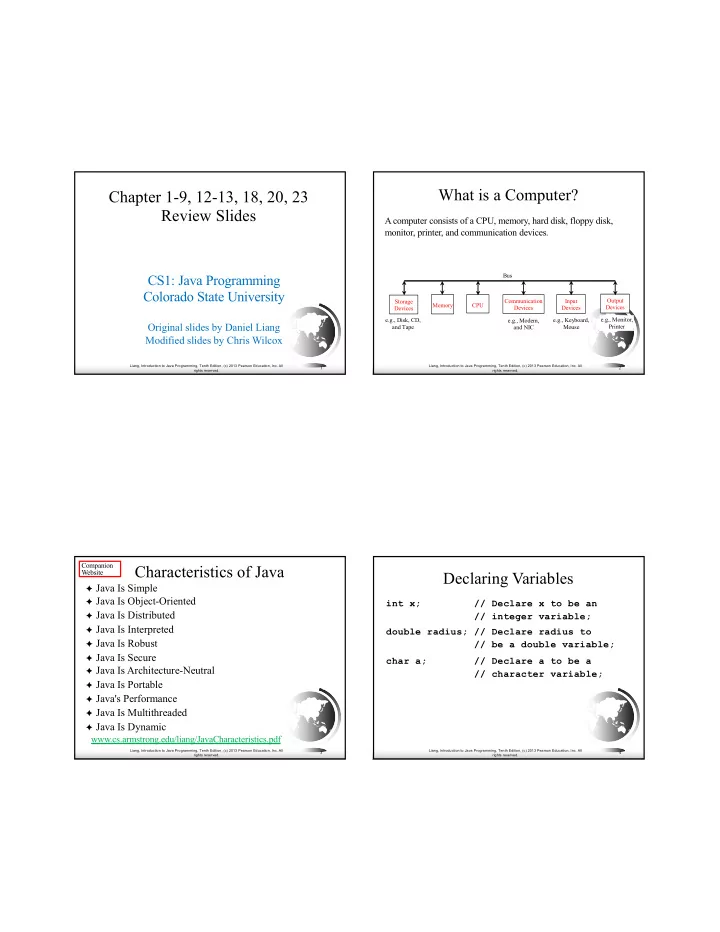
What is a Computer?

A computer consists of a CPU, memory, hard disk, floppy disk, monitor, printer, and communication devices.

CPU e.g., Disk, CD, and Tape Input Devices e.g., Keyboard, Mouse e.g., Monitor, Printer Communication Devices e.g., Modem, and NIC Storage Devices Memory Output Devices Bus

Liang, Introduction to Java Programming, Tenth Edition, (c) 2013 Pearson Education, Inc. All rights reserved.

3

Characteristics of Java

✦ Java Is Simple ✦ Java Is Object-Oriented ✦ Java Is Distributed ✦ Java Is Interpreted ✦ Java Is Robust ✦ Java Is Secure ✦ Java Is Architecture-Neutral ✦ Java Is Portable ✦ Java's Performance ✦ Java Is Multithreaded ✦ Java Is Dynamic

Companion Website

www.cs.armstrong.edu/liang/JavaCharacteristics.pdf

Liang, Introduction to Java Programming, Tenth Edition, (c) 2013 Pearson Education, Inc. All rights reserved.

4

Declaring Variables

int x; // Declare x to be an // integer variable; double radius; // Declare radius to // be a double variable; char a; // Declare a to be a // character variable;

slide-2
SLIDE 2

Liang, Introduction to Java Programming, Tenth Edition, (c) 2013 Pearson Education, Inc. All rights reserved.

5

Assignment Statements

x = 1; // Assign 1 to x; radius = 1.0; // Assign 1.0 to radius; a = 'A'; // Assign 'A' to a;

Liang, Introduction to Java Programming, Tenth Edition, (c) 2013 Pearson Education, Inc. All rights reserved.

6

Identifiers

✦ An identifier is a sequence of characters that consist of

letters, digits, underscores (_), and dollar signs ($).

✦ An identifier must start with a letter, an underscore (_),

  • r a dollar sign ($). It cannot start with a digit.

✦ An identifier cannot be a reserved word. (See Appendix

A, “Java Keywords,” for a list of reserved words).

✦ An identifier cannot be true, false, or

null.

✦ An identifier can be of any length.

Liang, Introduction to Java Programming, Tenth Edition, (c) 2013 Pearson Education, Inc. All rights reserved.

7

Numerical Data Types

Name

Range Storage Size byte –27 to 27 – 1 (-128 to 127) 8-bit signed short –215 to 215 – 1 (-32768 to 32767) 16-bit signed int –231 to 231 – 1 (-2147483648 to 2147483647) 32-bit signed long –263 to 263 – 1 64-bit signed (i.e., -9223372036854775808 to 9223372036854775807) float Negative range: 32-bit IEEE 754

  • 3.4028235E+38 to -1.4E-45

Positive range: 1.4E-45 to 3.4028235E+38 double Negative range: 64-bit IEEE 754

  • 1.7976931348623157E+308 to -4.9E-324

Positive range: 4.9E-324 to 1.7976931348623157E+308

Liang, Introduction to Java Programming, Tenth Edition, (c) 2013 Pearson Education, Inc. All rights reserved.

8

Numeric Operators

Name Meaning Example Result

+ Addition 34 + 1 35

  • Subtraction 34.0 – 0.1 33.9

* Multiplication 300 * 30 9000 / Division 1.0 / 2.0 0.5 % Remainder 20 % 3 2

slide-3
SLIDE 3

Liang, Introduction to Java Programming, Tenth Edition, (c) 2013 Pearson Education, Inc. All rights reserved.

9

Integer Division

+, -, *, /, and % 5 / 2 yields an integer 2. 5.0 / 2 yields a double value 2.5 5 % 2 yields 1 (the remainder of the division)

Liang, Introduction to Java Programming, Tenth Edition, (c) 2013 Pearson Education, Inc. All rights reserved.

10

How to Evaluate an Expression

Though Java has its own way to evaluate an expression behind the scene, the result of a Java expression and its corresponding arithmetic expression are the same. Therefore, you can safely apply the arithmetic rule for evaluating a Java expression.

3 + 4 * 4 + 5 * (4 + 3) - 1 3 + 4 * 4 + 5 * 7 – 1 3 + 16 + 5 * 7 – 1 3 + 16 + 35 – 1 19 + 35 – 1 54 - 1 53 (1) inside parentheses first (2) multiplication (3) multiplication (4) addition (6) subtraction (5) addition

Liang, Introduction to Java Programming, Tenth Edition, (c) 2013 Pearson Education, Inc. All rights reserved.

11

Conversion Rules

When performing a binary operation involving two

  • perands of different types, Java automatically

converts the operand based on the following rules: 1. If one of the operands is double, the other is converted into double. 2. Otherwise, if one of the operands is float, the other is converted into float. 3. Otherwise, if one of the operands is long, the other is converted into long. 4. Otherwise, both operands are converted into int.

Liang, Introduction to Java Programming, Tenth Edition, (c) 2013 Pearson Education, Inc. All rights reserved.

12

Type Casting

Implicit casting double d = 3; (type widening) Explicit casting int i = (int)3.0; (type narrowing) int i = (int)3.9; (Fraction part is truncated) What is wrong? int x = 5 / 2.0; byte, short, int, long, float, double range increases

slide-4
SLIDE 4

Liang, Introduction to Java Programming, Tenth Edition, (c) 2013 Pearson Education, Inc. All rights reserved.

13

The boolean Type and Operators

Often in a program you need to compare two values, such as whether i is greater than j. Java provides six comparison operators (also known as relational operators) that can be used to compare two values. The result of the comparison is a Boolean value: true or false. boolean b = (1 > 2);

Liang, Introduction to Java Programming, Tenth Edition, (c) 2013 Pearson Education, Inc. All rights reserved.

14

Relational Operators

Java Mathematics Name Example Result

Operator Symbol (radius is 5) < < less than radius < 0 false <= ≤ less than or equal to radius <= 0 false > > greater than radius > 0 true >= ≥ greater than or equal to radius >= 0 true == = equal to radius == 0 false != ≠ not equal to radius != 0 true

Liang, Introduction to Java Programming, Tenth Edition, (c) 2013 Pearson Education, Inc. All rights reserved.

15

Multiple Alternative if Statements

if (score >= 90.0)

System.out.print("A"); else if (score >= 80.0) System.out.print("B"); else if (score >= 70.0) System.out.print("C"); else if (score >= 60.0) System.out.print("D"); else System.out.print("F");

(a) Equivalent

if (score >= 90.0) System.out.print("A"); else if (score >= 80.0) System.out.print("B"); else if (score >= 70.0) System.out.print("C"); else if (score >= 60.0) System.out.print("D"); else System.out.print("F");

(b) This is better

Liang, Introduction to Java Programming, Tenth Edition, (c) 2013 Pearson Education, Inc. All rights reserved.

16

Multi-Way if-else Statements

slide-5
SLIDE 5

Liang, Introduction to Java Programming, Tenth Edition, (c) 2013 Pearson Education, Inc. All rights reserved.

17

Logical Operators

Operator Name Description ! not logical negation && and logical conjunction ||

  • r

logical disjunction ^ exclusive or logical exclusion

Liang, Introduction to Java Programming, Tenth Edition, (c) 2013 Pearson Education, Inc. All rights reserved.

18

switch Statements

switch (status) { case 0: compute taxes for single filers; break; case 1: compute taxes for married file jointly; break; case 2: compute taxes for married file separately; break; case 3: compute taxes for head of household; break; default: System.out.println("Errors: invalid status"); System.exit(1); }

Liang, Introduction to Java Programming, Tenth Edition, (c) 2013 Pearson Education, Inc. All rights reserved.

19

switch Statement Flow Chart

Liang, Introduction to Java Programming, Tenth Edition, (c) 2013 Pearson Education, Inc. All rights reserved.

20

Operator Precedence

✦ () ✦ var++, var-- ✦ +, - (Unary plus and minus), ++var,--var ✦ (type) Casting ✦ ! (Not) ✦ *, /, % (Multiplication, division, and remainder) ✦ +, - (Binary addition and subtraction) ✦ <, <=, >, >= (Relational operators) ✦ ==, !=; (Equality) ✦ ^ (Exclusive OR) ✦ && (Conditional AND) Short-circuit AND ✦ || (Conditional OR) Short-circuit OR ✦ =, +=, -=, *=, /=, %= (Assignment operator)

slide-6
SLIDE 6

Liang, Introduction to Java Programming, Tenth Edition, (c) 2013 Pearson Education, Inc. All rights reserved.

21

The Math Class

✦ Class constants:

– PI – E

✦ Class methods:

– Trigonometric Methods – Exponent Methods – Rounding Methods – min, max, abs, and random Methods

Liang, Introduction to Java Programming, Tenth Edition, (c) 2013 Pearson Education, Inc. All rights reserved.

22

ASCII Code for Commonly Used Characters

Characters Code Value in Decimal Unicode Value

'0' to '9' 48 to 57 \u0030 to \u0039 'A' to 'Z' 65 to 90 \u0041 to \u005A 'a' to 'z' 97 to 122 \u0061 to \u007A

Liang, Introduction to Java Programming, Tenth Edition, (c) 2013 Pearson Education, Inc. All rights reserved.

23

Escape Sequences for Special Characters

Liang, Introduction to Java Programming, Tenth Edition, (c) 2013 Pearson Education, Inc. All rights reserved.

24

Appendix B: ASCII Character Set

ASCII Character Set is a subset of the Unicode from \u0000 to \u007f

slide-7
SLIDE 7

Liang, Introduction to Java Programming, Tenth Edition, (c) 2013 Pearson Education, Inc. All rights reserved.

25

Methods in the Character Class

Method Description isDigit(ch) Returns true if the specified character is a digit. isLetter(ch) Returns true if the specified character is a letter. isLetterOfDigit(ch) Returns true if the specified character is a letter or digit. isLowerCase(ch) Returns true if the specified character is a lowercase letter. isUpperCase(ch) Returns true if the specified character is an uppercase letter. toLowerCase(ch) Returns the lowercase of the specified character. toUpperCase(ch) Returns the uppercase of the specified character.

Liang, Introduction to Java Programming, Tenth Edition, (c) 2013 Pearson Education, Inc. All rights reserved.

26

The String Type

The char type only represents one character. To represent a string

  • f characters, use the data type called String. For example,

String message = "Welcome to Java"; String is actually a predefined class in the Java library just like the System class and Scanner class. The String type is not a primitive

  • type. It is known as a reference type. Any Java class can be used

as a reference type for a variable. Reference data types will be thoroughly discussed in Chapter 9, “Objects and Classes.” For the time being, you just need to know how to declare a String variable, how to assign a string to the variable, how to concatenate strings, and to perform simple operations for strings.

Liang, Introduction to Java Programming, Tenth Edition, (c) 2013 Pearson Education, Inc. All rights reserved.

27

Simple Methods for String Objects

Method Description

Returns the number of characters in this string. Returns the character at the specified index from this string. Returns a new string that concatenates this string with string s1. Returns a new string with all letters in uppercase. Returns a new string with all letters in lowercase. Returns a new string with whitespace characters trimmed on both sides. length() charAt(index) concat(s1) toUpperCase() toLowerCase() trim()

Liang, Introduction to Java Programming, Tenth Edition, (c) 2013 Pearson Education, Inc. All rights reserved.

28

Reading Numbers from the Keyboard

Scanner input = new Scanner(System.in); int value = input.nextInt(); Method Description

nextByte() reads an integer of the byte type. nextShort() reads an integer of the short type. nextInt() reads an integer of the int type. nextLong() reads an integer of the long type. nextFloat() reads a number of the float type. nextDouble() reads a number of the double type.

slide-8
SLIDE 8

Liang, Introduction to Java Programming, Tenth Edition, (c) 2013 Pearson Education, Inc. All rights reserved.

29

while Loop

while (loop-continuation-condition) { // loop-body; Statement(s); } int count = 0; while (count < 100) { System.out.println("Welcome to Java!"); count++; }

Liang, Introduction to Java Programming, Tenth Edition, (c) 2013 Pearson Education, Inc. All rights reserved.

30

do-while Loop

do { // Loop body; Statement(s); } while (loop-continuation-condition);

Liang, Introduction to Java Programming, Tenth Edition, (c) 2013 Pearson Education, Inc. All rights reserved.

31

for Loops

for (initial-action; loop- continuation-condition; action- after-each-iteration) { // loop body; Statement(s); } int i; for (i = 0; i < 100; i++) { System.out.println( "Welcome to Java!"); }

Liang, Introduction to Java Programming, Tenth Edition, (c) 2013 Pearson Education, Inc. All rights reserved.

32

Using break and continue

Examples for using the break and continue keywords:

✦ TestBreak.java ✦ TestContinue.java

TestBreak Run TestContinue Run

slide-9
SLIDE 9

Liang, Introduction to Java Programming, Tenth Edition, (c) 2013 Pearson Education, Inc. All rights reserved.

33

break

public class TestBreak {

public static void main(String[] args) { int sum = 0; int number = 0; while (number < 20) { number++; sum += number; if (sum >= 100) break; } System.out.println("The number is " + number); System.out.println("The sum is " + sum); } }

Liang, Introduction to Java Programming, Tenth Edition, (c) 2013 Pearson Education, Inc. All rights reserved.

34

continue

public class TestContinue {

public static void main(String[] args) { int sum = 0; int number = 0; while (number < 20) { number++; if (number == 10 || number == 11) continue; sum += number; } System.out.println("The sum is " + sum); } }

Liang, Introduction to Java Programming, Tenth Edition, (c) 2013 Pearson Education, Inc. All rights reserved.

35

Formatting Output

Use the printf statement. System.out.printf(format, items); Where format is a string that may consist of substrings and format specifiers. A format specifier specifies how an item should be displayed. An item may be a numeric value, character, boolean value, or a string. Each specifier begins with a percent sign.

Liang, Introduction to Java Programming, Tenth Edition, (c) 2013 Pearson Education, Inc. All rights reserved.

36

Frequently-Used Specifiers

Specifier Output Example %b a boolean value true or false %c a character 'a' %d a decimal integer 200 %f a floating-point number 45.460000 %e

a number in standard scientific notation

4.556000e+01 %s a string "Java is cool"

int count = 5; double amount = 45.56; System.out.printf("count is %d and amount is %f", count, amount); display count is 5 and amount is 45.560000 items

slide-10
SLIDE 10

Liang, Introduction to Java Programming, Tenth Edition, (c) 2013 Pearson Education, Inc. All rights reserved.

37

Formal Parameters

The variables defined in the method header are known as formal parameters.

public static int max(int num1, int num2) { int result; if (num1 > num2) result = num1; else result = num2; return result; }

modifier return value type method name formal parameters return value method body method header parameter list Define a method Invoke a method

int z = max(x, y);

actual parameters (arguments) method signature

Liang, Introduction to Java Programming, Tenth Edition, (c) 2013 Pearson Education, Inc. All rights reserved.

38

Actual Parameters

When a method is invoked, you pass a value to the parameter. This value is referred to as actual parameter or argument.

public static int max(int num1, int num2) { int result; if (num1 > num2) result = num1; else result = num2; return result; }

modifier return value type method name formal parameters return value method body method header parameter list Define a method Invoke a method

int z = max(x, y);

actual parameters (arguments) method signature

Liang, Introduction to Java Programming, Tenth Edition, (c) 2013 Pearson Education, Inc. All rights reserved.

39

Return Value Type

A method may return a value. The returnValueType is the data type

  • f the value the method returns. If the method does not return a

value, the returnValueType is the keyword void. For example, the returnValueType in the main method is void.

public static int max(int num1, int num2) { int result; if (num1 > num2) result = num1; else result = num2; return result; }

modifier return value type method name formal parameters return value method body method header parameter list Define a method Invoke a method

int z = max(x, y);

actual parameters (arguments) method signature

Liang, Introduction to Java Programming, Tenth Edition, (c) 2013 Pearson Education, Inc. All rights reserved.

40

Calling Methods, cont.

public static void main(String[] args) { int i = 5; int j = 2; int k = max(i, j); System.out.println( "The maximum between " + i + " and " + j + " is " + k); } public static int max(int num1, int num2) { int result; if (num1 > num2) result = num1; else result = num2; return result; }

pass the value of i pass the value of j

animation

slide-11
SLIDE 11

Liang, Introduction to Java Programming, Tenth Edition, (c) 2013 Pearson Education, Inc. All rights reserved.

41

Scope of Local Variables

A local variable: a variable defined inside a method. Scope: the part of the program where the variable can be referenced. The scope of a local variable starts from its declaration and continues to the end of the block that contains the variable. A local variable must be declared before it can be used.

Liang, Introduction to Java Programming, Tenth Edition, (c) 2013 Pearson Education, Inc. All rights reserved.

42

Introducing Arrays

Array is a data structure that represents a collection of the same types of data.

Liang, Introduction to Java Programming, Tenth Edition, (c) 2013 Pearson Education, Inc. All rights reserved.

43

Declaring, creating, initializing Using the Shorthand Notation

double[] myList = {1.9, 2.9, 3.4, 3.5};

This shorthand notation is equivalent to the following statements:

double[] myList = new double[4]; myList[0] = 1.9; myList[1] = 2.9; myList[2] = 3.4; myList[3] = 3.5;

Liang, Introduction to Java Programming, Tenth Edition, (c) 2013 Pearson Education, Inc. All rights reserved.

44

Passing Arrays to Methods

public static void printArray(int[] array) { for (int i = 0; i < array.length; i++) { System.out.print(array[i] + " "); } } Invoke the method int[] list = {3, 1, 2, 6, 4, 2}; printArray(list); Invoke the method printArray(new int[]{3, 1, 2, 6, 4, 2}); Anonymous array

slide-12
SLIDE 12

Liang, Introduction to Java Programming, Tenth Edition, (c) 2013 Pearson Education, Inc. All rights reserved.

45

Passing Arrays as Arguments

✦ Objective: Demonstrate differences of

passing primitive data type variables and array variables.

TestPassArray Run

Liang, Introduction to Java Programming, Tenth Edition, (c) 2013 Pearson Education, Inc. All rights reserved.

46

Enhanced for Loop (for-each loop)

JDK 1.5 introduced a new for loop that enables you to traverse the complete array sequentially without using an index variable. For example, the following code displays all elements in the array myList: for (double value: myList) System.out.println(value); In general, the syntax is for (elementType value: arrayRefVar) { // Process the value } You still have to use an index variable if you wish to traverse the array in a different order or change the elements in the array.

Liang, Introduction to Java Programming, Tenth Edition, (c) 2013 Pearson Education, Inc. All rights reserved.

47

The Arrays.toString(list) Method

The Arrays.toString(list) method can be used to return a string representation for the list.

Liang, Introduction to Java Programming, Tenth Edition, (c) 2013 Pearson Education, Inc. All rights reserved.

48

Linear Search

The linear search approach compares the key element, key, sequentially with each element in the array list. The method continues to do so until the key matches an element in the list or the list is exhausted without a match being

  • found. If a match is made, the linear search

returns the index of the element in the array that matches the key. If no match is found, the search returns -1.

slide-13
SLIDE 13

Liang, Introduction to Java Programming, Tenth Edition, (c) 2013 Pearson Education, Inc. All rights reserved.

49

Linear Search Animation

6 4 1 9 7 3 2 8 6 4 1 9 7 3 2 8 6 4 1 9 7 3 2 8 6 4 1 9 7 3 2 8 6 4 1 9 7 3 2 8 6 4 1 9 7 3 2 8

3 3 3 3 3 3 animation

Key List

Liang, Introduction to Java Programming, Tenth Edition, (c) 2013 Pearson Education, Inc. All rights reserved.

50

Binary Search, cont.

✦ If the key is less than the middle element,

you only need to search the key in the first half of the array.

✦ If the key is equal to the middle element,

the search ends with a match.

✦ If the key is greater than the middle

element, you only need to search the key in the second half of the array. Consider the following three cases:

Liang, Introduction to Java Programming, Tenth Edition, (c) 2013 Pearson Education, Inc. All rights reserved.

51

Binary Search

1 2 3 4 6 7 8 9 1 2 3 4 6 7 8 9 1 2 3 4 6 7 8 9

8 8 8

Key List

animation

Liang, Introduction to Java Programming, Tenth Edition, (c) 2013 Pearson Education, Inc. All rights reserved.

52

Selection Sort

Selection sort finds the smallest number in the list and places it first. It then finds the smallest number remaining and places it second, and so on until the list contains only a single number.

slide-14
SLIDE 14

Liang, Introduction to Java Programming, Tenth Edition, (c) 2013 Pearson Education, Inc. All rights reserved.

53

Motivations

Chicago Boston New York Atlanta Miami Dallas Houston

Distance Table (in miles)

Chicago Boston New York Atlanta Miami Dallas Houston 0 983 787 714 1375 967 1087 983 0 214 1102 1763 1723 1842 787 214 0 888 1549 1548 1627 714 1102 888 0 661 781 810 1375 1763 1549 661 0 1426 1187 967 1723 1548 781 1426 0 239 1087 1842 1627 810 1187 239 0

Thus far, you have used one-dimensional arrays to model linear collections of elements. You can use a two-dimensional array to represent a matrix or a table. For example, the following table that describes the distances between the cities can be represented using a two-dimensional array.

Liang, Introduction to Java Programming, Tenth Edition, (c) 2013 Pearson Education, Inc. All rights reserved.

54

Declaring, Creating, and Initializing Using Shorthand Notations

You can also use an array initializer to declare, create and initialize a two-dimensional array. For example,

int[][] array = new int[4][3]; array[0][0] = 1; array[0][1] = 2; array[0][2] = 3; array[1][0] = 4; array[1][1] = 5; array[1][2] = 6; array[2][0] = 7; array[2][1] = 8; array[2][2] = 9; array[3][0] = 10; array[3][1] = 11; array[3][2] = 12; int[][] array = { {1, 2, 3}, {4, 5, 6}, {7, 8, 9}, {10, 11, 12} };

Same as

Liang, Introduction to Java Programming, Tenth Edition, (c) 2013 Pearson Education, Inc. All rights reserved.

55

Lengths of Two-dimensional Arrays, cont.

int[][] array = { {1, 2, 3}, {4, 5, 6}, {7, 8, 9}, {10, 11, 12} }; array.length array[0].length array[1].length array[2].length array[3].length array[4].length ArrayIndexOutOfBoundsException

Liang, Introduction to Java Programming, Tenth Edition, (c) 2013 Pearson Education, Inc. All rights reserved.

56

Classes

class Circle {

/** The radius of this circle */ double radius = 1.0; /** Construct a circle object */ Circle() { } /** Construct a circle object */ Circle(double newRadius) { radius = newRadius; } /** Return the area of this circle */ double getArea() { return radius * radius * 3.14159; } } Data field Method Constructors

slide-15
SLIDE 15

Liang, Introduction to Java Programming, Tenth Edition, (c) 2013 Pearson Education, Inc. All rights reserved.

57

UML Class Diagram

Circle

radius: double Circle() Circle(newRadius: double) getArea(): double getPerimeter(): double setRadius(newRadius: double): void

circle1: Circle

radius = 1.0

Class name Data fields Constructors and methods circle2: Circle

radius = 25

circle3: Circle

radius = 125

UML Class Diagram UML notation for objects

Liang, Introduction to Java Programming, Tenth Edition, (c) 2013 Pearson Education, Inc. All rights reserved.

58

Constructors

Circle() { } Circle(double newRadius) { radius = newRadius; } Constructors are a special kind of methods that are invoked to construct objects.

Liang, Introduction to Java Programming, Tenth Edition, (c) 2013 Pearson Education, Inc. All rights reserved.

59

Declaring/Creating Objects in a Single Step

ClassName objectRefVar = new ClassName();

Example:

Circle myCircle = new Circle();

Create an object

Assign object reference

Liang, Introduction to Java Programming, Tenth Edition, (c) 2013 Pearson Education, Inc. All rights reserved.

60

Accessing Object’s Members

q Referencing the object’s data:

  • bjectRefVar.data

e.g., myCircle.radius

q Invoking the object’s method:

  • bjectRefVar.methodName(arguments)

e.g., myCircle.getArea()

slide-16
SLIDE 16

Liang, Introduction to Java Programming, Tenth Edition, (c) 2013 Pearson Education, Inc. All rights reserved.

61

Differences between Variables of Primitive Data Types and Object Types

1 Primitive type int i = 1 i Object type Circle c c reference

Created using new Circle()

c: Circle radius = 1

Liang, Introduction to Java Programming, Tenth Edition, (c) 2013 Pearson Education, Inc. All rights reserved.

62

Instance Variables, and Methods

Instance variables belong to a specific instance. Instance methods are invoked by an instance of the class. Instance variables and methods are specified by

  • mitting the static keyword.

Liang, Introduction to Java Programming, Tenth Edition, (c) 2013 Pearson Education, Inc. All rights reserved.

63

Static Variables, Constants, and Methods

Static variables are shared by all the instances of the class. Static methods are not tied to a specific object. Static constants are final variables shared by all the instances of the class.

Liang, Introduction to Java Programming, Tenth Edition, (c) 2013 Pearson Education, Inc. All rights reserved.

64

Visibility Modifiers and Accessor/Mutator Methods

By default, the class, variable, or method can be accessed by any class in the same package.

q public

The class, data, or method is visible to any class in any package.

q private

The data or methods can be accessed only by the declaring class. The get and set methods are used to read and modify private properties.

slide-17
SLIDE 17

Liang, Introduction to Java Programming, Tenth Edition, (c) 2013 Pearson Education, Inc. All rights reserved.

65

Array of Objects, cont.

Circle[] circleArray = new Circle[10];

Liang, Introduction to Java Programming, Tenth Edition, (c) 2013 Pearson Education, Inc. All rights reserved.

66

The this Keyword

qThe this keyword is the name of a reference that

refers to an object itself. One common use of the this keyword is reference a class’s hidden data fields.

qAnother common use of the this keyword to

enable a constructor to invoke another constructor of the same class.

Liang, Introduction to Java Programming, Tenth Edition, (c) 2013 Pearson Education, Inc. All rights reserved.

67

Checked Exceptions vs. Unchecked Exceptions

RuntimeException, Error and their subclasses are known as unchecked exceptions. All other exceptions are known as checked exceptions, meaning that the compiler forces the programmer to check and deal with the exceptions.

Liang, Introduction to Java Programming, Tenth Edition, (c) 2013 Pearson Education, Inc. All rights reserved.

68

Declaring Exceptions

Every method must state the types of checked exceptions it might throw. This is known as declaring exceptions. public void myMethod() throws IOException public void myMethod() throws IOException, OtherException

slide-18
SLIDE 18

Liang, Introduction to Java Programming, Tenth Edition, (c) 2013 Pearson Education, Inc. All rights reserved.

69

Throwing Exceptions

When the program detects an error, the program can create an instance of an appropriate exception type and throw it. This is known as throwing an

  • exception. Here is an example,

throw new TheException(); TheException ex = new TheException(); throw ex;

Liang, Introduction to Java Programming, Tenth Edition, (c) 2013 Pearson Education, Inc. All rights reserved.

70

Catching Exceptions

try { statements; // Statements that may throw exceptions } catch (Exception1 exVar1) { handler for exception1; } catch (Exception2 exVar2) { handler for exception2; } ... catch (ExceptionN exVar3) { handler for exceptionN; }

Liang, Introduction to Java Programming, Tenth Edition, (c) 2013 Pearson Education, Inc. All rights reserved.

71

The File Class

The File class is intended to provide an abstraction that deals with most of the machine-dependent complexities

  • f files and path names in a machine-independent
  • fashion. The filename is a string. The File class is a

wrapper class for the file name and its directory path.

Liang, Introduction to Java Programming, Tenth Edition, (c) 2013 Pearson Education, Inc. All rights reserved.

72

Obtaining file properties and manipulating file

slide-19
SLIDE 19

Liang, Introduction to Java Programming, Tenth Edition, (c) 2013 Pearson Education, Inc. All rights reserved.

73

Text I/O

A File object encapsulates the properties of a file or a path, but does not contain the methods for reading/writing data from/to a file. In order to perform I/O, you need to create

  • bjects using appropriate Java I/O classes. The objects

contain the methods for reading/writing data from/to a file. This section introduces how to read/write strings and numeric values from/to a text file using the Scanner and PrintWriter classes.

Liang, Introduction to Java Programming, Tenth Edition, (c) 2013 Pearson Education, Inc. All rights reserved.

74

Writing Data Using PrintWriter

java.io.PrintWriter +PrintWriter(filename: String) +print(s: String): void +print(c: char): void +print(cArray: char[]): void +print(i: int): void +print(l: long): void +print(f: float): void +print(d: double): void +print(b: boolean): void Also contains the overloaded println methods. Also contains the overloaded printf methods. Creates a PrintWriter for the specified file. Writes a string. Writes a character. Writes an array of character. Writes an int value. Writes a long value. Writes a float value. Writes a double value. Writes a boolean value. A println method acts like a print method; additionally it prints a line separator. The line separator string is defined by the system. It is \r\n on Windows and \n on Unix. The printf method was introduced in §4.6, “Formatting Console Output and Strings.”

Run WriteData

Liang, Introduction to Java Programming, Tenth Edition, (c) 2013 Pearson Education, Inc. All rights reserved.

75

Reading Data Using Scanner

java.util.Scanner +Scanner(source: File) +Scanner(source: String) +close() +hasNext(): boolean +next(): String +nextByte(): byte +nextShort(): short +nextInt(): int +nextLong(): long +nextFloat(): float +nextDouble(): double +useDelimiter(pattern: String): Scanner Creates a Scanner object to read data from the specified file. Creates a Scanner object to read data from the specified string. Closes this scanner. Returns true if this scanner has another token in its input. Returns next token as a string. Returns next token as a byte. Returns next token as a short. Returns next token as an int. Returns next token as a long. Returns next token as a float. Returns next token as a double. Sets this scanner’s delimiting pattern.

Run ReadData

Liang, Introduction to Java Programming, Tenth Edition, (c) 2013 Pearson Education, Inc. All rights reserved.

76 76

Abstract Classes and Abstract Methods

Run GeometricObject Circle Rectangle TestGeometricObject

slide-20
SLIDE 20

Liang, Introduction to Java Programming, Tenth Edition, (c) 2013 Pearson Education, Inc. All rights reserved.

77 77

Define an Interface

To distinguish an interface from a class, Java uses the following syntax to define an interface: public interface InterfaceName { constant declarations; abstract method signatures; }

Example:

public interface Edible { /** Describe how to eat */ public abstract String howToEat(); }

Liang, Introduction to Java Programming, Tenth Edition, (c) 2013 Pearson Education, Inc. All rights reserved.

78 78

Interfaces vs. Abstract Classes

In an interface, the data must be constants; an abstract class can have all types of data. Each method in an interface has only a signature without implementation; an abstract class can have concrete methods.

Liang, Introduction to Java Programming, Tenth Edition, (c) 2013 Pearson Education, Inc. All rights reserved.

79 79

The toString, equals, and hashCode Methods

Each wrapper class overrides the toString, equals, and hashCode methods defined in the Object class. Since all the numeric wrapper classes and the Character class implement the Comparable interface, the compareTo method is implemented in these classes.

Liang, Introduction to Java Programming, Tenth Edition, (c) 2013 Pearson Education, Inc. All rights reserved.

80

Computing Factorial

factorial(4) = 4 * factorial(3) = 4 * (3 * factorial(2)) = 4 * (3 * (2 * factorial(1))) = 4 * (3 * ( 2 * (1 * factorial(0)))) = 4 * (3 * ( 2 * ( 1 * 1)))) = 4 * (3 * ( 2 * 1)) = 4 * (3 * 2) = 4 * (6) = 24

animation factorial(0) = 1; factorial(n) = n*factorial(n-1);

slide-21
SLIDE 21

Liang, Introduction to Java Programming, Tenth Edition, (c) 2013 Pearson Education, Inc. All rights reserved.

return 1 factorial(4) return 4 * factorial(3) return 3 * factorial(2) return 2 * factorial(1) return 1 * factorial(0) Step 9: return 24 Step 0: executes factorial(4) Step 1: executes factorial(3) Step 2: executes factorial(2) Step 3: executes factorial(1) Step 5: return 1 Step 6: return 1 Step 7: return 2 Step 8: return 6 Step 4: executes factorial(0)

81

Trace Recursive factorial

animation returns factorial(4)

Main method Space Required for factorial(4) Stack

Liang, Introduction to Java Programming, Tenth Edition, (c) 2013 Pearson Education, Inc. All rights reserved.

82

Sierpinski Triangle

1.

It begins with an equilateral triangle, which is considered to be the Sierpinski fractal of order (or level) 0, as shown in Figure (a).

2.

Connect the midpoints of the sides of the triangle of order 0 to create a Sierpinski triangle of order 1, as shown in Figure (b).

3.

Leave the center triangle intact. Connect the midpoints of the sides of the three other triangles to create a Sierpinski of order 2, as shown in Figure (c).

4.

You can repeat the same process recursively to create a Sierpinski triangle of order 3, 4, ..., and so on, as shown in Figure (d).

Liang, Introduction to Java Programming, Tenth Edition, (c) 2013 Pearson Education, Inc. All rights reserved.

83

Java Collection Framework hierarchy, cont.

Set and List are subinterfaces of Collection.

Liang, Introduction to Java Programming, Tenth Edition, (c) 2013 Pearson Education, Inc. All rights reserved.

84

ArrayList and LinkedList

The ArrayList class and the LinkedList class are concrete implementations of the List interface. Which of the two classes you use depends on your specific needs. If you need to support random access through an index without inserting or removing elements from any place other than the end, ArrayList offers the most efficient collection. If, however, your application requires the insertion or deletion of elements from any place in the list, you should choose LinkedList. A list can grow or shrink dynamically. An array is fixed once it is created. If your application does not require insertion or deletion of elements, the most efficient data structure is the array.

slide-22
SLIDE 22

Liang, Introduction to Java Programming, Tenth Edition, (c) 2013 Pearson Education, Inc. All rights reserved.

85

Insertion Sort

2 9 5 4 8 1 6 2 9 5 4 8 1 6 2 5 9 4 8 1 6 2 4 5 8 9 1 6 1 2 4 5 8 9 6 2 4 5 9 8 1 6 1 2 4 5 6 8 9

int[] myList = {2, 9, 5, 4, 8, 1, 6}; // Unsorted animation

Liang, Introduction to Java Programming, Tenth Edition, (c) 2013 Pearson Education, Inc. All rights reserved.

86

Bubble Sort

2 5 9 4 8 1 2 5 4 9 8 1 2 5 4 8 9 1 2 5 4 8 1 9 (a) 1st pass 2 4 5 8 1 9 2 4 5 8 1 9 2 4 5 1 8 9 (b) 2nd pass 2 4 5 1 8 9 2 4 1 5 8 9 (c) 3rd pass 2 1 4 5 8 9 (d) 4th pass 2 9 5 4 8 1 (e) 5th pass 2 5 4 8 1 9 2 4 5 1 8 9 2 4 1 5 8 9 1 2 4 5 8 9

2 2 1 2 ... ) 2 ( ) 1 (

2

n n n n = + + + +

Bubble sort time: O(n2)

Run BubbleSort

Liang, Introduction to Java Programming, Tenth Edition, (c) 2013 Pearson Education, Inc. All rights reserved.

87

Merge Sort

2 9 5 4 8 1 6 7 2 9 5 4 8 1 6 7 split 2 9 split 5 4 2 split 9 5 4 8 1 6 7 8 1 6 7 2 9 merge 4 5 1 8 6 7 2 4 5 9 1 6 7 8 1 2 4 5 6 7 8 9 merge merge divide conquer Run MergeSort

Liang, Introduction to Java Programming, Tenth Edition, (c) 2013 Pearson Education, Inc. All rights reserved.

88

Quick Sort

Quick sort, developed by C. A. R. Hoare (1962), works as follows: The algorithm selects an element, called the pivot, in the array. Divide the array into two parts such that all the elements in the first part are less than or equal to the pivot and all the elements in the second part are greater than the

  • pivot. Recursively apply the quick sort algorithm to

the first part and then the second part.

slide-23
SLIDE 23

Liang, Introduction to Java Programming, Tenth Edition, (c) 2013 Pearson Education, Inc. All rights reserved.

Computational Complexity (Big O)

✦ T(n)=O(1)

// constant time

✦ T(n)=O(log n)

// logarithmic

✦ T(n)=O(n)

// linear

✦ T(n)=O(nlog n)

// linearithmic

✦ T(n)=O(n2)

// quadratic

✦ T(n)=O(n3)

// cubic

89

Liang, Introduction to Java Programming, Tenth Edition, (c) 2013 Pearson Education, Inc. All rights reserved.

Complexity Examples

90

http://bigocheatsheet.com/