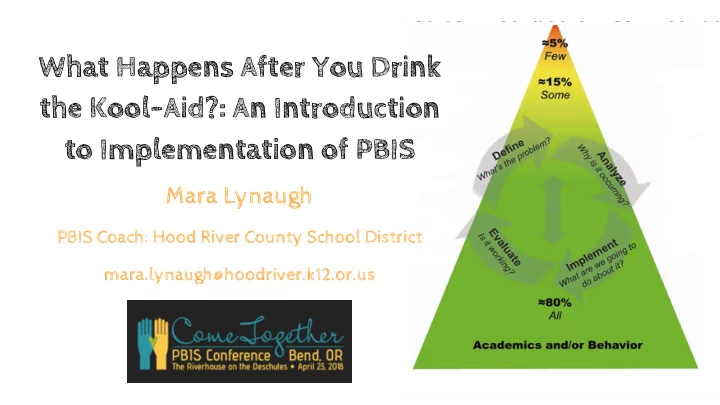
SLIDE 1
What Happens After You Drink the Kool-Aid?: An Introduction to Implementation of PBIS
Mara Lynaugh
PBIS Coach: Hood River County School District mara.lynaugh@hoodriver.k12.or.us
SLIDE 2 www.pbis.org www.pbisapps.org
SLIDE 3
SLIDE 4 Find one or two individuals seated close to you.
Introduce yourselves & share a little about your role and your institution. If you already know each other, share
- ne question you hope will be answered during this
session. This will be your group for the following activities : Think and Share: These activities will ask you to think to yourself before turning to your group and share thoughts and/ or questions.
SLIDE 5 Objectives:
- Define the stages of PBIS implementation.
- Understand the basics of implementation
science as it relates to PBIS implementation.
- Understand the drivers facilitating
successful implementation and sustainment
- f PBIS.
- Identify potential next steps for institutions
as they work to implement PBIS.
Avoiding “PBIS Lite”
SLIDE 6
SLIDE 7
SLIDE 8
Which of these do you have in place? Which are your greatest concerns?
SLIDE 9 Implementation Guidelines:
- Readiness & Commitment
- Implementation Demonstrations
- Implementation Phases
- Leadership Team
- Implementation Capacity
- Action Plan
SLIDE 10
Which stage(s) most accurately reflect your school’s current implementation status?
SLIDE 11
20??-?? District Leadership Team Exploration 2014-15 Grant Funded Scaling Up in 3 schools 2015-16 K-8 Initial Implementation T1 & T2 2016-17 K-5 Full Implementation T1 & T2 6-8 Full Implementation T1, Initial Implementation T2 9-12 Exploration T1 2017-18 K-5 Initial Implementation of T3 6-8 Initial- Full implementation of T2 9-12 Initial Implementation of T1, Exploration of T2 2018-19 K-5 Full Implementation of T3 6-8 Full implementation of T2, Exploration T3 9-12 Full Implementation of T1, Initial Implementation of T2
SLIDE 12 Exploration and Readiness:
- What is the need? Does data
support this? Is it a priority?
- How does the evidenced-based
practice (PBIS) address this need?
- How does this practice fit with
current needs and capacity? What is your why? What are some ways you can further explore PBIS?
SLIDE 13
SLIDE 14
What is your “elevator speech” to describe PBIS and how it would benefit your school?
SLIDE 15 Installation:
- Leadership Team
- Assign resources & funding
○ Personnel ○ Data System ○ Materials
- Developing policies & practices
- Planning for professional development
- Action Plan for implementation
SLIDE 16
Who needs to be on the team?
SLIDE 17
SLIDE 18 Key PRACTICES of PBIS
- Cleary define expectations & routines
- Explicitly teach expectations & routines
- Frequently positively reinforce expected behaviors
- Consistently correct unexpected behavior
- Use data-based decision making
SLIDE 19 What are your expectations & procedures? How will you teach these and visually remind students? How will you reinforce expected behaviors? What will you do to correct unexpected behaviors? What data will you use for problem solving?
SLIDE 20
What systems do you need to support PBIS practices? What data could you use for DBDM?
SLIDE 21
SLIDE 22
If you aren’t yet sustaining, where would you like to be? Why?
SLIDE 23 Fidelity Data & Action Planning
(Click on images for resource links)
SLIDE 24 Initial Implementation:
within a subsection with high levels of technical assistance
implement with fidelity available resources?
- Are desired outcomes
- btainable? Is there
data to support this?
Full Implementation:
implementation to entire
- rganization
- Maintaining fidelity and
desired outcomes
practice expertise, administrative structures, efficient procedures, data collection, evaluation
Sustaining & Scaling:
systems & practices
internal expertise
response to outcome & fidelity data
new problems