What Happened in the 2016 Election? Understanding the Presidential - - PowerPoint PPT Presentation

what happened in the 2016 election understanding the
SMART_READER_LITE
LIVE PREVIEW

What Happened in the 2016 Election? Understanding the Presidential - - PowerPoint PPT Presentation

What Happened in the 2016 Election? Understanding the Presidential Race and Losses Down the Ballot Analyzing the Impacts of Turnout, the Economy, Change, Racism, and Sexism Celinda Lake November 16 th , 2016 Washington, DC | Berkeley, CA |


slide-1
SLIDE 1

1

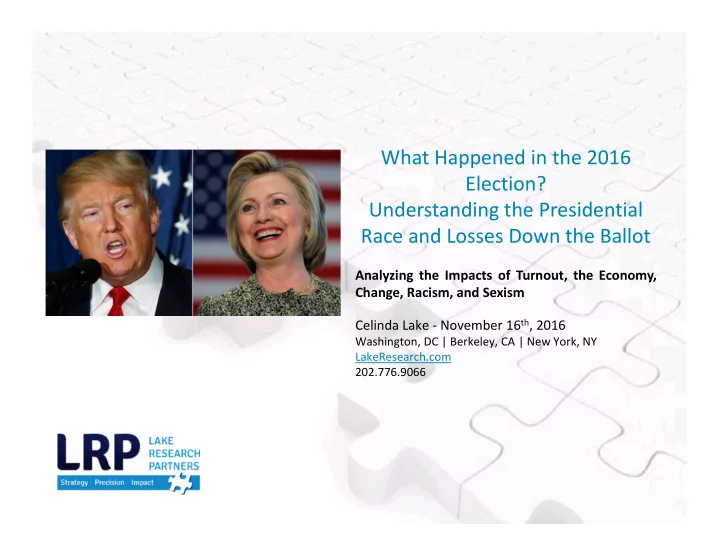
What Happened in the 2016 Election? Understanding the Presidential Race and Losses Down the Ballot

Analyzing the Impacts of Turnout, the Economy, Change, Racism, and Sexism Celinda Lake ‐ November 16th, 2016

Washington, DC | Berkeley, CA | New York, NY LakeResearch.com 202.776.9066

slide-2
SLIDE 2

Lessons from 2016

  • 1. There’s real anger and frustration in the electorate with the status quo. They

took great risks for change.

  • 2. Demographics are not destiny.
  • 3. Women candidates have to be likeable as well as competent, while the same

is not true for male candidates.

  • 4. Turnout and enthusiasm are important.
  • 5. Having a strong economic message is critical.
  • 6. People have to have a reason to vote for someone and not just against.
  • 7. Democrats have significant ground to make up with the working class and

have to get back to their working class roots.

2

slide-3
SLIDE 3

In terms of national popular vote, Trump narrowly lost the popular vote to Clinton, compared to Obama who won his reelection in 2012

  • ver Romney by a margin of 3 points nationally.

3

Source: http://www.politico.com/2016‐election/results/map/president Source: http://elections.nbcnews.com/ns/politics/2012/all/president/#.WByf9iu9ldM

48 47

Clinton Trump Presidential Vote Overall

51 48

Obama Romney

2012 Results

slide-4
SLIDE 4

Huffpollster’s polling average had the race significantly farther apart than the final results showed, but the race was very volatile the whole way due to all of the major events that took place.

4

Source: http://elections.huffingtonpost.com/pollster/2016‐general‐election‐trump‐vs‐clinton

Democratic National Convention Republican National Convention 1st Presidential Debate Trump/Billy Bush Video Leaks Trump Enters Race FBI Recommends No Charges On Clinton Email Comey Letter Iowa Cacuses Clinton Fainting Spell

slide-5
SLIDE 5

Trump completely changed the electoral map. He won 6 states that had previously voted for Obama 2012 – Ohio, Iowa, Pennsylvania, Michigan, Wisconsin, and Florida.

5

Iowa Ohio States That Flipped Red From 2012 Pennsylvania Michigan Florida Wisconsin

Source: http://www.nytimes.com/elections/results/president

slide-6
SLIDE 6

Democrats netted 2 seats by winning in Illinois and New Hampshire, but will still be in the minority in the Senate.

6

Source: http://www.politico.com/

State Incumbent Party Open Seat Incumbent Democratic Candidate Final Results Result Florida R ‐‐ Marco Rubio Patrick Murphy Rubio – 52% Murphy – 44% Republican Hold Illinois R ‐‐ Mark Kirk Tammy Duckworth Duckworth – 54% Kirk – 40% Democratic Pickup Indiana R Open Todd Young Evan Bayh Bayh – 42% Young – 52% Republican Hold Nevada D Open Joe Heck Catherine Cortez Masto Cortez Masto – 47% Heck – 45% Democratic Hold New Hampshire R ‐‐ Kelly Ayotte Maggie Hassan Hassan – 48% Ayotte – 48% Democratic Pickup Ohio R ‐‐ Rob Portman Ted Strickland Portman – 58% Strickland – 37% Republican Hold Pennsylvania R ‐‐ Pat Toomey Katie McGinty McGinty – 47% Toomey – 49% Republican Hold Wisconsin R ‐‐ Ron Johnson Russ Feingold Feingold – 47% Johnson – 50% Republican Hold Missouri R ‐‐ Roy Blunt Jason Kander Kander – 46% Blunt – 49% Republican Hold North Carolina R ‐‐ Richard Burr Deborah Ross Burr – 51% Ross – 45% Republican Hold

slide-7
SLIDE 7

Democrats picked up seats in Nevada, Florida, Illinois, New Hampshire, and New Jersey, but will still be in a deep minority when the next Congress opens.

7

Source: Ballotpedia

Democratic Pickups FL‐07 & FL‐13 Democratic Pickups NV‐03 & NV‐04 Democratic Pickup NH‐01 Democratic Pickup NJ‐05 Democratic Pickup IL‐10

slide-8
SLIDE 8

The 2016 Election Results By Demographics

slide-9
SLIDE 9

There was a 24 point gender gap in this election, with women favoring Clinton 54% to 42%, while men supported Trump 53% to 41%.

9

Source: http://www.cnn.com/election/results/exit‐polls

41 53 54 42

Clinton Trump Clinton Trump Presidential Vote By Gender Men (48%) Women (52%)

slide-10
SLIDE 10

Breaking down the election results by age, younger voters were much more supportive of Clinton than were older voters, who voted for Trump and comprised a larger portion of the electorate.

10

Source: http://www.cnn.com/election/results/exit‐polls

55 37 50 42 44 53 45 53

Clinton Trump Clinton Trump Clinton Trump Clinton Trump Presidential Vote By Age 18‐29 (19%) 30‐44 (25%) 45‐64 (40%) 65+ (15%)

slide-11
SLIDE 11

The presidential electorate has become more and more racially diverse over time, a trend that tends to favor Democrats.

11

Source: http://ropercenter.cornell.edu/polls/us‐elections/how‐groups‐voted/how‐groups‐voted‐2000/ Source: http://elections.nytimes.com/2012/results/president/exit‐polls Source: http://www.cnn.com/election/results/exit‐polls

81 77 74 72 70 10 11 13 13 12

2000 2004 2008 2012 2016 Other Race Asian Hispanic Black White

U.S. Presidential Electorate Over Time By Race

7 2 10 9 8 3 2 2 2 11 4 3 2 3

slide-12
SLIDE 12

Trump’s huge 21 point margin with white voters helped him to

  • vercome the significant deficits that he had with voters of color and

allowed him to win the Electoral College.

12

Source: http://www.cnn.com/election/results/exit‐polls

37 58 88 8 65 29 65 29 56 37

Clinton Trump Clinton Trump Clinton Trump Clinton Trump Clinton Trump Presidential Vote By Race White (70%) Black (12%) Latino (11%) Asian (4%) Other (3%)

slide-13
SLIDE 13

13

53 67 71 65 44 31 27 29

10 20 30 40 50 60 70 80

2004 2008 2012 2016

Democrat Republican

Latino Presidential Vote Over Time Since 2004, the Latino vote has become much more solidly Democratic and Republicans have lost ground among Latinos from George Bush’s high water mark

  • f 44% in 2004. In the long term, Republicans will have to improve their vote share

among Latinos to continue to remain viable nationally.

Source: http://elections.nytimes.com/2012/results/president/exit‐polls Source: http://www.cnn.com/election/results/exit‐polls

slide-14
SLIDE 14

Women and men of color were both supportive of Clinton, but women of color were even more supportive than their male counterparts. Among white men and women, Trump won white men overwhelmingly and won white women, but by a smaller margin.

14

Source: http://www.cnn.com/election/results/exit‐polls

31 63 43 53 80 13 94 4 62 33 68 26

Clinton Trump Clinton Trump Clinton Trump Clinton Trump Clinton Trump Clinton Trump

Presidential Vote By Race/Gender

White Men (34%) White Women (37%) Black Men (5%) Black Women (7%) Latino Men (5%) Latino Women (6%)

slide-15
SLIDE 15

Both Clinton and Trump consolidated their respective party bases. The decisive factor was that independents went to Trump by 6 points.

15

Source: http://www.cnn.com/election/results/exit‐polls

89 9 7 90 42 48

Clinton Trump Clinton Trump Clinton Trump Presidential Vote By Party Identification Democrat (37%) Republican (33%) Independent/Other (31%)

slide-16
SLIDE 16

In 2012, Obama won voters of all education levels, but other than voters who only had a high school level of education or less, the difference between Obama’s vote share and Romney’s was not very significant.

16

Source: http://elections.nbcnews.com/ns/politics/2012/all/president/#exitPoll

52 46 49 48 50 48

Obama Romney Obama Romney Obama Romney Presidential Vote By Education 2012 High School or Less (24%) Some College/Assoc. Degree (29%) College Graduate+ (47%)

slide-17
SLIDE 17

Education level was a major cleavage in the electorate for this election, with people without college degrees much more supportive of Trump, while people with a college education or higher supported Clinton 52% to 43%.

17

Source: http://www.cnn.com/election/results/exit‐polls

45 51 43 52 52 43

Clinton Trump Clinton Trump Clinton Trump Presidential Vote By Education 2016 High School or Less (18%) Some College/Assoc. Degree (32%) College Graduate+ (50%)

slide-18
SLIDE 18

According to preliminary figures, turnout in 2016 was down compared to 2008 and 2012, contrary to

  • expectations. Lower turnout hurt Democrats.

63.6 61.8 55.6

% Turnout of Voting Eligible Population

2008 2012 2016

18

Source: CPS Supplement – vox.com

Turnout was down with African Americans, women, and millennials.

slide-19
SLIDE 19

Turnout increased among rural voters and white voters, and Democrats underperformed with these groups.

  • Rural voters went from ‐8 in 2008 to ‐28 in 2016.
  • Married women outnumbered unmarried women 30% of the electorate to 23%. We did

improve with married women ‐7 to +2, but declined among unmarried women +36 to +29.

  • 70% of the electorate was white.
  • Note that we have never won white women, but the Clinton/Trump dynamic didn’t improve
  • ur vote.
  • Clinton also got the lowest percentage of white men.

19

WHITE WOMEN ‐ YEAR Republican Democrat 2004 55% Bush 44% Kerry 2008 53% McCain 46% Obama 2012 56% Romney 42% Obama 2016 53% Trump 43% Clinton WHITE MEN ‐ YEAR Republican Democrat 2004 62% Bush 37% Kerry 2008 57% McCain 41% Obama 2012 62% Romney 35% Obama 2016 63% Trump 31% Clinton

slide-20
SLIDE 20

Lack of an economic message and vision hurt Democrats up and down the ballot, and is one of the two biggest factors in our losses.

20

  • Democrats do not win then they are behind on the economy.

Source: Lake Research Battleground Poll

  • On election eve, a Democracy Corps poll showed Democrats behind (‐6) on the
  • economy. Exit polls showed Clinton behind Trump (46% to 49%) on the economy
  • A populist economic message combined with a reform agenda can win.
  • 63% of Americans of think the economy is not good or poor, and we lost them (‐

32%) (31% Clinton to 63% Trump).

Republicans Democrats Net Net – September Battleground The economy 55 38 +17 R +11 R Jobs 50 44 +6 R +7 R

slide-21
SLIDE 21

Our economic framing should describe lived experiences; embrace progressive values; and provide an aspirational call to a better life, centering on what people and families need, not what will grow or help the economy.

21

Best Messages on the Economy

(source: Lake Research Partners Research Brief – Words that Work: Messaging for Working People) [FAMILY COMES FIRST] Everyone knows – family comes first. Whether it’s for that newborn you swear already smiles, your elderly mom, or your spouse nursing an injury, being there and providing for family isn’t negotiable. Every working person deserves to be paid enough to set their kids up for a bright future, and return the support they once received to their parents, and to speak up, with one clear voice, for a better workplace. Working people deserve to make more than a decent living; we deserve to have a decent life. [VALUE WORK] America has so much good work to be done, roads to be paved, kids to be taught, energy to be generated. All work has value and all working people have rights. But when people are given a work schedule that constantly changes or told to work more for less, the workplace isn’t fair. We cannot allow anyone to be paid less than a living and left scrambling to retire. People’s hard work should be recognized and rewarded. We must act together for fair wages, the right to speak up for each other, and earn paid time when loved ones need us. [CHANGED RULES] We need a better balance between the right to profit and the rights of those who produce these profits. A handful of wealthy CEOs and politicians have rigged the rules in their favor and hard work, ingenuity and perseverance are not rewarded the way they used to be. Wages ought to reflect a fair return on work. We can create an economy where working people have a say at work, including raising wages and improving benefits. We need an economy that works for everyone. America should work for we the people, not just the wealthy and well connected. [SECURE FOUNDATION] America is a land of entrepreneurs. Many of us want to create the next big thing for ourselves that would also create new jobs for others. But right now many people live paycheck to paycheck, working unreliable hours, with few or no

  • benefits. Launching a new venture requires first making ends meet today and having something left over to launch a new venture
  • tomorrow. To restore opportunity, we need basic standards – good wages, strong benefits, secure retirement, and time to be with
  • family. Reaching for the stars first requires standing on a secure foundation.
slide-22
SLIDE 22

22

In terms of different personal qualities of the candidates, in the Battleground survey, Clinton had an advantage over Trump on every dimension except for “says what they believe.”

Thinking specifically about the personal qualities of the candidates running for President… I am going to read you a list of personal qualities. Please listen as I read the list and tell me, for each one, who better represents this quality ‐ Donald Trump, or Hillary Clinton to deal with this issue. Source: Lake Research Partners/Tarrance Group Battleground Poll, October 8 – 13, 2016. N=1000 registered likely voters/Split Sample A/B with a margin of error of +/‐3.1%.

More Confidence in/Better Represents Trump Clinton Net Net from September Battleground Strong Leader 44% 48% +4 C +1 T Cares About People Like You 35% 51% +16 C +10 C Represents Your Values 35% 49% +14 C +8 C Honest and Trustworthy 33% 38% +5 C +4 T Says What They Believe 58% 33% +15 T +29 T Has Temperament Needed To Serve 28% 60% +32 C +26 C

slide-23
SLIDE 23

Change was the top trait that mattered to voters, and the Democratic ticket didn’t have credibility on it.

23

Which candidate quality mattered most?

Clinton Trump Other/No Answer Cares about me (15%) 58 35 7 Can bring about change (39%) 14 85 3 Right experience (21%) 90 8 2 Good judgment (20%) 66 26 8

slide-24
SLIDE 24

Perceptions of race and immigration were strongly correlated with the vote.

24

Clinton Trump Other/No opinion Support (41%) 10 86 4 Oppose (54%) 76 17 7 View of a U.S. Wall along the Mexican border Clinton Trump Other/no opinion Treat all fairly (43%) 23 74 3 Treat blacks unfairly (48%) 71 22 7 Does the country’s criminal justice system….

Being white, non‐college educated, and living near a high concentration of people of color was one of the strongest predictors of voting for Trump.

V.O. Keys research

slide-25
SLIDE 25

Perceptions of Gender Roles and Sexism

  • We got a sobering reminder of how difficult it is to elect a woman
  • president. Women suffer more for being less likable (Lee Family

Foundation).

  • A record high number of voters disliked both candidates (18%).

Normally, they would have gone for the candidate they disliked less (HRC) or thought was more qualified (+14 HRC). – Instead they voted solidly for Trump – 29% Clinton, 49% Trump, 22% other/no answer

  • Being authoritarian was one of the strongest predictor of voting

Trump.

  • Only 38% of Trump voters say they have a lot or a fair amount of

respect for women.

  • In a PPRI poll, a slight majority (51%) of Americans say that since the

1950’s, our culture and way of life has changed for the worse. Only 48% say that it has changed for the better.

25

slide-26
SLIDE 26

Looking Ahead to 2018

  • Democrats will have to win seats in several red and swing states to stay

even in the Senate – Indiana, Missouri, Montana, North Dakota, West Virginia, Florida, Ohio, and Wisconsin. There is tremendous overlap with

  • pen governor races.
  • Democrats will need to communicate a strong economic message that

resonates with working class voters, and captures the populist spirit that drove much of this election.

  • In the wake of Trump’s presidential victory, Democrats suffered major

losses down the ballot – Democrats now only fully control 13 state

  • legislatures. If Democrats lose one more state legislature, they will also

lose the power to stop the ratification of constitutional amendments. As such, it will be crucial for Democrats to focus energy and fundraising on races down the ballot as well as in the House and the Senate.

  • Catalyzing turnout among loyal Democratic voting blocks (racial

minorities, unmarried women, and young voters) will be more important than ever before.

26

slide-27
SLIDE 27

Washington, DC | Berkeley, CA | New York, NY

LakeResearch.com 202.776.9066

Celinda Lake clake@lakeresearch.com