What eHealth leaders and activists can learn from social movements - - PowerPoint PPT Presentation

what ehealth leaders and activists can learn from social
SMART_READER_LITE
LIVE PREVIEW

What eHealth leaders and activists can learn from social movements - - PowerPoint PPT Presentation

What eHealth leaders and activists can learn from social movements Dr Helen Bevan @HelenBevan @HISA_HIC #HIC17 @HelenBevan #HIC17 The Horizons team : Change agents and change agency A small, diverse team of people within the English


slide-1
SLIDE 1

@HelenBevan #HIC17
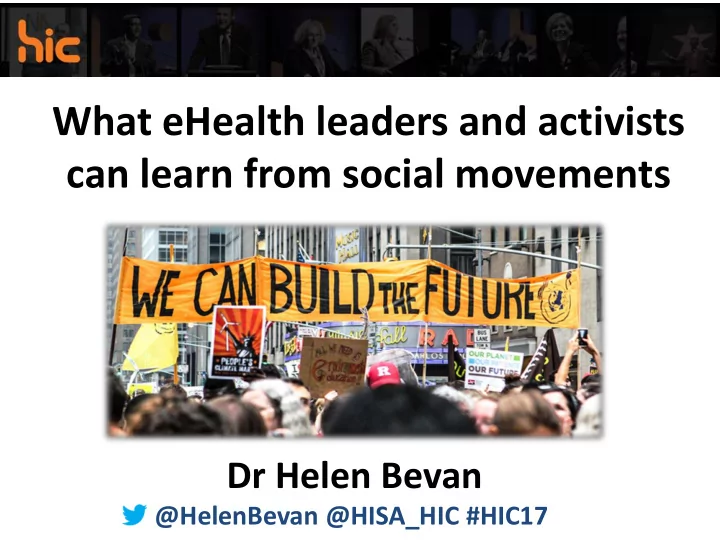
What eHealth leaders and activists can learn from social movements

Dr Helen Bevan

@HelenBevan @HISA_HIC #HIC17

slide-2
SLIDE 2

@HelenBevan #HIC17

The Horizons team:

Change agents and change agency

  • A small, diverse team of people within

the English National health Service that supports change agents and builds change agency

  • We tune into the latest change thinking and

practice in healthcare and other industries around the world

  • The team has emerged through years of supporting

change in the NHS and the wider health and care system

slide-3
SLIDE 3

@HelenBevan #HIC17

“When we talk of social change, we talk of movements, a word that suggest vast groups of people walking together, leaving behind one way and travelling towards another” Rebecca Solnit

slide-4
SLIDE 4

@HelenBevan #HIC17

What do successful social movements do?

  • Define the change they want to see
  • Identify the pillars of power
  • Create a spectrum of allies
  • Seek to attract not overpower
  • Build a plan to survive victory

Source: Satell G (2017) How to create transformational change, according to the world’s most successful social movements

slide-5
SLIDE 5

@HelenBevan #HIC17

“We must act with all due alacrity [speed/swiftness], yet also with the thoughtfulness and seriousness of purpose appropriate to meaningful action” Dr Martin Luther King Jr.

slide-6
SLIDE 6

@HelenBevan #HIC17

slide-7
SLIDE 7

@HelenBevan #HIC17

If we want people to take action, we have to connect with their emotions through values

action values emotion

Source: Marshall Ganz

slide-8
SLIDE 8

@HelenBevan #HIC17

“I have some KPIs for

  • ur digital journey”
  • r

“I have a dream”

Source: @RobertVarnam

slide-9
SLIDE 9

@HelenBevan #HIC17

“Because we want to, not because we have to”

slide-10
SLIDE 10

14,000 contributions identified 10 barriers to change:

Confusing strategies Over controlling leadership Perverse incentives Stifling innovation Poor workforce planning One way communication Inhibiting environment Undervaluing staff Poor project management Playing it safe

Source: Health Service Journal, Nursing Times, NHS Improving Quality, “Change Challenge”

slide-11
SLIDE 11

@HelenBevan #HIC17

Front line teams get inundated with high priority messages from leaders each day, making it difficult for them to know what to focus on

Increasing number of messages as information cascade through the organisation Source: adapted from http://businessjournal.gallup.com/content/162707/change-initiatives-fail- don.aspx

slide-12
SLIDE 12

@HelenBevan #HIC17

Identify the pillars of power

slide-13
SLIDE 13

@HelenBevan #HIC17

We still organise health and care like the Tabulating Machine Co. of 1917

Source of image: @corp_rebels

slide-14
SLIDE 14

@HelenBevan #HIC17

Jeremy Heimens, Henry Timms This is New Power

  • ld power

new power

Currency Held by a few Pushed down Commanded Closed Transaction Current Made by many Pulled in Shared Open Relationship

slide-15
SLIDE 15

@HelenBevan #HIC17

Create a spectrum of allies

Source of image: Greg Satell

slide-16
SLIDE 16

@HelenBevan #HIC17

WHO will make the change happen?

List A

  • The Digital Transformation

Delivery Board

  • The programme sponsors
  • The Programme Management

Office

  • The Digital Transformation

work stream leads

  • The Clinical Leads
  • The Directors of participating

functions

  • The Change Facilitators

Source: adapted by Helen Bevan from Leandro Herrera

slide-17
SLIDE 17

@HelenBevan #HIC17

WHO will make the change happen?

List B

  • The mavericks and rebels
  • The deviants (positive). Who do

things differently and succeed

  • The nonconformists who see

things through glasses no one else has

  • The hyper-connected who spread

behaviours, role model at a scale, set mountains on fire and multiply anything they get their hands on

  • The hyper-trusted. Multiple

reasons, doesn’t matter which

  • nes

Source: adapted by Helen Bevan from Leandro Herrera

List A

  • The Digital Transformation

Delivery Board

  • The programme sponsors
  • The Programme Management

Office

  • The Digital Transformation

work stream leads

  • The Clinical Leads
  • The Directors of participating

functions

  • The Change Facilitators
slide-18
SLIDE 18

@HelenBevan #HIC17

List A

  • The Digital Transformation

Delivery Board

  • The programme sponsors
  • The Programme Management

Office

  • The Digital Transformation

work stream leads

  • The Clinical Leads
  • The Directors of participating

functions

  • The Change Facilitators

WHO will make the change happen?

List B

  • The mavericks and rebels
  • The deviants (positive). Who do

things differently and succeed

  • The nonconformists who see

things through glasses no one else has

  • The hyper-connected who spread

behaviours, role model at a scale, set mountains on fire and multiply anything they get their hands on

  • The hyper-trusted. Multiple

reasons, doesn’t matter which

  • nes

Source: adapted by Helen Bevan from Leandro Herrera

slide-19
SLIDE 19

@HelenBevan #HIC17

What’s the evidence?

The failure of large scale transformational change projects is rarely due to the content or structure of the plans that are put into action

http://iedp.com/articles/vertical-leadership/?utm_source=Sign- Up.to&utm_medium=email&utm_campaign=13787-257163-Campaign+-+01%2F09%2F2016

Source: David Dinwoodie (2015)

It’s much more about the role of informal networks in the organisations and systems affected by change To make large scale change happen we should connect networks of people who ‘want’ to contribute

slide-20
SLIDE 20

@HelenBevan #HIC17

Mark Jaben on the science behind resistance

What NOT to do

But what we do do

Engage people here

slide-21
SLIDE 21

@HelenBevan #HIC17

Mark Jaben on the science behind resistance to change What NOT to do

(but what we usually do)

We don’t need buyers (who “buy-in” to change) We need investors

What TO do

Engage people here Engage people here

slide-22
SLIDE 22

@HelenBevan #improvedischarge

Seek to attract not overpower

slide-23
SLIDE 23

@HelenBevan #HIC17

To enable change, connect with the 3%

Just 3% of people in the organisation or system typically drive conversations with 90% of the

  • ther people

Source: research by Innovisor

slide-24
SLIDE 24

@HelenBevan #HIC17

  • Did we accomplish the goal we were trying to

accomplish?

  • Did our community grow stronger? (create

capacity; new power – power we didn’t have before)

  • Did individuals involved in the whole effort learn,

grow and develop their capacity to organise with

  • thers?

How would we know if our digital transformation efforts were successful from a social movement perspective?

slide-25
SLIDE 25

14,000 contributions identified 11 building blocks for change:

Inspiring & supportive leadership Collaborative working Thought diversity Autonomy & trust Smart use of resources Flexibility & adaptability Long term thinking Nurturing our people Fostering an open culture A call to action

Source: Health Service Journal, Nursing Times, NHS Improving Quality, “Change Challenge” March 2015

Challenging the status quo

slide-26
SLIDE 26

@HelenBevan #HIC17

After years of intensive analysis, Google discovered that the key to high performing teams that deliver change is being nice

Project Aristotle: https://www.youtube.com/watch?v=UfGiCnhdU78&feature=youtu.be&list=PLHEw3ja- xoaZybvz9f0b1_6bJyG7zZO6L

slide-27
SLIDE 27

@HelenBevan #improvedischarge

“If we take care of the relationships, the results will follow”

Chip Bell

Bridge building leaders