What Does the Future Hold? Structuring Arrangements, Meeting Legal - - PowerPoint PPT Presentation

what does the future hold
SMART_READER_LITE
LIVE PREVIEW

What Does the Future Hold? Structuring Arrangements, Meeting Legal - - PowerPoint PPT Presentation

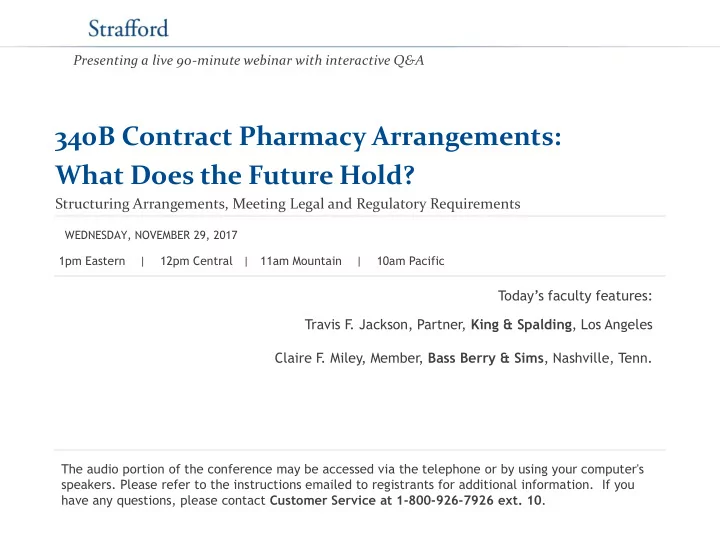
Presenting a live 90-minute webinar with interactive Q&A 340B Contract Pharmacy Arrangements: What Does the Future Hold? Structuring Arrangements, Meeting Legal and Regulatory Requirements WEDNESDAY, NOVEMBER 29, 2017 1pm Eastern |


slide-1
SLIDE 1

The audio portion of the conference may be accessed via the telephone or by using your computer's

  • speakers. Please refer to the instructions emailed to registrants for additional information. If you

have any questions, please contact Customer Service at 1-800-926-7926 ext. 10.

Presenting a live 90-minute webinar with interactive Q&A

340B Contract Pharmacy Arrangements: What Does the Future Hold?

Structuring Arrangements, Meeting Legal and Regulatory Requirements

Today’s faculty features:

1pm Eastern | 12pm Central | 11am Mountain | 10am Pacific WEDNESDAY, NOVEMBER 29, 2017

Travis F . Jackson, Partner, King & Spalding, Los Angeles Claire F . Miley, Member, Bass Berry & Sims, Nashville, Tenn.

slide-2
SLIDE 2

Tips for Optimal Quality

Sound Quality If you are listening via your computer speakers, please note that the quality

  • f your sound will vary depending on the speed and quality of your internet

connection. If the sound quality is not satisfactory, you may listen via the phone: dial 1-888-450-9970 and enter your PIN when prompted. Otherwise, please send us a chat or e-mail sound@straffordpub.com immediately so we can address the problem. If you dialed in and have any difficulties during the call, press *0 for assistance. Viewing Quality To maximize your screen, press the F11 key on your keyboard. To exit full screen, press the F11 key again.

FOR LIVE EVENT ONLY

slide-3
SLIDE 3

Continuing Education Credits

In order for us to process your continuing education credit, you must confirm your participation in this webinar by completing and submitting the Attendance Affirmation/Evaluation after the webinar. A link to the Attendance Affirmation/Evaluation will be in the thank you email that you will receive immediately following the program. For additional information about continuing education, call us at 1-800-926-7926

  • ext. 35.

FOR LIVE EVENT ONLY

slide-4
SLIDE 4

Program Materials

If you have not printed the conference materials for this program, please complete the following steps:

  • Click on the ^ symbol next to “Conference Materials” in the middle of the left-

hand column on your screen.

  • Click on the tab labeled “Handouts” that appears, and there you will see a

PDF of the slides for today's program.

  • Double click on the PDF and a separate page will open.
  • Print the slides by clicking on the printer icon.

FOR LIVE EVENT ONLY

slide-5
SLIDE 5

340B Contract Pharmacy Arrangements: What Does the Future Hold?

November 29, 2017

5

slide-6
SLIDE 6

Outline

  • I. Structuring and implementing contract pharmacy arrangements

A.

Overview and need for services

B.

Due diligence

C.

Fee structures

D.

What operational and contractual considerations should counsel keep in mind when structuring and implementing these arrangements?

E.

What compliance challenges must be overcome when structuring a contract pharmacy arrangement?

  • II. 340B entity compliance issues

A.

Certifications

B.

Contractor-associated liability

C.

Covered entity requirements

  • III. A look ahead

A.

Enforcement and sanctions

B.

Future of 340B Guidance

6

slide-7
SLIDE 7

Overview and Need For Services

7

slide-8
SLIDE 8

340B Program Overview

The 340B Drug Pricing Program

► requires drug manufacturers who participate

in Medicaid to provide outpatient drugs to eligible healthcare organizations (“Covered Entities,” or “CEs”) at significantly reduced prices.

8

slide-9
SLIDE 9

340B Program Overview

CEs receive significant discounts on covered

  • utpatient drugs

► Estimated average savings of 20-50% ► Estimated $16 billion in 340B drug purchases in 2016

(5% of U.S. Drug Market), per Drug Channels

CEs are defined in statute and include

► HRSA-supported health centers, ► Ryan White clinics and State AIDS Drug Assistance

programs,

► Medicare/Medicaid Disproportionate Share Hospitals, ► children’s hospitals, and ► other safety net providers.

9

slide-10
SLIDE 10

340B Program Overview: Contract Pharmacies

HRSA permits CEs to contract with pharmacies to provide pharmacy services on the CE’s behalf to CE patients. Initially, CEs were limited to one contract pharmacy relationship In 2010, HRSA allowed CEs to enter into multiple contract pharmacy relationships Contract pharmacies (“CPs”) are a growth area, but also one under OIG, GAO, and manufacturer scrutiny

10

slide-11
SLIDE 11

Contract Pharmacy Arrangement: Example Process Flow

Patient CE purchases 340B Drugs Drugs shipped to CP Covered Entity Payer CP remits reimbursement less fee 340B eligible patient relationship CP adjudicates script Payer reimburses CP CP dispenses; collects Patient cost-share

11

Wholesaler Contract Pharmacy

slide-12
SLIDE 12

Need For Contract Pharmacy Services

HRSA: “[T]he delivery of pharmacy services is central to the mission” of covered entities, which “rely on

  • utside pharmacies to fill the need. It would defeat

the purpose of the 340B program if these covered entities could not use their affiliated pharmacies in

  • rder to participate in the 340B program [emphasis

supplied].”

► 61 Fed. Reg. 43549, 43550 (Aug. 23, 1996).

BUT, there is growing backlash among some 340B stakeholders to CP arrangements There is also growing government scrutiny of the 340B program in general

12

slide-13
SLIDE 13

Congressional Scrutiny

Extensive number of Congressional hearings Potential draft legislation discussed in May 2017:

► At a trade association event, Rep. Collins (R-NY) promised to introduce

340B reform legislation

► Reports indicate that the proposed bill would narrow the eligible patient

definition, limit new CE enrollment, limit CPs, and expand HRSA

  • versight of the program

► Has not been introduced in Congress

Even if the Rep. Collins legislation does not materialize, we do expect some legislative package, which may contain one or more of the following:

► Definition of patient ► Limits on contract pharmacies (e.g., by number and/or location) ► Limits on charges for 340B drugs ► Required reporting of amount and use of 340B savings

13

slide-14
SLIDE 14

Congressional Scrutiny

July 2017 – Testimony of GAO Before Congress “Update on Agency Efforts to Improve 340B Program Oversight” Highlights of Testimony:

► HRSA Audits ► Clarifying Program Guidance on

  • Definition of Patient
  • Eligibility Criteria for non-publicly owned hospitals

► Due in 2018 -- Oversight of 340B Contract Pharmacies

14

slide-15
SLIDE 15

Reimbursement – 340B Trend to Watch

Government Program Capture of 340B Savings 2018: Final Medicare OPPS Rule

► Cuts the applicable payment rate for separately

payable drugs and biologicals (other than drugs on pass-through payment status and vaccines) acquired under the 340B program from average sales price (ASP) plus 6 percent to ASP minus 22.5 percent.

► Exemptions for certain rural sole community

hospitals, CAHs, PPS-exempt cancer hospitals, and HOPDs subject to site neutrality rules

15

slide-16
SLIDE 16

Reimbursement – 340B Trend to Watch

Government Program Capture of 340B Savings 2018: Final Medicare OPPS Rule

► The AHA and other advocacy groups filed suit

against HHS on11/13/17.

► The complaint alleges that HHS’s rulemaking was:

  • arbitrary and capricious; and/or
  • contrary to law; and
  • is in excess of the agency’s statutory authority.

16

slide-17
SLIDE 17

Reimbursement – 340B Trend to Watch

Government Program Capture of 340B Savings 2018: Final Medicare OPPS Rule

► Rep. David McKinley (R-WV) introduced H.R.

4392 to block the 340B OPPS cuts on 11/14/17

► Bill has been referred to the House Committee on

Energy and Commerce and the House Ways and Means Committee

17

slide-18
SLIDE 18

Reimbursement – 340B Trend to Watch

Government Program Capture of 340B Savings 2016: Medicaid Covered Outpatient Drug Rule

► “[T]his final rule is designed to ensure that

pharmacy reimbursement is aligned with the acquisition cost of drugs and that the states pay an appropriate professional dispensing fee.”

► Requires States to transition to AAC-based

methodology for pharmacy reimbursement

18

slide-19
SLIDE 19

Reimbursement – What Effect on Contract Pharmacies?

OPPS cut due to take effect January 1, 2018 If cuts survive, the 340B program will likely become less attractive to covered entity hospitals Therefore, despite the recent boom in contract pharmacies, will they dry up in the future?

19

slide-20
SLIDE 20

340B Program Overview: Contract Pharmacies

Contract pharmacy growth has perhaps leveled off:

► Per Apexus:

20

Date # of Unique 340B CPs % Growth 1/1/12 4,238 1/1/13 9,832 132% 1/1/14 13,707 39% 1/1/15 16,269 19% 1/1/16 17,463 7% 1/1/17 18,705 7%

slide-21
SLIDE 21

Due Diligence

21

slide-22
SLIDE 22

Contract Pharmacy Due Diligence

Three Areas of Inquiry

1.

The Pharmacy

2.

The Vendor

3.

The Covered Entity

22

slide-23
SLIDE 23

The Pharmacy

  • What is the business justification for the contract pharmacy

relationship?

  • What is the pharmacy’s compliance record?
  • Is the pharmacy a good fit for the covered entity’s culture?
  • What processes does the pharmacy have in place to ensure

340B outpatient drugs are dispensed only to qualifying patients?

  • How does the pharmacy store prescription records?
  • Is the pharmacy equipped to connect to the covered entity

through its EHR?

  • What restrictions might exist on the pharmacy through

managed care or vendor agreements?

23

slide-24
SLIDE 24

The Vendor

  • What is the vendor’s experience and reputation?
  • Is the vendor a good cultural fit for the covered entity?
  • Does the vendor offer a system that supports compliance?

― Identifying eligible patients ― Preventing duplicate discounts

  • How does the vendor support inventory management?
  • What are the vendor’s reporting capabilities?
  • How is the fee structured?
  • Does the covered entity control the revenue?

24

slide-25
SLIDE 25

The Covered Entity

  • Is the contract pharmacy network exclusive?
  • What is the pharmacy’s role and responsibilities in audits?
  • Will the engagement affect any wholesaler arrangements?
  • Will the engagement impact any rebates?
  • What miscellaneous costs might exist, e.g. EHR and additional
  • versight?
  • What is the covered entity’s compliance record?
  • Is the covered entity a good cultural fit?

25

slide-26
SLIDE 26

Fee Structures

26

slide-27
SLIDE 27

Fee structures

HRSA permits CEs and CPs wide flexibility to develop mutually acceptable fee structures Compensation must comply with state and federal fraud and abuse requirements

27

slide-28
SLIDE 28

Fee structures

In a typical contract pharmacy arrangement, the contract pharmacy receives a fixed dispensing fee for each 340B prescription dispensed. Many contract pharmacy arrangements also use what is known as a “replenishment model”

► CP uses its own inventory initially ► Accumulator software is used after the fact to tally the

eligible 340B patients from records of prior prescriptions

► CE then replenishes the inventory, in an amount

equaling the actual prior usage by such eligible patients, with covered drugs purchased at the discounted 340B price from manufacturers.

28

slide-29
SLIDE 29

Typical Financial Arrangement – “Pass-Through Model”

Transaction Payments CP buys initial inventory $100 CP bills payer $120 CP collects co-pay $20 CP collects reimbursement $100 CP transfers total reimbursement to CE $120 CE pays CP fixed dispensing fee for the 340B prescription (if not already netted out of reimbursement transferred to CE) $20 CE pays for replenishment inventory $60 Gross Margin to CP (dispensing fee) $20 Gross Margin to CE (reimbursement – COGs – dispensing fee) $40

29

slide-30
SLIDE 30

Other Fee structures

Tiered Dispensing Fees

► What drives the tier? ► Payer Reimbursement Amount ► Cost of Drug

Variations of Per Rx Dispense Fees

► Per Processed Claim ► Per Eligible Claim

30

slide-31
SLIDE 31

Other Fee structures

Flat Monthly Fees Percentage of Collections Fees “Reference Pricing” Model Combinations and “Add-On” Fees

31

slide-32
SLIDE 32

Operational and Contractual Considerations

32

slide-33
SLIDE 33

Operational Considerations

  • The Compliance Challenge

Applying the covered entity’s policies and procedures to the contract pharmacy

Patient definition

GPO prohibition

Ensuring adequate oversight of the day-to-day contract pharmacy operations

― Contract pharmacy registration

― Conducting internal and external audits ― Understanding financial expectations

Third party payors

Financial assistance

Dispensing fees

33

slide-34
SLIDE 34

Operational Considerations

  • The IT Challenge

― Incorporating all necessary data components to

identify eligible patients

― Minimizing/eliminating manual processes

― Understanding inventory management protocols

― Replenishment ― True Ups ― Formulary

― Making appropriate payments

34

slide-35
SLIDE 35

Operational Considerations

  • The People Challenge

― Developing policies and procedures that allow

covered entity and pharmacy employees to work as a team

― Identifying key contacts ― Understanding when and how audits will be

conducted

― Discussing implementation or operational issues ― Developing a mechanism to resolve disputes

35

slide-36
SLIDE 36

Contractual Considerations

  • Vendor Agreement

― Fee Structure ― Application of other federal and state laws ― Non-Exclusivity ― Replenishment ― Reports

36

slide-37
SLIDE 37

Contractual Considerations

  • Contract Pharmacy Agreement

― HRSA Essential Covered Entity Compliance

Elements

― Operational Needs

― The Compliance Challenge ― The IT Challenge ― The People Challenge

― Term and Termination ― Compliance with Laws ― Exclusivity v. Non-Exclusive

37

slide-38
SLIDE 38

Contracting Compliance Challenges

38

slide-39
SLIDE 39

Contracting Compliance Challenges: HRSA’s 12 Essential Compliance Elements

Ship to, Bill to Compliance with law Patient Choice Comprehensive Pharmacy Services 340B Pricing Restriction Contract Pharmacy Reporting Tracking System Duplicate Discounts Prohibited Patient Eligibility Verification Subject to Audits Maintain Auditable Records Provision of Agreement to OPA

39

slide-40
SLIDE 40

Typical Roles – Allocation of Functions Among Different Parties Underscores Need for Compliance Coordination

Role Covered Entity Contract Pharmacy Admin Determine Patient Eligibility Dispense Drug and Provide Patient Care Track Replenishment and Prepare Order for Drug Order Replenishment Drug from Wholesaler Bill Payer Receive Reimbursement and Collect Copay Written Materials such as Policies and Procedures

? ? ?

CE Training/Internal Audits

? ? ?

Coordination with Account Managers, Operations, and IT for Items on COPs

? ? ?

40

slide-41
SLIDE 41

Contracting Compliance Challenges – Focus Areas

Implementation of 2018 OPPS changes

► Modifier JG ► Includes PVP/Apexus drugs acquired at sub-

ceiling prices

► Modifier TB – rural sole community hospitals,

children’s hospitals, and PPS-exempt cancer hospitals

Required reporting of amount and use of savings – Expected part of any legislative package

41

slide-42
SLIDE 42

Contracting Compliance Challenges – Focus Areas

Prevention of Diversion and Potential Legislative Narrowing of Definition of “Patient” Duplicate Discounts, including Managed Medicaid

► No formal guidance from HRSA ► 2016 Medicaid managed care rule obligates plans

to exclude 340B drugs from rebate claims

► BUT, still no standard reporting practices

42

slide-43
SLIDE 43

Contracting Compliance Challenges – Focus Areas

Standard advice regarding carve out of Medicaid Claims at Contract Pharmacies vs. State Legislative Initiatives Overpayments from Payers

43

slide-44
SLIDE 44

Contractor Liability?

Compliance with 340B program rules is the sole responsibility of the CE A CP generally does not have direct exposure for program violations Therefore, CEs seek recourse against CPs and TPAs via contract provisions:

► Indemnification/consequential damages ► Insurance?

44

slide-45
SLIDE 45

Certifications

45

slide-46
SLIDE 46

Certifications

46

slide-47
SLIDE 47

Certifications

  • All information listed on the 340B Program database for the

covered entity is complete, accurate and correct.

  • The covered entity meets 340B Program eligibility

requirements.

  • The covered entity will comply with all requirements of the

340B Program, e.g.:

― Diversion ― Duplicate discounts ― GPO prohibition, if applicable

  • The covered entity maintains auditable records pertaining to

compliance with 340B Program requirements.

  • Contract pharmacy arrangements will be performed in

accordance with OPA requirements and guidelines.

47

slide-48
SLIDE 48

Certifications

  • Covered entity will contact OPA as soon as

possible if a breach occurs or change in 340B Program eligibility.

  • Covered entity may be liable to manufacturers for

repayment and could be terminated from participating in the 340B Program.

48

slide-49
SLIDE 49

Contract Pharmacy Registration

  • Enrolling in the 340B Program is a multi-step process that

varies based on entity type

Must meet all eligibility criteria prior to registering with OPA

Must register the calendar quarter prior to participating in the 340B Program

Poor planning regarding eligibility and prospective registration requirements often result in improper or denied applications and the loss of significant savings / revenue

49

slide-50
SLIDE 50

Contract Pharmacy Registration

  • Covered entities must register contract pharmacies

prior to use. A new contract pharmacy can only be registered during quarterly periods:

Registration Periods Start Date January 1 – 15 April 1 April 1 – 15 July 1 July 1 – 15 October 1 October 1 – 15 January 1

50

slide-51
SLIDE 51

Covered Entity Requirements

51

slide-52
SLIDE 52

Covered Entity Requirements

  • Eligibility
  • Diversion
  • GPO Prohibition*
  • Duplicate Discount Prohibition
  • Orphan Drug Exclusion**
  • Contract Pharmacy Arrangements
  • OPA Database Registration

*DSHs, children’s and cancer hospital only **SCHs, RRCs, CAHs and cancer hospitals only

52

slide-53
SLIDE 53

Eligibility

  • Hospitals

− Certain Disproportionate Share Hospitals − Critical Access Hospitals − Rural Referral Centers − Sole Community Hospitals − Children’s Hospitals − Free Standing Cancer Hospitals

  • Federal Grantees

Comprehensive Hemophilia Treatment Centers

Federally Qualified Health Centers

Urban/638 Health Center

Ryan White Programs

Sexually Transmitted Disease/Tuberculosis

Title X Family Planning

53

slide-54
SLIDE 54

Hospital Eligibility

Covered Entity Non- profit / govt contract DSH% GPO Exclusion Orphan Drug Exclusion Critical Access Hospital Yes No No Yes Rural Referral Center Yes > 8% No Yes Sole Community Hospital Yes > 8% No Yes Free-Standing Cancer Hospitals Yes >11.75% Yes Yes Children’s Hospitals Yes >11.75% Yes No DSH Hospital Yes >11.75% Yes No

54

slide-55
SLIDE 55

Diversion

  • Diversion is strictly prohibited!

― 340B drugs can only be provided to eligible

  • utpatients

― Cannot re-sell, give, or otherwise transfer 340B drugs to

any other entity or individual

― Cannot loan or borrow 340B drugs to/from another

entity

  • Must maintain an audit trail for every dispensation

55

slide-56
SLIDE 56

GPO Prohibition

  • DSHs, children’s hospitals and freestanding cancer hospitals may not

“obtain covered outpatient drugs through a group purchasing

  • rganization or other group purchasing arrangement”
  • February 7, 2013 HRSA Policy Release
  • Sanctions for violating GPO prohibition can include, but are not limited

to the following:

  • Removal from the program
  • Corrective action plans
  • Repayments to wholesalers/manufacturers
  • Examples of when the GPO prohibition applies:
  • 340B outpatients
  • Drugs that are not available at 340B pricing (must notify OPA)
  • Carved-out Medicaid patients

56

slide-57
SLIDE 57

GPO Prohibition

  • GPOs come in many shapes and sizes
  • GPO accounts may include:

− Traditional GPO accounts (Cardinal, McKesson,

AmerisourceBergen, etc.)

− Generic source accounts − Other collectively negotiated drug purchasing

accounts (e.g. multi-covered entity health system)

57

slide-58
SLIDE 58

Duplicate Discounts

  • Manufacturers only required to provide 340B discount OR

Medicaid (MCD) Drug Rebate Program rebate, not both

Statute places onus on covered entity and state to ensure no duplicate discounts are obtained

Must properly register with OPA/MCD Exclusion File

Carve-in = 340B drugs to MCD patients; state will not seek rebates; on exclusion file

Carve-out = non-340B drugs to MCD patients; state should seek rebates; not on exclusion file

Contract pharmacies must carve-out unless a limited exception is met

58

slide-59
SLIDE 59

Orphan Drug Exclusion

  • An orphan drug is a drug designated by the FDA to

treat a specific rare disease or condition

  • Orphan drugs cannot be purchased at 340B rates if the

covered entity is a rural referral center, sole community hospital, critical access hospital or free- standing cancer hospital.

  • Manufacturers are not required to provide these

covered entities orphan drugs under the 340B Program.

− A manufacturer may, at its sole discretion, offer

discounts on orphan drugs to these hospitals

59

slide-60
SLIDE 60

Contract Pharmacy Arrangements

  • Examples of published OPA findings include:

― Covered entity was using a pharmacy with which it

had a written contract in place, but the pharmacy was not listed on the 340B database

― Covered entity registered contract pharmacies on

the 340B database without having written contracts in place

― Patients were ineligible for 340B

60

slide-61
SLIDE 61

Enforcement and Sanctions

61

slide-62
SLIDE 62

Enforcement and Sanctions - HRSA

CEs are subject to audit by HRSA for compliance with 340B Program requirements, including CP requirements. HRSA regularly sanctions CEs for failing to comply with CP registration and oversight requirements. Sanctions include: manufacturer repayment; CE or CP termination from the 340B program; corrective action plan

62

slide-63
SLIDE 63

HRSA Audit Expectations

Annual Re-certifications Self-Disclosures/Material Breach Internal Investigations HRSA/OPA/Bizzell Audits

63

slide-64
SLIDE 64

Enforcement and Sanctions - Manufacturers

CEs are also subject to audit by manufacturers for violation of diversion or duplicate discount prohibitions. At least 45 days prior to conducting an audit, manufacturers must submit audit work plans to HRSA for review. Manufacturer audits must be performed by an independent auditor at the manufacturer’s expense. CEs must respond to audit findings within 30 days. Unlike HRSA audits, results of manufacturer audits are not publically available.

64

slide-65
SLIDE 65

Enforcement and Sanctions - Manufacturers

Manufacturer Audit Guidelines:

► Number of Audits – may only conduct audits

when “reasonable cause” to believe a CE has violated 340B program requirements

► Scope of Audits – audit work plan must be

approved by HRSA. Limited to the manufacturer's drugs (not CE’s entire 340B operations)

► Duration of Audits – audit duration of no more

than 1 year; performed with the minimum time and intrusion necessary

65

slide-66
SLIDE 66

Enforcement and Sanctions - Manufacturers

Post-Audit Procedures

► Manufacturer submits copy of final audit to CE,

and CE has 30 days to respond with a corrective action proposal or grounds for disagreement.

► Manufacturer submits copies of final audit report

& CE response to HRSA

Potential sanctions (HRSA determines penalty): manufacturer repayment; termination of participation in 340B Program; corrective action plan

66

slide-67
SLIDE 67

Enforcement and Sanctions

HRSA has published the results of 103 audits of CEs for FY 2017.

► Of these, HRSA identified non-compliance

with 340B Program requirements in about 45% of audits.

67

slide-68
SLIDE 68

Examples of HRSA Sanctions

Baptist Health Medical Center – Arkadelphia (FY 2017)

► Audit Findings:

  • Diversion; 340B drugs dispensed at contract

pharmacy for prescriptions written at ineligible sites

► Sanction Imposed:

  • Corrective Action Plan
  • Manufacturer Repayments

68

slide-69
SLIDE 69

Examples of HRSA Sanctions

Escambia Community Clinics, Inc. (FY 2017)

► Audit Findings:

  • Incorrect 340B database record; Registered

contract pharmacies without written contracts in place.

  • Duplicate Discounts

► Sanction Imposed:

  • Termination of 2 CPs from 340B Program
  • Manufacturer Repayment
  • Corrective Action Plan

69

slide-70
SLIDE 70

Examples of HRSA Sanctions

San Joaquin Community Hospital (FY 2017)

► Audit Findings:

  • Entity’s written contract pharmacy agreement listed

information inconsistent with the 340B database record.

  • Diversion; 340B drugs were not properly

accumulated.

► Sanction Imposed:

  • Manufacturer Repayments
  • Corrective Action Plan

70

slide-71
SLIDE 71

Examples of HRSA Sanctions

Southwest Memorial Hospital (FY 2017)

► Audit Findings:

  • Entity did not provide contract pharmacy oversight.
  • Diversion; 340B drugs dispensed at entity and at

contract pharmacies for prescriptions written at ineligible sites.

► Sanction Imposed:

  • Termination of CPs from 340B Program
  • Manufacturer Repayments
  • Corrective Action Plan

71

slide-72
SLIDE 72

Future of 340B Guidance

72

slide-73
SLIDE 73

Where do we go from here?

73

June 2017:

  • Media reports cite a leaked draft executive order targeting

the 340B Program.

  • Resources provided by the 340B Program directed so they

primarily benefit lower income or otherwise vulnerable

  • Rescind or revise regulations or guidance that allow 340B

Program benefits to accrue to entities or populations other than the safety net healthcare providers that the program was intended to strengthen

slide-74
SLIDE 74

Where do we go from here?

October 2017

― Reportedly leaked policy document from the

administration prescribes “serious 340B reform.” November 2017:

― Joseph Grogan, associate director of health programs

for the Office of Management and Budget, criticized the 340B program.

― President Trump nominates Alex Azar to be the next

Secretary of the U.S. Department of Health & Human Services.

74

slide-75
SLIDE 75

Questions?

Contact Information:

Travis F . Jackson, tjackson@kslaw.com Claire F . Miley, cmiley@bassberry.com

75