What do (ordinary) nuclei look like? Charge densities of magic - - PowerPoint PPT Presentation

what do ordinary nuclei look like
SMART_READER_LITE
LIVE PREVIEW

What do (ordinary) nuclei look like? Charge densities of magic - - PowerPoint PPT Presentation

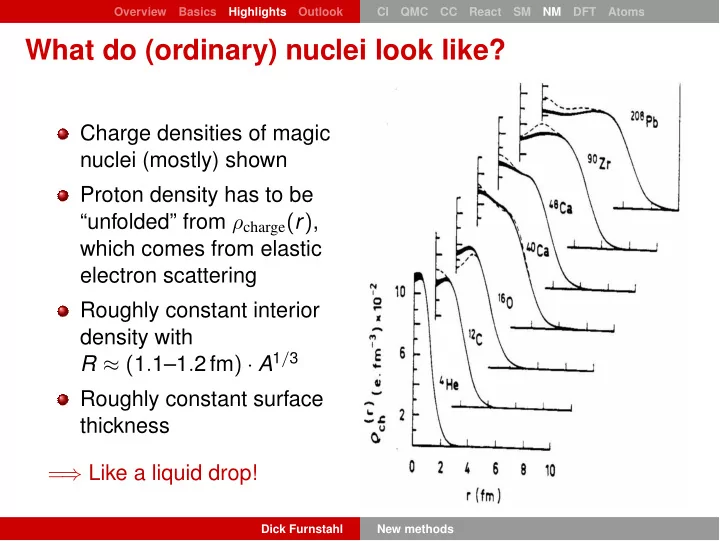
Overview Basics Highlights Outlook CI QMC CC React SM NM DFT Atoms What do (ordinary) nuclei look like? Charge densities of magic nuclei (mostly) shown Proton density has to be unfolded from charge ( r ) , which comes from


slide-1
SLIDE 1

Overview Basics Highlights Outlook CI QMC CC React SM NM DFT Atoms

What do (ordinary) nuclei look like?

Charge densities of magic nuclei (mostly) shown Proton density has to be “unfolded” from ρcharge(r), which comes from elastic electron scattering Roughly constant interior density with R ≈ (1.1–1.2 fm) · A1/3 Roughly constant surface thickness = ⇒ Like a liquid drop!

Dick Furnstahl New methods

slide-2
SLIDE 2

Overview Basics Highlights Outlook CI QMC CC React SM NM DFT Atoms

What do (ordinary) nuclei look like?

Charge densities of magic nuclei (mostly) shown Proton density has to be “unfolded” from ρcharge(r), which comes from elastic electron scattering Roughly constant interior density with R ≈ (1.1–1.2 fm) · A1/3 Roughly constant surface thickness = ⇒ Like a liquid drop!

Dick Furnstahl New methods

slide-3
SLIDE 3

Overview Basics Highlights Outlook CI QMC CC React SM NM DFT Atoms

Semi-empirical mass formula

(A = N + Z) EB(N, Z) = avA − asA2/3 − aC Z 2 A1/3 − asym (N − Z)2 A + ∆ Many predictions! Rough numbers: av ≈ 16 MeV, as ≈ 18 MeV, aC ≈ 0.7 MeV, asym ≈ 28 MeV Pairing ∆ ≈ ±12/ √ A MeV (even-even/odd-odd) or 0 [or 43/A3/4 MeV or . . . ] Surface symmetry energy: asurf sym(N − Z)2/A4/3 Much more sophisticated mass formulas include shell effects, etc.

Dick Furnstahl New methods

slide-4
SLIDE 4

Overview Basics Highlights Outlook CI QMC CC React SM NM DFT Atoms

Semi-empirical mass formula per nucleon

EB(N, Z) A = av − asA−1/3 − aC Z 2 A4/3 − asym (N − Z)2 A2

Divide terms by A = N + Z Rough numbers:

av ≈ 16 MeV, as ≈ 18 MeV, aC ≈ 0.7 MeV, asym ≈ 28 MeV

Surface symmetry energy:

asurf sym(N − Z)2/A7/3

Now take A → ∞ with Coulomb → 0 and fixed N/A, Z/A Surface terms negligible

Dick Furnstahl New methods

slide-5
SLIDE 5

Overview Basics Highlights Outlook CI QMC CC React SM NM DFT Atoms

Nuclear and neutron matter energy vs. density

[Akmal et al. calculations shown]

0.05 0.1 0.15 0.2 0.25

  • 20

20 40

APR NRAPR RAPR )

  • 3

n (fm E/A (MeV) Nuclear matter Neutron matter

Uniform with Coulomb turned off Density n (or often ρ) Fermi momentum n = (ν/6π2)k3

F

Neutron matter (Z = 0) has positive pressure Symmetric nuclear matter

(N = Z = A/2) saturates

Empirical saturation at about E/A ≈ −16 MeV and n ≈ 0.17 ± 0.03 fm−3

Dick Furnstahl New methods