What Are You Looking at? Jerry Gilfoyle The Zeeman Effect 1 / 17 - - PowerPoint PPT Presentation

what are you looking at
SMART_READER_LITE
LIVE PREVIEW

What Are You Looking at? Jerry Gilfoyle The Zeeman Effect 1 / 17 - - PowerPoint PPT Presentation

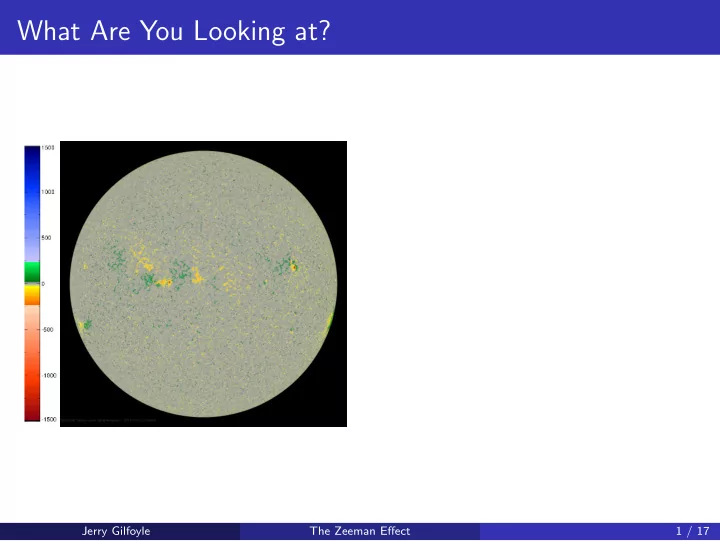
What Are You Looking at? Jerry Gilfoyle The Zeeman Effect 1 / 17 What Are You Looking at? 1 Hint: It makes these happen. Jerry Gilfoyle The Zeeman Effect 1 / 17 What Are You Looking at? 1 Hint: It makes these happen. 2 This a magnetogram


slide-1
SLIDE 1

What Are You Looking at?

Jerry Gilfoyle The Zeeman Effect 1 / 17
slide-2
SLIDE 2

What Are You Looking at?

1 Hint: It makes these happen. Jerry Gilfoyle The Zeeman Effect 1 / 17

slide-3
SLIDE 3

What Are You Looking at?

1 Hint: It makes these happen. 2 This a magnetogram from the

Solar Dynamics Observatory (SDO).

Jerry Gilfoyle The Zeeman Effect 1 / 17

slide-4
SLIDE 4

What Are You Looking at?

1 Hint: It makes these happen. 2 This a magnetogram from the

Solar Dynamics Observatory (SDO).

3 It shows the magnetic field

strength and polarity along the line of sight from the satellite.

Jerry Gilfoyle The Zeeman Effect 1 / 17

slide-5
SLIDE 5

What Are You Looking at?

1 Hint: It makes these happen. 2 This a magnetogram from the

Solar Dynamics Observatory (SDO).

3 It shows the magnetic field

strength and polarity along the line of sight from the satellite.

4 The legend shows the field

strength in gauss.

Jerry Gilfoyle The Zeeman Effect 1 / 17

slide-6
SLIDE 6

What Are You Looking at?

1 Hint: It makes these happen. 2 This a magnetogram from the

Solar Dynamics Observatory (SDO).

3 It shows the magnetic field

strength and polarity along the line of sight from the satellite.

4 The legend shows the field

strength in gauss.

5 Understanding the Sun’s magnetic

field is essential for understanding solar weather.

Jerry Gilfoyle The Zeeman Effect 1 / 17

slide-7
SLIDE 7

What Are You Looking at?

1 Hint: It makes these happen. 2 This a magnetogram from the

Solar Dynamics Observatory (SDO).

3 It shows the magnetic field

strength and polarity along the line of sight from the satellite.

4 The legend shows the field

strength in gauss.

5 Understanding the Sun’s magnetic

field is essential for understanding solar weather.

6 Why should you care? Ask him. Jerry Gilfoyle The Zeeman Effect 1 / 17

slide-8
SLIDE 8

How Do We Measure the Magnetic Field on the Surface of the Sun?

Jerry Gilfoyle The Zeeman Effect 2 / 17

slide-9
SLIDE 9

How Do We Measure the Magnetic Field on the Surface of the Sun?

1

The Sun consists of hydrogen (71.0%), helium (27.1%) and 65 other elements.

Jerry Gilfoyle The Zeeman Effect 2 / 17

slide-10
SLIDE 10

How Do We Measure the Magnetic Field on the Surface of the Sun?

1

The Sun consists of hydrogen (71.0%), helium (27.1%) and 65 other elements.

2

These atoms are constantly absorbing and emitting energy.

Jerry Gilfoyle The Zeeman Effect 2 / 17

slide-11
SLIDE 11

How Do We Measure the Magnetic Field on the Surface of the Sun?

1

The Sun consists of hydrogen (71.0%), helium (27.1%) and 65 other elements.

2

These atoms are constantly absorbing and emitting energy.

3

Left-hand side shows close-up of a sunspot.

Jerry Gilfoyle The Zeeman Effect 2 / 17

slide-12
SLIDE 12

How Do We Measure the Magnetic Field on the Surface of the Sun?

1

The Sun consists of hydrogen (71.0%), helium (27.1%) and 65 other elements.

2

These atoms are constantly absorbing and emitting energy.

3

Left-hand side shows close-up of a sunspot.

4

Right-hand side shows spectroscopic

  • lines. One of the lines divides.

Jerry Gilfoyle The Zeeman Effect 2 / 17

slide-13
SLIDE 13

How Do We Measure the Magnetic Field on the Surface of the Sun?

1

The Sun consists of hydrogen (71.0%), helium (27.1%) and 65 other elements.

2

These atoms are constantly absorbing and emitting energy.

3

Left-hand side shows close-up of a sunspot.

4

Right-hand side shows spectroscopic

  • lines. One of the lines divides.

5

The split lines are caused by the high magnetic field in that region.

Jerry Gilfoyle The Zeeman Effect 2 / 17

slide-14
SLIDE 14

How Do We Measure the Magnetic Field on the Surface of the Sun?

1

The Sun consists of hydrogen (71.0%), helium (27.1%) and 65 other elements.

2

These atoms are constantly absorbing and emitting energy.

3

Left-hand side shows close-up of a sunspot.

4

Right-hand side shows spectroscopic

  • lines. One of the lines divides.

5

The split lines are caused by the high magnetic field in that region.

6

The splitting of spectroscopic lines was first observed by Pieter Zeeman (Nobel with Lorentz in 1902).

Jerry Gilfoyle The Zeeman Effect 2 / 17

slide-15
SLIDE 15

How Do We Measure the Magnetic Field on the Surface of the Sun?

1

The Sun consists of hydrogen (71.0%), helium (27.1%) and 65 other elements.

2

These atoms are constantly absorbing and emitting energy.

3

Left-hand side shows close-up of a sunspot.

4

Right-hand side shows spectroscopic

  • lines. One of the lines divides.

5

The split lines are caused by the high magnetic field in that region.

6

The splitting of spectroscopic lines was first observed by Pieter Zeeman (Nobel with Lorentz in 1902).

The Zeeman Effect!

Jerry Gilfoyle The Zeeman Effect 2 / 17

slide-16
SLIDE 16

The Question

Left-hand plot below shows spectra of a sunspot. The labels from (A) to (D) correspond to the locations indicated in right-hand image. The single line (A) is split as the position shifts into the sunspot. The absorption lines at 6301.5 angstroms and 6302.5 angstroms are from iron. What is the size of the magnetic field that created the observed splitting?

Jerry Gilfoyle The Zeeman Effect 3 / 17

slide-17
SLIDE 17

Hydrogen Eigenvalues (Energy Levels)

En = −µ(e2)2 22n2 = −13.6 eV n2

Discrete States Continuum States 2 4 6 8

  • 15
  • 10
  • 5

5 Energy (eV) Jerry Gilfoyle The Zeeman Effect 4 / 17

slide-18
SLIDE 18

Hydrogen Eigenvalues (Energy Levels)

En = −µ(e2)2 22n2 = −13.6 eV n2

Discrete States Continuum States 2 4 6 8

  • 15
  • 10
  • 5

5 Energy (eV) Jerry Gilfoyle The Zeeman Effect 4 / 17

slide-19
SLIDE 19

Zeeman Effect - Hα line in hydrogen

Jerry Gilfoyle The Zeeman Effect 5 / 17

slide-20
SLIDE 20

Current Loop in a Magnetic Field - 1 z I B r p

Jerry Gilfoyle The Zeeman Effect 6 / 17

slide-21
SLIDE 21

Current Loop in a Magnetic Field - 2

B Iin Iout Fin Fout τ in y x out z θ µ

Jerry Gilfoyle The Zeeman Effect 7 / 17

slide-22
SLIDE 22

Current Loop in a Magnetic Field - 3

B Iin Iout Fin Fout τ in y x out z θ µ

Jerry Gilfoyle The Zeeman Effect 8 / 17

slide-23
SLIDE 23

Current Loop in a Magnetic Field - 4

Jerry Gilfoyle The Zeeman Effect 9 / 17

slide-24
SLIDE 24

Current Loop in a Magnetic Field - 5

Jerry Gilfoyle The Zeeman Effect 10 / 17

slide-25
SLIDE 25

Current Loop in a Magnetic Field - 6

Jerry Gilfoyle The Zeeman Effect 11 / 17

slide-26
SLIDE 26

Current Loop in a Magnetic Field - 6

Jerry Gilfoyle The Zeeman Effect 11 / 17

slide-27
SLIDE 27

Current Loop in a Magnetic Field - 7

Fin Fout Iout Iin B y x out z θ µ

Jerry Gilfoyle The Zeeman Effect 13 / 17

slide-28
SLIDE 28

Current Loop in a Magnetic Field - 8

B Iin Iout Fin Fout τ in y x out z θ µ

Jerry Gilfoyle The Zeeman Effect 14 / 17

slide-29
SLIDE 29

Current Loop in a Magnetic Field - 8

B µ Iin Iout Fin Fout τ in y x out z θ

Jerry Gilfoyle The Zeeman Effect 15 / 17

slide-30
SLIDE 30

Test the Model - Zeeman Effect and Hα line in hydrogen

Jerry Gilfoyle The Zeeman Effect 16 / 17

slide-31
SLIDE 31

The Question

Left-hand plot below shows spectra of a sunspot. The labels from (A) to (D) correspond to the locations indicated in right-hand image. The single line (A) is split as the position shifts into the sunspot. The absorption lines at 6301.5 angstroms and 6302.5 angstroms are from iron. What is the size of the magnetic field that created the observed splitting?

Jerry Gilfoyle The Zeeman Effect 17 / 17