SLIDE 1
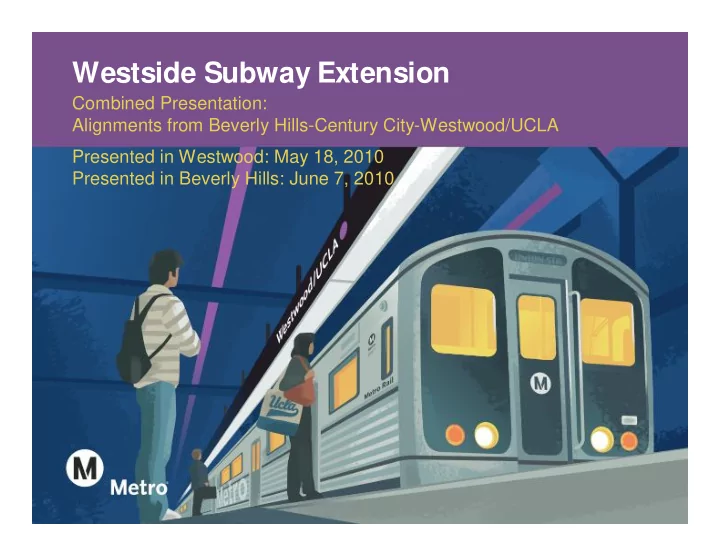
Westside Subway Extension
Combined Presentation: Alignments from Beverly Hills-Century City-Westwood/UCLA Presented in Westwood: May 18, 2010 Presented in Beverly Hills: June 7, 2010
SLIDE 2 Where We are in the Process
Draft EIS/ EIR Final EIS/ EIR/ PE
18 M onths 12 M onths M inimum 6 Years to ?
*
* Depends on Funding Availability
We Are H ere Final Design Construction
18 M onths
Alternatives Analysis
17 Alternatives
5 Subway Alternatives LPA The Project
= Metro Board Decision Point
SLIDE 3 Within Adopted LRTP/ M easure R Funding
- Alt. 1: Westwood/ UCLA Extension
- Alt. 2: Westwood/ VA H ospital Extension
Beyond Adopted LRTP/ M easure R Funding
- Alt. 3: Santa M onica Extension
- Alt. 4: Westwood/ West H ollywood Extension
- Alt. 5: Santa M onica/ West H ollywood Extension
Subway Alternatives Under Study in Draft EIS/ EIR
LRTP: Long Range Transportation Plan for LA County
SLIDE 4 To be Built in Phases Within Adopted LRTP/ M easure R Funding
- LRTP/ M easure R allocates $4.2 billion over approximately 30
years for the Westside Subway Extension
– 2019: Phase 1 to Fairfax – 2026: Phase 2 to Century City – 2036: Phase 3 to Westwood/ UCLA or Westwood/ VA
– Goal is to fund the M easure R projects in 10 years – M etro is working with Federal government to find ways to accelerate funds
SLIDE 5 Purpose of Tonight’s M eeting
- M etro promised a focused
community meeting on this topic
- Provide update on potential
alignments and stations
- Present preliminary results of
seismic investigations
- Describe alignment evaluation
process
SLIDE 6 Why Operate Under Private Property?
- Need to connect to stations located at
major centers and destinations
- Large radius turns needed for train
- perations and tunnel construction
- Shortest & straightest route between
stations
– Reduces travel time – Increases ridership – Reduces construction and operating costs – Reduces wheel-wear and noise
SLIDE 7 M etro Subway Tunnels Today
- M etro Gold Line to East LA built
with new generation TBM s. No measurable surface subsidence
damage claims
- M etro Red/ Purple lines run
below ground, under multiple private properties
- No noise/ vibration complaints
since subway opened
SLIDE 8 Perception of Sound & Vibration
generated from the track
from track
- Dissipates sooner in soft
soil; travels more in hard soil
- Influenced by train speed
City Year(s) built Typical Depth (to tunnel bottom)
New York 1910 - Now 35’ BART (Bay Area) 1964 - 2003 50’-70’ Washington, D.C. 1970s - 1980s 50’-70’ Los Angeles 1986 - 2000 50’-70’
Depths are generally more shallow at stations & deeper at tunnels in between
SLIDE 9 Existing M etro Red Line Subway Tunnels
- Union Station to Civic Center
– 50’ - 100’ underground* – Passes under newly built apartments – Passes near historic El Pueblo and Cathedral of Our Lady of Angels
* depths to track/ bottom of tunnel
SLIDE 10 Existing M etro Red Line Subway Tunnels
- Pershing Square to 7th St/ M etro
Center
– 60’ – 80’ underground* – Passes under high-density residential, commercial and retail
* depths to track/ bottom of tunnel
SLIDE 11 Existing M etro Red Line Subway Tunnels
– 30’-50’ underground (upper tunnel)* – 70’ – 110’ underground (lower tunnel)* – Passes under high-density residential, commercial and retail – TOD residential built above station
* depths to track/ bottom of tunnel
SLIDE 12 Existing M etro Red Line Subway Tunnels
H ollywood/ Western
– 60’ – 70’underground* – Adjacent to hospitals (Kaiser, Children’s H ospital, H ollywood Presbyterian) – Turns from Vermont to H ollywood under shopping center and park
* depths to track/ bottom of tunnel
SLIDE 13 Existing M etro Red Line Subway Tunnels
- H ollywood/ H ighland to North
H ollywood
– 60’-80’ underground* on approaches to Santa M onica M ountains (hundreds of feet under mtns.)* – Under single-family homes – Adjacent to sensitive recording studios
* depths to track/ bottom of tunnel
SLIDE 14 Criteria for Deciding Alignment
- Connection to preferred stations
- Cost of construction
- Impact on travel time (which affects ridership)
- Geotechnical data including seismic
- Sub-surface easements
SLIDE 15 Connecting to Stations
Century City Station Options
- Santa M onica Blvd & Ave of the Stars
- Constellation Blvd & Ave of the Stars
Westwood/ UCLA Station Options
- Off Street under UCLA Lot 36
- Under Street at Wilshire/ Westwood Blvd
4 station pairs, each with 3 alignment options
SLIDE 16 Wilshire/ Rodeo Station
- Station box located in between El Camino and
Canon
- Public interest in placing station & portal as
close to Rodeo as possible
- M any other portal locations suggested
- Challenging area to identify construction
staging location
SLIDE 17 Century City Station Options
- Strong support for Constellation station
- Located in “center” of Century City
- H igher ridership at this location
- Santa M onica Boulevard station
- Located at north end of Century City,
adjacent to golf course
- Alignment under golf course already
studied and ruled out
- Requires station under Ave of the Stars
with north-south alignment
- Requires extremely long tunnel and
greater expense
- Travels under the same, or more number
- f properties than other alignment
- ptions
SLIDE 18 Westwood/ UCLA Station Options
- UCLA off-street station reduces
construction impacts
- Wilshire/ Westwood Boulevard located
more in “center” of area
- Intersection is already very congested
- Stations closer to UCLA studied &
ruled out
- Even greater impacts constructing in
Village
- Can’t tunnel under cemetery
SLIDE 19 Alignment Alternatives between Wilshire/ Rodeo and Century City
- Santa M onica
- Constellation North
- Constellation South
SLIDE 20 Constellation to Westwood/ UCLA Options
Constellation to Westwood/ UCLA (Under-Street) Constellation to Westwood/ UCLA (Off-Street)
SLIDE 21 Santa M onica Blvd to Westwood/ UCLA Options
Santa M onica Blvd to Westwood/ UCLA (Under-Street) Santa M onica Blvd to Westwood/ UCLA (Off-Street)
SLIDE 22
Distance & Cost Estimates
(Wilshire/ Rodeo to Century City)
Alignment Length (feet) Cost ($M 2010) Santa M onica 6,860 $472 Constellation North 6,370 $471 Constellation South 5,925 $455
SLIDE 23
Distance, Cost and Travel Time Estimates
(Century City to Westwood/ UCLA)
Alignment Length (feet) Cost ($M 2010) Travel Time (minutes) East 9,100 – 11, 900 $680 – 720 2.0 – 2.5 Central 11, 300 – 12,100 $690 – 730 ~ 2.5 West 14, 600 – 15,000 $820 – 830 ~ 4.9
SLIDE 24 Properties Above Tunnels
(Preliminary Estimates – Wilshire/ Rodeo to Century City)
Alignment Residential Properties Non-Residential Properties Total Number of Properties Santa M onica 3 3 Constellation North 4 18 22 Constellation South 23 13 36
M etro purchases easements
SLIDE 25 Properties Above Tunnels
(Preliminary Estimates – Century City to Westwood/ UCLA)
Alignment Residential Properties Non-Residential Properties Total Number of Properties East 56-69 5-13 61-82 Central 75-110 8-11 83-121 West 30-65 18-24 51-86
M etro purchases easements
SLIDE 26
Tunnel & Station Depth Estimates
(Wilshire/ Rodeo to Century City)
SLIDE 27
Tunnel & Station Depth Estimates
(Century City to Westwood/ UCLA)
SLIDE 28 Easement Acquisition Process
- After tunnel alignment selected, easement area/ envelope will be
defined
– Easement will be limited to just above top of tunnel – Easement will not extend to the surface or below bottom of tunnel
- Value of easement will be determined by independent appraisal
based on following factors
– Depth of tunnel below the surface – Impact to surface – Ability to develop or redevelop the surface
- Timing of easement acquisition
– After Final EIS/ EIR approval – During Final Design
SLIDE 29
We Live in Earthquake Country
SLIDE 30 Recent Geotechnical Investigations Results
to/ along Santa M onica Blvd in this location
requires special measures along greater distance
expensive than avoiding or crossing a fault
Santa M onica Fault
SLIDE 31 Affect of Seismic Activity on Subway Tunnels
Earthquake Date M agnitude Impact on Subway M exico City 1985 8.1 No damage to tunnels. Some power disruption. Patrons evacuated safely. Used to transport rescue personnel. Loma Prieta (SF) 1989 6.9 No damage to tunnels. Subway served as lifeline structure. Northridge 1994 6.7 No damage Kobe, J apan 1995 7.2 No damage to tunnels. Damage to station and sewer pipes – attributed to 1962 design with moderate seismic provision Taipei 2002 6.8 No damage Chile 2010 8.8 Running next day. Some damage at entrance to stations
SLIDE 32 Tunnel Construction Around Faults
- Goal is to avoid tunnel exposure to faults
- Where fault is unavoidable:
– Reduce exposure to fault as much as possible – Design tunnels to withstand anticipated magnitude of
seismic event in order to:
- M inimize damage
- Ease repairs if necessary
- Allow for swift return to normal service
- Possible tunnel design features for fault crossing
–
Larger diameter tunnel – eases repairs if needed
–
Different tunnel liner material – minimizes damage should earth movement occur
- Will be determined during Final EIS/ EIR
SLIDE 33 21st Century Subway Tunneling
- New generation TBM s maintain
pressure in surrounding earth
- Reduces risk of settlement
- “It is possible to tunnel and operate a
subway along the Wilshire Corridor safely” (APTA Peer Review, 2005)
- Tunnels built underground using tunnel
boring machines
- Stations built excavating from above off-
street or under “decked-over” streets
TBM maintains pressure in surrounding earth as it tunnels
SLIDE 34 Recent M etro Tunneling Experience
Gold Line Eastside Extension:
- Opened Fall 2009
- 1.8 mile tunnel segment
- Used pressurized face TBM s
- Two underground subway stations
- No measurable surface subsidence
- No substantiated property damage claims
- Excellent safety record
Gold Line Eastside Extension Tunnel Soto Street Station Under Construction
SLIDE 35 Oil Fields & Wells
- Los Angeles is an oil producing area
- Significant underground construction experience in LA
– Subways – Sewer tunnels & storm drains – Buildings with deep basements/ foundations
- Draft EIS/ EIR has researched locations of active &
abandoned wells
– Oil fields are much deeper than tunnels – Unlikely to encounter active or abandoned wells – Further investigation during Final EIS/ EIR & Design – Standard procedures for dealing with wells if found – M etro Gold Line Eastside Extension successfully tunneled in former Boyle H eights oil field
SLIDE 36 Anticipated Refinements during Final EIS/ EIR
- Further engineering analysis
- Further geotechnical
investigation
- Refine tunneling technique
- Potential minor alignment
adjustments
- Refine cost estimates including
seismic-related expenses
- No new impacts anticipated due
to refinements
- Determine mitigation measures
SLIDE 37 Review of Construction Outreach
- Survey/ inspect properties before work
begins to assess conditions
- Process for reviewing damage
complaints
- Construction project will carry
insurance to address such issues
SLIDE 38 Where We’re H eading
- Selection of the Locally Preferred Alternative (LPA)
- Project to seek final environmental clearance
- Project to be engineered for construction
- M eets FTA’s “N ew Starts” funding guidelines
- Fiscally constrained (i.e. can be built and operated within
projected funding)
SLIDE 39 Where We Go From H ere
une 2010: Community Update
- Results of further analysis of alternatives including cost
estimates, user benefits & cost effectiveness
- Summer 2010: Public H earings on Draft EIS/ EIR
- Results of technical analyses
- Fall 2010: M etro Board Consideration
- Staff recommendations
- Adopt Locally Preferred Alternative (LPA)
- Authorize preparation of Final EIS/ EIR
- Seek FTA approval to enter N ew Starts Preliminary Engineering
SLIDE 40
une 14 – LACM A West
une 17 – West H ollywood – Plummer Park
une 28 – Westwood United M ethodist Church Live web-cast of this meeting available at metro.net/ Westside
une 29 – Beverly H ills Library Auditorium
uly 1 – Santa M onica M ain Library M ultipurpose Room All meetings 6pm-8pm. Content will be identical.
Upcoming M eetings
SLIDE 41 metro.net/ westside WestsideExtension@metro.net J
- dy Litvak, Regional Communications
litvakj@metro.net 213.922.1240 David M ieger, Project Director miegerd@metro.net 213.922.3040 Information line: 213.922.6934 Facebook.com/ WestsideSubwayExtension Twitter.com/ WestsideSubway
Contact us
SLIDE 42
Questions & Comments