Well-being and occupational safety and health in central government - - PDF document

well being and occupational safety and health in central
SMART_READER_LITE
LIVE PREVIEW

Well-being and occupational safety and health in central government - - PDF document

Safer and Healthier Work for All -Modernisation of the EU OSH Legislation and Policy (COM(2017) 12): the case of psychosocial risks Well-being and occupational safety and health in central government administrations: tackling psychosocial risks


slide-1
SLIDE 1

1

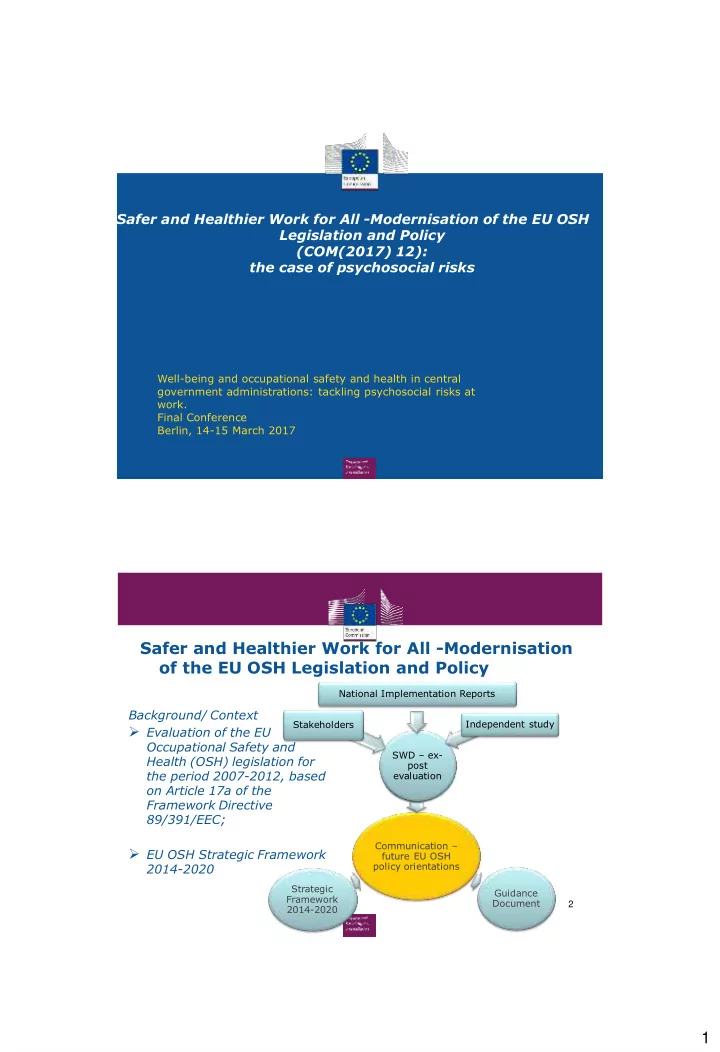
Safer and Healthier Work for All -Modernisation of the EU OSH Legislation and Policy (COM(2017) 12): the case of psychosocial risks

Well-being and occupational safety and health in central government administrations: tackling psychosocial risks at work. Final Conference Berlin, 14-15 March 2017

Safer and Healthier Work for All -Modernisation

  • f the EU OSH Legislation and Policy

Communication – future EU OSH policy orientations SWD – ex-post evaluatio n Guidance Document Strategic Framework 2014-2020 SWD – ex- post evaluation Stakeholders National Implementation Reports Independent study

Background/ Context

  • Evaluation of the EU

Occupational Safety and Health (OSH) legislation for the period 2007-2012, based

  • n Article 17a of the

Framework Directive 89/391/EEC;

  • EU OSH Strategic Framework

2014-2020

2

slide-2
SLIDE 2

2

OSH acquis is relevant but some challenges persist, e.g.:

  • While a decrease in incidence of accidents could be observed over the evaluation period,

work-related ill-health, in particular the burden of occupational cancer remains high;

  • A need to better tackle issues of growing concern, such as work-related

MSDs and psychosocial risks or work-force ageing, by exploiting the full potential of the OSH framework;

  • Coverage of some groups of workers could be improved
  • A need to update outdated provisions, providing for simplification whenever

possible;

  • A need to improve the compliance of SMEs, in particular of microenterprises, by

inter alia allowing for solutions aiming at reducing administrative burden;

  • Need to strengthen inspection and monitoring
  • A need to improve monitoring tools.

Ex-post evaluation – main findings:

3

Communication: focus on three priority areas

  • Stepping up the fight against occupational cancer and

exposure to chemicals;

  • Helping businesses, in particular microenterprises and

SMEs, comply with OSH rules;

  • Cooperating with Member States and social partners to

remove or update outdated rules and to refocus efforts on ensuring better and broader protection, compliance and enforcement on the ground.

4

slide-3
SLIDE 3

3 Making OSH framework future-proof…

  • A program for removing or updating outdated provisions in several

Directives, in close cooperation with social partners:

  • Display screen equipment
  • OSH signs
  • Biological agents
  • Medical assistance on board
  • Workplaces
  • Personal protective equipment
  • Encouraging MS to ensure a broad coverage of OSH policies:
  • Self-employed
  • Domestic workers

5

Helping businesses comply with OSH rules

  • Focus on micro and small enterprises
  • Only 69% of microenterprises declare that they perform

regular OSH risk assessments (against 96% for larger enterprises).

  • Lack of awareness and expertise, limited resources
  • Need for practical support

6

slide-4
SLIDE 4

4 Tools for businesses

  • Practical guidance document published with the Communication – risk

management in practice for work-related stress

  • Boosting the availability and use of free

e-tools such as the Online interactive Risk Assessment (OiRA)

  • Good practices, guides and tools to address

issues of growing concern (psychosocial risks, MSDs, ageing) to be developed together with the EU-OSHA, ACSH and the Senior Labour Inspectors Committee

7

Supporting business cover risks of growing concern (1)

  • Psychosocial risks, MSDs, Diversity-sensitive risk assessment (ageing,

gender)

  • Over half of EU workers report that stress is common in

their workplace and 4 in 10 think that it is not handled well

  • 40% of companies need information on how to assess

psychosocial risks

  • Workplace stress has an important impact on productivity

8

slide-5
SLIDE 5

5 Framework Directive 89/391/EEC (2)

  • covers “all health and safety risks” (recital 15, Case C-49/00), i.e.

including psychosocial risks

  • no EU specific rules on psychosocial risks
  • applies to all sectors of activity, both public and private
  • the employer has the obligation to ensure the safety and health of

workers in every aspect related to the work

  • the words "working environment", "health" and "safety" embrace all

factors, physical or otherwise, capable of affecting the health and safety

  • health is a state of complete physical, mental and social well-

being (ECJ, Case C84/94, UK v Council, para 15) =>psychosocial risks are to be addressed in organizations’ health and safety strategies

Supporting business cover risks of growing concern (3)

  • Practical Guidance for employers (SWD(2017)9)
  • examples of risk management in practice, including for work-related stress
  • Overview of existing legal obligations
  • Overview of existing tools and ressources

 EC, Promoting mental health in the workplace: Guidance to implementing a

comprehensive approach

 EU-OSHA, A practical e-Guide to managing psychosocial risks

10

slide-6
SLIDE 6

6

Supporting business cover risks of growing concern (4)

  • Working closely with EU-OSHA and ACSH to identify good practice for

promotion and dissemination, with a view to raise awareness

  • Mandating SLIC to develop a guide for assessing quality of risk

assessments and risk management measures with regard to psychosocial risks. Actions to come:

  • Early 2018 – publication on best practices in managing psychosocial risks and

ergonomic risks (EU-OSHA)

  • 2020-2021 – Healthy Workplaces Campaign devoted to MSDs prevention (EU-

OSHA) 11

… improving compliance and enforcement

  • Perception of OSH rules as complex varies from 14% to 67%

across the Member States – need to work together to reduce administrative burdens related to transposition of EU law into national legislation.

  • Peer-review process to facilitate learning from good practices in
  • ther Member States
  • Inspections going beyond mere sanctioning - Improving

enforcement on the ground (better standards and guidance, raising awareness, SLIC).

12

slide-7
SLIDE 7

7 Better OSH = Better protection of workers and improved productivity for business

  • Clear, up-to-date rules at EU and national level
  • Businesses helped to draw maximum benefits from OSH
  • Permanent awareness raising and exchange of best practice
  • Importance of social dialogue

13

Useful tools and references

  • European Commission, Promoting mental health in the workplace: Guidance to implementing a comprehensive
  • approach. It introduces and provides guidance for employers, employees and other stakeholders on the management
  • f mental health issues in the workplace. http://ec.europa.eu/social/main.jsp?catId=716&langId=en
  • EU-OSHA, Psychosocial risks and stress at work. This website includes good practice resources on this topic.

https://osha.europa.eu/en/themes/psychosocial-risks-and-stress

  • EU-OSHA, A practical e-Guide to managing psychosocial risks. This multi-lingual e-guide helps employers and

people working in small and micro enterprises to deal with psychosocial risks. It has 30 national versions, each including references to the national legislation and information on national resources and practical tools. http://hw2014.healthy-workplaces.eu/en/tools-and-resources/a-guide-to-psychosocial-risks

  • Good practices at EU-OSHA website;

https://osha.europa.eu/sites/default/files/publications/documents/ healthy-workplaces-good-practice-awards2014- 2015booklet.pdf

  • The European Pact for Mental Health and Wellbeing

http://ec.europa.eu/health/mental_health/policy/statements_en

14

slide-8
SLIDE 8

8

Thank you for your attention!

15

Where to find the documents: COM(2017)12, SWD(2017)9, SWD(2017)10 http://ec.europa.eu/social/main.jsp?langId =en&catId=89&newsId=2709