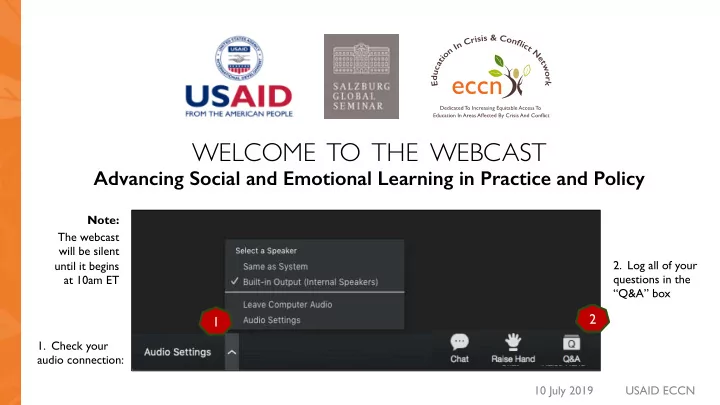
SLIDE 1 10 July 2019 USAID ECCN
WELCOME TO THE WEBCAST
Advancing Social and Emotional Learning in Practice and Policy
audio connection:
questions in the “Q&A” box Note: The webcast will be silent until it begins at 10am ET
1 2
SLIDE 2
ADVANCING SOCIAL AND EMOTIONAL LEARNING IN POLICY AND PRACTICE
SLIDE 3 OVERVIEW
USAID ECCN
Ø ECCN is a forum for collaboration, networking, information, and knowledge sharing that USAID and its implementing partners use to equitably increase access to education in crisis and conflict-affected environments. Ø Priority Areas: Safer Learning Environments, Improved Programming, Enhanced Equity, & Stronger Local Institutions. Ø ECCN’s external Partner Initiatives program showcases timely and important research on issues of education in crisis and conflict settings. Save the Children was one of 5 Partner Initiatives selected by ECCN.
Salzburg Global Seminar
Ø Salzburg Global Seminar’s mission is to challenge current and future leaders to shape a better world.
eccnetwork.net @EdCCNetwork usaideccn@edc.org Website Twitter E-mail salzburgglobal.org @SalzburgGlobal info@SalzburgGlobal.org
SLIDE 4 SPEAKERS
Shailendra Sharma
Principal Advisor to the Director
Delhi Government (India) shailendraksharma10@gmail.com
Nina Weisenhorn
- Sr. Advisor in Education in
Crisis and Conflict USAID Office of Education (United States) nweisenhorn@usaid.gov
Dominic Regester
Program Director Salzburg Global Seminar (Austria) dregester@SalzburgGlobal.org
Daniela Labra
Co-Founder and General Director AtentaMente (México) daniela@atentamente.mx
Stephanie Jones
Professor of Education Harvard University (United States) jonesst@gse.harvard.edu
SLIDE 5
AGENDA
Introductions SEL and Salzburg Global Seminar India: The Happiness Curriculum México: Construye-T Contextualizing SEL SEL and USAID Q&A Closing Remarks
SLIDE 6 THE HAPPINESS CURRICULUM IN DELHI
Integrating the science of emotions into classrooms
Shailendra Sharma
Principal Advisor to the Director of Education Delhi Government (India) shailendraksharma10@gmail.com
SLIDE 7
REVISITING THE BUILDING BLOCKS OF SEL
SLIDE 8
INTENTION AND APPROACH
Ø Help children develop skills of mindfulness, self-awareness, critical thinking and reflection Ø Adopt a scientific, structured approach to social emotional learning Ø Encourage students to explore the qualitative nature of happiness Ø A 35 minute period is scheduled in the timetable each day for Grades 1-8 Ø Weekly structure for the classes with specific activities planned for each day Ø Daily Mindfulness Practice, observation and discussion on emotions using stories & experiential activities as mediums Ø 20 Stories & Activities provided as a bank for the year without the expectation of having to complete them in a specified period
SLIDE 9
SCALE
Ø Implemented in all 1024 schools in Delhi from Grades Nursery - VIII Ø 800,000 students being reached every day Ø 18,000 teachers have been trained to facilitate the classes during regular school hours
SLIDE 10
IMPACT
Ø Numerous stories of change have been related by students, teachers and parents describing how Happiness classes have led to reduced mental tension and a calmer state of mind
SLIDE 11
IMPACT CONT…
Ø The stories and activities have led to reduced misunderstandings between friends and improved relations with parents and teachers
SLIDE 12 TESTIMONIALS
Ø “I am able to control my temper better” – student, Grade 8 Ø “I feel an increased sense of gratitude when someone does something for me” – student, Grade 7 Ø “I keep things in their proper place in the class so that others can find them when they need it” – Khushi, Grade 3 Ø “I was overjoyed when my daughter came and told me that I was the source
- f her happiness which she discovered
through an activity in the Happiness Class” – a Parent of Grade 7 student Ø “This is the first time I have seen a curriculum that focuses on building better human beings which is the greatest need of the hour” – a Middle School Teacher
SLIDE 13 SEL AS PUBLIC POLICY IN MÉXICO
The case of Construye T
Daniela Labra
Co-Founder and General Director AtentaMente (México) daniela@atentamente.mx
SLIDE 14 Text
10 July 2019 USAID ECCN
Mexico, a leading country in Socio-emotional Education
The importance of developing skills such as self-awareness, empathy and team work is acknowledged They were not part
in school
2017: SOCIO- EMOTIONAL SKILLS
SLIDE 15 Genesis of a nation-wide intervention
- Between 60% - 70% of Mexican
students have been victims of violence (OECD).
- Violence spread throughout the
country: organized crime, decomposition of the social fabric
- Mexico is significantly below
average in the PISA test.
workplace stress in the world.
being stressed (IWO).
The importance of developing skills such as self-awareness, empathy and team work is acknowledged
VIOLENCE EDUCATION WELLBEING
SLIDE 16 An answer from prevention: SEL in the curricula
The importance of developing skills such as self-awareness, empathy and team work is acknowledged
Professional development
- In-person (12 hours, 8500 Principals and tutors)
- Online program (40 hours, 50,000 teachers)
- Online tutoring/support (4000 tutors)
Curriculum development
- Instructional design
- 352 lessons (teachers and students)
Research
- Program evaluation design: Efficacy and fidelity of
implementation
Construye T (K10-12), 2016-2018
- Federal, Nation-wide
- 4 (10)6 teens, 280,000 teachers, 16,000
schools
SLIDE 17 CONSTRUYE T EXPERIENCE IN FULL IMPLEMENTATION
RELATE
KNOW YOURSELF CHOOSE YOURSELF
BUILD YOURSELF
3 Transversal Skills:
- Attention
- Clarity
- Emotional
literacy
SLIDE 18 Buy-in and sustainability: TEACHERS AND PRINCIPALS FIRST
EMOTIONAL MATERIAL PHYSICAL
WELLBEING
SOCIAL PROFESSIONAL
SLIDE 19 19
KEY ELEMENTS TO IMPACTING PUBLIC POLICY:
EMBODYING AND SPEAKING OUT
1
MAPPING KEY STAKEHOLDERS
In the education sector and other sectors too.
3
SCIENTIFIC AND FIELD EVIDENCE
- Evidence-based program, from mexico for
Mexico, with renowned researchers
- Previous experience in different education
levels and other workplace contexts.
2
POSITIONING
- Becoming a reference of SEL in
Mexico.
- Multidisciplinary team with
knowledge and experience, fidelity
4
ALLIANCES
- National and international
- Researchers, universities, experts,
entrepreneurs, policy-makers
5
- Being and advocating
- Inviting international and national
experts as spokespersons
SLIDE 20 20
HOW DID/DO WE IMPACT EDUCATIONAL POLICY?
PUBLIC FORUMS & CONFERENCES
Promoting SEL in different spheres and sectors.
1
NATIONAL CURRICULA
Invited by SEP (Ministry of education) as part of expert group
2
TEACHER HIGHER EDUCATION
Designing SEL curriculum for teacher higher-education ESCUELAS NORMALES
3
OPERATIONALIZATION
- High-school, Construye-T/ Book
- Preeschool, Banorte Fundation
- Junior school/ Books (McGraw Hill)
4
CONTINUITY: THE UNCERTAIN FUTURE
- Lobbying: new Ministers, stakeholders,
policy-makers) other NGOs, public opinion.
5
SLIDE 21 RESOURCES FOR SOCIAL AND EMOTIONAL LEARNING
Stephanie Jones
Professor of Education Harvard University (United States) jonesst@gse.harvard.edu
Decision-making and implementation
SLIDE 22
SOCIAL AND EMOTIONAL LEARNING RESOURCES
Navigating SEL Frameworks Navigating SEL Strategies and Practices Contextualizing SEL for Different Settings
SLIDE 23 NAVIGATING SEL FRAMEWORKS
THE TAXONOMY PROJECT
Ø System for transparently navigating between and communicating across different disciplines, perspectives, organizing systems in the field. Ø Uses a common coding system to look at widely-used frameworks and determine what skills/competencies they include and how they are defined. Ø Designed to function as a Rosetta Stone, allowing users to:
Communicate clearly and precisely across disciplines, perspectives and sectors. Understand how skills and terms are defined in various frameworks. Navigate between frameworks that employ different language.
SLIDE 24
THE TAXONOMY PROJECT
EXPLORE SEL
SLIDE 25
NAVIGATING SEL STRATEGIES AND PRACTICES
Targeted; flexible; easy to use, adapt, integrate
KERNELS OF SEL
SLIDE 26
CONTEXTUALIZING SEL FOR DIFFERENT AUDIENCES
SLIDE 27
CONTEXTUALIZING SEL CONT.…
SLIDE 28 SOCIAL AND EMOTIONAL LEARNING AT USAID
Nina Weisenhorn
- Sr. Advisor in Education in
Crisis and Conflict USAID Office of Education (United States) nweisenhorn@usaid.gov
SLIDE 29 U.S. GOVERNMENET BASIC EDUCATION STRATEGY
Vision The goal of the U.S. Government Strategy on International Basic Education is to achieve a world where education systems in partner countries enable all individuals to acquire the education and skills needed to be productive members of society. Objective 1 Improve Learning Outcomes Objective 2 Expand Access to Quality Basic education for All, Particularly Marginalized and Vulnerable populations.
SLIDE 30 USAID EDUCATION POLICY
Priorities Ø Children and youth, particularly the most marginalized and vulnerable, have increased access to quality education that is safe, relevant, and promotes social well-being. Ø Children and youth gain literacy, numeracy, and social- emotional skills that are foundational to future learning and success. Ø Youth gain the skills they need to lead productive lives, gain employment, and positively contribute to society. Ø Higher education institutions have the capacity to be central actors in development by conducting and applying research, delivering quality education, and engaging with communities.
SLIDE 31
USAID TERMINOLOGY AND DEFINITIONS
Social and Emotional Skills Set of cognitive, social, and emotional competencies that children, youth, and adults learn through explicit, active, focused, sequenced instruction that allows them to understand and manage their emotions, set and achieve positive goals, feel and show empathy for others, establish and maintain positive relationships, and make responsible decisions. Soft Skills Broad set of skills, behaviors, and personal qualities that enable people to effectively navigate their environment, relate well with others, perform well, and achieve their goals.
SLIDE 32 ADVANCING USAID’S PRIORITIES
Ø Build individual self-reliance Ø Reach and retain students Ø Boost academic outcomes, such as literacy and numeracy Ø Mitigate the negative effects of prolonged exposure to conflict and crisis Ø Help youth be successful in a variety of career pathways Ø Ensure teachers have the skills needed to create inclusive, supportive classrooms
SLIDE 33
RESOURCES AND GUIDANCE
Available Resources
Ø www.edu-links.org
Forthcoming…
Ø USAID Education Policy Brief: Social and Emotional Learning and Soft Skills (2019) Ø USAID SEL/Soft Skills Implementation Guidance (2020)
SLIDE 34 QUESTIONS AND ANSWERS
Advancing Social and Emotional Learning in Practice and Policy
Note: You can join the conversation by using “Q&A” feature in RingCentral To do so, select the “Q&A” icon along the control banner
SLIDE 35 THANKS FOR JOINING!
For more information about Salzburg Global Seminar, please visit salzburgglobal.org. Register for free at eccnetwork.net to receive our announcements, including more upcoming Partner Initiative webcasts and other activities. USAID ECCN is developing new webcast titled Ensuring Research Ethics in Rapid Assessments in Crisis and Conflict Contexts which will be out later this summer.
10 July 2019 USAID ECCN