SLIDE 1
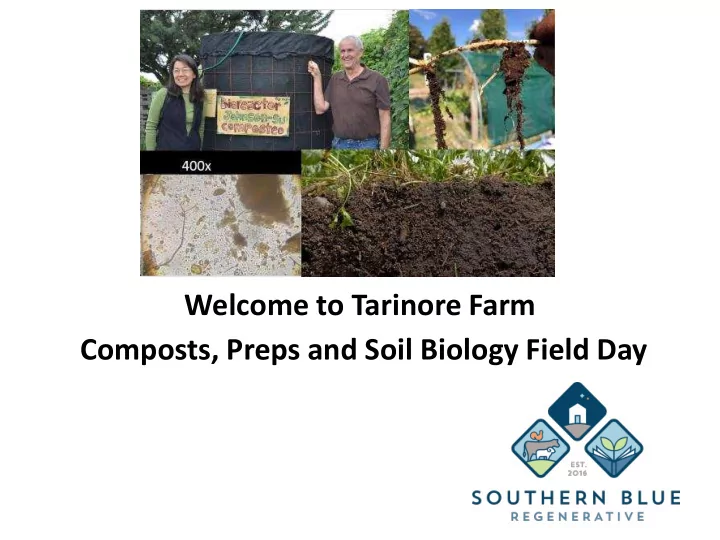
Welcome to Tarinore Farm Composts, Preps and Soil Biology Field Day
SLIDE 2 Program
- Intro and House keeping
- James Turnell, UNE
- 12:30 – Lunch
- Lee Fieldhouse – Island Biologicals
- Discussion
SLIDE 3
What questions do you have? What did you want to learn/see/hear today?
SLIDE 4
Rule of Succession
A species will move into an environment when the conditions become suitable for its establishment, and will move out of that environment when the conditions become unsuitable for its reproduction
SLIDE 5
SLIDE 6
SLIDE 7 Moredun – Richard Makim
- Long term grazing history – taken up in 1825
- History of cropped areas and pasture “improvement”
- Planned Grazing implemented across whole property
- Areas that were just designated as grazing responded
- Areas with cropping and ploughing history did not respond
as well.
SLIDE 8
This 1.5% increase means the top 30cm of soil now can hold an additional 22mm of rainfall.
Moredun – St Straig ight grazin ing result lt 2004-2011
BUT – researchers discarded this result as an “outlier”
SLIDE 9
Native Grass species recovering after 5-6 years of grazing management
SLIDE 10
“But some paddocks we couldn’t move the country with the holistic rotation [grazing] alone… there were too many sins related to toxins, irrigation, hard pans, pH and lack of plant growth and density to kick start the carbon and mulch etc.” Richard This was where the compost application in small amounts across a large area moved this from near the district average of 1% carbon to 5.5% carbon
+63mm additional rainfall storage
SLIDE 11
SLIDE 12 However, there are limitations
- Capital intensive
- Time involved
- Water required considerable even in temperate
climate of the New England
- Access to suitable material – tomato farm waste in
this case
SLIDE 13
SLIDE 14
SLIDE 15 Johnson-Su BEAM
- Process to create fungal-dominated compost
- Over the 4.5 year trial he observed a 25-times
increase in active soil fungal biomass and an annual average capture and storage of 10.27 metric tons soil C ha-1 year
- Increase nutrient availability
- And significant Increase crop establishment and
yields
SLIDE 16
SLIDE 17
SLIDE 18
SLIDE 19
SLIDE 20
SLIDE 21
SLIDE 22
SLIDE 23
SLIDE 24
- Material
- Woodchips, Leaves, any material to hand
Key is to maintain aerobic conditions in the static pile
- Vermicomposting
- Add worms in once initial compost temp has fallen
below 26oC
- Tube air holes will fill in and the worms maintain
the aerobic conditions in the pile
- Age – min 9-12 months to allow for fungal
maturity
SLIDE 25
SLIDE 26 Use and Application
- Extract the microbes from the compost material
and apply with water spray at 1 kg of compost/hectare
- Use as an inoculant for seed being sown – pasture,
cover crops, forage or pasture crops
SLIDE 27
- Create a batter slurry
- ½ cup of a milk/molasses mixture (8 parts milk to 1 part
molasses)
- a litre of compost
- Water (amount varies - add the water while stirring until the
compost slurry has a viscosity similar to pancake batter)
- 1 litre of the resultant slurry used per 25kg of seed
in a cement mixer then air dried before planting (wet planting can be done with larger seeds)
SLIDE 28
https://www.csuchico.edu/regenerativeagriculture /bioreactor Johnson-Su Composting Facebook Group https://www.facebook.com/groups/233254887357 239/
SLIDE 29 Wilmot – Stuart Austin
- Setup in July 2017 and had three bio reactors
- 25% Green waste - lawn clippings & leaves
- 25% Fine wood shavings
- 25% Coarse wood shavings
- 25% Sorghum straw/mulch
SLIDE 30
SLIDE 31
SLIDE 32