SLIDE 1
Montessori 101
Welcome to
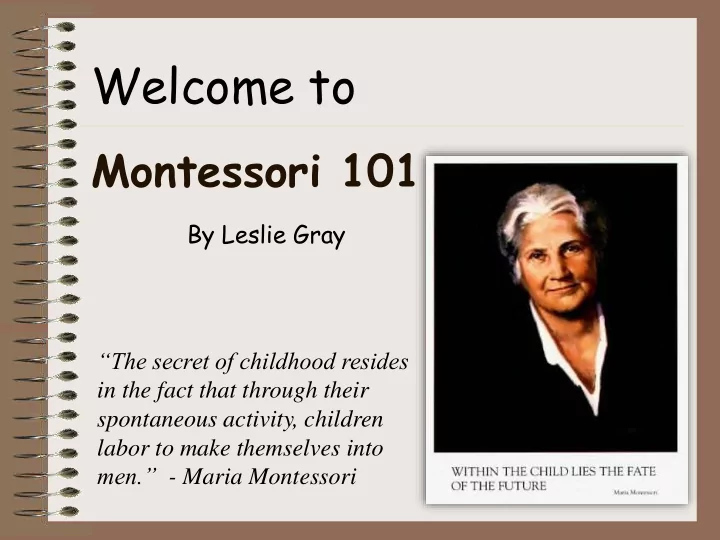
By Leslie Gray “The secret of childhood resides in the fact that through their spontaneous activity, children labor to make themselves into men.” - Maria Montessori
SLIDE 2
Who and What is Montessori?
SLIDE 3
Who was Maria Montessori?
SLIDE 4 Medical Doctor, Scientist & Researcher First female physician to graduate from the University of
Rome Medical School (1896)
Child Psychiatrist Early career - co-director at the Orthophrenic School
- Helped to establish the new field of Child Neuro-
Psychiatry
- Developed an extensive understanding of brain functions,
mental and emotional development during childhood
Writer, Pacifist & International Lecturer:
- Published over 15 unique books
- Nominated three times for the Nobel Peace Prize
- Activist & advocate for the rights of women & children.
SLIDE 5 What is Montessori?
3-year age span (multi-age classrooms)
- Models real-life communities
- Younger students - modeling / tutoring from older
students.
- Older students - leadership role
- Strong sense of community with classmates &
teachers
- Research - students who stay with the same
teacher more than one year experience fewer gaps in learning
SLIDE 6
- New concepts in all subjects are introduced with
concrete materials - many designed by Dr. Montessori herself
- Helps make connections to the “real world”
- Supports retention of information and make
connections to future experiences
- Lays a strong and lasting foundation once
introduced to the abstract (Neural Pathways)
- Materials are specifically arranged and sequenced
- n shelves
Concrete to Abstract
SLIDE 7
SLIDE 8 Prepared Environment
- Attributes of a prepared environment:
– Order, reality, beauty and simplicity
- Environment should reinforce independence and
intellectual development
- Set up to facilitate student discussion and
stimulate collaborative learning
- The teacher is considered part of the prepared
environment
- Preparing this environment appropriately is one
- f a Montessori guide’s greatest tasks
SLIDE 9
Sequence and Order
“Order, most especially within the child, but also in the child's environment, is prerequisite to the child becoming an independent, autonomous, and rational individual.”
SLIDE 10
Reality and Nature
SLIDE 11
Beautiful and Inviting
SLIDE 12
Simplicity
SLIDE 13
SLIDE 14 Work
- Any activity that meets developmental needs
- Given freedom and time, children choose
purposeful activities to fulfill those needs
Work cycle
- 3-hour uninterrupted work cycle (morning)
- Through careful observation Montessori
concluded that with freedom to choose meaningful work, children displayed a distinct work cycle
- Two peaks and one valley and lasts about 3 hours
SLIDE 15
Work Cycle & False Fatigue
SLIDE 16
A 3 Hour Work Cycle
(in 4 minutes)
SLIDE 17 Freedom with Responsibility
(Limits)
- Children are free to move about the room…
– with purpose
- Free to use the works they please…
– as long as they use them appropriately
- Free to work with others…
– as long as they stay focused and get their work done
- Free to have snack when they are hungry…
– but must prepare it themselves and clean up any messes they make
SLIDE 18 Practical Life
- Lessons on skills needed for everyday life
- Self-control, independence, focus & coordination
- Designed to help child adapt to new community
and see as contributing part of social unit
- Develops confidence and executive functioning
- Fine motor development
- Vastly different over the age ranges
SLIDE 19
SLIDE 20 Grace and Courtesy
- Lessons that demonstrate positive social behavior
- Helps them adapt to life in a group and to provide
socially acceptable behavior cues
SLIDE 21
SLIDE 22 Independence
- Normal developmental milestones such as
weaning, walking, talking, etc.
- Empowering on a social and emotional basis
- Children become confident in ability to:
– master the environment – ask questions – puzzle out the answer – learn without needing to be spoon-fed by an adult
- Throughout four planes of development, the child
and young adult continuously seek to become more independent
SLIDE 23 Planes of Development
- Each phase or plane is marked by external and internal
changes
– Physical – Mental – Emotional – Social
- Each plane has specific developmental needs
- The environment must provide the right enrichment and
proper conditions for optimum potential to develop
SLIDE 24
Four Planes of Development
SLIDE 25 Four Distinct Planes
Infancy 0 to 6 Childhood 6 to 12 Adolescence 12 to 18 Maturity 18 to 24
The Sensorial Explorer: What? The Cultural Explorer: Why? How? When? The Humanistic & Social Explorer: Who am I? The Specialist Explorer: How can I change the world?
SLIDE 26 Sensitive Periods
- Phase in development in which a child will be more open,
interested, motivated, and capable of learning particular concepts or developing particular skills
- Unquenchable passion for mastering the skills or concepts
- f this phase - motivated by an intense inner drive
- Maria Montessori –
– “a burning intellectual love” – “an animated psychic factor leading to an immense mental activity” – “a drama of love between the child and its environment”
SLIDE 27 Sensitive Periods 3-6
- Movement
- Language
- Small Objects
- Order
- Music
- Grace and Courtesy
- Refinement of the Senses
- Writing
- Reading
- Spatial Relationships
- Math
SLIDE 28 Sensitive Periods 6-12
Justice and Moral Judgments
The child is very concerned (or obsessed) with right and wrong, fair treatment and justice
Social Relationships
Important part of the elementary class experience is for them to find positive ways to explore relationships
Money and Economic Value
They love to count money and are fascinated by how it is earned and what it will buy
SLIDE 29 The Abstract Use of the Imagination
Now firmly grounded in reality and can allow imagination to soar to the abstract
The Use of Tools and Machines A Sense of History and Time
With imagination the child is able to further explore the concepts of distant past and future
A Sense of Human Culture & Membership in the Human Family
Interested in other cultures and easily forms positive or prejudiced attitudes
A Sense of How the World Works
The child at this stage loves to explore the world and its scientific principles - experiments and asks questions
SLIDE 30
“The secret of good teaching is to regard the children's intelligence as a fertile field in which seeds may be sown, to grow under the heat of flaming imagination. Our aim therefore is not merely to make the children understand, and still less to force them to memorize, but so to touch their imagination as to enthuse them to their innermost core...” —Maria Montessori
SLIDE 31 The Integrated Montessori Curriculum
compartmentalized into separate subjects
- Concepts introduced simply
and concretely
- Reintroduced several times
- ver succeeding years at
increasing degrees of abstraction and complexity
- Interrelated so concepts are
reinforced across the classroom culture
SLIDE 32
SLIDE 33
SLIDE 34
Research