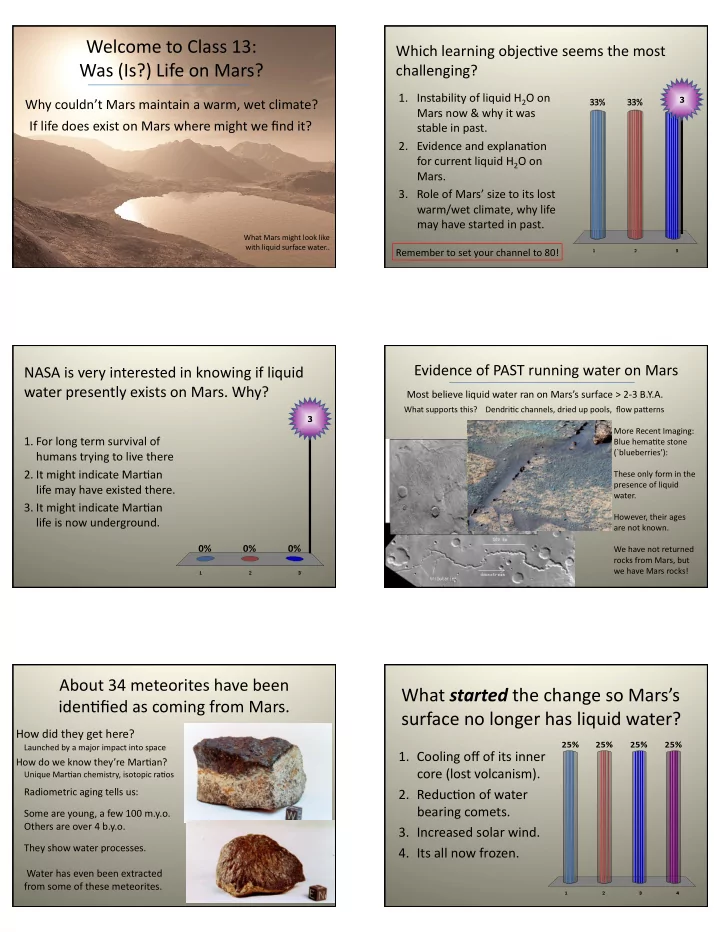
Welcome to Class 13: Which learning objecHve seems the - - PDF document

welcome to class 13
SMART_READER_LITE
LIVE PREVIEW

Welcome to Class 13: Which learning objecHve seems the - - PDF document

Welcome to Class 13: Which learning objecHve seems the most Was (Is?) Life on Mars? challenging? 1. Instability of liquid H 2 O on Why couldnt


slide-1
SLIDE 1

Why ¡couldn’t ¡Mars ¡maintain ¡a ¡warm, ¡wet ¡climate? ¡ If ¡life ¡does ¡exist ¡on ¡Mars ¡where ¡might ¡we ¡find ¡it? ¡

Welcome ¡to ¡Class ¡13: ¡ ¡ Was ¡(Is?) ¡Life ¡on ¡Mars? ¡

What ¡Mars ¡might ¡look ¡like ¡ with ¡liquid ¡surface ¡water.. ¡ ¡ ¡

Which ¡learning ¡objecHve ¡seems ¡the ¡most ¡ challenging? ¡

3

Remember ¡to ¡set ¡your ¡channel ¡to ¡80! ¡

  • 1. Instability ¡of ¡liquid ¡H2O ¡on ¡

Mars ¡now ¡& ¡why ¡it ¡was ¡ stable ¡in ¡past. ¡

  • 2. Evidence ¡and ¡explanaHon ¡

for ¡current ¡liquid ¡H2O ¡on ¡

  • Mars. ¡
  • 3. Role ¡of ¡Mars’ ¡size ¡to ¡its ¡lost ¡

warm/wet ¡climate, ¡why ¡life ¡ may ¡have ¡started ¡in ¡past. ¡

NASA ¡is ¡very ¡interested ¡in ¡knowing ¡if ¡liquid ¡ water ¡presently ¡exists ¡on ¡Mars. ¡Why? ¡ ¡

3

  • 1. For ¡long ¡term ¡survival ¡of ¡

humans ¡trying ¡to ¡live ¡there ¡

  • 2. It ¡might ¡indicate ¡MarHan ¡

life ¡may ¡have ¡existed ¡there. ¡

  • 3. It ¡might ¡indicate ¡MarHan ¡

life ¡is ¡now ¡underground. ¡

Evidence ¡of ¡PAST ¡running ¡water ¡on ¡Mars ¡

Most ¡believe ¡liquid ¡water ¡ran ¡on ¡Mars’s ¡surface ¡> ¡2-­‑3 ¡B.Y.A. ¡

What ¡supports ¡this? ¡ ¡ ¡ ¡DendriHc ¡channels, ¡dried ¡up ¡pools, ¡ ¡flow ¡paberns ¡ More ¡Recent ¡Imaging: ¡ Blue ¡hemaHte ¡stone ¡ (`blueberries’): ¡ ¡ These ¡only ¡form ¡in ¡the ¡ presence ¡of ¡liquid ¡

  • water. ¡

However, ¡their ¡ages ¡ are ¡not ¡known. ¡ We ¡have ¡not ¡returned ¡ rocks ¡from ¡Mars, ¡but ¡ we ¡have ¡Mars ¡rocks! ¡

About ¡34 ¡meteorites ¡have ¡been ¡ idenHfied ¡as ¡coming ¡from ¡Mars. ¡

How ¡did ¡they ¡get ¡here? ¡

Launched ¡by ¡a ¡major ¡impact ¡into ¡space ¡

How ¡do ¡we ¡know ¡they’re ¡MarHan? ¡

Unique ¡MarHan ¡chemistry, ¡isotopic ¡raHos ¡

Radiometric ¡aging ¡tells ¡us: ¡ Some ¡are ¡young, ¡a ¡few ¡100 ¡m.y.o. ¡ ¡ Others ¡are ¡over ¡4 ¡b.y.o. ¡ ¡ They ¡show ¡water ¡processes. ¡ ¡ ¡Water ¡has ¡even ¡been ¡extracted ¡ from ¡some ¡of ¡these ¡meteorites. ¡

What ¡started ¡the ¡change ¡so ¡Mars’s ¡ surface ¡no ¡longer ¡has ¡liquid ¡water? ¡

  • 1. Cooling ¡off ¡of ¡its ¡inner ¡

core ¡(lost ¡volcanism). ¡

  • 2. ReducHon ¡of ¡water ¡

bearing ¡comets. ¡

  • 3. Increased ¡solar ¡wind. ¡
  • 4. Its ¡all ¡now ¡frozen. ¡
slide-2
SLIDE 2

What ¡happened ¡when ¡Mars’s ¡core ¡solidified? ¡

Mars ¡lost ¡its ¡atmosphere ¡when ¡ ¡it ¡cooled ¡

DemonstraHon ¡Hme! ¡

What ¡is ¡dry ¡ice? ¡

It’s ¡not ¡unHl ¡very ¡high ¡pressures, ¡ 5x ¡that ¡of ¡Earth’s ¡surface, ¡that ¡ CO2 ¡will ¡have ¡a ¡liquid ¡phase. ¡ ¡

Solid ¡CO2 ¡

CO2 ¡ ¡ Phase ¡diagram ¡ CO2 ¡gas ¡is ¡transparent. ¡ ¡Why ¡do ¡ we ¡see ¡a ¡‘gas’ ¡coming ¡off ¡the ¡ solid ¡sample? ¡

A ¡liquid ¡phase ¡does ¡not ¡always ¡‘exist’ ¡

You ¡understand ¡phases ¡based ¡on ¡range ¡of ¡temperature, ¡only. ¡ ¡ ¡That’s ¡because ¡you ¡have ¡always ¡lived ¡at ¡a ¡single ¡pressure. ¡ Earth’s ¡surface ¡= ¡1 ¡atm ¡

NFP ¡= ¡Normal ¡Freezing ¡Point ¡ NBP ¡= ¡Normal ¡Boiling ¡Point ¡

Anyone ¡know ¡the ¡ pressure ¡on ¡Mars? ¡

1/100th ¡that ¡of ¡Earth! ¡

0.001 atm

Phase ¡diagram ¡of ¡H2O ¡

What ¡would ¡be ¡required ¡ for ¡liquid ¡water ¡to ¡exist ¡

  • n ¡Mars’s ¡surface? ¡

Why ¡is ¡there ¡not ¡liquid ¡water ¡on ¡the ¡surface ¡

  • f ¡Mars ¡today? ¡ ¡

3

  • 1. The ¡water ¡is ¡all ¡gone. ¡
  • 2. It ¡never ¡gets ¡warm ¡enough ¡

to ¡melt ¡it. ¡

  • 3. Too ¡lible ¡atmosphere. ¡
  • 4. The ¡water ¡only ¡exists ¡at ¡the ¡

poles ¡as ¡solid ¡ice ¡

What ¡about ¡early ¡Mars? ¡

Global ¡volcanism ¡for ¡the ¡first ¡billion ¡years ¡ would ¡have ¡provided: ¡

1) Liquid ¡metal ¡core ¡to ¡produce ¡a ¡magneHc ¡field ¡ 2) Significant ¡outgassing ¡for ¡a ¡dense ¡atmosphere ¡ 3) CO2 ¡and ¡possibly ¡other ¡greenhouse ¡gases ¡

It ¡is ¡expected ¡that ¡Early ¡Mars ¡ was ¡very ¡similar ¡to ¡Early ¡Earth! ¡

How ¡soon ¡aker ¡Earth ¡formed ¡was ¡there ¡ evidence ¡for ¡life? ¡ ¡ ¡< ¡½ ¡Billion ¡years. ¡ ¡ ¡ ¡ There ¡is ¡evidence ¡that ¡Water ¡Flowed ¡for ¡

  • ver ¡a ¡billion ¡years ¡on ¡Mars. ¡

* ¡Did ¡life ¡take ¡hold, ¡if ¡only ¡briefly? ¡ * ¡Has ¡life ¡survived ¡underground? ¡

An ¡environment ¡which ¡supported ¡SURFACE ¡LIQUID ¡WATER ¡

Where ¡is ¡all ¡the ¡Mars ¡water ¡now ¡and ¡ is ¡it ¡available ¡for ¡life? ¡

Some ¡is ¡in ¡the ¡ice ¡caps. ¡ ¡ ¡Some ¡is ¡under ¡ground. ¡ Much ¡of ¡it ¡was ¡lost ¡forever ¡to ¡space: ¡

How? ¡

  • ­‑ ¡Atmospheric ¡water ¡vapor ¡was ¡stripped ¡by ¡the ¡solar ¡wind. ¡
  • ­‑ Ultraviolet ¡light ¡(blocked ¡by ¡Ozone ¡on ¡Earth) ¡breaks ¡atmospheric ¡

water ¡into ¡Hydrogen ¡and ¡Oxygen ¡atoms. ¡ ¡Oxygen ¡oxidizes ¡(rusts) ¡ the ¡surface ¡or ¡combines ¡to ¡make ¡CO2. ¡ ¡Hydrogen ¡is ¡lost ¡to ¡space. ¡

If ¡Mars’s ¡surface ¡was ¡habitable ¡for ¡an ¡extended ¡Hme ¡ early ¡on, ¡life ¡may ¡have ¡took ¡hold ¡sufficiently ¡deep ¡to ¡ embed ¡itself ¡underground ¡and ¡even ¡exist ¡there ¡now. ¡

slide-3
SLIDE 3

Surface ¡water ¡on ¡Mars ¡now: ¡at ¡the ¡poles, ¡in ¡craters ¡ near ¡the ¡poles ¡(below) ¡ ¡and ¡in ¡the ¡atmosphere. ¡

Where ¡might ¡one ¡find ¡liquid ¡water ¡on ¡Mars ¡ today? ¡ ¡

3

  • 1. In ¡the ¡atmosphere. ¡
  • 2. On ¡the ¡surface. ¡
  • 3. On ¡the ¡poles ¡
  • 4. Deep ¡Underground ¡

Evidence ¡for ¡underground ¡liquid ¡water ¡

Below ¡ground, ¡high ¡pressure ¡and ¡temperature ¡means ¡water ¡can ¡ exist ¡as ¡a ¡LIQUID. ¡ ¡ ¡It ¡even ¡appears ¡for ¡a ¡brief ¡Hme ¡on ¡the ¡surface. ¡ How ¡can ¡this ¡happen ¡if ¡the ¡liquid ¡ phase ¡is ¡not ¡stable? ¡ Have ¡you ¡ever ¡seen ¡an ¡ice ¡cube ¡ siqng ¡at ¡room ¡temperature? ¡

The ¡phase ¡diagram ¡shows ¡us ¡where ¡states ¡ exist ¡in ¡equilibrium. ¡ ¡An ¡ice ¡cube ¡siqng ¡at ¡ room ¡temperature ¡will ¡on ¡its ¡own ¡change ¡ to ¡the ¡equilibrium ¡state ¡of ¡a ¡liquid. ¡ ¡ Might ¡these ¡‘gullies’ ¡be ¡old, ¡represenHng ¡a ¡ Hme ¡when ¡there ¡was ¡a ¡more ¡dense ¡ atmosphere ¡on ¡Mars? ¡

What ¡have ¡searches ¡for ¡life ¡on ¡Mars ¡told ¡us? ¡

Direct ¡studies ¡of ¡its ¡soil ¡ ¡ ¡

NASA's ¡Viking ¡missions ¡to ¡Mars ¡(1976) ¡ (orbiter ¡and ¡a ¡lander) ¡ ¡ ¡ 1) Obtained ¡the ¡first ¡high ¡res. ¡images ¡

  • f ¡Mars ¡surface. ¡ ¡ ¡

2) Characterized ¡the ¡structure ¡and ¡ composiHon ¡of ¡the ¡atmosphere ¡and ¡

  • surface. ¡ ¡ ¡

3) Conducted ¡on-­‑the-­‑spot ¡biological ¡ tests ¡for ¡life. ¡

Three ¡biological ¡tests ¡were ¡consistent ¡with ¡ life, ¡but ¡a ¡chemical ¡(mass ¡spectroscopy) ¡test ¡ showed ¡the ¡surface ¡ENTIRELY ¡VOID ¡of ¡

  • rganic ¡molecules. ¡

Where ¡might ¡one ¡find ¡Life ¡on ¡Mars ¡today? ¡ ¡

3

  • 1. In ¡the ¡atmosphere. ¡
  • 2. On ¡the ¡surface. ¡
  • 3. At ¡the ¡poles ¡
  • 4. Deep ¡Underground ¡

Note: ¡this ¡is ¡virtually ¡the ¡ same ¡quesHon ¡I ¡asked ¡you ¡ searching ¡for ¡liquid ¡water ¡

slide-4
SLIDE 4

Further ¡tests/indicators ¡for ¡life ¡on ¡Mars ¡

DetecHon ¡of ¡Methane ¡in ¡Mars ¡Atmosphere: ¡ ¡In ¡2004, ¡scienHsts ¡ announced ¡they ¡had ¡detected ¡methane ¡gas ¡

Methane ¡is ¡destroyed ¡in ¡the ¡open ¡MarHan ¡air ¡in ¡a ¡maber ¡of ¡years. ¡Its ¡ existence ¡indicates ¡it’s ¡currently ¡being ¡resupplied ¡from ¡the ¡MarHan ¡surface. ¡ ¡ Underground ¡microbes ¡might ¡ be ¡creaHng ¡it, ¡or ¡created ¡it ¡in ¡ the ¡recent ¡past. ¡ ¡Life ¡might ¡be ¡ present ¡deep ¡under ¡the ¡ surface ¡of ¡Mars ¡even ¡today. ¡ ¡ It’s ¡also ¡possible ¡that ¡methane ¡ is ¡being ¡created ¡by ¡geologic ¡ processes, ¡via ¡volcanism ¡or ¡ rust, ¡and ¡not ¡any ¡life ¡forms. ¡

A ¡moon ¡is ¡for ¡more ¡than ¡romance ¡

What ¡good ¡is ¡a ¡massive ¡moon? ¡

Variable ¡Hlt ¡is ¡NOT ¡good ¡for ¡life ¡ (remember ¡snowball ¡Earth?) ¡ GravitaHonal ¡force ¡(torque) ¡on ¡ spinning ¡Earth ¡causes ¡angle ¡of ¡Hlt ¡ (precession) ¡to ¡stay ¡the ¡same. ¡ Mars ¡has ¡no ¡massive ¡moon ¡to ¡ keep ¡TILT ¡the ¡same. ¡Mars’s ¡Hlt ¡ can ¡change ¡drasHcally! ¡

The ¡end ¡of ¡class ¡quiz ¡

  • 1. ¡In ¡which ¡characterisHc ¡were ¡Mars ¡and ¡

Earth ¡similar ¡4 ¡billion ¡years ¡ago? ¡

5

  • 1. Length ¡of ¡year ¡
  • 2. Geological ¡acHvity ¡
  • 3. RadiaHon ¡from ¡sun ¡
  • 4. Diameter ¡
  • 2. ¡ ¡Why ¡is ¡water ¡vapor ¡on ¡Earth ¡NOT ¡

destroyed ¡by ¡UV ¡radiaHon ¡from ¡the ¡sun? ¡ ¡

5

  • 1. Too ¡far ¡from ¡the ¡Sun ¡
  • 2. The ¡water ¡is ¡stronger ¡
  • 3. UV ¡radiaHon ¡is ¡blocked ¡

by ¡ozone ¡

  • 4. The ¡UV ¡radiaHon ¡is ¡not ¡

strong ¡enough. ¡

  • 3. ¡What ¡was ¡the ¡effect ¡on ¡Mars ¡of ¡losing ¡

its ¡geological ¡acHvity? ¡ ¡ ¡

5

  • 1. It ¡lost ¡its ¡strong ¡magneHc ¡
  • field. ¡
  • 2. Liquid ¡water ¡was ¡no ¡

longer ¡stable ¡on ¡the ¡

  • surface. ¡
  • 3. It ¡no ¡longer ¡had ¡geo-­‑
  • utgassing ¡to ¡maintain ¡

an ¡atmosphere. ¡

  • 4. All ¡of ¡the ¡above. ¡
slide-5
SLIDE 5
  • 4. ¡Why ¡is ¡the ¡presence ¡of ¡methane ¡gas ¡

in ¡the ¡Mars ¡atmosphere ¡of ¡interest? ¡

5

  • 1. It ¡must ¡be ¡acHvely ¡

resupplied ¡

  • 2. It ¡is ¡a ¡valuable ¡

greenhouse ¡gas ¡

  • 3. It ¡indicates ¡surface ¡

water ¡is ¡on ¡Mars ¡

  • 4. It ¡proves ¡life ¡is ¡on ¡
  • Mars. ¡
  • 5. ¡ ¡Why ¡is ¡Earth’s ¡Hlt ¡more ¡stable ¡than ¡

Mars? ¡

5

  • 1. Its ¡more ¡massive ¡

than ¡Mars. ¡

  • 2. It ¡has ¡a ¡stronger ¡

magneHc ¡field. ¡

  • 3. Its ¡volcanically ¡more ¡
  • acHve. ¡
  • 4. None ¡of ¡the ¡above. ¡