Welcome! The Webinar will Begin Shortly Technical Assistance FAQs - - PowerPoint PPT Presentation

welcome the webinar will begin shortly
SMART_READER_LITE
LIVE PREVIEW

Welcome! The Webinar will Begin Shortly Technical Assistance FAQs - - PowerPoint PPT Presentation

Welcome! The Webinar will Begin Shortly Technical Assistance FAQs 1. Why cant I hear anything? To hear audio, follow the instructions under the Event Info tab above Call toll-free: 1-855-749-4750 and enter Access Code and Attendee ID#


slide-1
SLIDE 1

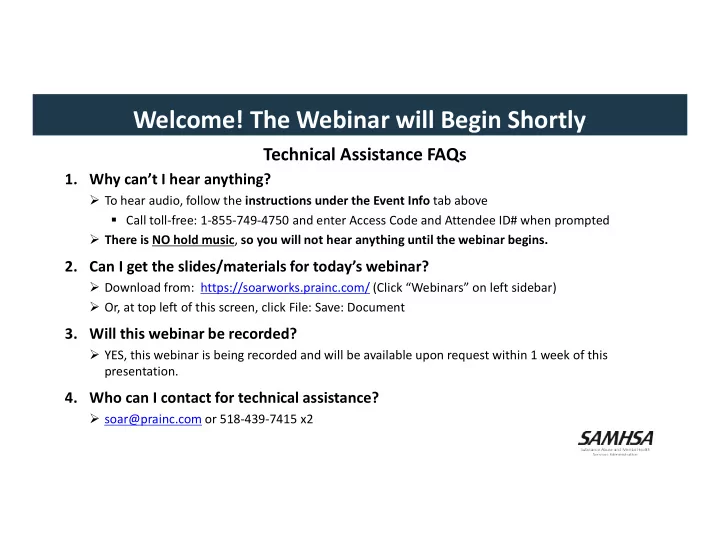
Welcome! The Webinar will Begin Shortly

Technical Assistance FAQs

  • 1. Why can’t I hear anything?
  • To hear audio, follow the instructions under the Event Info tab above
  • Call toll-free: 1-855-749-4750 and enter Access Code and Attendee ID# when prompted
  • There is NO hold music, so you will not hear anything until the webinar begins.
  • 2. Can I get the slides/materials for today’s webinar?
  • Download from: https://soarworks.prainc.com/ (Click “Webinars” on left sidebar)
  • Or, at top left of this screen, click File: Save: Document
  • 3. Will this webinar be recorded?
  • YES, this webinar is being recorded and will be available upon request within 1 week of this

presentation.

  • 4. Who can I contact for technical assistance?
  • soar@prainc.com or 518-439-7415 x2
slide-2
SLIDE 2

SOAR Medical Summary Report (MSR) Summer Writing Camp

August 28, 2019

Presented by the Substance Abuse and Mental Health Services Administration (SAMHSA) SOAR Technical Assistance (TA) Center

U.S. Department of Health and Human Services

slide-3
SLIDE 3

Disclaimer

The views, opinions, and content expressed in this presentation do not necessarily reflect the views,

  • pinions, or policies of the Center for Mental Health

Services (CMHS), the Substance Abuse and Mental Health Services Administration (SAMHSA), or the U.S. Department of Health and Human Services (HHS).

slide-4
SLIDE 4
  • Muting
  • Recording availability
  • Downloading documents
  • Questions and Answers

4

Webinar Instructions

slide-5
SLIDE 5
  • Why it’s important to include an MSR with your

SOAR-assisted SSI/SSDI application.

  • What information is relevant to key sections of the

MSR.

  • How to write quality MSRs and get them reviewed

with feedback prior to SSA submission.

5

Purpose and Objectives

slide-6
SLIDE 6

Presenters

  • Dan Coladonato, Project Associate, SAMHSA SOAR TA Center,

Policy Research Associates, Inc., Delmar, New York

  • Jennifer Ankton, Disability Adjudication Supervisor, Nevada

Bureau of Disability Adjudication, Las Vegas, Nevada

  • Shaun Kostiuk, MBA, Client Financial Services Manager and

SOAR Local Lead, Pittsburgh Mercy, Pittsburgh, Pennsylvania Questions and Answers

  • Facilitated by the SAMHSA SOAR TA Center

5

Agenda

slide-7
SLIDE 7

Welcome!

August 28, 2019

Mark P. Jacobson, Ph. D. Office of Program Analysis and Coordination Center for Mental Health Services Substance Abuse and Mental Health Services Administration

slide-8
SLIDE 8

MSR Overview and New Findings on It’s Effectiveness!

August 28, 2019

Dan Coladonato Project Associate SAMHSA SOAR Technical Assistance Center Policy Research Associates, Inc.

slide-9
SLIDE 9
  • The MSR is a letter which describes the individual and their limitations

in functioning – Supports medical records submitted – Provides a clear link between an applicant’s conditions and functional limitations – Often takes place of the SSA-3373 Function Report – Is medical evidence when co-signed by an Acceptable Medical Source – Can be sent directly to the DDS examiner or hand delivered to SSA

  • Answers the question: “Can the person work and earn SGA?”

9

Medical Summary Report (MSR)

slide-10
SLIDE 10
  • Tool for gathering information needed to

write the MSR

  • Open-ended questions

– Tell me about … – How often … – When was the last time …

  • Questions about functional limitations

– Context of questions – SGA – Distinguish between access and ability

  • Use the MSR Template to organize and write

the MSR

10

Medical Summary Report Interview Guide and Template

slide-11
SLIDE 11
  • Collect medical records after releases of information are

signed

  • Go through medical records and organize in chronological
  • rder
  • Set aside blocks of time to begin writing the report with no

interruptions

  • Sit down with all information -- medical records, intake

packet, completed MSR Interview Guide (personal, medical, employment, and substance use history) and any current mental status exams

11

Tips for Writing

slide-12
SLIDE 12
  • Reference Section
  • Introduction
  • Personal History (Personal, Educational, Legal)
  • Occupational History
  • Substance Use History
  • Physical Health History
  • Psychiatric History
  • Functional Information
  • Summary
  • Contact Information

Components of the MSR

Tips on what to include for each component is provided on the following slides!

12

slide-13
SLIDE 13
  • Demographics
  • Physical description – hygiene, grooming,

dress, make-up, any unique characteristics

  • Include diagnoses and impairment

information

  • Help the DDS examiner “see” the individual as

you do!

Introduction Section

13

slide-14
SLIDE 14
  • Childhood and family information

– Brief overview of their background – Past trauma that may relate to current diagnoses and functioning

  • Education

– What was the last grade they completed? – Any struggles or symptoms of diagnoses in school?

  • Legal History

– Brief overview of legal history – Any connections between symptoms and contacts with police? – Any treatment while incarcerated?

14

Personal History

slide-15
SLIDE 15
  • Describe past jobs – include how long they stayed at

each job, the tasks they performed, any struggles they had at work, and why they left.

  • How can you connect their difficulties in maintaining

work to their symptoms and health conditions?

  • Quotes from the applicant and the employer
  • Overview of military service (if applicable)

15

Employment History

slide-16
SLIDE 16
  • If substance use is deemed "material" to a person's

disability, benefits will be denied

  • The determination does NOT require sobriety
  • Substance use is "material" when:

– If a person were clean and sober, the functional impairment would not exist and the person would not be disabled

  • Use past periods of sobriety (hospital, jail, treatment)

to document symptoms that persisted

16

Substance Use and Co-Occurring Disorders

slide-17
SLIDE 17
  • Diagnoses and chronological treatment history
  • Specific quotes from the applicant or record

that illustrate symptoms

  • Observations of behavior
  • Durational issues
  • Current mental status exam

17

Physical and Psychiatric Health Treatment

slide-18
SLIDE 18
  • Address all four areas of mental functioning
  • Discuss any effects or side effects of medication
  • Describe any supports the applicant receives and

compare with lack of support

18

Information about Functional Limitations

Diagnosis/ Symptoms Limitations in Functioning

Why the applicant is unable to maintain work

slide-19
SLIDE 19
  • Understand, remember, or apply information

– Memory, following instructions, solving problems, etc.

  • Interact with others

– Getting along with others, anger, avoidance, etc.

  • Concentrate, persist, or maintain pace

– Task completion, focusing on details, distractibility at work, etc.

  • Adapt or manage oneself

– Hygiene, responding to change, setting realistic goals, etc.

19

Areas of Mental Functioning

Activities of Daily Living will be considered throughout all areas!

slide-20
SLIDE 20
  • Ties all information together for a concise picture of the

individual

  • Contact information – names and numbers
  • Co-signed by case worker and an Acceptable Medical

Source:

– Physicians or Licensed PhD/PsyD Psychologists – Advanced Practice Registered Nurses (APRNs)

– This includes: Certified Nurse Midwife, Nurse Practitioner, Certified Registered Nurse Anesthetist, and Clinical Nurse Specialist.

– Physician Assistants – Audiologists

20

Summary and Contact Information

slide-21
SLIDE 21

Visit the SOAR website for MSR samples

21

MSR Samples and Support

The SAMHSA SOAR TA Center will review redacted MSR letters and provide feedback upon request

slide-22
SLIDE 22

Use of the SOAR critical components, including the Medical Summary Report (MSR), statistically increases the likelihood of an approval and reduces the days to decision on initial application.

  • Based on the analysis of 22,808 applications tracked in OAT over the last 10

years.

  • Applications with an MSR were more likely to be approved. (p<.001)
  • Having a co-signature on the MSR increased the approval rate by 13

percentage points.

22

The Effectiveness of the Medical Summary Report

slide-23
SLIDE 23

MSRs from a Disability Determination Services Perspective

August 28, 2019

Jennifer Ankton Disability Adjudication Supervisor/SOAR Liaison Nevada Bureau of Disability Adjudication Las Vegas, Nevada

slide-24
SLIDE 24
  • For the disability adjudicator, a well written MSR should

provide a brief summary of the claimant’s medical impairments and how the impairments inhibit their ability to perform work related tasks.

  • Key components the DDS reviewer is considering in review of

the MSR:

– What is the medical diagnosis and how established? – Has the claimant received any treatment? – What type of treatment and response? – How does the claimant’s condition affect their ability to function?

24

Factors Relevant to DDS

slide-25
SLIDE 25

25

Medical Evidence

The summary of evidence outlined in the MSR should be supported by the

  • bjective medical findings to include the signs and laboratory findings that

establish the medically determinable impairment or MDI.  Signs are defined as the anatomical, physiological or psychological abnormalities that are observable such as gait disturbance, limited mobility, abnormal behaviors and moods, deficits in memory or

  • rientation.

 Laboratory findings are defined as one or more anatomical, physiological or psychological phenomena that is evident in diagnostic testing such as medical imaging (X-rays, MRI), EEGs, ECGs, blood test and psychological testing.

slide-26
SLIDE 26

26

Treatment History

 The MSR should provide some details of past and current treatment showing the longitudinal effects of the claimant’s impairment.  Reports of treatment should be relevant to the impairments alleged.  Pertinent treatment history should include medications, mental and physical therapy, hospitalizations, frequent ER visits and surgical intervention.  Statements regarding the response to and/or changes in treatment and side effects related to treatment can be useful in the reviewer’s assessment.

slide-27
SLIDE 27

27

The Importance of Functional Information (Physical)

Functional information is a significant factor in assessing the severity of one’s

  • condition. Collateral information provided in the MSR is typically a true reflection
  • f the claimant’s limitations.

Key functional information to include for physical impairments:

  • Difficulties in standing and walking for a length of time
  • Weight restrictions in lifting and carrying
  • Limitations in bending, stooping or kneeling
  • Limitations in hand function, decreased strength, weakness, difficulty grasping.
  • Ex. difficulty with buttons, zippers or picking up objects such as a coin.
  • How long does it take them to complete certain tasks such as cooking and

chores?

slide-28
SLIDE 28

28

The Importance of Functional Information (Mental)

Key functional information to include for mental impairments:

  • Difficulty with attention and concentration.
  • Do they need encouragement to complete tasks such as

personal care?

  • Are they able to follow written and oral instructions?
  • Do they have difficulty with getting along with others? Are

they Isolative?

  • How do they respond to stress or changes in their

environment?

slide-29
SLIDE 29

29

How is the MSR Beneficial to DDS?

  • The MSR may assist the adjudicative team in

determining the next appropriate action leading to an expedient and accurate determination.

  • May provide the supporting collateral

information that is missing from other medical and non medical findings.

  • Can provide a more accurate assessment of

functioning.

slide-30
SLIDE 30

Winning MSR Tips and Tricks!

August 28, 2019

Shaun Kostiuk Client Financial Services Manager SOAR Local Lead Pittsburgh Mercy Pittsburgh, Pennsylvania

slide-31
SLIDE 31

31

So You Want to Write an MSR?

  • Congratulations! All you need to do is follow the rules…
  • Rule #1: Don’t get overwhelmed!
  • Rule #2: Refer to Rule #1
  • If you ignore Rule #1, just remember- only good things can

result from an MSR!

  • Many of us are case workers, who may not have been English

and Journalism majors!

slide-32
SLIDE 32

32

Tips on Writing Key MSR Sections

  • Personal History – Less is more! Only include relevant info.
  • Physical Health History – 1 sentence if this is unremarkable.
  • Substance Use History – Be honest. Highlight period of

sobriety and Substance Use Disorder (SUD) treatment.

  • Work History – Highlight on the job difficulties and barriers to

getting to the job, if applicable.

  • Functional Areas – Give succinct examples of marked to

extreme limitations where applicable. It only takes 2 marked

  • r 1 extreme!
slide-33
SLIDE 33

33

Let’s Take Trip to a Case Study: David

  • David is a 27 year-old, single white male
  • Diagnosed with Major Depressive Disorder and Generalized Anxiety

Disorder/Social Phobia with a very limited treatment history

  • Sister was very supportive
  • MSR was not signed by an “acceptable medical source”
  • MSR was heavy on observation and examples
  • David was approved for Social Security Disability Insurance (SSDI)

and Supplemental Security Income (SSI) benefits in 54 days!

  • No Consultative Examination (CE)
  • Social Security Administration (SSA) agreed with alleged onset date

($11,200 retroactive benefits)

slide-34
SLIDE 34

34

Let’s Take Trip to a Case Study: Keith

  • Keith is a 60 year-old, single white male
  • Diagnosed with Major Depressive Disorder, Incipient Presenile

Dementia, and Alcohol Use Disorder, severe, in remission

  • Significant full-time work history and work was above

Substantial Gainful Activity (SGA)

  • First encounter with medical treatment was January 2017
  • MSR was co-signed by his treating physician
  • Keith was approved for SSDI benefits in 57 days, no CE
  • $1,881/month. 1st payment 2 months post-approval
slide-35
SLIDE 35

Things Not To Do

  • Do not jeopardize your credibility.

– Avoid giving your opinion. This is a report, not an editorial. – Never embellish or exaggerate

  • Do not ask every question on the interview guide!
  • Do not leave out quotes!
  • Do not give unnecessary details – being succinct is

effective.

  • Do not try to be too technical.
  • Do not stare at a blank screen if you are stuck!
slide-36
SLIDE 36

Things To Remember

  • When in doubt, focus on the person’s functioning.
  • Refer to the SSA Blue Book.
  • There are TONS of resources available in the toolkit.
  • This is your opportunity to share what is not in a record.
  • These aren’t meant to be done in 1 sitting!
  • Share everything that demonstrates functional limitations.
  • Talk to other supports, family, or staff for more information.
slide-37
SLIDE 37

Please type your questions into the Q&A box on the right of your screen

37

Questions and Answers

slide-38
SLIDE 38

SAMHSA’s mission is to reduce the impact of substance abuse and mental illness on America’s communities.

www.samhsa.gov

1-877-SAMHSA-7 (1-877-726-4727) ● 1-800-487-4889 (TDD)

38

Thank You https://soarworks.prainc.com soar@prainc.com