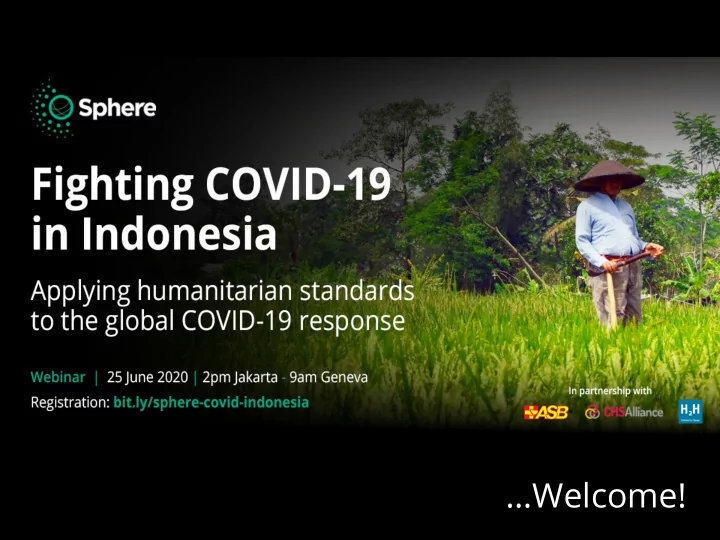
Welcome! Selamat datang! Some housekeeping rules Please mute your - - PowerPoint PPT Presentation

welcome selamat datang some housekeeping rules
SMART_READER_LITE
LIVE PREVIEW

Welcome! Selamat datang! Some housekeeping rules Please mute your - - PowerPoint PPT Presentation

Welcome! Selamat datang! Some housekeeping rules Please mute your microphones J Raise your hand or write in the chat if youd like to ask a question or need support. Rolf will monitor the chat. We will split into


slide-1
SLIDE 1

…Welcome!

slide-2
SLIDE 2

…Selamat datang!

slide-3
SLIDE 3

Some housekeeping rules…

  • Please mute your microphones J
  • “Raise your hand” or write in the chat if you’d like to ask a

question or need support. Rolf will monitor the chat.

  • We will split into breakout rooms. (How does that work?)
  • Tweeting about the webinar? Tag us as @SpherePRO!

This webinar is being recorded and the video will be posted online. We will share the presentation, too.

slide-4
SLIDE 4

Accessibility

  • We will translate to and from

English / Bahasa Indonesia

  • We are prividing

live captions

  • We will translate

into sign language

slide-5
SLIDE 5

Objectives

  • Explore a community-led response as an approach for

humanitarian response

  • Listen to and learn from members of a

community, their experiences and their own approach

  • Discover links between this particular community-led

response and the Sphere Handbook

slide-6
SLIDE 6

Meet the speakers

Axel Schmidt, facilitator

Arbeiter-Samariter-Bund e.V. (ASB)

Aninia Nadig, co-facilitator

Policy and Practice Manager, Sphere

Veronica Oktik Lestari Wisnu Isnawan Ary Ananta

slide-7
SLIDE 7

7

slide-8
SLIDE 8

Ary Ananta

Project & Emergency Response Manager ASB Indonesia and the Philippines

slide-9
SLIDE 9
slide-10
SLIDE 10
slide-11
SLIDE 11
slide-12
SLIDE 12
slide-13
SLIDE 13
slide-14
SLIDE 14
slide-15
SLIDE 15
slide-16
SLIDE 16
slide-17
SLIDE 17

Wisnu Isnawan

Covid-19 Task Force of Gumuk Indah

slide-18
SLIDE 18

Veronica Oktik Lestari

Community member of Gumuk Indah

slide-19
SLIDE 19

Aninia Nadig

Policy & Practice Manager, Sphere

Community inclusion and Sphere

slide-20
SLIDE 20

A brief history of Sphere

1995: Joint Evaluation of Emergency Assistance to Rwanda: quality, accountability, coordination 1997: Humanitarian Charter and minimum

  • standards. Sphere

Project was established. 1994: Publication of Code of Conduct 2018: 4th edition of the Sphere Handbook Sphere is a global community of practice

slide-21
SLIDE 21

21

2000 2018 2011 2004

slide-22
SLIDE 22

22

Sphere Project linked technical standards and rights of affected people («consumer rights») Standards based on international law and conventions

slide-23
SLIDE 23

Rights frame the Sphere Handbook Standards are expressions of rights

A holistic approach

slide-24
SLIDE 24
slide-25
SLIDE 25
  • 1. Do no harm

Safety, dignity and rights Protection risks, context analysis, the treatment of sensitive information Community protection mechanisms

  • 2. Impartial access to aid without

discrimination

  • 3. Support to recovery from violations
  • 4. Referral to legal redress and support

to strengthening the protection environment

Protection Principles

25

slide-26
SLIDE 26

Core Humanitarian Standard

  • Voluntary code that

describes the essential elements of principled, accountable and quality humanitarian action

  • People at the centre
  • Nine Commitments to

people affected by crisis

  • Link to technical

standards

slide-27
SLIDE 27

Sphere for Covid-19 response

  • Human dignity
  • à Humanitarian Charter, Code of Conduct, all of the Handbook
  • Community engagement
  • à WASH chapter (Hygiene promotion) and all of the Handbook
  • Other needs
  • à Health chapter – all technical chapters
slide-28
SLIDE 28

Community engagement

slide-29
SLIDE 29

Community engagement in WASH

Hygiene promotion only works if people engage in it à Hygiene promotion standards 1.1 to 1.3 WASH in disease outbreaks and healthcare settings à WASH standard 6 Community engagement remains a key component of outbreak response to prevent the spread of disease. Existing community perceptions and beliefs can support or hinder a response, so it is important to understand and address them. Some social norms may need to be changed to prevent disease

  • transmission. Example: handshaking
slide-30
SLIDE 30

Health standards

slide-31
SLIDE 31

Breakout rooms

How to make your next project/activity more people-centred, maybe with Sphere?

slide-32
SLIDE 32

Questions & Answers

slide-33
SLIDE 33

Find the recording and presentations online: bit.ly/sphere-covid-indonesia Join our upcoming webinars: bit.ly/sphere-covid-webinars

slide-34
SLIDE 34

YOU

THANK

spherestandards.org communications@spherestandards.org