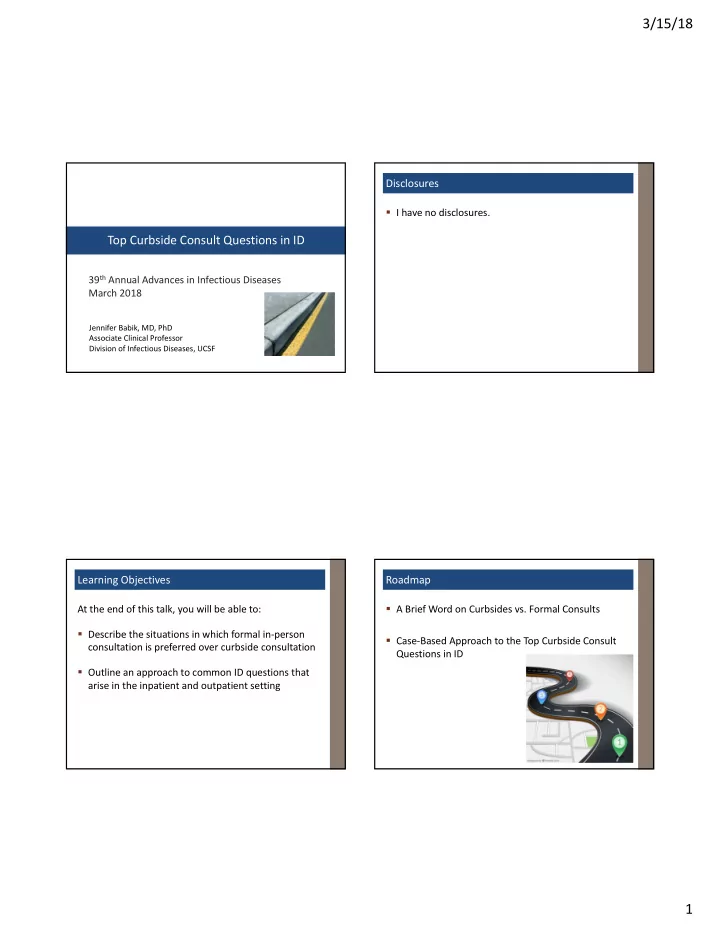
3/15/18 Disclosures I have no disclosures. Top Curbside Consult - - PDF document

3 15 18
SMART_READER_LITE
LIVE PREVIEW

3/15/18 Disclosures I have no disclosures. Top Curbside Consult - - PDF document

3/15/18 Disclosures I have no disclosures. Top Curbside Consult Questions in ID 39 th Annual Advances in Infectious Diseases March 2018 Jennifer Babik, MD, PhD Associate Clinical Professor Division of Infectious Diseases, UCSF Learning


slide-1
SLIDE 1

3/15/18 1

Top Curbside Consult Questions in ID

Jennifer Babik, MD, PhD Associate Clinical Professor Division of Infectious Diseases, UCSF

39th Annual Advances in Infectious Diseases March 2018

Disclosures

§ I have no disclosures.

Learning Objectives

At the end of this talk, you will be able to: § Describe the situations in which formal in-person consultation is preferred over curbside consultation § Outline an approach to common ID questions that arise in the inpatient and outpatient setting

Roadmap

§ A Brief Word on Curbsides vs. Formal Consults § Case-Based Approach to the Top Curbside Consult Questions in ID

slide-2
SLIDE 2

3/15/18 2

Curbsides vs Formal Consults

Burden et al, J Hosp Med 2013, 8:31.

Study of 47 curbsides vs. formal consults

  • Medicine consult
  • Curbside à formal

consult by a colleague

  • Curbsided providers

could not look in chart Curbsides

  • Information inaccurate
  • r incomplete in 51%

Formal Consults

  • Changed Rx in 60%

(36% “major changes”)

  • If info was

inaccurate/incomplete then it changed Rx in 92% (45% “major changes”)

Are Curbsides Okay?

§ Need to balance patient safety, provider workload, education § Curbside volume in ID

§ In the literature: 20-120 curbsides/month § UCSF Medical Center: 60 curbsides/mo (15 hours/mo)

§ Impossible in most practices to convert all curbsides into formal consults

Grace et al, Clin Infect Dis 2010, 51:651. Wachter, B. "The Dangers of Curbside Consults... and Why We Need Them."Wachter's World. 29 Apr. 2013.

Is This An Appropriate Curbside?

What is the dose of ertapenem when the CrCl is <30?

Is This An Appropriate Curbside?

  • 1. Yes
  • 2. No
slide-3
SLIDE 3

3/15/18 3

Is This An Appropriate Curbside? Is This An Appropriate Curbside?

  • 1. Yes
  • 2. No

Is This An Appropriate Curbside?

Theoretically, if a patient has mild cystitis due to VRE that is sensitive to doxycycline, can I use that drug to treat a VRE UTI?

Is This An Appropriate Curbside?

  • 1. Yes
  • 2. No
slide-4
SLIDE 4

3/15/18 4

What is an Appropriate Curbside?

§ The Goldilocks of Curbside Consultation

§ Not too simple: the answer can be easily looked up § Not too complicated: the answer requires nuanced clinical judgment or interpretation of a lot of data § Just right: Hypothetical, factual question

§ We also tell our ID Fellows that it should probably be a consult if:

§ You need to look up the answer § It’s early in the year § The team calls you back several times

The Special Case of S. aureus Bacteremia

§ Benefit of ID consultation versus no consultation

§ ñ adherence to quality indicators for SAB:

§ Getting an echo, repeat blood cultures § Improved antibiotic choice and duration § ñ removal of prosthetic devices/source control

§ ñ detection of metastatic foci of infection

§ ê mortality (by 20-50%)

Saunderson et al, Clin Micro Infect 2015, 21:779. Forsblom et al, Clin Infect Dis 2013, 56:527. Bai et al, Clin Infect Dis 2015; 60:1451. Paulsen et al, OFID 2016. Vogel et al, J Infection 2016; 72:19.

Curbsides for S. aureus Bacteremia?

§ Curbside consult is associated with:

§ Less identification of deep infectious foci § Less likely to receive the proper duration of therapy § ñ 90d mortality by > 2-fold compared to formal consult

§ Formal consult for SAB is preferred if available

Forsblom et al, Clin Infect Dis 2013, 56:527.

Curbside #1

55 y/o woman in the ICU after a complicated spinal surgery. She remains intubated, spikes a fever

  • n POD#3 and is pan-cultured.

§ She has thick secretions and a new CXR infiltrate. § Sputum is growing MRSA. § UA (catheter): 11-20 WBC, Ucx positive for VRE.

slide-5
SLIDE 5

3/15/18 5

Do You Need to Treat the VRE?

  • 1. Yes
  • 2. No
  • 3. Not sure

Asymptomatic Bacteriuria

ASB = (+) urine culture AND no signs/symptoms of UTI

§ Seen in up to: § 25% of elderly, diabetic, or HD patients § 50% of patients in long term care facilities § 25% of patients with short-term catheters, ~100% with long-term catheters

§ Of positive urine cultures obtained on the wards after hospital admission à ~90% are ASB

Asymptomatic Bacteriuria is COMMON!

Nicolle et al, Clin Infect Dis 2005, 40:643. Leis et al, Clin Infect Dis 2014, 58:980

Hazards of ASB Treatment

§ Side effects of antibiotics § ñ risk of Cdiff § ñ risk of resistance § May increase risk of recurrent UTI by getting rid of “good” interfering bacteria

Cai et al, Clin Infect Dis 2012;55(6):771. Cai et al, Clin Infect Dis 2015;61(11):1655..

slide-6
SLIDE 6

3/15/18 6

§ Pregnant women

§ ê risk pyelo, premature delivery

§ GU procedures w/mucosal bleeding

§ ê post-procedure bacteremia/sepsis

§ Immunosuppressed patients?

§ Renal transplant in the first 3 months? § Neutropenia?

Exceptions: Who With ASB Should Be Treated?

Nicolle et al, Clin Infect Dis 2005, 40:643.

What About Patients Undergoing Arthroplasty?

§ ASB is not associated with:

§ Risk of joint infection from the organism in the urine § Risk of post-operative UTI

§ Pre-op screening and treatment of ASB is not recommended

Sousa et al, Clin Infect Dis 2014;59:41. Duncan, Clin Infect Dis 2014;59:48. Lamb et al, Clin Infect Dis 2017, 64:806.

The Heart of the Problem

§ It’s Hard to Ignore a Positive Culture § Proof of concept study:

§ At Mount Sinai, 90% of inpatient urine cultures were ASB, and 50% were treated with ABx § They stopped reporting (+) urine cultures in the EMR § Results:

§ The % of ASB that was treated dropped by 80% § No untreated UTIs and no sepsis

Leis et al, Clin Infect Dis 2014, 58:980.

How To Distinguish ASB vs. UTI?

Use clinical context: does the patient have signs/symptoms of UTI?

Nicolle et al, Clin Infect Dis 2005, 40:643. Tambyah et al, Arch Intern Med 2000, 160:678. Lin et al, Arch Int Med 2012, 172:33.

Does the UA help?

  • Only if negative
  • Pyuria is very common in

ASB, but the absence of WBC suggests an alternative dx

  • Always order a UA when
  • rdering a urine culture

Does the organism help?

  • No, the same organisms

cause ASB and UTI (even Pseudomonas and ESBL)

slide-7
SLIDE 7

3/15/18 7

How to define UTI in patients with a catheter or AMS?

Nicolle et al, Clin Infect Dis 2005, 40:643.

Surrogate signs/symptoms that are consistent w/ UTI

  • Fever, rigors, AMS, malaise
  • Flank pain, CVAT, pelvic pain
  • Acute hematuria
  • Spinal cord injury: ñspasticity,

autonomic dysreflexia, unease No other source of infection (i.e., diagnosis of exclusion)

What if I Can’t Assess Symptoms?

AND

Alternate Diagnosis Likely? (Signs/ sx of other illness present) Yes Do not order U/A, urine cx No Send U/A, urine cx U/A, urine cx (-) Do not treat for UTI U/A (-), urine cx (+) Asymptomatic bacteriuria U/A (+), urine cx (+) Treat for UTI (If no alternate dx identified)

Slide courtesy of Catherine Liu.

U/A (+), urine cx (-) Do not treat

How to Interpret Urine Studies in a Patient With a Foley or AMS

ASB vs. UTI: Take-Home Points

§ ASB is common, especially in catheterized patients § Pyuria ≠ UTI, but its absence points to a different source § ASB does not require therapy except for:

§ Pregnancy § Urologic procedures § Neutropenia, renal transplant <3 mo?

§ To diagnose a UTI in a patient with a catheter or who cannot report symptoms, the patient must have:

§ Signs and symptoms compatible with UTI § No other source for infection (i.e., diagnosis of exclusion)

Curbside #2

A 75 y/o F with neurogenic bladder and history of prior UTI is admitted with confusion, fever, and a 2d history

  • f suprapubic pain and dysuria.

UA shows >50 WBC/hpf and urine culture grows E. coli. Blood cultures are negative. She improves on empiric ertapenem and is ready for discharge. Susceptibilities come back and the E. coli is an ESBL producer. Do I need to send her home on ertapenem or are there any oral options?

slide-8
SLIDE 8

3/15/18 8

Which Oral ABx Has the Best Efficacy in ESBL UTI?

  • 1. Fosfomycin
  • 2. Nitrofurantoin
  • 3. Minocycline
  • 4. Cephalexin

Oral Options for ESBL E. coli in the Urine

Antibiotic % Sensitive in vitro Ciprofloxacin 4-36 TMP-SMX 22-43 Amoxicillin/Clavulanate 11-70 Nitrofurantoin 58-94 Fosfomycin 91-100

Prakash et al, AAC 2009, 53:1278. Liu et al, J Micro Immunol Infect 2011, 44:364. Kumar et al, Infect Dis Res Treat 2014, 7:1. Meier et al, Infect 2011, 39:333. Kresken et al, IJAA 2014, 44:295. Fournier et al, Med Mal Infect 2013, 43:62. Rodriguez-Bano, Arch Intern Med 2008, 168:1897. Linsenmeyer, AAC 2016, 60:1134.

Caveat: susceptibilities for ESBL Klebsiella are lower for both fosfomycin (~54-80%) and nitrofurantoin (14%)

Data for Oral ABx in E.coli ESBL Cystitis (Outpatient)

Falagas et al, Lancet ID 2010, 10:43. Rodriguez-Bano, Arch Intern Med 2008, 168:1897. Pullukcu et al, Int J Antimicrob Agents 2007, 29:62. Reffert and Smith, Pharmacotherapy 2014, 34:845.

Fosfomycin

  • 1-3 doses à 94% cure
  • No pyelo/bacteremia
  • MIC not routinely done
  • Dose at 3gm PO qod x 3

(or improvement)

Nitrofurantoin

  • 14d à 69% cure
  • No pyelo/bacteremia
  • Avoid if CrCl<60

Amoxicillin/clav

  • 5-7d à 93% cure

What if the Patient has Pyelonephritis?

§ Small study in community-acquired pyelonephritis showing non-carbapenem = carbapenem § But, non-carbapenem group:

§ Mostly aminoglycoside or pip/tazo § Had much lower rates of bacteremia

§ Bottom line: could consider orals in very select circumstances without bacteremia, but no data

Park et al, J Antimicrob Chemother 2014, 69:2848.

slide-9
SLIDE 9

3/15/18 9

Oral Options for ESBL UTI: Take-Home points

§ Most data is for E. coli ESBL (limited data for Klebsiella) § For mild-moderate cystitis:

§ Oral ABx choice dictated by susceptibilities § Consider susceptibility testing for fosfomycin if possible § Caution with nitrofurantoin given poor clinical cure rates

§ Would not use orals if the patient is clinically ill, has bacteremia, or cannot be followed closely § In very select cases of mild pyelonephritis without bacteremia, could consider orals, but there is no data (and can’t use fosfomycin or nitrofurantoin)

Curbside #3

A 65 y/o man with ESRD on HD through a tunneled right IJ line is admitted with fever and found to be bacteremic on both line and peripheral cultures with Klebsiella pneumoniae. Line culture turned positive 4 hours before the peripheral culture, indicating the line as the source. He has very poor access options. Do we have to take out the line?

Do You Have to Change the Line?

  • 1. Yes, it’s a GNR
  • 2. No, you can consider line salvage

CLABSI: Diagnosis

§ Clinical findings at exit site in <3% § Catheter tip culture:

§ (+) peripheral bcx and > 15 cfu/plate from catheter tip § 80% sensitive, 90% specific § But >80% of catheters removed unnecessarily

Mermel et al, Clin Infect Dis 2009, 49:1. Safdar and Maki, Crit Care Med 2002, 30:2632.

slide-10
SLIDE 10

3/15/18 10

CLABSI: Differential Time to Positivity

§ Allows for diagnosis without removing the line § Culture from line + peripheral blood at the same time § CLABSI = blood culture drawn from central line turns positive at least 2 hrs before the peripheral culture § Test characteristics

§ 85-95% sensitive § 85-90% specific § Not as good for Candida (b/c slow-growing)

Liñares, Clin Infect Dis 2007, 44:827. Bouza et al, Clin Infect Dis 2007, 44:820. Bouza et al, Clin Microbiol Infect 2013, 19: E129. Safdar et al, Ann Intern Med 2005, 142:251.

When to Remove the Line

1. Severe sepsis 2. Persistent bacteremia (>72h of appropriate ABx) 3. Septic thrombophlebitis 4. Exit site or tunnel infection 5. Metastatic infection: endocarditis, osteomyelitis

  • 1. Staphylococcus aureus
  • 2. Pseudomonas
  • 3. Candida

Mermel et al, Clin Infect Dis 2009, 49:1

Virulent Organisms Complicated Infections

Line Management for Other Organisms

Organism Coag-negative staphylococci Enterococcus Other GNRs (not Pseudomonas)

Mermel et al, Clin Infect Dis 2009, 49:1

Less aggressive with line removal

HD Catheter Remove, retain, or guidewire exchange Remove, retain or guidewire exchange Remove, retain or guidewire exchange Tunneled Cath/Port Remove or retain Remove or retain Remove or retain PICC/Short-term CVC Remove or retain Remove Remove

Use clinical judgment based on:

  • Severity of infection
  • Access options (talk to renal!)
  • Risk of line removal/replacement

How to Retain an Infected Line (Line Salvage)

§ Which patients?

§ Uncomplicated infections § Not for exit site infections or virulent organisms § Only studied in long-term catheters

§ How to treat?

§ Give systemic ABx + antibiotic lock therapy for 7-14 d § Get surveillance blood cultures (1 wk after Abx stop)

Mermel et al, Clin Infect Dis 2009, 49:1

slide-11
SLIDE 11

3/15/18 11

What is Antibiotic Lock Therapy?

§ Goal is to get supra-therapeutic ABx concentrations to penetrate biofilms § Logistics

§ Work with pharmacy and nursing § Mix with heparin, dwell times are variable but usually <48h § Common Abx:

§ Gram positives: linezolid, vancomycin, cefazolin § Gram negatives: ceftazidime, ciprofloxacin, gentamicin

Line Salvage with Antibiotic Lock Therapy

Mermel et al, CID 2009, 49:1 Aslam et al. JASN 2014;25:2927. Fernandez-Hidalgo and Almirante, Expert Rev Anti-Infect Ther 2014, 12:117. Ashby et al, Clin J Am Soc Nephrol 2009, 4:1601. Beathard, JASN 1999, 10:1045.

10 20 30 40 50 60 70 80 90 100 30-45%

Systemic Abx Systemic Abx + Lock

10 20 30 40 50 60 70 80 90 100 80%

CoNS GNRs S.aureus 80% 40-55%

Abx Lock Efficacy by Organism (%) Overall Success Rate (%)

Line removal

What About Guidewire Exchange?

§ Goal is to eliminate biofilm § How good is it?

§ Limited data, mostly HD catheters § Seems at least equal to ABx lock (~70% cure), maybe better § Likely better than ABx lock for S. aureus

§ When to use?

§ If HD catheter removal is clearly indicated but not feasible (especially for S. aureus) § If you want to salvage an HD line but can’t use lock therapy

Robinson et al, Kidney Int 1998, 53:1792. Shaffer, Am J Kid Dis 1995, 25:593. Mokrzycki et al, Dial Transpl 2006, 21:1024. Aslam et al. JASN 2014;25:2927

Line Management: Take-Home Points

§ Physical exam findings are insensitive for diagnosis

  • f CLABSI

§ All lines should be removed for:

§ Any complicated infection § S. aureus, Pseudomonas, or Candida

§ Line management for other organisms depends on line type (lower barrier to remove line for short term catheter > long-term catheter > HD catheter) § Use antibiotic lock when possible for line salvage

slide-12
SLIDE 12

3/15/18 12

Curbside #4

A 45 y/o woman with diabetes is admitted with

  • pyelonephritis. Her urine and 2 blood cultures are positive

for pan-sensitive Klebsiella pneumoniae. She was treated empirically with ceftriaxone and has improved (defervesced, normalized her WBC count, resolution of symptoms). When can she change to PO therapy and how long do we need to treat for? I want to use cephalexin because this is the most narrow antibiotic – is this okay?

She Should Finish a Treatment Course With:

  • 1. Ceftriaxone IV x 14 days
  • 2. Ciprofloxacin PO x 14 days
  • 3. Ciprofloxacin PO x 7 days
  • 4. Cephalexin PO x 7 days

When is it Ok to Change to PO Therapy?

§ Meta-analysis of early-switch (days 1-4) vs late switch (days 7-10) to PO therapy showed no difference in clinical outcome

§ Studies included beta-lactams, TMP-SMX, cipro § Caveat: 6 of the 8 studies were in children

§ Bottom line: when is it ok to change to PO?

§ When susceptibilities are known § When patient has defervesced and clinically improved

Vouloumanou et al, Curr Med Res Opin 2008, 24:3423.

RCTs on Short Course Therapy for Pyelonephritis

Talan et al, JAMA 2000, 283:1583. Peterson et al, Urology 2008, 71:17. Sandberg et al, Lancet 2012, 380:48.

Study ABx Results Patients Bacteremia Talan et al 2000 Cipro 500mg PO bid x 7d superior to TMP-SMX 1 DS PO bid x 14d Uncomplicated pyelo 5% Peterson et al 2008 Levo 750mg PO qday x 5d = cipro 500mg PO bid x 10d Uncomplicated and complicated pyelo 2% Sandberg et al 2012 Cipro 500mg PO bid for 7d = cipro 500mg PO bid for 14d Uncomplicated pyelo 27%

slide-13
SLIDE 13

3/15/18 13

Short Course Therapy for Pyelonephritis

§ Recent systematic review of short vs long course therapy for pyelonephritis § Patients

§ 8 RCTs, 2515 patients § Uncomplicated and complicated pyelo § Most studies compared fluroquinolones § 3-29% of patients bacteremic

§ Results

§ Short course (≤7d) = long course (>7d) § Exception: Micro cure rates in short course were lower in pts w/urogenital abnormalities

Eliakim-Raz et al, J Antimicrob Chemother 2013, 68:2183.

Treatment Recommendations for Pyelonephritis

Uncomplicated Pyelo (IDSA)

§ Fluoroquinolones

§ Cipro 500mg PO bid x 7 days (A-I) § Levo 750mg PO daily x 5 days (B-II)

§ TMP-SMX

§ TMP-SMX 1 DS PO bid x 14 days (A-I)

§ Beta-lactams

§ Oral beta lactam x 10-14 days (B-III) § Lower efficacy than other regimens § If bacteremia would be wary as serum levels will be lower than can be achieved with FQ or TMP-SMX

Complicated Pyelo

§ No guidelines exist § Most would treat for 7-14 days as per uncomplicated pyelo § If urogenital abnormalities, consider treating for 14 days

Gupta et al, Clin Infect Dis 2011, 52:e103..

PO Therapy for Pyelonephritis: Take-Home Points

§ Ok to change to PO therapy once the patient is improving clinically § First choice oral therapy is a fluoroquinolone § Duration in most cases can be short (≤7 days) with a fluoroquinolone § Duration should be longer with TMP-SMX (14 days) and beta-lactams (10-14 days) and the latter should be used with caution in patients with bacteremia

Curbside #5

23 y/o woman with Takayasu arteritis on prednisone who needs escalation of immunosuppression to

  • infliximab. She has had an indeterminate

QuantiFERON (QFT) x 2, negative PPD, and no lung pathology on chest CT. She is US-born and has no known TB exposures or other risk factors. Should she be treated for latent TB infection (LTBI)?

slide-14
SLIDE 14

3/15/18 14

An Indeterminate QFT Means:

  • 1. Intermediate probability of LTBI
  • 2. Borderline/equivocal result
  • 3. Low level positive result
  • 4. The test didn’t work

QuantiFERON Interferon Gamma Release Assay (IGRA)

Measure IFN-γ by ELISA

1) Nil tube: Negative control 2) TB antigen tube:

  • ESAT-6 + CEP-10
  • Not in BCG or most NTM

3) Mitogen tube: Positive control

Incubate

Definition of an Indeterminate Assay

Indeterminate = TEST FAILURE

>85% of indeterminate results

Positive control (mitogen) didn’t work Negative control (nil) had too much background IFN-γ

How Common is an Indeterminate QFT?

§ HCWs and TB Screening Programs: 1% § Tertiary care inpatient settings: 20%

Fabre, Open Forum Infect Dis 2014. Lucet al al, Infect Contrl Hosp Epi 2015, 36:569. Simpson et al, J Immigrant Minorty Health 2013, 15:686.

slide-15
SLIDE 15

3/15/18 15

Reasons for an Indeterminate QFT

Test Factors

§ Volume of blood drawn § Suboptimal handling § Delays from blood draw to incubation step

Patient Factors

§ Immunocompromise impairs ability of T cells to produce IFN-γ in response to mitogen

Pai et al, Clin Micro Rev 2014, 27:3.

Indeterminate QFT and Immunocompromise

Cho et al, Lupus 2016; 0:1. Huang et al, Sci Rep 2016; 6:19972. Sester et al, Am J Respir Crit Care Med 2014, 190:1168. Leutkemeyer et al, Am J Respir Crit Care Med 2007, 175:737.

1 5 15 15 20 60 10 20 30 40 50 60 70 HCWs HIV HIV (CD4<100) SLE SOT/HSCT Critical illness

% indeterminate results

How to Manage Indeterminate QFT?

§ If high risk patient à repeat and/or perform a PPD § Repeat QFT

§ May eliminate possibility of lab-related factors § Many will still be indeterminate (40-70%) § Consider waiting until CD4 is higher or immunosuppression is decreased

§ In a high risk patient, use epidemiologic risk factors, clinical history, chest imaging

Indeterminate QFT: Take-Home Point

§ Indeterminate QFT = test failure due to failure of either the positive (most likely) or negative control

slide-16
SLIDE 16

3/15/18 16

Roadmap Revisited

§ Remember the Goldilocks Rule for curbsides and avoid them in S. aureus bacteremia if possible § Top Curbside Consult Questions in ID

  • 1. Asymptomatic bacteriuria: Don’t treat (3 exceptions)
  • 2. Oral Abx for ESBL cystitis: Fosfomycin has best data
  • 3. Line management in CLABSI: remove for virulent
  • rganisms and complicated infections
  • 4. Oral therapy for pyelo: best data for short course therapy

is with fluoroquinolones

  • 5. Indeterminate QFT = test failure

Thanks For Your Attention!

§ Questions?