
SLIDE 1
Welcome
Natural Capital Expedition ‘Built Environment’ Angélique Laskewitz, VBDO
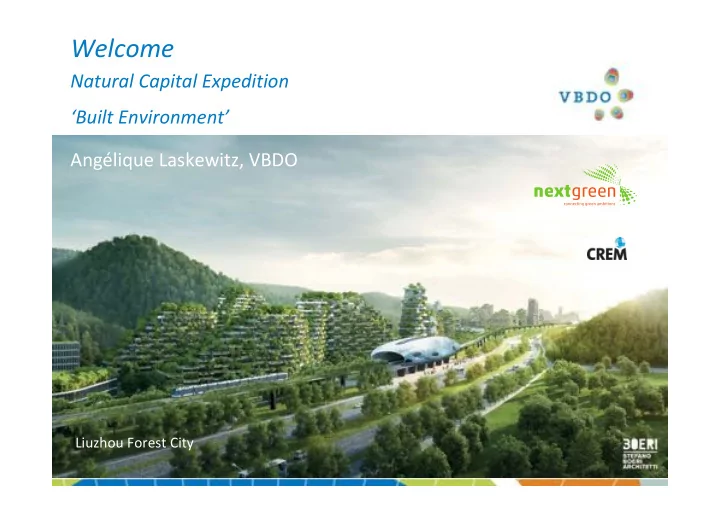
Liuzhou Forest City
Welcome Natural Capital Expedition Built Environment Anglique - - PowerPoint PPT Presentation
Welcome Natural Capital Expedition Built Environment Anglique Laskewitz, VBDO Liuzhou Forest City Natural Capital Expedition Finance & Built Environment Amsterdam, 23 January 2018 OPENING Anglique Laskewitz - VBDO Anne-Marie Bor
Liuzhou Forest City
Amsterdam, 23 January 2018
OPENING Angélique Laskewitz - VBDO Anne-Marie Bor - NextGreen PART A
Presentation 1 Jan Raes - ABN AMRO
Arie-Dirk Blom - Van Nieuwpoort Group and Richard van den Berg - Dekker Natural Resources
PART B
Marta Santamaria - Natural Capital Coalition
Robert Koolen - Heijmans
PANEL Jurgen van der Heijden - AT Osborne Albert Vliegenthart - Dutch Butterfly Conservation
Source: ‘Finance for one planet’
What is natural capital?
The stock of renewable and non-renewable natural resources, (e.g. plants, animals, air water, soils, minerals)
Natural Capital therefore includes all environmental aspects including, water, climate change, waste, and biodiversity
that combine to yield a flow
Source: PBL
Temperature regulation
Source: ‘Finance for one planet’
Q2: Which risks are relevant when investing from a natcap perspective? Q1: Which
can you think of when investing from a natcap perspective?
Q4: What do business and finance need to create better investments for ecosystems / natural capital?
Source: ‘Finance for one planet’
Q3: Which criteria are relevant when integrating natural capital into investment decisions?
Corporate Strategy & Sustainability Jan Raes
1 ABN AMRO strategy & sustainability strategy 2 Key impact: sustainable finance and investment services 3 Natural Capital 4 Q&A
2
3
4
Climate change Human rights Circular economy Inclusion
5
1 ABN AMRO strategy & sustainability strategy 2 Key impact: sustainable finance and investment services 3 Natura Capital 4 Q&A
6
7
§ ABN AMRO finances more than 10% of the total built environment in the Netherlands. § A large part of the Netherlands' carbon emissions are produced by the use of natural gas to heat homes and offices and by the use of electricity. § The energy label shows how energy-efficient a building is compared with similar buildings. There are different categories, ranging from A (ultra-efficient) to G (very inefficient). An energy-efficient home is well insulated, has double glazing or even has solar panels. The more energy-efficient your building is, the less carbon it emits. § Raising all of these buildings to an average energy label A would result in an enormous reduction in carbon emissions (about 1 third less carbon emissions). § Total loan amount of 185 Billion euro two thirds of the balance sheet (66%) of loan portfolio
8
9
ABN AMRO wants to achieve three goals by 2020:
47 53 78 87 91
20 40 60 80 100 2013-2014 2014-2015 2015-2016 2016-2017 2017-2018
1 Cijfers zijn gebaseerd op publiekelijk beschikbare informatie
1
Dow Jones Sustainability Index
(Schaal 1 tot 100)
1 ABN AMRO strategy & sustainability strategy 2 Key impact: sustainable finance and investment services 3 Natural Capital 4 Q&A
11
12
13
14
15
} We publish policies, sector guides, newsletters and blogs } ABN AMRO’s Trueprice Integrated P&L } Available on: www.abnamro.com/en/sustainable-banking
16
1
2
Cradle to cradle philosophy:
traditional construction and design processes The Alps still erode: so what about sand and gravel along the rivers? Principles of CIRCL:
What does such a challenge for just one single project mean for a whole industry and supply chain?
Aggregates Polystyrene foam (EPS/ Airpop) Precast Concrete elements Ready-mixed concrete
3
NGO’s Authorities Local residents
Contractors Developers Financial stakeholders Transport & shipping
(Cement&BetonCentrum) ( )
Aggregates - mining
Aggregates – trading
versus trading position
Ready-mixed concrete
(HeidelbergCement)
Precast concrete elements – production and sales
insulated precast concrete floors, specials and EPS insulation and foundation elements
4
5
Aggregates (sand & gravel) business is a project driven industry; the symbiosis of:
quality living environments)
protection) and concentration of risk
6
2-R Recycling, BAM, BASF, Bosch Beton, BRUIL, Cascade, CRH, Dekkergroep, DGBC, DuraVermeer, HeidelbergCement Nederland, Heijmans, Heros Sluiskil, Ministerie BZK, Ministerie EZ, Ministerie I&M, Movares, Orcem, ProRail, REKO B.V., Rijkswaterstaat, RVB, SBRCURnet, SER, Spijker, Strukton, TBI Mobilis, Theo Pouw Groep, Van Gansewinkel Minerals, Van Nieuwpoort, VBI, VERAS, Vereniging Hulpstoffen, Vliegasunie, Volker Wessels
companies) and multinational conglomerates (e.g. cement producers)
7
concrete floors and insulated precast concrete floors in a carrousel factory (like car production)
sustainability & energy management ‒ sand & gravel from recycled concrete ‒ sustainable energy supply mainly for the 43⁰C drying room:
foundation ‒ rain water storage use ‒ anticyclical investment during downturn period
8
‒ together with major family owned construction companies e.g. Dijkstra Draisma (https://www.bgdd.nl/nieuws/dijkstra-draisma-innoveert-met-gevelfabriek/1) ‒ disassembling possibilities for complete houses ‒ solution for lack of qualified work force on the construction site ‒ industrialised production with less cost of failure ‒ less transportation movements
9
for areas with soft ground conditions
– newly built factory for 3.000 ton/year (exceeding the brominated EPS volume) – Investment amount EUR 8,5 million financed by a Life(EU) grant of EUR 2,7 million, Rabobank loan of EUR 4,5 million, resulting in an over-leveraged investment competing traditional businesses
10
‒ ABN AMRO Bank ‒ Rabobank
discussions focused on joint ventures and other permitted transactions, showing friction between our business model and the LMA standardized view on credit structuring
meeting and in the KYC questionnaires
Director Landscape development Landscape development Sand, gravel, clay Trade & logistics Concrete
Investing in employees Reducing impact on the environment To enrich the environment
Energymanagement & CO2-reduction
Sustainable employability
Creating landscapes with value to society, nature and economy
Extraction with care and attention Social engagement
High water safety Recreation Landscape improvement Biodiversity & new nature
5"
– Through aggregate extraction – Without governement spendings/public money – Development of Natural Capital / biodiversity / new nature – Reducing NOx deposition – Measurable through nature value points system – High water safety (Room for the river, Deltaplan) – Increasing wellbeing - recreational & green areas
– -80% CO2 emissions by 2020 – Energy management – 100% green energy – Safety first – Aggregates are no scarce natural resources
– Thorough stakeholdermanagement
11
life cycles often require a joint venture set-up for project area development (preferably without venturing involvement of social stakeholders). This is not in line with the bankers trying to contractually prevent entering into joint ventures aiming to mitigate (financial) structure risks
which are financially overleveraged and subsidized do not harm or disrupt pure business initiatives
rules with some stimulating (not regulating) reward for sustainable and circular initiatives.
12
Driven by sustainability and circular ambitions, trivialities occur in the built environment with regard to natural & social goals, (traditional) business models, joint ventures and other co-operations, recycling, innovations and investments On our expedition to natural capital, our next speaker ‘Dekker Grondstoffen’ will also show our industry’s passion to social entrepreneurship.
This project has been made possible by generous funding and support from The Rockefeller Foundation, International Finance Corporation (IFC) with the support of the Swiss State Secretariat for Economic Affairs (SECO) and the Ministry of Foreign Affairs of the Government of the Netherlands, United Nations Environment Program (UNEP), and the Dutch Ministry of Agriculture, Nature and Food Quality.
VBDO Natural Capital Expedition: Built Environment Amsterdam, 23 January 2018 Marta Santamaria, Technical Director Natural Capital Coalition
The Finance Sector Supplement will help financial institutions incorporate consideration of natural capital impacts and dependencies, and to better assess risks and opportunities, into their banking, investment and insurance practices and processes. At present, there is no agreed framework for financial institutions to measure and value their impacts and dependencies on natural capital.
What is the Finance Sector ‘Supplement’?
What is natural capital?
The stock of renewable and non-renewable natural resources, (e.g. plants, animals, air water, soils, minerals) that combine to yield a flow
Natural Capital therefore includes all environmental aspects including, water, climate change, waste, and biodiversity
The Natural Capital Protocol
The Natural Capital Protocol was launched in July 2016. It provides a standardized framework for businesses to integrate natural capital into their decisions.
A capitals approach does three things Impacts Measure Separate issues Dependencies Value A systems approach
The conceptual model (Figure 1.1)
depend upon natural capital.
costs and benefits back to themselves and to society.
and risks and
reach the finance sector via banking, investment, and insurance activities.
with society. This is out
Supplement. 1 2
(Including government and people)
3 4
E.g., helps individuals and social institutions to ensure financial well- being, supports present and future consumption. Also depends on society for financial resources, and a social license to
What does natural capital bring?
E q u a t
p r i n c i p l e s UN Principles for Responsible Investment IFC Performance Standards Banking Environment Initiative UNEP-FI Principles for Sustainable Insurance UN Environment Inquiry V B D O Natural Capital Declaration The Finance Sector is already very active on measuring its environmental
standardized framework. ESG Criteria
What does the Finance Sector Supplement offer?
General approach Finance Sector Supplement
Commonly looks at Impacts only Assesses both impact and dependency simultaneously Focuses on a specific set of issues (water, carbon, soil), and assesses independently. Considers natural capital stocks and ecosystem services, and the interconnectivity between them. Range of issues is quite limited (e.g. less attention to regulating services and cultural values) Range of issues is much broader (e.g. includes issue that might vary by context) Typically measurement only Considers measurement and valuation
Engage Consult and pilot Apply and share
Drafting
Drafting Idea
The engagement process
193 organizations View report here.
From May 16 – August 31 6 regional workshops 40 countries Stay informed via the website
Apparel
The Coalition Organizations are broadening the Protocol with supporting work.
Food & Beverage
Protocol
Built Environment
Forest products Finance Oceans
Sector Guides Supplementary Information
Biodiversity
Data
Biodiversity is often a major challenge for natural capital assessments, with many of its benefits missing, hidden or complex to quantify. The Biodiversity Supplement aims to strengthen the way biodiversity is covered in the Protocol. Please register for updates on the project webpage
Biodiversity
Project is in scoping phase and stakeholder engagement Developed by the Cambridge Conservation Initiative (CCI),
16
For public & private sector investors:
§ Increased value and profitability from investment in sustainable building and infrastructure projects
For Design & Building Professionals:
§ Increased awareness of natural capital impacts and dependencies during the design and build process. § Improved capacity to design and build assets that are more risk resilient and adaptive to a changing climate.
For policy makers:
§ Ability to understand and measure policy impacts
Why Natural Capital In the Built Environment Matters
Scope
Direct operations, with impacts including: carbon, water consumption, waste, air pollution and biodiversity
Outcomes… and what next?
Overview of their business impacts on natural capital, and highlighted the impacts for which the company needs to work on improving suitable metrics (biodiversity).
Protocol Application: Built Environment sector
To find out more: Website: http://naturalcapitalcoalition.org/ projects/finance-sector- supplement/
Mail:
info@naturalcapitalcoalition.org
Heijmans NV Robert Koolen 23 januari 2018
Products and services Operation and construction Supply chain
The value of sustainable measures Monetisation provides issues for discussion with the clients about sustainable measures Based on GPR and extra measures on top of construction legislation (Bouwbesluit) Method includes four categories:
Pilot at the building complex of Karel de Grotelaan Eindhoven (Woonbedrijf) Value CO2- reduction approx. €100.000,- Value of avoided materials/environmental approx. €300.000,- Value of avoided health care costs approx. €300.000,- Total avoided costs during lifespan €700.000,- Costs which would have been payed by society and tax payers
Second project: total asset of social housing corporation ZOwonen is a social housing corporation with an asset of 14.000 dwellings in six communities in the south of Limburg. By achieving its's environmental goals the corporation saves the community 3,7 million euro’s per year on CO2-related and health care related costs. Not taken in to account the individual cost savings of house holds and capitalisation of better more comfortable living environment.
possible
with clients
financial decision making