Welcome! Introduction to Impact Evaluation Patricia Rogers - - PowerPoint PPT Presentation

welcome
SMART_READER_LITE
LIVE PREVIEW

Welcome! Introduction to Impact Evaluation Patricia Rogers - - PowerPoint PPT Presentation

Welcome! Introduction to Impact Evaluation Patricia Rogers Professor in Public Sector Evaluation RMIT University The presentation will begin at 4:00 pm EST. Impact Evaluation Guidance Note and Webinar Series Guidance Note 1 Introduction to


slide-1
SLIDE 1

Welcome!

The presentation will begin at 4:00 pm EST.
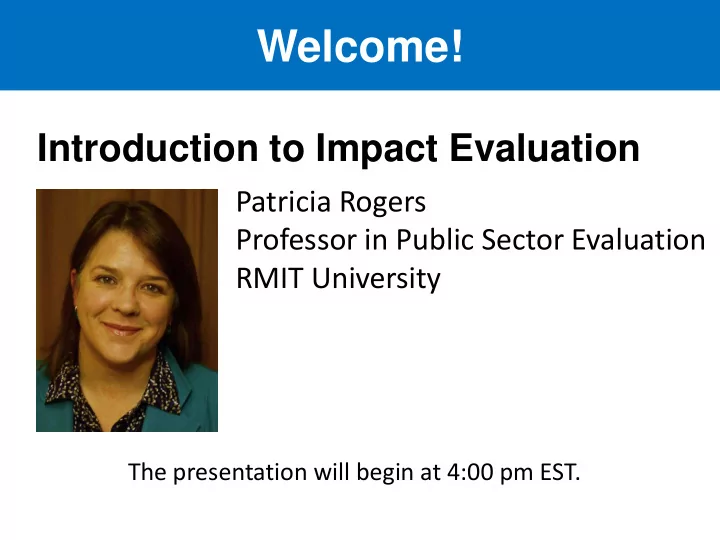
Patricia Rogers Professor in Public Sector Evaluation RMIT University

Introduction to Impact Evaluation

slide-2
SLIDE 2

Guidance Note 1 Introduction to Impact Evaluation

Impact Evaluation Guidance Note and Webinar Series

slide-3
SLIDE 3

Agenda

4:00 – 4:05 Welcome and Introductions

Laia Griñó, Coordinator for NGO Effectiveness, InterAction

4:05 – 4:35 Introduction to Impact Evaluation

Patricia Rogers, Professor in Public Sector Evaluation, RMIT University

4:35 – 4:55 Questions and Answers 4:55 – 5:00 Wrap-Up

slide-4
SLIDE 4

About the Series

  • Introduction to Impact Evaluation

by Patricia Rogers

  • Linking M&E to Impact Evaluation

by Burt Perrin

  • Introduction to Mixed Methods for Impact

Evaluation

by Michael Bamberger

  • Use of Impact Evaluation Results

by David Bonbright

slide-5
SLIDE 5

http://www.interaction.org/impact-evaluation-notes

slide-6
SLIDE 6

Webinar Instructions

Type your question(s) here Minimize or maximize this screen by clicking the orange arrow View presentation in full screen

slide-7
SLIDE 7

Introduction to Impact Evaluation

slide-8
SLIDE 8

Impact evaluation investigates the changes brought about by an intervention. Impacts - the positive and negative, intended and unintended, direct and indirect, primary and secondary effects produced by an

  • intervention. (OCED/DAC)
slide-9
SLIDE 9

Impacts An intervention (program or project or policy

  • r strategy)

Impact evaluation is not just about attribution

Appropriate methods are needed for all tasks in impact evaluation

An intervention (program or project or policy or strategy) Impacts ?

slide-10
SLIDE 10

Methods need to be:

slide-11
SLIDE 11

Methods need to suit:

Purpose(s) Replication? Adaptation? Accountability? Timeframes Evaluation reporting? Evidence of impacts? Resources Existing information, time, expertise, money? Credibility For primary intended users? Appropriateness Culturally and ethically?

slide-12
SLIDE 12

Webinar

  • Choosing methods for 6 different aspects of

impact evaluation

  • Frequently asked questions about impact

evaluation

  • Common challenges
slide-13
SLIDE 13

13

  • 1. Methods for clarifying values

Whose values? Values about what?

– Achieving desirable impacts and avoiding (or minimizing) negative impacts – Achieving desirable distribution of benefits

Some methods to articulate tacit values Appreciative Inquiry Community surveys Most Significant Change Some methods to negotiate between different values Delphi Sticky dot voting

slide-14
SLIDE 14

14

  • 2. Methods for developing a theory or

model of how we think things work

What the change process involves How the intervention will bring this about

Some methods

Logical Framework Approach (Logframe) Outcomes hierarchy (theory of change) Outcome mapping Results chain

slide-15
SLIDE 15

15

  • 3. Methods to measure/describe impacts

and other important variables

Deciding what to measure and how Understanding inputs, activities, outputs , outcomes, impacts, context - implementation failure, theory failure, translation

Some possible types of methods for gathering data

Existing indicators Existing documents and reports Collecting data from individuals or groups Physical measurement Observation/recording Accurate Relevant Timely Ethical Feasible

slide-16
SLIDE 16

16

  • 4. Methods for causal analysis

Did the intervention cause the impacts? Did it contribute to the impacts?

Some methods for examining the factual

Comparative case studies Dose-response Beneficiary/expert attribution Predictions Temporality

Some methods for identifying and ruling out alternative explanations

General Elimination Methodology Searching for disconfirming evidence Following up surprises

Some methods for creating a counterfactual

Difference in difference Logically constructed counterfactual Matched comparisons Multiple baselines Propensity scores Randomized Controlled Trial (control group) Regression discontinuity Statistically created counterfactual Some approaches that combine these different types of methods: Contribution analysis Multiple Lines and Levels of Evidence Collaborative Outcomes Reporting

slide-17
SLIDE 17

Positive impacts for all Positive impacts for some Negative impacts for some Negative impacts for all OVERALL SYNTHESIS

   

GOOD

   

?

   

?

   

BAD

  • 5. Methods for synthesis
slide-18
SLIDE 18

18

  • 5. Methods for synthesis

Across individual evaluations? Across multiple evaluations?

Some possible methods Weighted scale Evaluation rubric/ Global Assessment Scale

slide-19
SLIDE 19

19

  • 6. How do we report and support use?

Formats and processes for reporting Strategies for supporting use – knowledge transfer, knowledge translation

Some options

Focused around KEQs 1/3/15 page formats Multiple formats for multiple users Tracking recommendations

slide-20
SLIDE 20

FAQ: When should impact evaluation be done?

Circumstances - Focus impact evaluations where

clear need and intent to use findings:

  • Insufficient information about their impacts; high

risk; need to understand partnerships; periodic evaluation of portfolio

Timing –

  • Not too early – before impacts evident
  • Not too late – can’t influence decisions
slide-21
SLIDE 21

FAQ: Who should do impact evaluation?

Options

  • External evaluator/evaluation team; internal team

(but separate unit); implementing unit; community; intended beneficiaries; combined team

Balance

  • Independence
  • Transparency of methods and data
  • Cultural knowledge/access
  • Credibility
slide-22
SLIDE 22

Main messages

  • Address the different tasks involved in impact

evaluation

  • Choose methods that suit the situation
  • Guidance Note has links to additional

resources on particular methods

slide-23
SLIDE 23

Additional Questions/Comments

Send question/comments to: Laia Grino lgrino@interaction.org Deadline: COB Thursday, March 15

slide-24
SLIDE 24

Resources

  • Guidance Note
  • Webinar recording

http://betterevaluation.org/

slide-25
SLIDE 25

Next Webinar

Impact Evaluation: NGO Perspectives March 21, 11:00 am – 12:00 pm EST Presenters:

  • Allison Davis, Research and Evaluation Advisor, Oxfam

America

  • Muluemebet Chekol, Senior Director, Monitoring &

Evaluation, Save the Children

  • Larry Dershem, Senior Design, Monitoring & Evaluation

Advisor for the Middle East and Eurasia, Save the Children

Register here: https://www4.gotomeeting.com/register/587312743

slide-26
SLIDE 26

http://www.interaction.org/impact-evaluation-notes

Register for March 21 webinar here