Welcome Stage 2 ION: Light Rail Transit (LRT) from Kitchener to - - PowerPoint PPT Presentation

welcome
SMART_READER_LITE
LIVE PREVIEW

Welcome Stage 2 ION: Light Rail Transit (LRT) from Kitchener to - - PowerPoint PPT Presentation

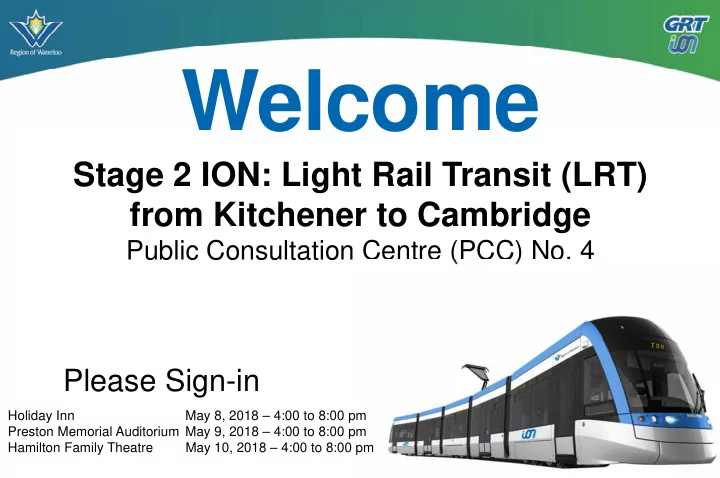
Welcome Stage 2 ION: Light Rail Transit (LRT) from Kitchener to Cambridge Public Consultation Centre (PCC) No. 4 Please Sign-in Holiday Inn May 8, 2018 4:00 to 8:00 pm Preston Memorial Auditorium May 9, 2018 4:00 to 8:00 pm Hamilton


slide-1
SLIDE 1

Stage 2 ION: Light Rail Transit (LRT) from Kitchener to Cambridge

Public Consultation Centre (PCC) No. 4

Welcome

Holiday Inn May 8, 2018 – 4:00 to 8:00 pm Preston Memorial Auditorium May 9, 2018 – 4:00 to 8:00 pm Hamilton Family Theatre May 10, 2018 – 4:00 to 8:00 pm

Please Sign-in

slide-2
SLIDE 2

Why LRT?

ION is the foundation for the Regional Official Plan objectives:

2

LRT will:

  • Help contain urban sprawl
  • Protect environmentally-sensitive areas
  • Preserve farmland and the rural lifestyle
  • Move people; create transportation choice
slide-3
SLIDE 3

How will LRT shape our community?

3

2041 2016

As the Region of Waterloo grows there will be greater demand for more housing options, and supporting facilities, amenities and services. Building more compact, higher density communities is key to accommodating growth while making efficient use of existing infrastructure, preserving natural areas, and protecting farm land and drinking water. LRT requires a mix of land uses with medium to high density. Stage 2 ION will support the concentration of existing and planned residents and jobs. Below are maps showing the density of people and jobs per hectare:

slide-4
SLIDE 4

What is the purpose of today?

  • Hear your feedback
  • Provide an overview of comments received at PCC No. 3 and

how these have provided input to the route evaluation process

  • Explain how the alternative routes were compared in the

various segments

  • Present the Project Team Preliminary Proposed Route (2018)

4

The study has not yet advanced to the stage where individual property impacts are known. Further details will be available at a future public meeting in 2019.

slide-5
SLIDE 5

How will my input be used?

Your comments are important and will be used to:

  • Identify issues that need further consideration during the

preliminary design stage

  • Verify study area conditions and constraints to reduce

impacts

Please provide feedback by:

  • Speaking with a project team member
  • Submitting your comments at this PCC
  • Sending an email
  • Completing our online survey

Feedback must be received by May 24, 2018

5

slide-6
SLIDE 6

Study Timeline

6

Activities Completed

Develop alternative design concepts and establish evaluation criteria PCC No. 1 Evaluate alternatives and identify Preliminary Potential Route (2017) PCC No. 2 Fall 2015 Winter 2017 We are here Identify additional and refined route

  • ptions based on

PCC No. 2 feedback PCC No. 3 Fall 2017 Complete evaluation and present updated Project Team Preliminary Proposed Route (2018) PCC No. 4 Spring 2018 Complete preliminary design and identify property requirements PCC No. 5 Early 2019 Present the Preferred Route and Business Case to Regional Council for Endorsement Spring 2019 File the Environmental Project Report for public review and complete the Transit Project Assessment Process Fall 2019 Project Team Preliminary Proposed Route (2018) to Regional Council for Endorsement Regional Council June 2018

slide-7
SLIDE 7

7

PCC No. 3 – Feedback on New Alternatives

KITCHENER

Opportunities Concerns

  • New alternative K3b provides a

more direct route, no traffic impact between River Road and King Street, and shorter travel time

  • New alternative K3b provides a

more direct route, no traffic impact between River Road and King Street, and shorter travel time

  • New alternative K3b has a shorter

crossing of Grand River, and proximity to Highway 8 could reduce environmental impact

  • New alternative K3b has a shorter

crossing of Grand River, and proximity to Highway 8 could reduce environmental impact

  • New alternative K3b does not

provide for potential future station near Grand River Hospital

  • New alternative K3b does not

provide for potential future station near Grand River Hospital

  • Potential impacts on Hidden

Valley Road and adjacent environmental features, additional traffic on River Road extension

  • Potential impacts on Hidden

Valley Road and adjacent environmental features, additional traffic on River Road extension

SOUTH CAMBRIDGE

Opportunities

  • S3c-S3d route alternatives

significantly reduce property impacts on Beverly Street

  • S3c-S3d route alternatives

significantly reduce property impacts on Beverly Street

  • Opportunity to preserve and/or

relocate multi-use pathway along Mill Creek

  • Opportunity to preserve and/or

relocate multi-use pathway along Mill Creek

  • Opportunity to effectively integrate

all modes in downtown Cambridge (vehicle, bus, LRT)

  • Opportunity to effectively integrate

all modes in downtown Cambridge (vehicle, bus, LRT)

  • Opportunity to provide better

coverage to south and west (across the Grand River) with T2 or T3

  • Opportunity to provide better

coverage to south and west (across the Grand River) with T2 or T3

NORTH CAMBRIDGE

Concerns

  • Property impacts and loss of

affordable housing along Beverly

  • Property impacts and loss of

affordable housing along Beverly

  • Impacts to heritage buildings

along Beverly

  • Impacts to heritage buildings

along Beverly

  • Traffic congestion, lack of parking

and potential barrier to river at T2 (Bruce Street)

  • Traffic congestion, lack of parking

and potential barrier to river at T2 (Bruce Street)

  • Need for a new facility at T2 or

T3, versus maintaining existing Ainslie Street terminal (T1)

  • Need for a new facility at T2 or

T3, versus maintaining existing Ainslie Street terminal (T1)

Concerns

  • Existing congestion on Preston

roadways, impacts to businesses during construction

  • Existing congestion on Preston

roadways, impacts to businesses during construction

  • Property, heritage and community

impacts in Preston, visual impact of elevated LRT on Shantz Hill Road

  • Property, heritage and community

impacts in Preston, visual impact of elevated LRT on Shantz Hill Road

  • Potential impacts on floodplain areas,

wildlife and existing trail network

  • Potential impacts on floodplain areas,

wildlife and existing trail network

  • Station in Preston allows for growth,

redevelopment and renewal

  • Station in Preston allows for growth,

redevelopment and renewal

Preliminary Potential Station (2017) Preliminary Potential Route (2017) Rail Corridor Areas Under Review at PCC No. 3

  • Some alternatives cross Riverside

Park and/or affect the King Street entrance to the Park

  • Some alternatives cross Riverside

Park and/or affect the King Street entrance to the Park

  • Most new alternative routes lessen

property impacts along Eagle Street and/or in the core of Preston

  • Most new alternative routes lessen

property impacts along Eagle Street and/or in the core of Preston

  • Maintains access to LRT for residents,

encourages urban renewal and supports businesses in Preston

  • Maintains access to LRT for residents,

encourages urban renewal and supports businesses in Preston

Opportunities

  • New alternative K3b has less

property impact

  • New alternative K3b has less

property impact

  • Traffic impacts on King Street,

particularly in Sportsworld/Deer Ridge area – prefer alignment following CP Rail corridor

  • Traffic impacts on King Street,

particularly in Sportsworld/Deer Ridge area – prefer alignment following CP Rail corridor

  • New alternative routes using the

abandoned CP Rail spur rather than Eagle St. North reduce property and traffic impacts

  • New alternative routes using the

abandoned CP Rail spur rather than Eagle St. North reduce property and traffic impacts

Preston Memorial Arena – Nov. 28, 2017 Cambridge City Hall –

  • Nov. 21, 2017

Kitchener: Lions Arena – Jan. 16, 2018

ATTENDANCE: 383 members of the public over the three sessions COMMENTS: 269

87 in person comment sheets 39 maps with suggested routes 143 online submissions & emails
slide-8
SLIDE 8

What was used to compare routes?

The additional route alternatives were compared against the Preliminary Potential Route (2017) from PCC No. 2 The evaluation criteria are based on the Regional Official Plan objectives and input received from public

  • consultation. They are consistent with the original evaluation presented at PCC No. 2 in Spring 2017.

CATEGORY CRITERIA

Transportation

  • Ability to Serve Multi-Modal Nodes
  • Impact on Traffic Operations
  • Engineering Challenges
  • Potential Ridership
  • Integration with Local Transit Service (for Downtown Cambridge

Terminal Station options) Social/Cultural Environment

  • Destinations Served
  • Properties Impacted
  • Cultural Heritage Impacts
  • Transit and Pedestrian Supportive Land Use Policy

Natural Environment

  • Impact on Floodplains
  • Impact to Significant Natural Features

Economic Environment

  • Ability to Serve Concentrations of Employment (existing and future)
  • Opportunity for Intensification and Revitalization
  • Cost (Capital and Operating)

8

slide-9
SLIDE 9

Cultural heritage resources

A cultural heritage inventory has been completed for the study area, including the new alternatives presented at this PCC. The inventory identified all cultural heritage resources located in proximity to the route alternatives, including:

  • Nationally significant properties
  • Properties designated under Part IV or Part V of the Ontario Heritage Act
  • Properties listed on a Municipal Heritage Register (City of Cambridge and City of Kitchener)
  • Candidate properties identified by the heritage specialist during the field survey as having potential

cultural heritage value or interest Potential impacts to cultural heritage resources could include removal, alteration, isolation, shadows, or temporary impacts due to construction. Design refinements will be explored to reduce these impacts throughout the study area during the Preliminary Design phase. Examples of cultural heritage resources along the alternative routes:

9

154-156 Eagle St. S (ARA Architects) Water St., Galt (ARA Architects) 125 Beverly St. (ARA Architects)

slide-10
SLIDE 10

How did we approach the evaluation process?

10

Alternatives were evaluated in six areas:

1 2 4 5

Legend

Preliminary Potential Route (2017) Route Alternatives Evaluated (2018) LRT Station Rail Corridor Potential GO Station Location General Area of Evaluated Segments (by colour) Area/Segment Number (by colour)

#

6 An alternative has been brought forward by a group of local residents to be evaluated separately from the other segments 3 3 4 1 2 5 6

slide-11
SLIDE 11

What would it look like at street level?

11

Off-street LRT with multi-use trail Two-way mixed-use – LRT and general traffic (two lane) LRT traveling adjacent to existing rail corridors Side running LRT with one-way traffic Centre running LRT with two-way general traffic (two lane) Centre running LRT with two-way general traffic (four lane) LRT on structure LRT adjacent to Highway 8 – north of Grand River LRT adjacent to Highway 8 – south of Grand River

Final cross-sections and dimensions will be confirmed during the design process. Not all roadway elements are shown here (e.g. utilities, landscaping, bus shelters).

slide-12
SLIDE 12

Alternatives – Kitchener (F-K)

12 1

An alternative to King Street has been proposed by a group

  • f local residents see .

3

Legend

Preliminary Potential Route (2017) Project Team Preliminary Proposed Route (2018) LRT Station Potential Property Impacts Regulatory Floodplain Significant Environmental Features Area/Segment Number

3

K3b crosses over the Highway 8 exit ramp on a structure, and then rejoins King Street in the centre median Grand River Hospital – Freeport Campus is and will continue to be serviced by GRT bus from the Fairway Station K2 has more property and traffic impacts on King Street than K3b The alignment is contained within the approved River Road extension corridor to avoid environmentally sensitive areas LRT will run on an independent structure along the west side of Highway 8, and will fully span the river and be elevated through the valley to minimize environmental impact Alternatives connect to Stage 1 LRT at Fairway Station LRT will be adjacent to Highway 8; potential property impacts are for grading at the property line Potential Property Impacts Properties Impacted* Potential Full Buyout F2a-K2 15-20 1-3 F2b-K3b 8-13 1-3 *Total, including partial and full buyout

slide-13
SLIDE 13

Evaluation Results – Kitchener (F-K)

13

F2a-K2: River Road Extension, King Street F2b-K3b: River Road Extension, Parallel to Highway 8, King Street

Fairway Station to King Street at Sportsworld Crossing Drive

NOT PREFERRED

Less impact to natural features

More properties impacted

More traffic impacts on King Street

Longer travel time

More expensive to build, operate, and maintain

PREFERRED

Shorter travel time

Lower traffic impacts on King Street

Fewer properties impacted

Fewer cultural heritage resources impacted

Less expensive to build, operate, and maintain

More impacts to natural features

slide-14
SLIDE 14

14

North Cambridge - additional route alternatives considered following PCC No. 3

Legend

Preliminary Potential Route (2017) Route Alternatives Presented at PCC No. 3 Route Alternatives Added Following PCC No. 3 LRT Station on Preliminary Potential Route (2017) Regulatory Floodplain Significant Environmental Features

Q1 is a refinement to the Q alternative crossing the Speed River and wetland on a diagonal to reduce property impacts. P3 crosses the Speed River on a diagonal with piers on existing land masses to minimize environmental impacts while reducing property impacts. M3 runs on a structure over Riverside Park and the Speed River

  • n the north side of the

existing CP rail corridor Future Highway ramps by MTO P4 reduces property impacts, reduces traffic impacts, eliminates a bend, and creates opportunities for an off-street LRT station.

slide-15
SLIDE 15

15

Legend

Preliminary Potential Route (2017) Route Alternatives Presented at PCC No. 3 Route Set Aside Following Initial Review LRT Station on Preliminary Potential Route (2017) Regulatory Floodplain Significant Environmental Features

Z eliminated, no positive/beneficial tradeoff versus 'Y' and 'X' alternatives M3 eliminated due to three CPR crossings and elevated station location P-P1 eliminated, no improvement over O- L if traffic lanes maintained M eliminated following discussion with MTO regarding ramp operations/safety and required setback from right-of-way M2 eliminated after confirming there is not adequate space between CP Rail and the existing condominium building M1 eliminated after confirming that it must be elevated across entire park

North Cambridge - eliminated route alternatives

P-P2 eliminated, property impacts at mill, slower than P3 and Q1 with no added benefit Future Highway ramps by MTO

slide-16
SLIDE 16

Alternatives – North Cambridge (N3)

16 2

N3b follows Fountain Street and King Street, and therefore has some traffic impact and slower travel time All alternatives cross the Speed River and floodplain on structures; walking trail network can be accommodated Reducing property impacts was one of the key goals of exploring alternatives Gated crossing of southbound King Street would impact traffic flow All alternatives start with N and follow Shantz Hill Road to cross over Fountain Street on an elevated structure Future Highway ramps by MTO

Legend

Preliminary Potential Route (2017) Project Team Preliminary Proposed Route (2018) LRT Station on Preliminary Potential Route (2017) LRT Station (2018) – final location to be confirmed Potential Property Impacts Regulatory Floodplain Significant Environmental Features

Alignment and station location within this block will be explored in preliminary design for better bus interface and pedestrian access and to limit impacts to heritage buildings Potential Property Impacts Properties Impacted* Potential Full Buyout N3 30-40 20-25 N3a 30-40 10-15 N3b 30-40 10-15 N3c 25-35 10-25 N3d 30-40 10-15 N3e 25-35 10-25 *Total, including partial and full buyout

slide-17
SLIDE 17

Alternatives – North Cambridge (N3e)

17 2

Legend

Project Team Preliminary Proposed Route (2018) – final alignment to be confirmed LRT Station (2018) – final location to be confirmed Potential Property Impacts

  • The route is shown wider here because

more analysis and design is needed to confirm the final alignment

  • Cultural heritage and property impacts

will be considered further

  • Yellow shading shown for potential

property impacts, direct or indirect, of works required to implement the project

  • Alignment and station location will be

confirmed during preliminary design then presented in 2019

  • Where possible buildings will be

preserved

slide-18
SLIDE 18

Evaluation Results – North Cambridge (N)

18

N3: Shantz Hill, across Speed River, Moore Street,

Eagle Street (Preliminary Potential Route 2017)

NOT PREFERRED 

Fewer commercial properties impacted

Lower traffic impacts on King/Eagle than N3b and N3d

Least impact to natural features due to shortest crossing of the Speed River and floodplain

Less expensive to build

Highest number of residential properties impacted and the most full buyouts

Longer travel time

N3d: Shantz Hill, across Speed River, behind

properties, King Street

NOT PREFERRED 

Fewer full buyouts than N3; similar to N3a and N3b

Shorter travel time

Highest number of properties impacted

Highest impact to natural features

More expensive to build than N3

N3b: Shantz Hill, Fountain Street, King Street NOT PREFERRED 

Fewest full buyouts, fewest residential properties impacted

Less expensive to build than N3c, N3d and N3e

Least impact to natural features due to use of existing roadways

Highest number of total properties impacted

Highest traffic impacts on Fountain Street and King Street

Longer travel time due to length and slower average speed

N3a: Same as N3, except running in mixed traffic on

Eagle Street

NOT PREFERRED 

Fewer full buyouts than N3

Least expensive to build

Least impact to natural features due to shortest crossing of the Speed River and floodplain

Highest number of residential properties impacted

Longest travel time due to length and share lanes (LRT/vehicles) on Eagle Street

N3c: Shantz Hill, across Speed River “islands”,

through King/Eagle/Queenston/Chopin block to Eagle Street

NOT PREFERRED 

Fewest properties impacted and fewer full buyouts than N3

Least impact on traffic, particularly King/Eagle intersection

Shorter travel time (similar to N3e)

Most expensive to build

Highest impacts to the Speed River

N3e: Shantz Hill, across Speed River, along river valley,

through King/Eagle/Queenston/Chopin block to Eagle Street

PREFERRED

Fewest properties impacted, fewer full buyouts than N3

Least traffic impacts

Shortest travel time

More impacts to natural features than N3

More expensive to build than N3

slide-19
SLIDE 19

Shantz Hill LRT Bridge Concept

19

Legend

Project Team Preliminary Proposed Route (2018) LRT Station Rail Corridor

2 1 1 2

Conceptual rendering of the Shantz Hill LRT structure shown here to demonstrate how it could work. Final alignment and appearance to be confirmed during preliminary and detailed design.

Traffic passes under the LRT tracks, eliminating traffic impacts on Fountain Street Shantz Hill is quite steep so the LRT tracks won’t follow the grade

  • f the hill
slide-20
SLIDE 20

Alternatives – Kitchener to North Cambridge (J)

20 3

Legend

Alignment J - as proposed by local resident group Alignment J – as refined and evaluated Route selected through evaluations LRT Station selected through evaluations LRT Station – for Alternative J alignment Potential Property Impacts Regulatory Floodplain Significant Environmental Features

1 2 4 1 2 4

Both alternatives cross the Grand River at relatively narrow locations Sportsworld stop on J is elevated above Maple Grove Road, requiring extensive ramps or elevator/stair towers for pedestrian access and transfers with bus service Sportsworld station on K3b is located within existing developed area, where further intensification is planned The alignment of J was modified to avoid the Parklawn and Hagey Mennonite cemeteries, and to remain

  • utside of active CP Rail lands

The alignment of J was modified to reduce the number of Hydro transmission towers impacted, but still affects seven towers, at significant cost premium J follows the old CP Rail corridor to King Street, then along King Street to Eagle Street; N3e avoids King and includes an off-street stop for better pedestrian access and bus transfers New bridge over 401 required This route is not in the CP corridor, but is parallel in some areas Future Highway ramps by MTO Sportsworld station on J is a significant walking distance from existing development, in an area where new development will be very limited J is mostly off-road; therefore J has less traffic impacts, and a 22 second shorter travel time

An alternative has been brought forward by a group of local residents to be evaluated separately from the other segments. The route was refined to reduce major impacts.

Potential Property Impacts Properties Impacted* Potential Full Buyout F2b-K3b-N-N3e 60-75 25-35 J 40-50 10-15 *Total, including partial and full buyout Planning is under way for the King Street Improvements project, from Freeport bridge to Highway 401, and it will be constructed within the next five years. It will be coordinated to accommodate future LRT construction.

slide-21
SLIDE 21

Evaluation Results – Alternative J

21

F2b-K3b-N-N3e: River Road extension, parallel to Highway 8 and King Street

PREFERRED

Higher ridership potential

Sportsworld station is centrally located within commercial and employment zone

Less expensive to build, operate and maintain

Best supports transit and pedestrian goals and policies

More properties impacted and more full buyouts Alternative J: River Road extension, parallel to Highway 8 on east side and CP corridor NOT PREFERRED

Lower traffic impacts

Lower ridership potential

Sportsworld station is further from residential and commercial developments

Sportsworld station is less accessible to vehicles and pedestrians

Least compatible with Region and city transit and pedestrian goals and policies

More expensive to build, operate and maintain

slide-22
SLIDE 22

Alternatives – North Cambridge (E)

22 4

Legend

Preliminary Potential Route (2017) Project Team Preliminary Proposed Route (2018) LRT Station Potential Property Impacts Regulatory Floodplain Significant Environmental Features

E1 and E2 use CP Rail line (no longer in use) E2 is fastest because it has a higher operating speed C1a and E1 likely require grade separation

  • f LRT and Eagle Street
  • ver CN Rail

E1 and E2 result in some impact to significant environmental features E2 requires grade separation with the CN Rail corridor, then follows a railway spur to Eagle Street E1 and E2 require grade separation

  • f LRT only over CP rail

Potential Property Impacts Properties Impacted* Potential Full Buyout C1a 50-65 30-40 E1 40-50 10-15 E2 20-25 7-10 *Total, including partial and full buyout

slide-23
SLIDE 23

Evaluation Results – North Cambridge (E)

23

C1a: Eagle Street NOT PREFERRED

Least impact to natural features

Least expensive to operate and maintain due to shorter route

Highest traffic impacts

Highest number of properties impacted and most full buyouts

E2: Rail spur

PREFERRED 

Fewest properties impacted and full buyouts

Shortest travel time

Best location for LRT-over-CN Rail grade separation

Least expensive to build

Highest impacts to natural features east of Speedsville Road

More expensive to operate and build due to route length

E1: Rail spur, Speedsville Road, Eagle Street NOT PREFERRED

Fewer properties impacted and full buyouts than C1a

Less traffic impact than C1a

More traffic impact than E2

More properties impacted and full buyouts than E2

Most expensive to build

slide-24
SLIDE 24

24

Legend

Preliminary Potential Route (2017) Project Team Preliminary Proposed Route (2018) LRT Station Alternative LRT Station Potential Property Impacts Regulatory Floodplain Significant Environmental Features

Alternatives – South Cambridge (S3)

5

An additional station at Main Street is provided with the T2 or T3 alternative in downtown Cambridge to provide access to LRT from a larger area, T1 is too close to Main Street to add another station Mill Creek Trail to be adjusted with S3c, relocated to the east side of Mill Creek with S3d Property impacts (S3c & S3d) would be primarily partial impacts to rear lot, S3c & S3d avoid impacts to built heritage resources along Beverly Street Property impacts along Beverly Street for S3a and S3b would be primarily full takings. Potential Property Impacts Properties Impacted* Potential Full Buyout S3a 45-55 35-45 S3b 25-30 10-15 S3c 30-40 3-6 S3d 25-30 3-6 *Total, including partial and full buyout

slide-25
SLIDE 25

Evaluation Results – South Cambridge (S3)

25

S3b: Beverly Street, side running with Beverly as one-way NOT PREFERRED

Fewest properties impacted

Less expensive to build due to reduced property acquisition

No changes to Mill Creek Trail

More full buyouts than S3c and S3d

Longest travel time

Highest traffic impacts due to Beverly Street one-way conversion

More cultural heritage resources impacted than S3c and S3d

S3d: Along Mill Creek, walking trail on east side of Mill Creek

PREFERRED 

Fewest properties impacted and full buy-outs

Fewer cultural heritage resources impacted

Shortest travel time

Less expensive to build

Located closest to Mill Creek and relocates Mill Creek Trail

S3a: Beverly Street NOT PREFERRED

No significant impact on traffic operations, no new signalized intersections required

No changes to Mill Creek Trail

Highest number of properties impacted and full buyouts

Highest number of cultural heritage resources impacted

Longest travel time

Most expensive to build

S3c: Along Mill Creek, walking trail on west side of Mill Creek NOT PREFERRED

Fewer properties impacted and fewer full buy-outs

Fewer cultural heritage resources impacted

Shortest travel time

Least expensive to build

Located closer to Mill Creek and beside Mill Creek Trail

slide-26
SLIDE 26

26

Alternatives – South Cambridge Terminal (T)

Legend

Preliminary Potential Route (2017) Project Team Preliminary Proposed Route (2018) LRT Station Alternative LRT Station Potential Property Impacts Regulatory Floodplain Significant Environmental Features

6

Proximity of T2 to the new pedestrian bridge and waterfront walking trail improves access to LRT for potential riders on west side of Grand River, however narrow streets could introduce design challenges for bus facilities T1 is the existing Ainslie Street Terminal, it is the most centrally located to downtown Cambridge but would require some reconstruction to accommodate LRT and improve passenger transfers An additional station at Main Street is provided with the T2 or T3 alternative to provide access to LRT from a larger area; T1 is too close to Main Street to add another station T2 and T3 would require a small on-

  • r off-street bus facility to optimize

transfers, and a driver’s facility Design of bus interface at T3 is challenging due to grade differences between Wellington, Concession and Ainslie streets, however more land is available for off-street bus platforms This new pedestrian bridge will soon be open for public use Potential Property Impacts Properties Impacted Potential Full Buyout T1 3-6 None anticipated T2 10-15 1-3 T3 10-15 None anticipated *Total, including partial and full buyout

slide-27
SLIDE 27

Evaluation Results – South Cambridge Terminal (T)

27

T2: Wellington Street, Bruce Street, new Terminal on Bruce Street at Water Street; additional station at Main Street

PREFERRED

Best access to the core area due to central location and additional station

Better access from west side of the Grand River via pedestrian bridge

More pedestrian-friendly on-street LRT bus connections

Most supportive of Region and city pedestrian goals and policies

Opportunity to streamline bus routes, improve efficiency and reduce travel time

Most expensive to build, operate and maintain

Highest number of properties impacted

T3: Wellington Street, new Terminal on Wellington Street at Concession Street; additional station at Main Street NOT PREFERRED 

Better access to the core area due to additional station

More pedestrian-friendly on-street LRT-bus connections

Opportunity to streamline bus routes, improve efficiency and reduce travel time

More properties impacted than T1

More expensive than T1 to build, operate, and maintain

T1: Wellington Street, Ainslie Street Terminal NOT PREFERRED 

Centrally located and provides good access to the core

Good connectivity for passengers transferring to/from LRT

Least expensive to build and maintain, route is shorter and terminal site already in place

Less efficient for bus operations with more travel through the city core

Requires redevelopment of existing terminal site to properly integrate LRT

slide-28
SLIDE 28

What could the GRT Bus network look like?

28

This figure shows how the GRT network could be routed through Downtown Cambridge to provide connections with LRT:

  • All bus routes in Downtown Cambridge would continue

to connect to each other, while also connecting at the Downtown Cambridge LRT station. Stops would be on street or in the LRT station area to enable convenient

  • transfers. Routes would continue to be scheduled to

connect.

  • “Through-routing” of buses in this area instead of

ending all routes at a terminal could reduce transfers, reduce duplication in routing (thereby improving

  • perating efficiency) and increase bus frequency
  • Bus layover and driver’s facilities could be moved out of

Downtown, providing redevelopment opportunities This is an illustration of a modified bus network that could be introduced with any of the Downtown Cambridge LRT

  • concepts. It applies only to bus routes in southern

Cambridge that currently use the Ainslie Terminal. Any potential bus route changes would be subject to public consultation and Council approval before implementation.

Legend

Project Team Preliminary Proposed Route (2018) Project Team Preliminary Proposed LRT Station (2018) Potential Integrated LRT/Bus Station Potential Bus Station Potential Bus Route Rail Corridor Potential GO Station Location

slide-29
SLIDE 29

Route refinements based on feedback

29

Reduces traffic and property impacts along King Street, and significantly reduces travel time What we heard: Add a station at Grand River Hospital – Freeport Campus What we did: This location is not a good candidate for an infill station due to low redevelopment potential, poor connectivity to surrounding area, and distance from the Freeport Campus. GRT is seeking to implement an express bus from Fairway to better serve patients needs. What we heard: Impacts to residential properties along Eagle and Moore streets. What we did: Significantly reduced impacts to the residential area by running along the River and crossing through the block south-west of King/Eagle. What we heard: Additional traffic congestion along Eagle and King streets with N3/N3a alternatives. What we did: The N3e refinement avoids Eagle St. S. and introduces the opportunity for an off-street LRT station. What we heard: Property and traffic impacts along Eagle Street North. What we did: E2 refinement suggested by the public runs along the abandoned CP spur, reduces property and traffic impacts and significantly improves travel time. What we heard: Impacts to residential properties and potential loss of affordable housing along Beverly Street. What we did: The S3d alternative runs adjacent to Mill Creek, relocating the walking trail to the east side of Mill Creek minimizes impacts to the back of lots along Beverly Street. What we heard: Concerns about traffic and property access along King Street near Sportsworld. What we did: Evaluated an additional alternative (Alternative J) that was brought forward by local residents. While it reduced traffic and property impacts along King Street, the Sportsworld station is located a significant distance from existing and planned commercial and residential lands, in an area which will see limited future development. In addition, the estimated capital cost is significantly higher (~$47M higher) than the Preliminary Potential Route (2017).

Compared to the Preliminary Preferred Route (2017) presented at PCC No. 2, the Project Team Preliminary Proposed Route (2018):

  • 3 minutes faster
  • 60 fewer property Impacts
  • 70 fewer full property buyouts
  • 33 fewer Built Heritage and Cultural Landscape

Resources affected Reduces impact on the established residential community and provides transit

  • riented development
  • pportunities at King/Eagle

Relocating the Downtown Cambridge terminal promotes urban growth in the area, expands the reach of the LRT and allows for better transfers between LRT and GRT buses Legend

Preliminary Potential Route (2017) Project Team Preliminary Proposed Route (2018) LRT Station Rail Corridor Potential Property Impacts Potential GO Station Location

Potential Property Impacts Properties Impacted* Potential Full Buyout 2017 Route 220-260 95-120 2018 Route 180-220 45-60 *Total, including partial and full buyout

slide-30
SLIDE 30

Project Team Preliminary Proposed Route (2018)

30

The need for additional stations will be examined, and local bus stops and intermodal connections (GRT, GO Transit, intercity coach and commuter parking) will be determined; GRT will develop changes to bus routes to interface with LRT service Legend

Project Team Preliminary Proposed Route (2018) LRT Station Rail Corridor Potential Property Impacts Potential GO Station Location

Potential Property Impacts Properties Impacted* Potential Full Buyout 180-220 45-60 * Total, including partial and full buyout

Route identified by the project team based on the evaluation results and feedback from stakeholders and agencies

Reduced localized impacts to environmental features will be developed Alignment and station at King/Eagle will be further examined to reduce property impacts, maximize pedestrian access and ease of bus transfers. Alignment will be further optimized in consultation with MTO to protect for Highway 8 maintenance and future widening, minimize environmental impacts in Grand River valley, and reduce grading impacts on private property LRT design will be coordinated with the King Street Improvements project LRT will be incorporated into the River Road Extension design Alignment will be further developed to reduce property impacts, relocation of the Mill Creek Trail will be developed Bus platforms and driver facilities will be developed with GRT to interface with LRT at this terminal station for Stage 2 N is along King Street from Sportsworld Drive to Shantz Hill Road. (formerly part of N3)

slide-31
SLIDE 31

What happens next?

  • Project Team to review all public feedback and incorporate any

new information

  • Planning and Works Committee (June 19) – Present the Project

Team Preliminary Proposed Route (2018) for Committee consideration

  • Pending Council Endorsement of a preferred route the

preliminary design (including station locations/names) and the identification of the associated property requirements will be completed

  • Prepare the business case for the project
  • Finalize station locations/names

31

slide-32
SLIDE 32

Future steps

  • Hold PCC No. 5 to present the preliminary design and

associated property requirements in 2019

  • Determine location of maintenance and storage facility
  • Present recommended route (including business case) to

Regional Council for final authority to initiate the formal Transit Project Assessment Process (Late 2019)

  • Address any comments submitted during the public or Minister
  • f Environment and Climate Change’s review periods
  • File the Environmental Project Report for public review and

complete the Transit Project Assessment process

  • Submit Provincial and Federal funding applications

32

slide-33
SLIDE 33

Property impact identification

  • Impacts to individual properties have not been confirmed

and will be identified during preliminary design (over the next six to eight months)

  • Efforts to acquire property will start only after Council has

endorsed the preliminary design of the recommended route

  • Property impacts can include partial buyout, full buyout,
  • r an easement (right to use or gain access)

33

slide-34
SLIDE 34

Property buyout process

  • When ready to buy property, Region staff will meet with property
  • wners, the goal is to reach a fair and equitable agreement for both

the property owner and the Region

  • Such an agreement will provide compensation for the fair market

value of the lands and address the project impacts (e.g. repairing or replacing landscaping, fencing, paving)

  • Compensation is based on fair market value (not MPAC assessed

value) at the time of buyout

  • Typically over 90% of all required lands and interests are acquired

through the negotiation process and not by expropriation

  • Refer to the Information Package for more information about

process

34

slide-35
SLIDE 35

Your opinion matters! Please provide feedback by May 24, 2018 using the comment sheet

  • r one of the other methods below

Thank You for Attending

35

E-mail: ION@regionofwaterloo.ca Website: www.stage2ION.ca Phone: 519-575-4757 x 3461 @rideION @rideIONrt /rideION

Stay connected Follow us online!