SLIDE 1
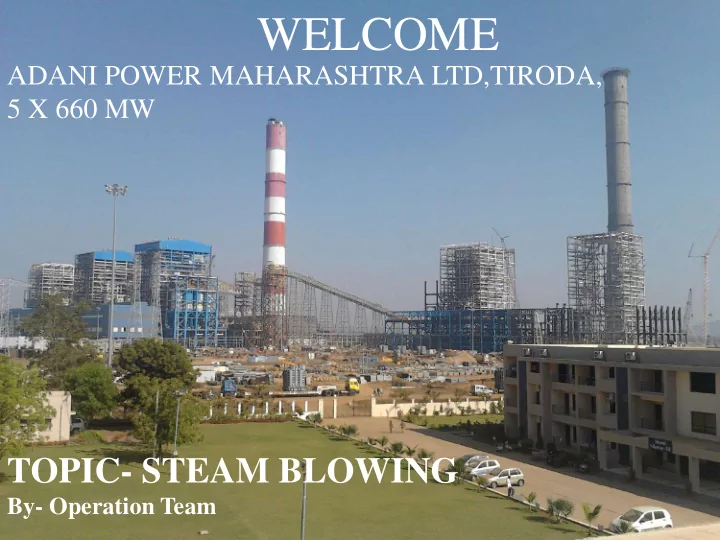
WELCOME
TOPIC- STEAM BLOWING
By- Operation Team
ADANI POWER MAHARASHTRA LTD,TIRODA, 5 X 660 MW
SLIDE 2
SLIDE 3 INTRODUCTION
PURPOSE :
Steam blowing
MS lines, CRH,HRH,SH,RH,HP & LP bypass pipe lines
- f turbine is carried out in order to remove
welding slag, loose foreign materials, iron pieces, rust etc. from the system, generated during manufacturing, transportation & erection.
SLIDE 4
EFFECT OF BLOWING DEPENDS ON
1) Thermal shock 2) Removal force of steam 3) Cleaning force of steam
SLIDE 5
REMOVAL FORCE OF STEAM
Blowing Mass Flow , Q flow= √1.25 * Qmcr √(Vmcr /Vblow)
Qmc= mass flow at MCR Vmc= velocity at MCR Vblow=blowing velocity
SLIDE 6
CLEANING FORCE OF STEAM
The necessity to create in the system, the steam velocity greater than that is possible at MCR condition is obvious. These two velocities are expressed as a ratio “Cleaning factor” or “ Distribution factor” or “Cleaning Force Ratio” denoted by “X” or “K”.
SLIDE 7
CLEANING FORCE REQUIRED (CFR) OR DISTRIBUTION FACTOR
a) K=Velocity of steam during blowing / Velocity of steam at MCR b) K= (Steam flow during blowing)2 *(Sp.vol of steam at blowing (Steam flow at MCR)² * ( Sp.vol of steam at MCR)
Steam flow can be measured by the net feed water flow CFR & velocities of the steam should be verified to avoid “Over
Blowing”
The recommended value K > 1.25 ( between 1.25 and 1.4)
SLIDE 8
PRECONDITIONS FOR STEAM LINE BLOWING
1)
Chemical cleaning should be completed
2) SH primary and secondary de-superheater piping
and RH’s emergency de-superheater piping ready for operation
3) All permanent piping & temporary piping
insulated and supports/hangers are released with cold setting
4) Silencer should be connected at temporary pipe
exit
5) Soot blowing for APH should be available 6) Make up for deaerator made ready 7) Motor Driven BFP with all controls made ready
SLIDE 9
PRECONDITIONS …
7) Hydraulic test of the following lines completed:
Feed Lines MS, HRH, CRH Lines MS to Aux. PRDS Line All other auxiliary lines identified for steam
blowing 8) Sampling system made ready
SLIDE 10 PRECONDITIONS …
9) Boiler auxiliaries proved serviceable and ready after pilot operation like:
- Fuel oil system
- Compressors & Atomizing steam system
- Start-up system ( for continuous system)
- Coal Mill system (for continuous system)
- CHP readiness
- Economizer hopper and bottom ash hopper and
its evacuation system (for continuous system)
SLIDE 11 PRECONDITIONS …
10) All safety valve disc installed after removing hydro-static plug in drum(sub-critical), superheaters and reheaters 11) Adequate communication between control room, boiler and TG area ensured. 12) Flow nozzle, control valves and NRV flaps wherever applicable should be not erected before steam blowing and suitable spool pieces are
- erected. Strainers in the path should be removed.
13) Required number of Target Plates and holder made available
SLIDE 12 CHEMICAL CLEANING PROCESS
- BOILER FRONT SYSTEM ALKALINE FLUSHING
- Mass Flushing
- Hot water Rinsing
- Alkaline Flushing
- Hot DM water Rinsing
- MAIN BOILER SYSTEM ACID CLEANIG
- Super Heater Filling
- Mass Flushing
- Alkaline Flushing
- Hot DM water Rinsing
- Acid Cleaning
- Passivation
SLIDE 13 CHEMICAL CLEANING …
ACID CLEANING ( BY CITRIC ACID METHOD )will be done by
circulation method for effectiveness of the cleaning process.
Acid cleaning will be followed by PASSIVATION, so that the uniform
protective coating of GAMMA FERRIC OXIDE is formed on the metal surface and corrosion / oxidation damage to metal surface is prevented and continue during normal operation by dosing oxygen. The gamma ferric Oxide formed by using the chemical 1-2 % sodium Nitrite(NaNO2)
SLIDE 14
BASIC TECHNIQUE USED
1)
PUFFING METHOD
2) PURGING METHOD / CONTINEOUS BLOW
METHOD
SLIDE 15
PUFFING METHOD
To give a thermal shock to the contour being purged,
to dislodge the scale etc.
Procedure: Raise the boiler pressure to a pre-
determined value (40-60 kg/cm2), shut off firing and at the same time open the quick opening valve(EOTV), thus allowing the steam to escape to atm. with high velocity carrying with it the loose debris.
SLIDE 16 PRECAUTION
The Pressure drop
allowed in drum is limited to corresponding saturation temp. change
SLIDE 17
SCHEME
Steam blowing done in stages
Stage-1(a)- SH, MSL, ESV, temporary lines from ESV
to EOTV, EOTV to CRH line, CRH lines upto boiler end with temporary exhaust pipe.
Tap off lines from CRH to deaerator, auxiliary PRDS, HP heater 6a & 6b, gland sealing, etc. shall be remain closed/isolated.
stage 1a end point will be concluded by observing the indents on the target plate.
SLIDE 18
STAGE- 1(a)
SLIDE 19 STAGE- 1(b)
SH,MSL, HP bypass inter connection, hand
- perated valve mounted in place of HP bypass valve
and CRH lines upto Boiler end with temporary exhaust piping.
In this stage 6 to 8 blows will be given through HP
bypass lines to ensure cleanliness of the limb.
Boiler MS stop valve will be used for stage 1b. EOTV
will be kept closed. Manually Operated Isolation Valves in HP bypass lines will be kept opened fully.
SLIDE 20
STAGE- 1(b)
SLIDE 21 STAGE-2(a)
1a plus reheater, HRH lines , Interceptor Valve
and temporary pipe.
CRH line along with attemperator shall be
welded with reheater before start of stage 2a. LP bypass lines shall be blanked during stage 2a. Stage 2a end point will be concluded by
- bserving the indents on target plates
SLIDE 22
STAGE- 2(a)
SLIDE 23
STAGE- 2(b)
2a upto IV + LP bypass lines with temporary
exhaust pipe.
Stage 2b blowing will be parallel blow in the path 2a & 2b. LP Bypass blanks shall be removed for stage 2b. 4 blows will be given through L.P. Bypass line to ensure cleanliness of the limbs
SLIDE 24
STAGE- 2(b)
SLIDE 25
STAGE-3 Auxiliary Steam Lines covered in steam blowing are listed below. 3a) Main steam line to Aux PRDS 3b) CRH to Deaerator 3c) CRH to HPH-6. All auxiliary steam lines will be steam blown by continuous blowing method
SLIDE 26
STAGE-4
The following Aux steam lines, connected to
deaerator are steam blown using auxiliary steam from Aux PRDS header. 4a)PRDS to Deaerator. 4b)Extraction 4 to Deaerator. 4c) PRDS to Gland steam header.
SLIDE 27 CONTINEOUS BLOWING METHOD
The initial procedure is same as puffing method
except:
- Continuous firing till the completion of steam
- blowing. No need to shut of the firing during
blowing.
- Maintain constant pressure during the blow
SLIDE 28
Recommended blowing parameters
Dynamic steam pressure
= 3.5 MPa
MS temp
= 420(not to exceed)
HRH temp
= 480( not to exceed)
Steam flow
= 845 TPH
Corresponding Drum pr.
= 40 Ksc
Furnace load
≈ 39%
SLIDE 29 METHOD
- Set the Temporary purging valve, by-pass valve
and drain valve and granulating device behind the temporary pipes
- Check the tightness, support and expansion of
the temporary system
- Section by section rinse of condensate water
piping, feed water piping and boiler through the start-up system to CW system
SLIDE 30 METHOD:
- Circulation begins when Fe+ in the water of
main feed water pipe and separator outlet will be less than 100 ppm.
- Maintain the circulation flow or start-up flow
at minimum set value
- Start oil firing and raise the temp and press.
according to the cold start-up.
- Temp. rise rate of water wall = less than 2OC /
min
- Temp. rise rate of main steam = 4 ~ 5 OC / min
SLIDE 31 METHOD:
- Before MS press reaches 1.0 Mpa , open the
bypass valve of temporary purging valve to warm the piping with all water drain valves of the system open.
- The blowing system divided into two parts
A) Preliminary Steam Blowing
B) Final Steam Blowing
SLIDE 32
PRELIMINARY CLEANING
PORPOSE-
a)Primary cleaning out sundries and bulky grain
deposited in the RH and main steam system
b)To ensure fastness of supports and hangers with
proper expansion
c)Know well about the operation property of oil
burning system, condensate water and feed water systems
METHOD
SLIDE 33 PRELIMINARRY STEAM BLOWING
- Start the oil firing with max. rating of 15%
- Control the gas temperature at furnace outlet
below 500 OC (max.538 OC )
- Raise the SH outlet press to 1.6 – 1.8 Mpa with
steam temperature around 350 OC.
- Open the temporary purging valve for 15-20 min
to blow in MS system
- Maintain K around 0.5.
- SH & RH desuperheater water system also
cleaned
SLIDE 34 FINAL STEAM BLOWING
- Main steam and reheated steam system are purged
in series
- Start 2-3 coal mills when oil burner hits the rated
firing rate of 15%
- Increase the SH outlet press. to 3.5 Mpa.
- Maintain the MS temp < 420 OC.
- Keep HRH steam temp around 480 OC.
- When the steam line blowing parameter reaches ,
- pen the temporary purging valve gradually and
increase the fuel and feed water volume to sustain parameter stability.
SLIDE 35 FINAL ….
- Establish the MS flow around 40% of the MCR
(max.- 50%)
- Ensure CFR (K) should be 1.25 to 1.3 for MS and 1.05
to 1.1 for reheated steam
- Blow under this operating condition for 20 to 30
min
- Gradually reduce coal firing and close the purge
valve at 0.5MPa .
- Remove the target plate and check it
- By estimation, target may satisfy the requirements
after 15 to 20 times in-series purging
SLIDE 36
- When the steam line temp is above the sat.
temp of MS press, close all drains and Open the boiler MSSV fully.
- Maintain the press. through controlled firing
- Insert a reference target
- Check the CFR
- Allow to run for 30-60 min
SLIDE 37
TARGET PLATE
Generally Stainless steel panel
Target plate set at the first, sixth, ninth, twelfth purging, thereafter set target for each purging until purging results qualified .
Width about 8% of the steam vent tubes inner diameter(ID) and length equal to ID
Brinell hardness < 90
Steam velocity – 258 m/sec
Target plates to be introduced just before steam blowing / light up—to be removed soon after blowing is completed.
SLIDE 38 ONLINE TARGET PLATE CHANGE ARRANGEMENT
GLAND PACKING ARRANGEMENT GLAND PACKING ARRANGEMENT
SLIDE 39
DEBRIS FILTER
SLIDE 40
AUX BOILER TO AUX STEAM HEADER
SLIDE 41 TDBFP INLET
BOILER HPSV HPSV
TEMPORARY PURGING VALVE
HPBP TDBFP-1 SV CRH LINE MS LINE TDBFP-2 SV TEMPORARY LINE PERMANENT LINE
SLIDE 42 HP,CRH,REHEATER & HRH
BOILER HPSV2 HPSV1 HPBP CRH LINE IPSV1 IPSV2 HRH LINE TEMPORARAY LINE PERMANENT LINE
SLIDE 43 HP BYPASS TO CRH NRV
BOILER HPSV2 HPSV1 HPBP CRH LINE IPSV1 IPSV2 HRH LINE TEMPORARAY LINE PERMANENT LINE
SLIDE 44 LP BYPASS VALVE INLET
BOILER HPSV2 HPSV1 HPBP CRH LINE IPSV1 IPSV2 HRH LINE LPBP TEMPORARAY LINE PERMANENT LINE
SLIDE 45
STEAM BLOWING COMPLETION CRITARIA
At least 2 continuous target plates should not have
ORIFICE GRANULARITY on the target shall be not larger than 0.8 mm.
CFR should be 1.25 to 1.4 No. of orifice granularity shall not supass 08 nos.
SLIDE 46 ADVANTAGES
- Required less time for completion of the total process
- Less time required to normalize the system for final light-
up to synchronisation
- This reduces the reactionary forces on the temporary pipes
- Stresses on the boiler system are lower
SLIDE 47 PUFFING METHOD CONTINEOUS METHOD
More time required for complete
steam blowing due to stage wise blowing(8-10 days)
More time required for stage wise
temporary pipe erection and shifting of blowing device
No mill required Quality of cleanliness is better
than continuous process
Less time required for
completion (3-4 days)
Less time required as only
valves to be opened for different systems
Minimum 02 nos. of mill
required
Quality of cleanliness is
slightly less than Puffing.
Comparison between Puffing & Contineous Method
SLIDE 48 Comparison …
PUFFING METHOD CONTINEOUS METHOD
Thermal shock is the driving
force of cleaning
More thermal stress on tube
material and sudden loading
Repeated light-up and
shutdown
There is a time gap between
the blows to make-up DM water
System normalization time
after steam blowing is more
Silencer use is optional Steam velocity or Removal
force is the driving force
Less thermal stress on tube
material
Light-up only once in the
beginning of the steam blowing
DM water make-up to the
system during steam blowing is a challenge
System normalization time
after steam blowing is less.
Silencer use is compulsory.
SLIDE 49