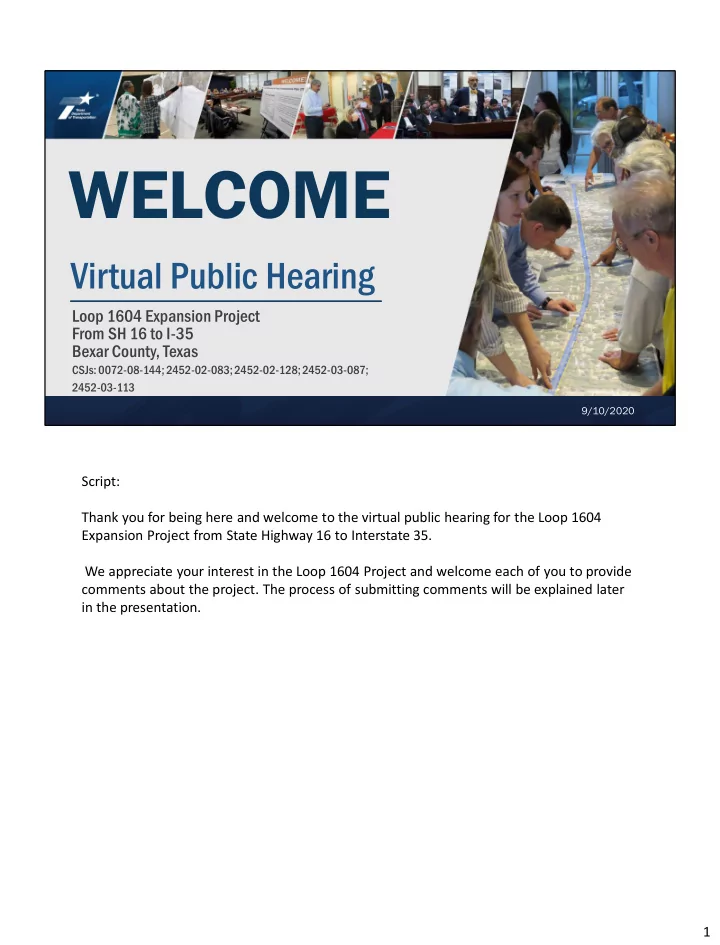
WELCOME Virtual Public Hearing Loop 1604 Expansion Project From SH - - PDF document

welcome
SMART_READER_LITE
LIVE PREVIEW

WELCOME Virtual Public Hearing Loop 1604 Expansion Project From SH - - PDF document

WELCOME Virtual Public Hearing Loop 1604 Expansion Project From SH 16 to I-35 Bexar County, Texas CSJs: 0072-08-144; 2452-02-083; 2452-02-128; 2452-03-087; 2452-03-113 9/10/2020 9/10/2020 Loop 1604 Expansion Project Script: Thank you for


slide-1
SLIDE 1

9/10/2020 Loop 1604 Expansion Project 9/10/2020

WELCOME

Loop 1604 Expansion Project From SH 16 to I-35 Bexar County, Texas

CSJs: 0072-08-144; 2452-02-083; 2452-02-128; 2452-03-087; 2452-03-113

Virtual Public Hearing

Script: Thank you for being here and welcome to the virtual public hearing for the Loop 1604 Expansion Project from State Highway 16 to Interstate 35. We appreciate your interest in the Loop 1604 Project and welcome each of you to provide comments about the project. The process of submitting comments will be explained later in the presentation. 1

slide-2
SLIDE 2

9/10/2020 Loop 1604 Expansion Project

Virtual Public Hearing in Response to Public Health

2

TxDOT changed the traditional in-person public hearing to an

  • nline format only in response to the COVID-19 outbreak.

This virtual public hearing and the information on the TxDOT website provide the same content as an in-person meeting: – Study information – Estimated timeline – Process for submitting comments – Key contacts In-person option offered by appointment only on Sept 10, 2020

Script: Given the unique circumstance of the COVID‐19 outbreak, along with our commitment to protecting public health during this national emergency, TxDOT is conducting this virtual public hearing to limit in‐person contact and large gatherings. At this time, the online format will be used in lieu of an in‐person public hearing. TxDOT made an in-person option available by appointment only on September 10, 2020, and with strict protocols to ensure public safety. This presentation covers the same information that the San Antonio District would have presented at an in-person public hearing. The comment process for the virtual public hearing will be described near the end of this presentation. All hearing materials can be found on the TxDOT website on the Loop 1604 hearing notice

  • page. The website for the project is www.txdot.gov; keyword search

“Loop 1604 from SH 16.” 2

slide-3
SLIDE 3

9/10/2020 Loop 1604 Expansion Project

Virtual Public Hearing in Other Languages

3

Presentation is available in Spanish, if you need this presentation translated to any other language, please contact:

Nancy Gates

Public Involvement Program Manager Email: nancy.gates@aecom.com

Script: This virtual public hearing is also available in Spanish on the txdot meeting notice

  • webpage. If you need the presentation translated into any other language, please contact

Nancy Gates at nancy.gates@aecom.com. 3

slide-4
SLIDE 4

9/10/2020 Loop 1604 Expansion Project

Virtual Public Hearing: Public Hearing Officer

4

Clayton Ripps, P.E.

Director of Transportation, Planning & Development

San Antonio District

Script: This is Nancy Gates, the public involvement task leader for the Loop 1604 project, and I will be narrating this presentation. Clayton Ripps is the Director of Transportation Planning and Development at TxDOT’s San Antonio District. He is the public hearing officer for tonight's public hearing. 4

slide-5
SLIDE 5

9/10/2020 Loop 1604 Expansion Project

Learn about t Enviro ronmenta tal Pro rocess ss and Study y Findings Pro roject ct Ove verview Pro roject ct Purpose se & Need Learn About t Pro roject ct (Schematic tic, Funding & Schedule) ) Pro rovide Comments ts Purpose of the Virtual Public Hearing

5

Script: The public hearing presentation will begin with an overview of the project, followed by a review of the project purpose and need. Next we will describe the project’s design, funding and anticipated schedule, followed by a description of the environmental process and study findings, and an explanation of how you can provide comments. 5

slide-6
SLIDE 6

9/10/2020 Loop 1604 Expansion Project

▪ Enviro ronmenta tal Assess ssment t prepared ▪ Federal Highway y Ad Administ stration

  • n – TxDOT

T Memora randum m of Understa standing: The environmental review, consultation, and other actions required by applicable Federal environmental laws for this project are being, or have been, carried-out by TxDOT pursuant to 23 U.S.C. 327 and a Memorandum of Understanding dated December 9, 2019, and executed by the Federal Highway Administration (FHWA) and TxDOT. ▪ Public comment t requ quest sted

6

National Environmental Policy Act (NEPA)

Script: The proposed project would be funded by the Federal Highway Administration and is a major federal action subject to the National Environmental Policy Act. TxDOT prepared a draft Environmental Assessment (EA) to evaluate the social, economic, and environmental impacts of the proposed project and determine whether such impacts warrant preparation

  • f an Environmental Impact Statement (EIS). The environmental review, consultation, and
  • ther actions required by applicable Federal environmental laws for this project are being,
  • r have been, carried-out by TxDOT pursuant to 23 U.S.C. 327 and a Memorandum of

Understanding dated December 9, 2019, and executed by FHWA and TxDOT. The EA is available for public review and TxDOT will consider any comments submitted. Once the comment period is over, TxDOT will prepare a final EA. If TxDOT determines there would be significant adverse effects on the quality of the human environment, an EIS would be prepared; otherwise TxDOT will prepare and sign a Finding of No Significant Impact (FONSI). 6

slide-7
SLIDE 7

9/10/2020 Loop 1604 Expansion Project

Project Location

7

Begin Project ct Begin Project ct End Project ct End Project ct

Study Corrid idor Study Area

Proje ject Limit its

SH 16 (Ban andera a Rd) to I-35 35

Proje ject Length

Approxi ximately 23 miles

Existin ing Facil ilit ity

▪ 2 2 – 3 3 mainlan anes in each direct ction ▪ Typical cal 2-lane frontage age roads in each direct ction ▪ Cloverleaf af interch chan ange ge at I-10 10

Script: The project limits on Loop 1604 extend from SH (also known as Bandera Road) on the west end, to I-35 on the east end – a total length of approximately 23 miles. The existing roadway typically has 2 or 3 mainlanes in each direction and 2 lanes along the frontage roads in each direction. The study area also includes the existing cloverleaf interchange at Interstate 10 and extends along I-10 from Camp Bullis Road to just south of UTSA Boulevard. 7

slide-8
SLIDE 8

9/10/2020 Loop 1604 Expansion Project

Why Improvements Are Needed?

8

PURPOSE AND NEED

NEED: What problems are we trying to address?

❑ The capacity of the LP 1604 from SH 16 to I-35 is inadequate to meet current and future traffic volumes, resulting in congestion, reduced mobility, and longer delays

PURPOSE: What are we trying to do?

❑ Accommodate current and future traffic volumes

  • n LP 1604 from SH 16 to I-35 with peak period

speeds closer to posted speed limit

Script: The Loop 1604 Expansion Project is needed because the capacity of LP 1604 from SH 16 to I-35 is inadequate to meet current and future traffic volumes. This has resulted, and will result, in congestion, reduced mobility and longer delays for drivers. The purpose of the project is to accommodate current and future traffic volumes in the project area with rush hour speeds closer to the posted speed limit. 8

slide-9
SLIDE 9

9/10/2020 Loop 1604 Expansion Project

Improve Mobility: Existing and Future Traffic Volumes and Travel Time

9

Travel Time along Loop 1604

Westbound

2045 2018

243,000 290,000 257,000 150,000 127,000 131,000 112,000 225,000

Eastbound

By 2045, traffic on LP 1604 will almost double.

No Improvement (Existing) No Improvement (2045) With Improvement (2045)

34 34min 88 88min 27 27min

No Improvement (Existing) No Improvement (2045) With Improvement (2045)

37min 113 113min 27 27min

No Improvement (Existing) No Improvement (2045) With Improvement (2045)

29 29min 64 64min 30 30min

No Improvement (Existing) No Improvement (2045) With Improvement (2045)

35min 26 26min 103 103min

Script: In 2018, the existing daily traffic volumes along Loop 1604 varied between approximately 112,000 vehicles per day to 150,000 vehicles per day. By the year 2045, traffic volumes on Loop 1604 are expected to nearly double, with volumes reaching 225,000 to 290,000 vehicles per day. The existing travel times to go from one end of the corridor to the other end are approximately 29 to 37 minutes. Without any improvements, these travel times are anticipated to increase to 64 to 113 minutes by the year 2045. With the proposed improvements, the travel times are anticipated to decrease to 26 to 30 minutes. 9

slide-10
SLIDE 10

9/10/2020 Loop 1604 Expansion Project

Project Description: Proposed Improvements

10

Add Capacity

1 High Occupancy Ve Vehicle (HOV) Lane and 2 additional mainlanes in each direction

Multimodal Improvements

Continuous sidewalks and bicycle accommodations

New Fully Directional Interchange

5-level interchange at I-10 and LP 1604

No Additional Right of Way

Proposed improvements fit within existing ROW and existing easement

NO Tolls

Script: The proposed improvements include the addition of one high occupancy vehicle or HOV lane and two mainlanes in each direction of travel with no toll lanes; a new fully-directional interchange at I-10 and Loop 1604 to replace the existing clover-leaf interchange; and continuous sidewalks and bicycle accommodations along both frontage roads. The proposed improvements fit within the existing right-of-way so no additional right-of-way is needed. 10

slide-11
SLIDE 11

9/10/2020 Loop 1604 Expansion Project

Existing Typical Section

11

Existing Typical Section: Four Mainlanes

Westbound Frontage Main Lanes Eastbound Frontage

Existing ROW

Script: The existing typical section along Loop 1604 generally contains two mainlanes in each direction of travel, an open median, and two frontage road lanes in each direction of

  • travel. Sidewalks are not continuous along the frontage roads and the frontage road

shoulders do not consistently accommodate bicycles. 11

slide-12
SLIDE 12

9/10/2020 Loop 1604 Expansion Project

Proposed Typical Section

12

Proposed Typical Section: Eight Mainlanes and Two HOV lanes

2 Additional Mainlanes

Westbound Frontage Mainlanes Eastbound Frontage

2 Additional Mainlanes 1 HOV Lane Each Direction

Existing ROW

Script: The proposed typical section includes a total of four mainlanes and one HOV lane in each direction, a closed median, two frontage road lanes in each direction of travel, and continuous sidewalks and bicycle accommodations along both frontage roads. 12

slide-13
SLIDE 13

9/10/2020 Loop 1604 Expansion Project

Proposed Improvements: Loop 1604 at I-10 Interchange

13

At-Grade Level (Level 1)

▪ 1st level of interchange at existing grade ▪ Replaces existing traffic signals with continuous flow partial roundabouts ▪ Partial roundabout system provides access to adjacent properties & local developments surrounding the interchange ▪ Adds turnarounds for I-10 frontage road traffic ▪ Provides access to VIA Park and Ride and Carpool facility within the interchange ▪ Improves bicycle & pedestrian facilities through interchange

A

A

Script: The next four slides describe the different levels and the traffic movements at the proposed Loop 1604 and I-10 interchange. The first level of the interchange would be at existing ground level and would replace the existing traffic signals with roundabouts. This level provides access to adjacent properties surrounding the interchange area. Turn-arounds would be added along I-10, sidewalks would be provided through the interchange area, and the existing VIA Park and Ride facility would be modified to fit under the new interchange. 13

slide-14
SLIDE 14

9/10/2020 Loop 1604 Expansion Project

Proposed Improvements: Loop 1604 at I-10 Interchange

14

Mainlanes – I-10 & LP 1604 (Levels 2 & 3)

▪ Reconstructs I-10 mainlane bridges on 2nd level of interchange and provides space for future expansion through the interchange ▪ Reconstructs LP 1604 mainlane bridges on 3rd level of interchange and adds two mainlanes and two HOV lanes ▪ Interchange design accounts for 18.5 ft vertical clearance for freight traffic

B

B

Script: The second level would include the I-10 mainlanes and would provide space for future expansion of I-10 through the interchange. The third level would contain the Loop 1604 mainlanes which would be expanded to include 1 additional mainlane and HOV lane in each direction through the interchange. Improvements at the interchange would account for 18.5 ft of vertical clearance for large trucks. 14

slide-15
SLIDE 15

9/10/2020 Loop 1604 Expansion Project

Proposed Improvements: Loop 1604 at I-10 Interchange

15

Collector Distributor System – LP 1604 & I-10 (Levels 2 & 3)

▪ CD Roads on the 2nd and 3rd level of interchange, same as LP 1604 and I- 10 mainlanes ▪ Serves local through traffic for developments around the interchange ▪ Provides option for through traffic to bypass partial roundabouts ▪ Provides continuous through connectivity of the frontage roads along LP 1604 and I-10 through the interchange

C

C

Script: On the 2nd level, the proposed interchange improvements include collector-distributor roads along the I-10 mainlanes. In other words, extra lanes between the mainlanes and frontage roads, along I-10 to will help serve local traffic within the interchange and provide an opportunity for frontage road traffic to bypass the roundabouts. The 3rd level would also contain collector distributor roads along the outside of the Loop 1604 mainlanes, similar to those along I-10. 15

slide-16
SLIDE 16

9/10/2020 Loop 1604 Expansion Project

Proposed Improvements: Loop 1604 at I-10 Interchange

16

Direct Connectors for all Directional Movements (Levels 4 & 5)

▪ 4th and 5th levels ▪ Provide higher-speed connections between LP 1604 and I- 10 10 ▪ Provide continuous connectivity from LP 1604 and I-10 mainlanes for long distance drivers

D

D

Script: The fourth and fifth levels would include the direct connector or flyover ramps for all directional movement to provide higher speed connections between Loop 1604 and I-10 for long distance drivers. 16

slide-17
SLIDE 17

9/10/2020 Loop 1604 Expansion Project

Project Planning and Funding

17

$1.36 Billion

Approximate cost of entire corridor improvements (from SH 16 to I-35) 35)

Funded

▪ SH 16 to West of US 281 ▪ Interchange at I-10

Amount Funded: $652 Million

Note: The proposed action is consistent with the AAMPO’s financially constrained Mobility 2045Metropolitan Transportation Plan and the Fiscal Year (FY) 2019–2022 Transportation Improvement Program.

Script: The Loop 1604 Expansion Project from SH 16 to west of US 281 and the 1604/I-10 interchange is currently funded with state and federal dollars for a total of 652 million

  • dollars. The cost to expand the entire corridor would be approximately 1.3 billion dollars.

Please note that the existing action is consistent with the Alamo Area MPO's funded projects included in the 2045 Metropolitan Transportation Plan and the fiscal year 2019 to 2022 Transportation Improvement Plan 17

slide-18
SLIDE 18

9/10/2020 Loop 1604 Expansion Project

Anticipated Project Schedule to Completion

18

Late 2020 September 2020

Environmental Clearance

Late 2020

Construction Completion (SH 16 to West of US 281)

2026

Ongoing Communication with Public & Stakeholders

Earliest Construction (SH 16 to West of US 281)

Spring 2021

Hold Public Hearing

Complete Schematic Design & Environmental Documents

Script: The anticipated project schedule after this September 2020 public hearing includes:

  • The completion of the schematic design and environmental documents in

late 2020

  • Environmental clearance in late 2020
  • The start of construction on the Loop 1604 expansion from SH 16 to west
  • f US 281 in the first quarter of 2021
  • The completion of construction (from SH 16 to west of US 281) in 2026

18

slide-19
SLIDE 19

9/10/2020 Loop 1604 Expansion Project

Environmental Overview

19

DRAFT ENVIRONMENTAL ASSESSMENT DRAFT ENVIRONMENTAL ASSESSMENT

2

ENVIRONMENTAL STUDIES ENVIRONMENTAL STUDIES

1

▪ Traffic Noise Analysis ▪ Water Resources ▪ Biological Resources ▪ Air Quality ▪ Cultural Resources ▪ Community Impacts ▪ Hazardous Material Draft Environmental Assessment is available for public review and comment

COORDINATION:

  • AAMPO; THC; TPWD; EAA; TCEQ;

FHWA; USFWS

PUBLIC INVOLVEMENT:

  • Stakeholder Meetings
  • Open Houses

Script: Numerous environmental studies were performed for the project to comply with environmental regulations and policies. They cover a wide range of topics including traffic noise, water resources, biological resources, air quality, cultural resources, community impacts, and hazardous materials. These studies were documented in over two dozen technical reports and summarized in the Environmental Assessment. The Environmental Assessment is available for public review and comment as part of the virtual public hearing and on the project meeting notice webpage. TxDOT coordinates with various agencies regarding the project, including the Alamo Area Metropolitan Planning Organization, Texas Historical Commission, Edwards Aquifer Authority, Texas Commission on Environmental Quality, Federal Highway Administration (FHWA), and the U.S. Fish and Wildlife Service. In addition, TxDOT has received public input from a variety of stakeholders such as cities, school districts and emergency services, and during open houses for the general public. 19

slide-20
SLIDE 20

9/10/2020 Loop 1604 Expansion Project

Environmental Consequences

Ke Key y Issue ues:

20

Traffic Noise Other Issues (See Environmental Assessment) Edwards Aquifer Endangered Species Air Quality

Script: A wide variety of natural resource, cultural and human environment topics are

  • addressed. It would take considerable time to review each of these in this presentation.

We encourage you to review a copy of the EA and provide comments on any topic. We will review a few of the key topics that were of interest during the public meetings. The issues are traffic noise, the Edwards Aquifer, Endangered Species, and air quality. 20

slide-21
SLIDE 21

9/10/2020 Loop 1604 Expansion Project

Traffic Noise

21

Miti tigat gation

  • n
  • Noise barriers feasible and

reasonable for 10 of the 27 receivers

  • Constructability of noise barriers

to be evaluated during detailed design

Miti tigat gation

  • n
  • Noise barriers feasible and

reasonable for 10 of the 27 receivers

  • Constructability of noise barriers

to be evaluated during detailed design

Impacts acts

  • Traffic Noise Impacts: 66 dBA (A-

weighted decibels)

  • 27 of the 117 modeled receivers

impacted

Impacts acts

  • Traffic Noise Impacts: 66 dBA (A-

weighted decibels)

  • 27 of the 117 modeled receivers

impacted

Script: The majority of the comments on environmental issues from the open houses were about traffic noise. Based on FHWA criteria, a noise level of 66 dBA, would constitute a noise impact at a residential receiver, such as a backyard. TxDOT has conducted a noise analysis of the proposed project layout using computer modeling software that was created by the FHWA. The computer model was used to predict noise levels at 117 different locations, or receivers, along the corridor. The proposed project would cause noise impacts at 27 of the 117 receivers. Most of the impacts would occur at apartment complexes or other residential areas. With respect to mitigation, the computer model was used to evaluate if noise barriers would provide feasible and reasonable abatement. Based on the computer modeling, barriers appear to be feasible and reasonable for 10 of the 27 impacted receiver locations. At the other 17 locations, barriers would either not provide the minimum acceptable levels of noise attenuation, or the cost to construct the barriers would exceed the reasonable cost criteria of $25,000 per benefitted receiver. As mentioned, the computer modeling is based on the schematic level data and engineering. If the project is approved, noise barriers would be further evaluated to determine if there are any conflicts that were not evident during the schematic level study. Once the detailed designs are complete, TxDOT would coordinate with property owners during construction if it is possible to construct feasible and reasonable abatement at these locations.

21

slide-22
SLIDE 22

9/10/2020 Loop 1604 Expansion Project

Edwards Aquifer

22

Miti tigat gation

  • n
  • Compliance with TCEQ Edwards

Aquifer rules & guidance

  • Contractor Waste & Material

Management Plan

  • 81 water quality controls
  • Increased spill control capacity
  • Nine sensitive features avoided

Miti tigat gation

  • n
  • Compliance with TCEQ Edwards

Aquifer rules & guidance

  • Contractor Waste & Material

Management Plan

  • 81 water quality controls
  • Increased spill control capacity
  • Nine sensitive features avoided

Impacts acts

  • 236 acres of impervious cover
  • 1.1 million cubic yards of fill, soil &

rock excavation

  • Nine sensitive features removed

Impacts acts

  • 236 acres of impervious cover
  • 1.1 million cubic yards of fill, soil &

rock excavation

  • Nine sensitive features removed

Script:

There were numerous comments regarding the Edwards Aquifer and issues involving the Edwards Aquifer can be contentious. This slide shows the San Antonio Pool of the Edwards Aquifer, with the project limits shown in red. The Edwards Aquifer is a major water resource spanning six counties. The project would add 236 acres of impervious cover to areas that drain to the recharge zone. The project would also excavate 1.1 million cubic yards of fill, soil and rock from the recharge zone. Most of the excavation would be less than 10 feet deep; however, the drilled shafts for some bridges would be 80 feet deep. Nine sensitive features, primarily solution cavities located at the base of roadcuts adjacent to the main lanes, would be removed by the project. The project would not directly affect groundwater because the groundwater is located roughly 140 to 225 feet below the

  • surface. However, the near surface impacts quantified here may indirectly affect underlying groundwater quality during construction

through the erosion of disturbed soils and spills of construction-related materials. After construction, the additional impervious cover would accumulate pollutants which may infiltrate to the underlying groundwater if the runoff is not treated. The project would include mitigation to avoid and minimize impacts to the Edwards Aquifer during and after construction. Key mitigation elements include the following:

  • The project would be implemented, operated, and maintained in a manner that complies with the Edwards Aquifer rules and any

applicable Texas Commission on Environmental Quality or TCEQ guidance documents in effect to implement the rules

  • The project would include appropriate water quality controls required by the TCEQ to control pollutants during and after

construction.

  • A Contractor Waste and Materials Management Plan would be voluntarily implemented to prevent spills of sanitary waste and

hazardous materials during construction.

  • The project would include the installation of 81 storm water quality controls that use media filtration or detention to filter runoff

before it is released to receiving streams where recharge may occur.

  • The water quality controls would voluntarily be outfitted with valves that would substantially increase the post-construction spill

control capacity of the facility.

  • Finally, as previously mentioned, there are 9 sensitive features, primarily along roadcuts adjacent to the main lanes, that would be
  • removed. This would prevent spills from entering them. There are 9 other sensitive features mostly in creeks that would be avoided

by the project.

  • Due to the required mitigation and voluntary conservation measures, the project would not be expected to adversely impact

groundwater quality.

22

slide-23
SLIDE 23

9/10/2020 Loop 1604 Expansion Project

Endangered Species

23

Miti tigat gation

  • n
  • USFWS consultation
  • Voluntary conservation measures

Miti tigat gation

  • n
  • USFWS consultation
  • Voluntary conservation measures

Impacts acts

  • Endangered cave-dwelling species
  • Three occupied caves in action

area

  • Potential undiscovered caves
  • Critical Habitat Unit
  • Golden-cheeked warbler

Impacts acts

  • Endangered cave-dwelling species
  • Three occupied caves in action

area

  • Potential undiscovered caves
  • Critical Habitat Unit
  • Golden-cheeked warbler

Script:

Endangered species are a major issue for the project. Eight endangered cave dwelling species live in northern Bexar County including small blind spiders and beetles similar to the one pictured here.

  • The project’s action area includes three occupied caves. One of them is located in the TxDOT right of way

and the other two are located on adjacent commercial property. The project’s proposed construction in close proximity to these caves may adversely affect the species that live in them.

  • Although geologists and karst scientists surveyed the right of way extensively, no other occupied caves

were found. However, it is possible that the excavation necessary for the proposed project could result in the discovery of more caves, and this may adversely affect endangered species.

  • There is also a designated critical habitat unit in the action area near UTSA. Based on the project's design,

avoidance and minimization measures, the project would not adversely affect the critical habitat unit.

  • There is potential habitat for the golden-cheeked warbler, which is a small endangered bird, in various

locations along the corridor. The project may remove up to 7 acres of potential habitat for the GCW. With respect to mitigation, TxDOT is engaged in formal consultation with the US Fish and Wildlife Service regarding the project’s effects to listed species. The project would include a variety of voluntary conservation measures to benefit the species while also permitting incidental take associated with the project. The design of the project avoids and minimizes impacts to the known species locations to the extent practicable and includes substantial water quality treatment at the critical habitat unit. Any potential habitat for the golden-cheekedwarbler that needs to be removed would be performed outside the nesting season. Additional conservation measures would be incorporated into the project and approved by the U.S. Fish and Wildlife Service before construction begins.

23

slide-24
SLIDE 24

9/10/2020 Loop 1604 Expansion Project

Air Quality

24

Climate ate Change nge

  • Statewide

Greenhouse gas emissions and climate change report

Climate ate Change nge

  • Statewide

Greenhouse gas emissions and climate change report

Impacts acts

  • Carbon Monoxid

ide

  • Mobile

ile Source Air Tox

  • xic

ics s (MSAT)

  • Ozone

Impacts acts

  • Carbon Monoxid

ide

  • Mobile

ile Source Air Tox

  • xic

ics s (MSAT)

  • Ozone

Miti tigat gation

  • n
  • Conformity

with State Implementation Plan

Miti tigat gation

  • n
  • Conformity

with State Implementation Plan

Script:

In regard to air quality, our modeling results indicate that local concentrations of carbon monoxide are not expected to exceed national standards at any time along the corridor. The project may result in increased exposure to Mobile Source Air Toxics or MSAT emissions in certain locations; however, total MSAT emissions would be lower because the project would allow for higher vehicle speeds and thus lower emissions for most MSAT pollutants. The proposed project is located in Bexar County, which is in an area that has been designated by the U.S. Environmental Protection Agency, EPA, as a marginal nonattainment area for the 2015 ozone National Ambient Air Quality Standards Ozone is not directly emitted from vehicles but vehicle emissions contribute to the formation of ozone. With respect to mitigation, it is necessary to demonstrate that the project conforms with local and state plans to return Bexar County to attainment status. The project-level conformity determination is currently in progress. There were several comments about issues related to climate change. The project was not individually evaluated with respect to climate change. TxDOT has prepared a Statewide On-Road Greenhouse Gas Emissions Analysis and Climate Change Assessment technical report which takes into consideration increases in temperature. Please refer to the air quality technical report for more details, including the climate change assessment and how TxDOT is responding to a changing climate. 24

slide-25
SLIDE 25

9/10/2020 Loop 1604 Expansion Project

25

PUBLIC INVOLVEMENT

PUBLIC MEETINGS PUBLIC MEETINGS

2

STAKEHOLDER MEETINGS STAKEHOLDER MEETINGS

1

▪ Group Meeting with Stakeholders, June 24, 2019

City of San Antonio, City of Live Oak, Bexar County, AAMPO, VIA, Northside ISD, Judson ISD

▪ Individual Stakeholder Meetings 2019 – 2020

UTSA, Fiesta Texas, VIA, City of Live Oak, Union Pacific RR, developers

▪ Meeting #1 (at 2 locations) September 24 and 25, 2019

– 359 people attended – Received 172 comments – Comment topics: HOV, traffic, engineering design, access, environmental, safety

Public Involvement: Outreach

Script: TxDOT’s San Antonio District conducted an extensive public involvement program for the Loop 1604 Project. This included both stakeholder and public outreach activities: On June 14, 2019, TxDOT met to gather feedback from a group of stakeholders including the City of San Antonio, City of Live Oak, Bexar county, the Alamo Area Metropolitan Planning Organization, VIA, and several independent school districts including Northside and Judson. Throughout 2019 and 2020, TxDOT met one-on-one with other stakeholders as well, including UTSA, Fiesta Texas, VIA, the City of Live Oak, the Union Pacific Railroad, and various developers. In September 2019, TxDOT held a public open house at two locations in the project

  • area. These open houses drew 359 people and received 172 comments on topics including

HOV lanes, traffic, engineering design, access, environmental issues, and safety. These comments and the comments from all of the stakeholders were considered during preparation of the Environmental Assessment. 25
slide-26
SLIDE 26

9/10/2020 Loop 1604 Expansion Project

Public Hearing Materials

26

PUBLIC HEARING COMMENT CARD (ENGLISH & SPANISH) PUBLIC HEARING COMMENT CARD (ENGLISH & SPANISH) PROPOSED SCHEMATIC DESIGN PROPOSED SCHEMATIC DESIGN ENVIRONMENTAL ASSESSMENT ENVIRONMENTAL ASSESSMENT PUBLIC HEARING PRESENTATION AND SCRIPT (ENGLISH & SPANISH) PUBLIC HEARING PRESENTATION AND SCRIPT (ENGLISH & SPANISH) Public c hearing g material als are provided on the TxDOT website:

Script: All public hearing materials can be found on the Loop 1604 webpage located at www.txdot.gov, key word search “Loop 1604 from SH 16.” These materials include this recording, the script for this presentation (English and Spanish), the proposed schematic design, the Environmental Assessment, and a comment card in English and Spanish. 26

slide-27
SLIDE 27

9/10/2020 Loop 1604 Expansion Project

Email il Us Comments

1604N-improvements@aecom.com

How to Submit Your Public Comments

27

Mail-in in Comments

AECOM PO Box 201088 Austin, TX 78720-1088 Attn: Nancy Gates

Onlin ine Comment

www.txdot.gov Key word search “Loop 1604 from SH16”

A

Verbal testimon

  • ny

y and comments s must be receive ved or postmark rked ed by by 11 11:59 59 pm CDT Septembe ber r 25, 2020, to to be included in the Documenta tati tion

  • n of Public Hearing Summary

y Repor

  • rt.

t.

We Request Your Feedback We Request Your Feedback

Verbal l Testim imony

(210) 714-0330

Script: TxDOT is committed to continuing its efforts to gain public feedback about this project. We understand this virtual public hearing format is a bit different, so let’s take a few minutes and explain the comment process – which is the most important part of this presentation. The TxDOT San Antonio District is asking the public to provide their comments in the following ways:

  • 1. To make a verbal comment: Call (210) 714-0330 and leave a voice message when
  • prompted. Please limit your voicemail to a maximum of three minutes. This option will be

available starting September 10 and will continue until September 25, 2020. Your verbal comments will be recorded and included in the Documentation of Public Hearing Summary Report.

  • 2. Email your comments to: 1604N-improvements@aecom.com.
  • 3. Download the online comment form and mail your comments to AECOM, PO Box

201088, Austin, Texas 78720-1088, Attention Nancy Gates

  • 4. Submit comments online by going to www.txdot.gov and entering “Loop 1604 from SH

16” in the “Search TxDOT” box in the upper‐right hand corner of the webpage. Select the Virtual Public Hearing webpage, then click on the Online Comment Form under downloads at the bottom of the page All comments must be received or postmarked by September 25, 2020. You may also submit a combination of both verbal and written comments. 27

slide-28
SLIDE 28

9/10/2020 Loop 1604 Expansion Project

Stay Informed and Stay in Touch

28

First & Last Name, P.E.

Title Address: Email:

PROJECT CONTACT:

Scott Nelson, P.E.

TxDOT Project Manager Email: scott.nelson@txdot.gov 210-615-5876

First & Last Name, P.E.

Title Address: Email:

The public may call project staff during regular office hours or email project staff to ask questions about the project at any time in the project development process. Please visit project website at: www.txdot.gov key search “Loop 1604 from SH 16” to review the Documentation of Public Hearing Summary Report (available by early November 2020) Please visit project website at: www.txdot.gov key search “Loop 1604 from SH 16” to review the Documentation of Public Hearing Summary Report (available by early November 2020)

Script: Please contact our project manager, Scott Nelson, to ask questions at any time during the project development process. Scott’s email is scott.nelson@txdot.gov and his phone number is 210-615-5876. As previously mentioned, project information including the Environmental Assessment, Environmental Technical Reports, public hearing presentation slides, and maps or drawings showing the proposed project design are currently on the project website at www.txdot.gov., keyword search Loop 1604 from SH 16. Following this hearing, the District will consider each comment received during the preparation of the final Environmental Assessment for this project. Responses to your comments will be included in the Documentation of Public Hearing Summary Report, which will be available for viewing

  • nline by early November 2020.

28

slide-29
SLIDE 29

9/10/2020 Loop 1604 Expansion Project

29

Thank you!

Please remembe ber r to to submit t comments ts by by Septem tember r 25, 2020

Script: Thank you for participating in this virtual public hearing and please remember to submit your comments by September 25, 2020. 29