Wednesday, December 10, 2014 VIRTUAL ROOM Link and SCHEDULE FOR - - PDF document

wednesday december 10 2014
SMART_READER_LITE
LIVE PREVIEW

Wednesday, December 10, 2014 VIRTUAL ROOM Link and SCHEDULE FOR - - PDF document

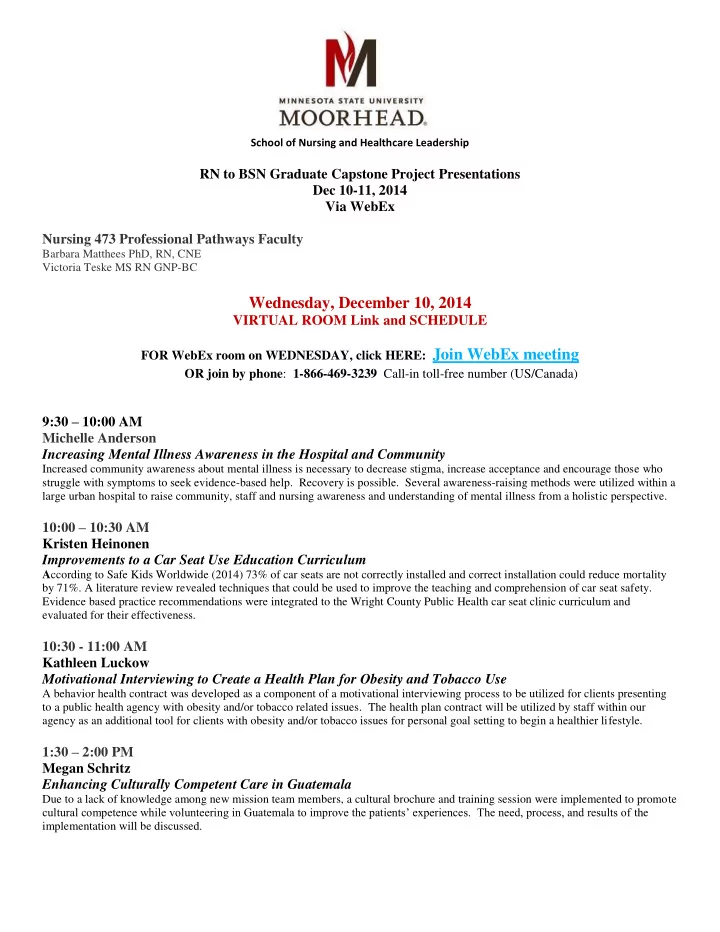
School of Nursing and Healthcare Leadership RN to BSN Graduate Capstone Project Presentations Dec 10-11, 2014 Via WebEx Nursing 473 Professional Pathways Faculty Barbara Matthees PhD, RN, CNE Victoria Teske MS RN GNP-BC Wednesday, December 10,


slide-1
SLIDE 1

School of Nursing and Healthcare Leadership

RN to BSN Graduate Capstone Project Presentations Dec 10-11, 2014 Via WebEx Nursing 473 Professional Pathways Faculty

Barbara Matthees PhD, RN, CNE Victoria Teske MS RN GNP-BC

Wednesday, December 10, 2014

VIRTUAL ROOM Link and SCHEDULE

FOR WebEx room on WEDNESDAY, click HERE: Join WebEx meeting OR join by phone: 1-866-469-3239 Call-in toll-free number (US/Canada)

9:30 – 10:00 AM Michelle Anderson Increasing Mental Illness Awareness in the Hospital and Community

Increased community awareness about mental illness is necessary to decrease stigma, increase acceptance and encourage those who struggle with symptoms to seek evidence-based help. Recovery is possible. Several awareness-raising methods were utilized within a large urban hospital to raise community, staff and nursing awareness and understanding of mental illness from a holistic perspective.

10:00 – 10:30 AM Kristen Heinonen Improvements to a Car Seat Use Education Curriculum

According to Safe Kids Worldwide (2014) 73% of car seats are not correctly installed and correct installation could reduce mortality by 71%. A literature review revealed techniques that could be used to improve the teaching and comprehension of car seat safety. Evidence based practice recommendations were integrated to the Wright County Public Health car seat clinic curriculum and evaluated for their effectiveness.

10:30 - 11:00 AM Kathleen Luckow Motivational Interviewing to Create a Health Plan for Obesity and Tobacco Use

A behavior health contract was developed as a component of a motivational interviewing process to be utilized for clients presenting to a public health agency with obesity and/or tobacco related issues. The health plan contract will be utilized by staff within our agency as an additional tool for clients with obesity and/or tobacco issues for personal goal setting to begin a healthier lifestyle.

1:30 – 2:00 PM Megan Schritz Enhancing Culturally Competent Care in Guatemala

Due to a lack of knowledge among new mission team members, a cultural brochure and training session were implemented to promote cultural competence while volunteering in Guatemala to improve the patients’ experiences. The need, process, and results of the implementation will be discussed.

slide-2
SLIDE 2

2:00 – 2:30 PM Stephanie Brustad Orientation in the Intensive Care Unit (ICU)

Nurses beginning in the ICU report feeling information overload which can increase staff turnover. Patricia Benner's 'Novice to Expert' theory is used to guide changes in the ICU nursing orientation process in conjunction with new staff input.

2:30 – 3:00 PM Teri Norris Nursing Education to Improve Response Time to Changes in Condition

Recognizing a change in condition of a hospitalized patient can be vital to the patient’s health and safety. When there is a delay in a nurse’s response, a patient is at risk for complications that could lead to death. It is essential that nurses be able to think critically and implement interventions when patients experience a deterioration of their condition. The focus of this project was the development of resource materials and education to improve nursing assessment skills leading to more rapid response times and improved patient

  • utcomes.

3:00 – 3:30 PM Joy Kahlhamer Revision of Colonoscopy Procedure Instructions

An increase in clinic patient colonoscopy procedure cancellations was occurring related to non-compliance of colon preparation purgatives, errors in pre-procedural medication management (especially anticoagulants) and sub-optimal colon preparations. To improve pre-procedure education and reduce the number of cancellations, the patient education literature was revised to consider health literacy, readability, clarity and visual appeal.

3:30 – 4:00 PM Laura Stoks Design and Implementation of a Hospital Discharge Checklist

Communication between members of the nursing staff is critical in a safe and successful hospital discharge. Since nursing staff tend to focus on the immediate needs of the patient discharge needs are often not given priority. A discharge checklist was designed and implemented to improve the discharge process promoting a safe, successful discharge.

4:00 - 4:30 PM Annie Waldal Acuity Based Hospital Staffing

Acuity based staffing in medical surgical units have been proven to decrease falls, improve patient outcomes and increase staff and patient satisfaction, yet they are rarely used because of the subjectivity involved. This project used evidence based research to create, implement, trial and evaluate an objective acuity based matrix to be used at a critical access 25 bed hospital.

4:30 – 5:00 PM Amy Peterson Education on Self-harm in Youth

Evidence based education regarding adolescent self-harm was developed for parents, school staff, and health-care professionals in a local school district. The project was based on the trans theoretical model of change.

slide-3
SLIDE 3

RN to BSN Graduate Presentations

Thursday, December 11, 2014

VIRTUAL ROOM Link and SCHEDULE

FOR WebEx room on THURSDAY, click HERE: Join WebEx meeting OR join by phone:1-866-469-3239 Call-in toll-free number (US/Canada)

8:30 – 9:00 AM Stacey Maurstad School Curriculum to Reduce Body Mass Index in Overweight and Obese Children

Overweight and obese children have created a substantial health problem in America. Schools are in a unique setting to promote healthy eating, prepare nutritious foods, provide physical activity, and educate students and parents. My presentation discusses an evidence-based, multifaceted school curriculum that will reduce body mass index and prevent chronic diseases in overweight and

  • bese children

9:00 – 9:30 AM Joann Greendahl Pain Assessment Educational Tool

This presentation will describe the development of a pain assessment educational tool for inpatient registered nurses.

9:30 – 10:00 AM Angela Long Safe Patient Transfers

Evidence based research strategies to promote patient and nursing safety were identified for patient handling activities.

10:00 – 10:30 AM Bobbie Jo Berndt Venipuncture Implementation in Long Term Care to Reduce Hospital Readmissions

Research and evidence-based literature review conducted on characteristics to reduce the number of hospital readmissions in a nursing home setting. The implementation of a venipuncture policy and procedure performed by nursing staff may result in decreased hospital readmissions and enhance patient-centered care.

10:30 – 11:00 AM Emily Herron Post-Fall Assessment of Elderly Long Term Care Residents

A post fall assessment (PFA) was designed and implemented for use in the long term care setting. The PFA may help to determine the specific cause of the fall and lead to individualized fall care plans for residents.

11:00 – 11:30 AM Karsta Sunne Improving Nutrition in Low Income Children

Childhood obesity is epidemic in the U.S. This project addressed education and experiential learning with a small group of low income urban children as part of an after-school program.

11:30 AM – 12:00 PM Stephani Green Improving Nursing Care Organization and Communication in the Home Care Setting

Poor communication between nurses can lead to negative health outcomes for patients, including death. The goal of this project was to improve communication during handoff and organization of patient cares by field nurses at Pediatric Home Service (PHS). To achieve this, a one-page shift report tool was designed and implemented.

slide-4
SLIDE 4

12:30 – 1:00 PM Nikki Schlenvogt Improved Patient Care Resources for Float Pool Registered Nurses

In order to improve patient care and safety, this project involved the development of cutomizable resource handbooks for RNs in the float pool at a major suburban hospital.

1:00 – 1:30 PM Jessica Gmach Extracorporeal Membrane Oxygenation Therapy Potential in the Emergency Setting

Cardiac arrest is a major cause of premature death and carries a poor prognosis. Extracorporeal membrane oxygenation (ECMO) is a machine that oxygenates and removes carbon dioxide from the blood. ECMO functions as an artificial heart, meeting the needs of the body in the presence of cardiac arrest or severe heart failure. The goal of this project was to explore the potential of ECMO therapy as a treatment modality at Regions Emergency Department for patients with cardiac arrest. Inclusion and exclusion criteria will be identified based on literature review and recommendations from other hospitals.

1:30 – 2:00 PM Michelle Faucher Family-centered Care

This evidence-based project identified interventions to increase family-centered care in the maternal-child healthcare setting.

2:00 – 2:30 PM Brittany Boehm Reducing the Incidence of Post-operative Delirium in Geriatric Patients

Delirium is a common post-operative complication for geriatric patients. This project examined risk factors and provided leadership in determining and implementing evidence-based nursing interventions to reduce the risk of postoperative delirium.

2:30 – 3:00 PM Nicole Westlund Hospital Discharge Follow up of High Risk Patients

A hospital discharge follow-up call intervention for patients identified as high risk for readmission was developed and implemented in a rural critical access hospital. High risk patients were identified as those with diagnoses of chronic obstructive pulmonary disease, chronic heart failure and pneumonia. Those with the selected diagnoses received a follow up call by the student within 24-72 hours post discharge. Calls focused on reviewing discharge instructions, the follow-up plan, concerns, problem identification, and identification of caregivers.

3:00 – 3:30 PM Ann Tesch Patient Activation Measures within the Rural Community

This project utilized collaboration between three health care facilities to improve patient activation among identified members that have chronic and persistent health conditions. The goal of improving patient activation was to improve health care outcomes for the patients and to decrease the utilization and cost of health care to each patient.

3:30 – 4:00 PM Jessica Chenze A Patient Centered Care Approach to Improve Sleep Quality for Residents of Long Term Care

Residents of long term care facilities frequently receive interrupted sleep related to night shift routines. By taking a patient centered care approach to care planning, and modifying night shift routines, residents can receive improved sleep quality.

4:00 – 4:30 PM Aran Augustin Quality Improvement in an Anticoagulation Clinic

Currently, the anticoagulation nurses are charting notes in two different electronic health records for their patient, doubling the chance

  • f errors. A process improvement project with research on lean principles was done to determine how to improve quality and safety of

the charting process.