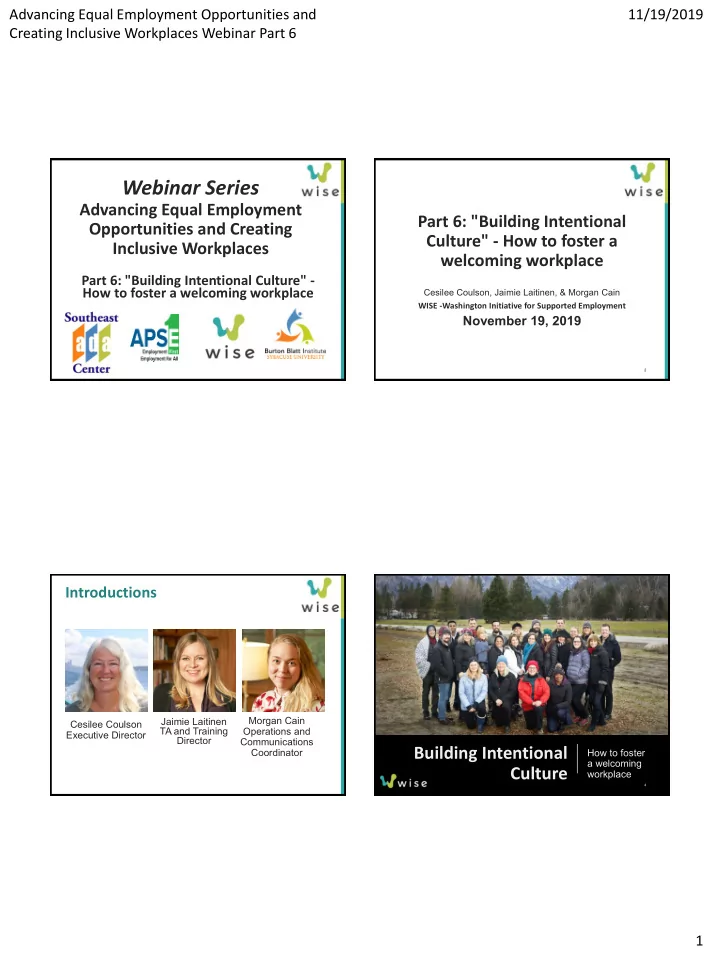
Webinar Series Advancing Equal Employment Part 6: "Building - - PDF document

webinar series
SMART_READER_LITE
LIVE PREVIEW

Webinar Series Advancing Equal Employment Part 6: "Building - - PDF document

Advancing Equal Employment Opportunities and 11/19/2019 Creating Inclusive Workplaces Webinar Part 6 Webinar Series Advancing Equal Employment Part 6: "Building Intentional Opportunities and Creating Culture" - How to foster a


slide-1
SLIDE 1

Advancing Equal Employment Opportunities and Creating Inclusive Workplaces Webinar Part 6 11/19/2019 1

Webinar Series

Advancing Equal Employment Opportunities and Creating Inclusive Workplaces

Part 6: "Building Intentional Culture" - How to foster a welcoming workplace

Hosted by: Southeast ADA Center; APSE – Employment First; Employment for All; WISE -Washington Initiative for Supported Employment; Burton Blatt Institute at Syracuse University

1

Part 6: "Building Intentional Culture" - How to foster a welcoming workplace

Cesilee Coulson, Jaimie Laitinen, & Morgan Cain WISE -Washington Initiative for Supported Employment

November 19, 2019

2

Introductions

Cesilee Coulson Executive Director Morgan Cain Operations and Communications Coordinator

3

Jaimie Laitinen TA and Training Director

Building Intentional Culture

How to foster a welcoming workplace

4

slide-2
SLIDE 2

Advancing Equal Employment Opportunities and Creating Inclusive Workplaces Webinar Part 6 11/19/2019 2

What is Organizational Culture?

Underlying beliefs, assumptions, values, and ways of interacting that contribute to the unique social and psychological environment of an

  • rganization.

5

Impacts of “Culture Fit”

What aspects

  • f our culture

are important for everyone to be aligned on? What aspects of

  • ur culture

should be flexible?

6

So What Works?

Knowing more about your culture can help you understand who fits well, who doesn’t, and why?

People stay longer in

  • rganizations when they:

Are able to learn and grow Feel both independent and supported Can specialize in areas where they naturally do well Fit well within the culture

7

Cultural Norms

How an organization’s culture presents itself Behaviors and rules of conduct can be:

  • formal or informal
  • healthy or unhealthy
  • often not actively

reflected on or challenged unless new people come in

8

slide-3
SLIDE 3

Advancing Equal Employment Opportunities and Creating Inclusive Workplaces Webinar Part 6 11/19/2019 3

Example - Formal & Healthy Norms

Culture: “Learning Organization”

  • Annual training budgets for staff
  • Trainings taken seriously (informal)
  • Leadership open to new ideas

Norms

9

Example - Formal & Unhealthy Norms

Culture: “Closed-door Decision Making Process”

  • No mechanism for collecting staff input
  • No transparency around items such as

budgets, priorities, hiring

  • Staff are not sure how decisions get made

Norms

10

Changing Norms

Formally & Informally

Be intentional about how you contribute to your

  • rganization’s culture:
  • Recognize, reflect on, and

acknowledge unhealthy norms

  • React with intention
  • Prepare to welcome someone

that will change the culture

  • Start conversations

11

Inclusion & Equity

12

slide-4
SLIDE 4

Advancing Equal Employment Opportunities and Creating Inclusive Workplaces Webinar Part 6 11/19/2019 4

Group Activities

Organizational Culture Snapshot Complete individually and review with your team or department Exclusive vs. Inclusive Norms Scales Typically work on this within your program teams and discuss similarities and differences

13

Organizational Culture Snapshot

14

Heroes

15

Norms & Typical Behavior

16

slide-5
SLIDE 5

Advancing Equal Employment Opportunities and Creating Inclusive Workplaces Webinar Part 6 11/19/2019 5

Values and Beliefs

17

Hierarchy

18

Who is Missing?

19

Cultural Snapshot Example

20

slide-6
SLIDE 6

Advancing Equal Employment Opportunities and Creating Inclusive Workplaces Webinar Part 6 11/19/2019 6

Exclusive vs. Inclusive Norms Scales

21

Exclusive vs. Inclusive Organizational Norms 1

22

Exclusive vs. Inclusive Organizational Norms 2

23

Exclusive vs. Inclusive Organizational Norms 3

24

slide-7
SLIDE 7

Advancing Equal Employment Opportunities and Creating Inclusive Workplaces Webinar Part 6 11/19/2019 7

Addressing Unhealthy Norms

Examples

Urgency and Overworking

  • Understand things may take longer

than expected

  • Learn from past experiences
  • Manage with data
  • Write realistic funding proposals and

workplans

Paternalism and Power-Hoarding

  • Everyone understands who makes

decisions

  • Leaders are trained to develop the

power and skills of others

  • Shared decision-making
  • Change is a practice

25

Equity & Inclusion

How do you recruit and include new people who may evolve your culture?

In order to:

  • Include more perspectives
  • n the team
  • Add more skills, styles,

and approaches to the work

  • Reach more people with

services

26

Contact Information

Cesilee Coulson cesilee@gowise.org Jaimie Laitinen jaimie@gowise.org Morgan Cain morgan@gowise.org www.gowise.org

27

Thank you

28

slide-8
SLIDE 8

Advancing Equal Employment Opportunities and Creating Inclusive Workplaces Webinar Part 6 11/19/2019 8

EDUCATION CREDIT

Requirements:

Must be registered, attendance verified, post-test completed.

Credits:

  • Certificate of Completion
  • CESP Credit

29

EDUCATION CREDIT POST TEST

  • **Must be registered, attendance verified,

and post-test completed to receive credit.

  • Post Test for Webinar Series Part 6
  • r copy and paste:

bit.ly/equal-employ-opp-webinar-test-6

30

EVALUATION

  • Your feedback is important to help determine the

effectiveness of this webinar in meeting your needs and to guide planning for future webinars.

  • Evaluation Part 6 of Webinar Series
  • or copy and paste

bit.ly/equal-employ-opp-webinar-eval-6

31

ARCHIVED WEBINARS

  • All webinars in this eight-part series will

be archived with recording (video & audio), presentation, and transcript - please share.

  • Archives: Advancing Equal Employment

Opportunities and Creating Inclusive Workplaces

  • r copy and paste

www.adasoutheast.org/webinars/archives.php

32

slide-9
SLIDE 9

Advancing Equal Employment Opportunities and Creating Inclusive Workplaces Webinar Part 6 11/19/2019 9

UPCOMING WEBINARS

Parts 7 & 8: Save the Dates!

  • Part 7: Sharing Your Story with Confidence in

the Workplace January 21, 2020

  • Part 8: Large Employer Initiatives and Public

Sector Employment February 25, 2020

  • Register for Webinar Series: Advancing Equal

Employment Opportunities and Creating Inclusive Workplaces

  • or copy and paste:

bit.ly/equal-employ-opp-webinar-seada-2019

33

Questions?

Southeast ADA Center Phone 800-949-4232 (toll free) 404-541-9001 711 (relay) E-mail adasoutheast@law.syr.edu Web www.adasoutheast.org

34

Disclaimer

The contents of this training were developed under a grant from the National Institute on Disability, Independent Living, and Rehabilitation Research (NIDILRR grant number 90DP0019-01-00). NIDILRR is a Center within the Administration for Community Living (ACL), Department of Health and Human Services (HHS). The contents of this training do not necessarily represent the policy of NIDILRR, ACL, HHS, and you should not assume endorsement by the Federal Government. The information, materials, and/or technical assistance provided by the Southeast ADA Center are intended solely as informal guidance, and are neither a determination of your legal rights or responsibilities under the Act, or binding on any agency with enforcement responsibility under the ADA. The Southeast ADA Center does not warrant the accuracy of any information contained herein. Furthermore, in order to effectively provide technical assistance to all individuals and entities covered by the ADA, NIDILRR requires the Southeast ADA Center to assure confidentiality of communications between those covered and the Center. Any links to non-Southeast ADA Center information are provided as a courtesy, and are neither intended to, nor do they constitute, an endorsement of the linked materials. You should be aware that NIDILRR is not responsible for enforcement of the ADA. For more information or assistance, please contact the Southeast ADA Center via its web site at ADAsoutheast.org or by calling 1-800-949-4232 or 404-541-9001.

35