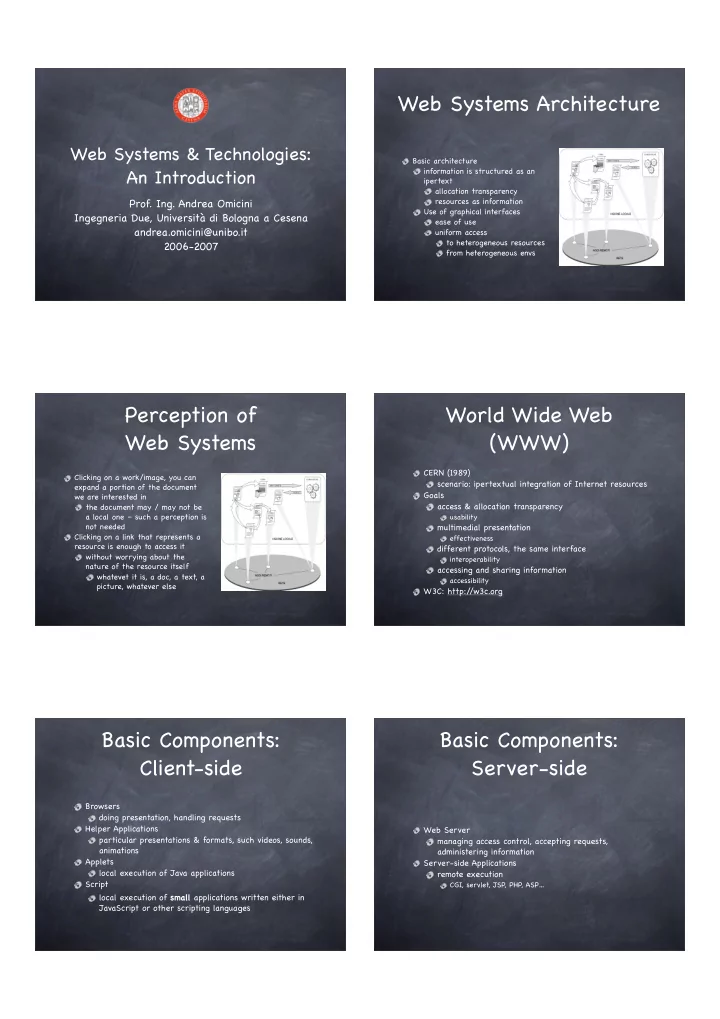
Web Systems Architecture Web Systems & Technologies: Basic - - PDF document

web systems architecture
SMART_READER_LITE
LIVE PREVIEW

Web Systems Architecture Web Systems & Technologies: Basic - - PDF document

Web Systems Architecture Web Systems & Technologies: Basic architecture An Introduction information is structured as an ipertext allocation transparency Prof. Ing. Andrea Omicini resources as information Use of graphical interfaces


slide-1
SLIDE 1

Web Systems & Technologies: An Introduction

  • Prof. Ing. Andrea Omicini

Ingegneria Due, Università di Bologna a Cesena andrea.omicini@unibo.it 2006-2007

Web Systems Architecture

Basic architecture information is structured as an ipertext allocation transparency resources as information Use of graphical interfaces ease of use uniform access to heterogeneous resources from heterogeneous envs

Perception of Web Systems

Clicking on a work/image, you can expand a portion of the document we are interested in the document may / may not be a local one – such a perception is not needed Clicking on a link that represents a resource is enough to access it without worrying about the nature of the resource itself whatevet it is, a doc, a text, a picture, whatever else

World Wide Web (WWW)

CERN (1989) scenario: ipertextual integration of Internet resources Goals access & allocation transparency

usability

multimedial presentation

effectiveness

different protocols, the same interface

interoperability

accessing and sharing information

accessibility

W3C: http:/ /w3c.org

Basic Components: Client-side

Browsers doing presentation, handling requests Helper Applications particular presentations & formats, such videos, sounds, animations Applets local execution of Java applications Script local execution of small applications written either in JavaScript or other scripting languages

Basic Components: Server-side

Web Server managing access control, accepting requests, administering information Server-side Applications remote execution

CGI, servlet, JSP, PHP, ASP…

slide-2
SLIDE 2

Advanced Components: Client-side Applications

The main problem executing applications server-side does not scale up Observations the web is an excellent opportunity for distributing knowledge & process – that is, data & applications high standardisation of web technologies may overcome the problem of heterogeneity of computing platforms The approach a tight integration of client- and server-side computation along with strict control & widespread diffusion of web standards to allow for the development of web-based client-side full-fledged

Advanced Components: Examples

Google applications have paved the way Today, Web Applications are likely to be the next step http:/ /www.whatwg.org/specs/web-apps/current-work/ In this course, however, we will just deal with basic web models and technologies, sorry :)

Fundamental Standard Specifications & Languages

Universal Addressing System URI & URL

Uniform Resource Identifier/Location

HTTP Protocol HyperText Transfer Protocol HTML / XHTML + CSS (eXtended) HyperText Markup Language Cascading Style Sheets CGI Common Gateway Interface Java language for Applet, Servlet & JSP

http client

WWW: Base Architecture

local system user

Client / Server Connection

HTTP Client client/server pattern toward one HTTP server at a time by specifying an URL (either writing or clicking) HTML page requests via HTTP HTTP response as HTML pages + other contents (images, scripts…) One-shot connection

  • ne different connection per each object

e.g.: an HTML page with a JPEG image = 2 HTTP connections

HTTP Connection

http client remote system request http client local system response network

TCP/IP TCP/IP

slide-3
SLIDE 3

Uniform Resource Locators

Unique names for system resources, specified by clients to determine the server Uniform Resource Locators (URL) node providing the resource resource access protocol (e.g. http, gopher) TCP port number (service default port) local path of the resource within the server

<protocol>[:/ /<host>][:<port>][<path>] e.g.: http:/ /www.address.edu:1234/path/subdir/file.ext

Internet services and their protocols are recognised http, gopher, ftp, wais, telnet, news, nntp, e mail (mailto) http:/ /www.w3.org/Addressing/

HTTP for Dummies (I)

HyperText Transfer Protocol client / server interface protocol based on TCP connections

default port 80

HTTP version 1.0 Request/response: only data are requested / sent One-shot connection: TCP connection maintained only as long as necessary to send data Stateless: no information is kept by server between two subsequent requests

then, information should be kept by clients

HTTP for Dummies (II)

typical HTTP interaction client request containing information for server (i.e., page local path) server response containing information (i.e, requested page, or error message) some negotiation possible on information and services

e.g., give me a page only if changed since my last request

HTTP version 1.1: some improvements http:/ /www.w3.org/Protocols/ It will be the subject of future courses, like “Computer Networks” (Reti di calcolatori)

HTML for Dummies (I)

http:/ /www.w3.org/MarkUp/ HyperText Markup Language specification language to encode information derived from SGML (Standard Generalized Markup Language)

it is a markup language (TeX, RTF) markup languages use tags to add features to enclosed text

very simple so as not to make clients computationally complex

HTML for Dummies (II)

tag HTML: examples header level 1

<h1>text</h1>

bold text

<strong>text</strong > or <B>text</B> browser-dependent visualisation

link

<a href = "destination"> description </a>

image

<img src = "myimage.gif">

Java applet

<applet code="Hello.class" width=”100” height=”80”>

XHTML for Dummies

eXtended HyperText Markup Language goals solve HTML problems toward XML some backward compatibility toward HTML

to avoid migration problems to programmers and tools

in this course, we mainly deal with XHTML

slide-4
SLIDE 4

Web Style Sheets for Dummies

http:/ /www.w3.org/Style/ Style sheets decribe how elements of a web page should be represented on a specific medium screen, audio, paper, ecc. CSS-1 e CSS-2 Cascading Stye Sheets for HTML pages XSL (Extensible Stylesheet Language Family) for XML sheets XSL Transformations (XSLT) XML Path Language (XPath) XSL Formatting Objects (XSL-FO)

Programming the Web: A First Approach

JavaScript [the main block of the course, only for LTI-LA] associating computations to Web pages (and browser events) to be execute by clients (browsers) to interact with servers (AJAX!!!)

Browsers: the Ancient Times

version browser properties 1.0 historic header, lists, emph 2.0 Mosaic inline images, forms 2.1 Netscape/Microsoft tables, alignment 3.2 Netscape/Microsoft frames, ... 4.0 Netscape/Microsoft styles, JavaScript

Browsers Today…

Mozilla / Firefox & Company a world-wide project the reference browser engine for this course also for web page construction / verification

Composer is fine, Front Page NOT allowed

Different versions of Internet Explorer bad seeds we should coexist with Safari, Opera, Konqueror, … good however, remember to verify compliance to standards

both in theory [they claim to] and in practice [they actually do]