1
Web Caching Web Caching and wireless networks Next generation - - PowerPoint PPT Presentation
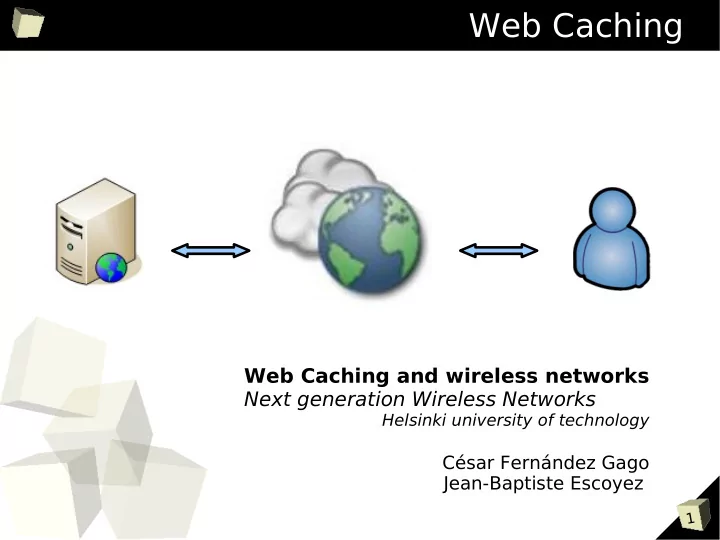
Web Caching Web Caching and wireless networks Next generation Wireless Networks Helsinki university of technology Csar Fernndez Gago Jean-Baptiste Escoyez 1 Index Web caching concepts Web caching issues How does it works?
2
Index
■ Web caching concepts
How does it works?
■ Web caching issues
Content delivery Cache consistency
➔ Wireless issues
Cache cooperation
➔ Wireless issues
3
Introduction: Concepts
■ Web caching
Different scheme: multiple readers, one writer Browser Cache & Proxy:
➔ Improve response time ➔ Save bandwidth ➔ Real-life usage: hierarchy, reverse
■ Other proxy services
➔ Security
- Ensure security policies
. Virus . Authentication & Billing (Wireless)
4
Http1.1: How does it work?
GET / HTTP/1.1 Host: www.google.fi Proxy-Connection: keep-alive Accept-Encoding: gzip,deflate
Ø Cache miss
Slow Hit Fast Hit
¿?
conditional
5
Http1.1: Optimizing a website
■ Expires ■ Cache-control header:
max-age=[seconds]
➔ s-maxage=[seconds]
public no-cache no-store must-revalidate
➔ proxy-revalidate
■ Validators: Etag, last-modified..
HTTP/1.1 200 OK Date: Fri, 30 Oct 2004 13:19:41 GMT Server: Apache/1.3.5 (Unix) Cache-Control: max-age=3600, must-revalidate Expires: Fri, 30 Oct 1998 14:19:41 GMT Last-Modified: Mon, 29 Jun 2004 02:28:12 GMT ETag: "3e86-410-3596fbbd" Content-Length: 1040 Content-Type: text/html
6
Content delivery
■ On demand request-response (Scales bad) ■ Prefetching
Proxy caching = 26%, prefetching = 60% Different techniques:
➔ Dependency graph (learning patterns) ➔ Prediction scheme ➔ Server Volumes
■ Multicast push
Asynchronous multicast push (AMP) Continuous multicast push (CMP) Geographic push caching
■ Optimizations: send only “differences”
7
Cache Consistency : Problem
■ Multiple copies of objects created
How and when renewing the copies?
■ Goals
Avoid stale copies Keep non useful traffic as low as possible
Internet Sub-domain Client Proxy Server
8
Cache Consistency : Polling
■ Solution 1: Polling every time ■ Benefits : Strong cache consistency ■ Drawbacks : Cache hits are always slow
Internet Sub-domain Client Proxy Server doc1.html doc1.html (v*) doc1.html (vx)
request poll retrieve if stale copy returned
9
Cache Consistency : Polling
■ Solution 2 : (Widely employed)
Assign a TTL to each document
Internet Sub-domain Client Proxy Server doc1.html doc1.html (v*) doc1.html (vx)
request poll if TTL expired retrieve and reset TTL if stale increase TTL if up-to-date copy returned
■ Benefits : More fast hits ■ Drawbacks : Weak cache consistency (5% stale)
Can lead to problems (e.g. Weather forecast)
1
Cache Consistency : Invalidation
■ Solution 3 :
The server helps the proxy in maintaining consistency Invalidation protocols
➔ When the proxy makes a request,
- Piggyback cache validation (PCV) : the proxy provides some other
potentially stale copies for server validating
- Piggyback cache invalidation (PCI) : the server provides some
copies which have been updates since last access . Use of volumes
- Volume lease :
. The client receive a lease from the server . During the lease validity the client can retreive copies from proxy . When the lease expire the client has to renew it
1 1
Cache Cooperation
■ Idea
Makes the proxies cooperating
➔ To improve the access latency ➔ To reduce the traffic load
■ Different techniques
Hierarchical caching
➔ Manually configured
Intercache communication
➔ Protocols to share data ➔ Use of volumes
Transparent caching
➔ Router redirect traffic to the proxy
1 2
The wireless problem
■ Wireless networks:
Save bandwidth, Low power, Client disconnections Location dependent information services Movements
➔ Temporal dependent updates ➔ Location dependent updates
1 3
The wireless problem: Cache invalidation
■ Update propagation ■ Update invalidation ■ Stateful-based protocols
Keeping track of each client
■ Stateless-based protocols
asynchronous
➔ If disconnected ?
synchronous (periodic)
➔ Waiting for a long time
1 4
The wireless problem: Cache invalidation
■ Cache invalidation
Bit vector with compression (BVC) Grouped bit vector with compression (GBVC) Implicit scope information (ISI)
■ Caching routes
On demand routing protocol (Dynamic Source route
protocol)
1 5
The Wireless Problem: Cache cooperation
■ Classical cooperation scheme no valid anymore
Hierarchical cache : too different Distributed cache : too complexe, heavy
■ Cooperative caching scheme
Cache line: ID, Tag, State bytes, Link fields, Client list and Origine
1 6
Conclusion
■ Cache technologies for wireless networks are not
mature yet
■ The possible improvements are not very
significant
■ Not a lot of common data to share
Caching issues only have sense in location
dependency problems
The wireless schemes are very different of the
classical schemes
■ Caching on fixed hosts links is not influenced by
wireless networks problems
1 7
Questions?
Questions?
1 8
References
➔ Performance Analysis of Location-Dependent Cache
Invalidation Schemes for Mobile Environments Jianliang Xu, Member, IEEE, Xueyan Tang, and Dik Lun Lee, March 03
➔ Caching Strategies in On-Demand Routing Protocols for
Wireless Ad Hoc Networks, Yih-Chun Hu, David B. Johnson, Carnegie Mellon University
➔ Cache invalidation scheme for mobile computing systems with
real-time data, CM SIGMOD Record archive, Volume 29 , Issue 4 (December 2000)
➔ Network Cache Model for Wireless Proxy Caching James Z.,