
SLIDE 1
WEA Conference – 7 September 2016 Innovations & options for grape sorting
Simon Nordestgaard simon.nordestgaard@awri.com.au
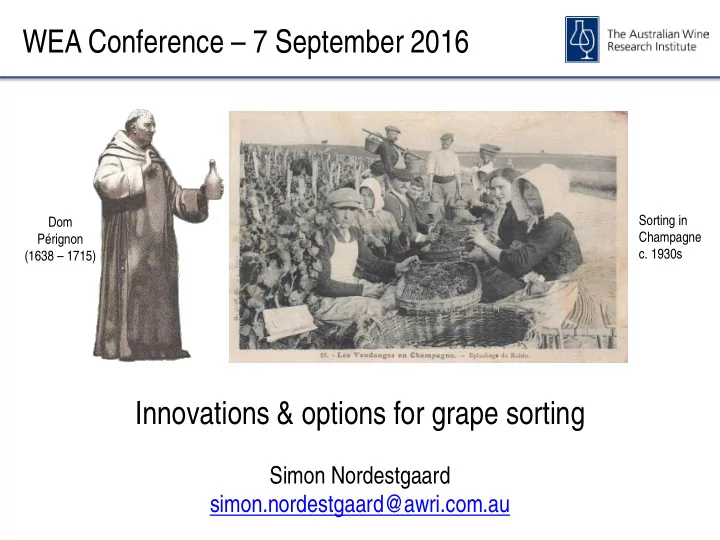
Sorting in Champagne
- c. 1930s
Dom Pérignon (1638 – 1715)
WEA Conference 7 September 2016 Sorting in Dom Champagne Prignon - - PowerPoint PPT Presentation
WEA Conference 7 September 2016 Sorting in Dom Champagne Prignon c. 1930s (1638 1715) Innovations & options for grape sorting Simon Nordestgaard simon.nordestgaard@awri.com.au Manual sorting (modern configurations) Before
WEA Conference – 7 September 2016 Innovations & options for grape sorting
Simon Nordestgaard simon.nordestgaard@awri.com.au
Sorting in Champagne
Dom Pérignon (1638 – 1715)
Manual sorting (modern configurations)
(with juice drainage)
automated sorting equipment
2-stage vibrating/belt sorter (c. 1990s)
*Nominal capacity, i.e. may overstate real capacity
Air-jet – gravity fed (Vaucher-Beguet Mistral, c. 2004)
they fall off an edge - petioles, leaves, larger raisins and smashed grape skins (Fraser 2012)
*Nominal capacity, i.e. may overstate real capacity
Fraser (2012) Adelaide 2011 ASVO seminar.
Vaucher-Beguet Mistral - Video
Air-jet – fast belt (Bucher-Vaslin Rflow, c. 2013)
to spread them out, allowing higher throughput per width
*Nominal capacity, i.e. may overstate real capacity
Bucher-Vaslin Rflow - Video
SOCMA linear winery destemmer – c. 1999
Open to see internals Faster
Rotary winery destemmer (traditional) SOCMA linear winery destemmer
23% juice 1.5% vegetal matter 12% juice 0.9% vegetal matter
Trial data from SOCMA website for hand-picked grapes
destemmer but shaft vibrates
Armbruster Rotovib destemmer (c. 2006 )
*Nominal capacity, i.e. may overstate real capacity Vegetal matter (%) Burst berries (%) Beater shaft speed (rpm) Beater shaft speed (rpm)
(Vinsonneau and Vergnes 2000):
http://www.matevi- france.com/uploads/tx_matevibase/Conditions_d_utilisation_d_un_erafloir_1995_-_1997.pdf
Armbruster Rotovib - Video
Pellenc Selectiv’ destemmer-sorter (c. 2008)
conveyor and overhead shark-fins
*Nominal capacity, i.e. may overstate real capacity
Pellenc Selectiv’ - Video
SOCMA Cube destemmer-sorter (c. 2010)
*Nominal capacity, i.e. may overstate real capacity
SOCMA Cube - Video
Bucher-Vaslin Oscillys destemmer-sorter (c. 2011)
*Nominal capacity, i.e. may overstate real capacity
Bucher-Vaslin Oscillys - Video
Roller sorting (standalone units)
vibrating, sweeping arms
*Nominal capacity, i.e. may overstate real capacity
Bucher Vaslin Trio - Video
Density sorting (AMOS Industrie Tribaie, c. 2005)
*Nominal capacity, i.e. may overstate real capacity
float in sugar/juice solution of set Brix
cooling
AMOS Tribaie - Video
Grape size sorting (AMOS Industrie Calibaie, c. 2014)
*Nominal capacity, i.e. may overstate real capacity
top of roller drum
drum at the top and fall out at bottom (strap releases spring-loaded rollers at bottom of rotation)
AMOS Calibaie - Video
Optical sorting (c. 2008, earlier in other industries)
*Nominal capacity, i.e. may overstate real capacity
fluoresces chlorophyll in vegetal matter & detected in the NIR)
throughput, or on a fast belt for high throughput machines)
Optical sorters - different feed systems - Videos
Key Vitisort Gravity feed Lower throughput Bucher-Vaslin Vistalys Belt feed Higher throughput
Automatic winery sorters – costs and adoption* (as of Nov 2014)
Notable mechanism Example brands and/or models Throughput (t/hr) Cost # Australia # World Rollers Bucher-Vaslin Delta Trio <15 $25,000 ~8 ~150
Integrated with vibrating destemmer – Pellenc/SOCMA/Bucher-Vaslin
~20 ~1,000 2-stage vibrating Enoveneta TSA 7-15 $30,000 ~3 ~150 Grape size Amos Industrie Calibaie 4-8 $45,000 ~10 Air-jet (gravity-fed) Vaucher-Beguet Mistral 6-9 $60,000 ~2 ~350 Air-jet (fast-belt) Bucher-Vaslin Rflow <15 $55,000 ~100 Density bath Amos Industrie Tribaie < 5 $120,000 ~85 < 20 $200,000 Optical Bucher-Vaslin, Pellenc, Protec, Key, WECO… < 5 $90,000 ~2 ~250 <10 $240,000 *Order of magnitude values – for general technology comparison purposes only, other capacities available
Machine harvesters - c. 1970s
Vegetal matter content estimates from Anneraud et al. (2012)
Pellenc Trieur grid-belt sorter - c. 1999
No Trieur With Trieur Leaves Petioles Stems Leaves Petioles Debris content (%)
Debris content with and without Trieur top-fan turned on
(Plot translated from Vinsonneau et al. 2005)
grid-belt so top fan can clean more effectively / operate at higher suction without losing juice
SOCMA destemmer on New Holland Braud harvester – c. 2002
Juice content – without or with on-board destemmer
Plots translated from Vinsonneau et al. (2004)
Stem content – on-board SOCMA vs. rotary destemmer at winery
Without destemmer With destemmer On-board SOCMA Rotary winery
Braud harvesters
than rotary winery destemmer
than without destemmer
Pellenc - Selectiv’ Process 1 & 2 - c. 2007 & 2013
destemmer
initial rollers to align petioles
eliminated” (bigger than 35 mm long, IFV testing)
Pellenc – grid-conveyor sorter
(evolution of Pellenc’s initial grid fan sorter)
exposed too directly to fans.
competitive machine”
Video - Pellenc Selectiv’ Process 2
(cross between SOCMA destemmer and traditional rotary destemmer)
the ViniSelect holed shaking belt sorter (low throughput, c. 2013) instead of roller sorting
Gregoire Cleantech Vario - c. 2009
Video – Gregoire Cleantech Vario
New Holland Braud Opti-Grape - c. 2013
(after a new roller pre-sorting stage)
effective at removing dry and mouldy fruit, and also botrytrised fruit”
Video – New Holland Braud Opti-Grape
ERO Vitiselect - c. 2013
(ERO claim that they were first with an on-board destemmer in 1998)
conveyor
Video – ERO Vitiselect
Oxbo PremiumSort - c. 2015
is centrally and rear-mounted
grapes fall through
conveyor
Video – Oxbo PremiumSort
Pellenc Selectiv’ Process 2 (XLE) – conveyor - c. 2015
board bins, but has side-arm discharge conveyor
destemmers transfers grapes to a single larger sorting table
buffer bin with a conveyor system in it that feeds the side- arm discharge conveyor
when changing gondolas, etc.
Australia last vintage
Speed and yield
throughput before their performance declines losses or maceration
recommendations (not independent – treat with considerable caution)
Opti-Grape “use in up to 8 tonnes/ha, shorter rows”
Maintenance and cleaning
complexity and moving parts
quality but experienced a few more breakdowns (will be model and conditions dependent)
Does sorting improve wine quality?
contact time during fermentation
impact quality for some red wines (this was added on top of the 0.5-2.1% that was already in the output from the destemmer)
and chemical changes in a Cabernet Sauvignon (petiole addition increased floral characters)
vineyard
Destemming/sorting in the vineyard or winery?
harvester as the grapes will be in the most intact condition for sorting
more grape skin derived phenolics in the free-run (level of maceration will be brand/model/conditions dependent)
Adoption of on-harvester destemming and sorting
the winery (and some good grapes – typically 0.5% in ITV/IFV studies)
(the increased operating costs are likely more influential than capital costs – destemming/sorting system only 2-10% extra on $400K harvester)
Future – what will happen?
likely to become more prevalent as producers seek to premiumise (more sorting is performed overseas).
sorting will be adopted more widely for hand-picked
their price reduces and performance increases.
sorting will also be more widely adopted as a cost- effective means of sorting machine-harvested red grapes while they are in their most intact condition.
Acknowledgements and further resources
equipment and offered their perspective
used/edited snippets from
the French Institute of Vine and Wine (IFV)
http://www.matevi-france.com
Disclaimer
The information contained in these slides should be considered general in nature, and viewers should undertake their own specific investigations before purchasing equipment
The dates when different inventions were introduced and the order in which these inventions were made are presented in good faith based on information currently
are again presented in good faith based on available information. It should be noted that there is fairly limited rigorous independent information available
importance of equipment performance to all wine producers - both in terms of wine quality and productivity. None of the information presented in this article should be considered as an endorsement of any product by the AWRI.
AWRI Vineyard and Winery Practices Survey
How common are?
What are the key?
How common are?