We shall consider how to combine the proposed modifications. - - PowerPoint PPT Presentation

we shall consider how to combine the proposed
SMART_READER_LITE
LIVE PREVIEW

We shall consider how to combine the proposed modifications. - - PowerPoint PPT Presentation

November 1998 doc.: IEEE 802.11-98/369a IEEE P802.11 Wireless LANs TGa Preamble Improvement Date: November 11, 1998 Author: Tal Kaitz and Naftali Chayat BreezeCOM Atidim Technology Park, Tel Aviv 61131 Israel Phone: 972 3-6456262


slide-1
SLIDE 1

November 1998 doc.: IEEE 802.11-98/369a

Submission page 1 Tal Kaitz and Naftali Chayat, BreezeCOM

IEEE P802.11 Wireless LANs TGa Preamble Improvement

Date: November 11, 1998 Author: Tal Kaitz and Naftali Chayat BreezeCOM Atidim Technology Park, Tel Aviv 61131 Israel Phone: 972 –3-6456262 Fax: 972-3-6546290 e-Mail: {Talk, Naftalic}@ Breezecom.co.il

Preamble Improvement for Tga

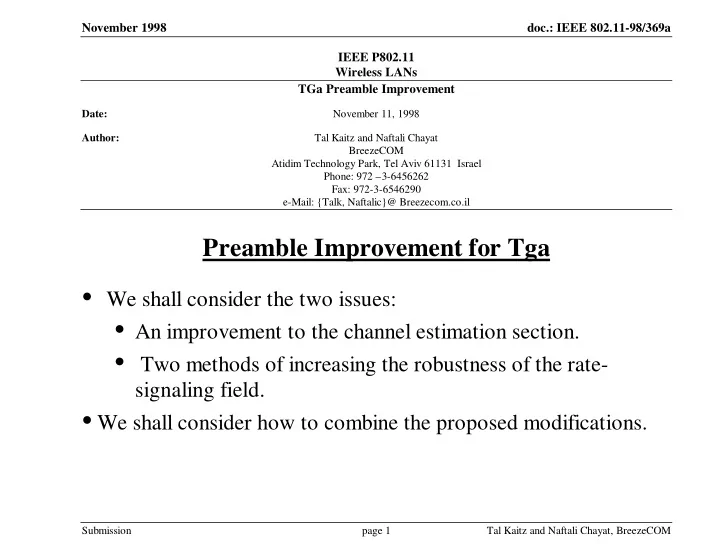
  • We shall consider the two issues:
  • An improvement to the channel estimation section.
  • Two methods of increasing the robustness of the rate-

signaling field.

  • We shall consider how to combine the proposed modifications.
slide-2
SLIDE 2

November 1998 doc.: IEEE 802.11-98/369a

Submission page 2 Tal Kaitz and Naftali Chayat, BreezeCOM

Current Preamble Structure

T1

0.8 µs 3.2 µs

Coarse Frequency Offset and Timing

AGC

t4 t3 t1 t7 t6 t5 t10 t9 t8 Data t12 t11 Fine Frequency Offset SIGNAL T2

Channel Estimation

17.6µs GI

0.8 µs 8.0 µs

t2

Figure 1

Functions:

  • AGC tuning: t1…t3.
  • Coarse frequency estimation: t5 and t6.
  • Fine frequency: t6 and t9
  • Channel estimation by T1 and T2.
  • Rate signaling by t11 and t12.
slide-3
SLIDE 3

November 1998 doc.: IEEE 802.11-98/369a

Submission page 3 Tal Kaitz and Naftali Chayat, BreezeCOM

Channel Estimation Improvement

  • The functions of fine frequency estimation and channel estimation

can be unified to allow a more efficient structure as shown in figure 2.

T1

0.8 µs 3.2 µs

Coarse Frequency Offset and Timing

AGC

t4 t3 t1 t7 t6 t5 SIGNAL T2

Channel estimation and fine frequency offset

17.6µs GI

0.8 µs 0.8+3*3.2=10.4µs

t2 T3 Rate signalling

Figure 2

  • The channel estimation now consists of 3 long sequences.
  • Averaging over 3 results in a more accurate estimation
slide-4
SLIDE 4

November 1998 doc.: IEEE 802.11-98/369a

Submission page 4 Tal Kaitz and Naftali Chayat, BreezeCOM

  • Fine frequency estimation is performed by comparing the phase of the

T1 sequence to that of T3 by means of a “dot product”

  • Slightly better frequency estimation SNR.

Simulation results

Trms =150nSec 100Bytes

10 11 12 13 14 15 16 17 18 10

  • 2

10

  • 1

10 EbNo per Performance in fading channels Trms=150nsec

A performance gain of about 1dB is apparent. Legend : Black: New proposal Blue: Current proposal

slide-5
SLIDE 5

November 1998 doc.: IEEE 802.11-98/369a

Submission page 5 Tal Kaitz and Naftali Chayat, BreezeCOM

Rate Signaling Improvement

  • Rate signalling is performed by QPSK modulation of the short

sequences t11 and t12.

  • Basic requirement: signalling scheme should as reliable as the lowest

rate data (6Mb/s BPSK OFDM).

  • This is the case for AWGN channels: Each rate field bit carries the

energy of 3 data bits. Accounting for 5dB coding gain for data bits we have the same probability of error.

  • However : Not the case for severe multipath conditions:
  • Problem: Interference from

adjacent symbols due to long impulse response.

  • We shall consider two solutions.

200 250 300 350 400 450 500 550 600 0.05 0.1 0.15 0.2 0.25 0.3 0.35 0.4 Trms [nSec] Error rate Error rate of rate field and 6Mb/s data (100bytes frame size)

Legend : Green: Rate field error rate Blue: Data frame rate

slide-6
SLIDE 6

November 1998 doc.: IEEE 802.11-98/369a

Submission page 6 Tal Kaitz and Naftali Chayat, BreezeCOM

  • 1. Adding a dedicated BPSK –OFDM symbol
  • 2. Modifying phase assignment to QPSK symbols.
  • 1. Adding a dedicated BPSK-OFDM symbol
  • 24 bit encoded and modulated as in the 6Mb/s mode.
  • Bit assignment:

2 bits random scrambling 4 bits rate 12 bits duration field 6 bits CRC

  • The duration field allows receiving units to assert a channel busy

condition for the duration of the packet even if the unit is incapable to receive the PLCP header.

slide-7
SLIDE 7

November 1998 doc.: IEEE 802.11-98/369a

Submission page 7 Tal Kaitz and Naftali Chayat, BreezeCOM

  • A “tail-bite” encoding mode is used in which trellis termination is

achieved without incurring any overhead. This is performed by initiating the encoder registers with the last bits of the block. Decoding is performed by cyclically pushing the data stream into the

  • VA. Extra bits should be entered to recover from unknown initial and

final state.

  • The CRC is extended hamming code (5 check bits +parity) capable of

detecting up to 3 error bits.

slide-8
SLIDE 8

November 1998 doc.: IEEE 802.11-98/369a

Submission page 8 Tal Kaitz and Naftali Chayat, BreezeCOM

2. Better phase assignments

  • Most of the distortion is from preceding symbols.
  • Basic idea: Assign the phases {0,0} the 6Mb/s case and decode by

comparing the phase of t10 to that of t11 t12.

  • Channel effects will be identical in t10 and t11 and t12 and will cancel
  • ut.
  • For other low rate assign the phases {0, exp(pi*j*n/2)}

How to combine ?

We have 4 options: A. New channel estimation and a dedicated rate symbol:

200 250 300 350 400 450 500 550 600 0.02 0.04 0.06 0.08 0.1 0.12 0.14 Trms nsec error rate 6Mb/s and 12Mb/s data and rate signaling errors

Legend 6Mb/s : Black =rate error Blue = data error 12Mb/s : Green =rate error Red = data error

slide-9
SLIDE 9

November 1998 doc.: IEEE 802.11-98/369a

Submission page 9 Tal Kaitz and Naftali Chayat, BreezeCOM

T1

3.2 µs

t1 t7 SIGNAL T2

Channel estimation and fine frequency offset

20 µs GI

0.8 µs 0.8+3*3.2=10.4µs

t2 T3 Rate signalling

Overall length 20uSec. Pros:

  • Robustness both in channel estimation and rate-signalling.
  • Duration field decodable by all stations

Cons: High complexity and overhead A. New channel estimation and QPSK rate signalling

Note that an extra guard interval (t8) should be added.

slide-10
SLIDE 10

November 1998 doc.: IEEE 802.11-98/369a

Submission page 10 Tal Kaitz and Naftali Chayat, BreezeCOM

T1

3.2 µs

t1 t7 SIGNAL T2

Channel estimation and fine frequency offset

18.4 µs GI

0.8 µs 0.8+3*3.2=10.4µs

t2 T3 t8 t9 t10

\\ Overall length 18.4uSec cons: Less robust rate signalling

B. Current channel estimation with a dedicated OFDM symbol

Overall length is 20uSec

C. Current channel estimation with QPSK symbols. Overall length is 17.6uSec

Conclusions

slide-11
SLIDE 11

November 1998 doc.: IEEE 802.11-98/369a

Submission page 11 Tal Kaitz and Naftali Chayat, BreezeCOM

  • Improvement to channel estimation section
  • Two method of increasing rate field robustness.
  • Several ways of combining the two elements
slide-12
SLIDE 12

November 1998 doc.: IEEE 802.11-98/369a

Submission page 12 Tal Kaitz and Naftali Chayat, BreezeCOM