
SLIDE 1
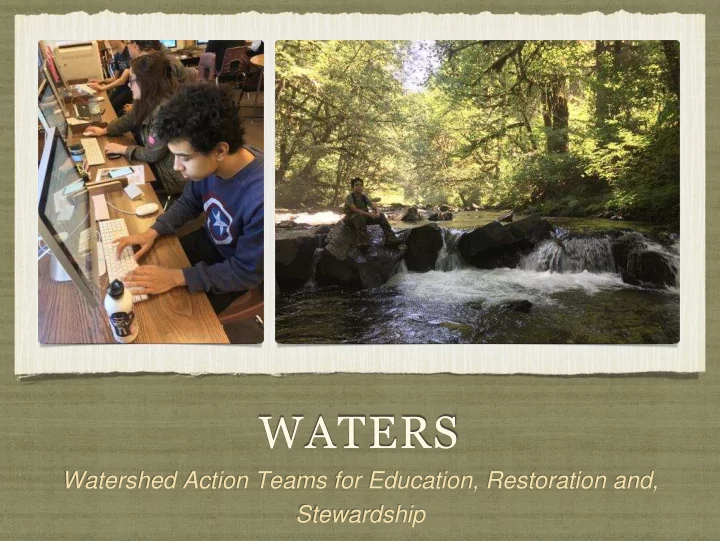
WATERS Watershed Action Teams for Education, Restoration and, - - PowerPoint PPT Presentation
WATERS Watershed Action Teams for Education, Restoration and, Stewardship THE BASICS WATERS focuses on direct involvement of students in hands-on, inquiry- and field-based projects centered in environmental education. Primary goals:
WATERS focuses on direct involvement of students in hands-on, inquiry- and field-based projects centered in environmental education.
public agencies, and non-profits
stewardship teams (H.S & M.S.)
projects for each team
protocols, critical thinking and problem solving
peer learning
HIGH SCHOOL TEAMS
Capstone event for high school team members Conference planning under way Will take place in May Students present reports or posters on data analyzed this year Expert panel composed of project partners will engage with presenters Middle school students may participate in a juried art contest
Real world projects benefit both students and partners Monitoring data used for in- stream projects (USFS, BLM) Water quality data shared with EWEB Native plantings and maintenance at active restoration sites (MRT, landowners) Regional approach
Programatic start in Fall 2016
Five schools involved now
Coast Fork watershed. Eventual expansion in to area high schools
MIDDLE SCHOOL RESTORATION TEAMS
Finn Rock Reach
Green Island
School Berggren Watershed Conservation Area & Dehne Property
teams)
Rujada Campground
London School grounds (Coast Fork Willamette River)
Row River Nature Park
Creswell Oaks
Watershed basics Riparian ecology / soil science introduction Twig ID Water quality Benthic macro-invertebrates ID Leaf ID Fish ID
Annual capstone event held in June Middle school students from region (200 approx.) Events include:
Prizes for top three teams & pizza for all
Meets Next Generation Science Standards Awareness of local ecology Introduction to scientific methods Career development and potentials Outdoor experience Builds teamwork ethic and longterm relationships Multiple years of participation foster sense of
Reinforces importance of collaboration and partnerships Empowers students and their ability to make an impact at any age
$50,400
$19,750
$4,120
$25,625
$22,131
$13,599
$135,625
Bureau of Land Management $5,000 City of Cottage Grove $3,500 City of Creswell $3,000 Environmental Protection Agency $38,000 Eugene Water & Electric Board $18,500 Gray Family Foundation $8,000 Oregon Community Foundation $1,000 Oregon Watershed Enhancement Board $24,948 Private Donations/Local Match (MWC) $7,625 Private Donations (CFWWC) $24,052 Springfield Public Schools $2,000
$135,625
OWEB funding changes (no programmatic funding after 2018-19) EWEB Source Water Protection Program limitations (local match) Uncertainty in federal funding (EPA, NFWF) Private foundations:
Integrate education funding line items into OWEB Restoration requests
Leverage local partners to expand existing support
Identify and maximize private foundation funding
Increase private donations