Water Quality Monitoring in the St. Marys River Area of Concern - - PowerPoint PPT Presentation

water quality monitoring in the st marys river area of
SMART_READER_LITE
LIVE PREVIEW

Water Quality Monitoring in the St. Marys River Area of Concern - - PowerPoint PPT Presentation

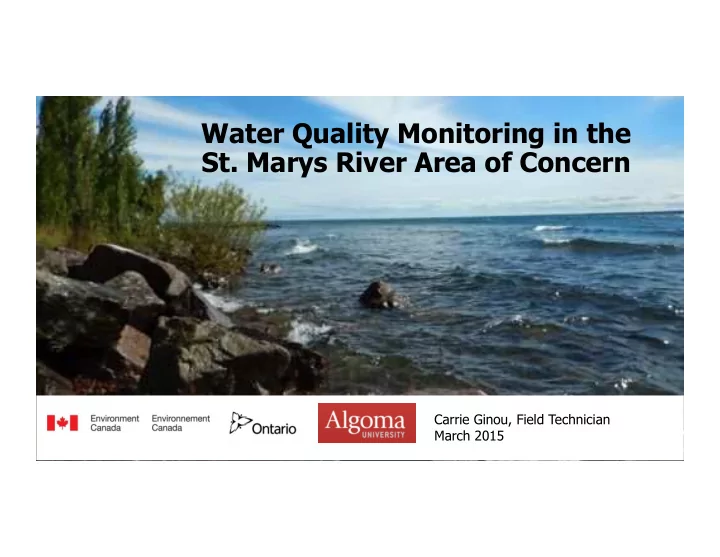
Water Quality Monitoring in the St. Marys River Area of Concern Carrie Ginou, Field Technician March 2015 Introduction St. Marys River Freshwater ecosystem connecting Lakes Superior and Huron Areas of Concern Geographically delineated

slide-1
SLIDE 1

Water Quality Monitoring in the

  • St. Marys River Area of Concern

Carrie Ginou, Field Technician March 2015

slide-2
SLIDE 2

Introduction

slide-3
SLIDE 3
  • St. Marys River
  • Freshwater ecosystem connecting Lakes Superior and Huron
slide-4
SLIDE 4

Areas of Concern

  • Geographically delineated regions where impairment of

beneficial uses has occurred due to human activities 1

1 Great Lakes Water Quality Agreement (1972, 1978, 1987, 2012)

slide-5
SLIDE 5

Remedial Action Plans

  • The goal of the Remedial Action Plan process is the restoration
  • f beneficial uses, leading to the recovery of Areas of Concern 2

2 St. Marys River Stage 1 Remedial Action Plan (1992)

slide-6
SLIDE 6

Beneficial Use Impairments

  • 1. Restrictions on Fish Consumption
  • 2. Degradation of Fish Populations
  • 3. Fish Tumours and Other Deformities
  • 4. Degradation of Benthos
  • 5. Restrictions on Dredging Activities
  • 6. Eutrophication and Undesirable Algae
  • 7. Beach Closings
  • 8. Degradation of Aesthetics
  • 9. Loss of Fish and Wildlife Habitat
slide-7
SLIDE 7

Eutrophication & Undesirable Algae

  • Eutrophication refers to the nutrient enrichment of a water

body, high levels of nutrients can lead to algal blooms 3

3 Particularly elevated levels of phosphorus and nitrogen (Smith & Smith 2006)

slide-8
SLIDE 8

Degradation of Aesthetics

  • Aesthetics involves the visual appearance of the river ecosystem 4

4 Identified due to oil slicks, grease, floating scums, oily fibrous material and woody debris (RAP 1992)

slide-9
SLIDE 9

Project Purpose

  • To provide water quality monitoring data to allow for a

reassessment of the beneficial uses of interest 5

5 Eutrophication and Undesirable Algae, Degradation of Aesthetics

slide-10
SLIDE 10

Methods

slide-11
SLIDE 11

Monitoring Sites

  • 1. Gros Cap (GCL)
  • 2. Bellevue Park (TSI)
  • 3. Bell’s Point (BPC)
  • 4. Echo Bay (EBB)
  • 5. Richards Landing (RLP)
slide-12
SLIDE 12

Workplan

  • Monitoring 2013 to 2015
  • Collecting field data and water samples at 5 sites
slide-13
SLIDE 13

Site Characteristics

  • Date and time
  • Air temperature
  • Weather
  • Substrate type
  • Waterfowl
  • Human activities
  • Photographs
  • GPS coordinates
slide-14
SLIDE 14

Aesthetic Parameters

  • Water clarity
  • Water colour
  • Water odour
  • Algae
  • Debris
slide-15
SLIDE 15

Physical & Chemical Parameters

  • Water temperature
  • Water pH
  • Total suspended solids
  • Turbidity
  • Chlorophyll a
  • Dissolved oxygen
  • Nutrients 6

6 Total Phosphorus, Dissolved Organic Carbon, Total Nitrogen (Ammonia, Nitrite, Nitrate, Organic Nitrogen)

slide-16
SLIDE 16

Quality Control & Data Analysis

  • Sampling protocols
  • Field replicates
  • Lab duplicates
  • Basic statistics
  • Analysis of variance
slide-17
SLIDE 17

Results & Discussion

slide-18
SLIDE 18

Site Characteristics

  • May to October 2014
  • 10 am to 5 pm
  • Air temperature
  • 7.5 to 25.8 °C
  • Weather
  • Sun, wind, rain, fog
  • Rain events and post rain days
slide-19
SLIDE 19

Site Characteristics

  • Substrate type
  • Rocks, cobbles, gravel, sand
  • Waterfowl
  • Geese, gulls, loons, ducks,

cormorants, tracks, scat

  • Human uses
  • Camping, dog-walking, fishing,

swimming, hiking, sight-seeing

  • Garbage left behind
slide-20
SLIDE 20

Site Characteristics

  • Photographs
  • Upstream, downstream,

shoreline, water, bottles

  • GPS coordinates
  • Varied slightly with changing

water levels

slide-21
SLIDE 21

12.0%%%%%%%%%%%%%13.5%%%%%%%%%%14.0 %%%%16.7%%%%%%%%%%%%%16.0 % %%

  • Water temperature
  • 2.8 to 20.4 °C
  • Varied with air temperature
  • Published: 0 to 22 °C 7

Aesthetic, Physical & Chemical Parameters

7 St. Marys River Stage 1 Remedial Action Plan (1992)

Whole%season%average%values%

slide-22
SLIDE 22
  • Water pH
  • 7.3 to 8.7
  • May 27 TSI: human activity
  • Standard: 6.5 to 8.5 8

8 Provincial Water Quality Objectives (MOE 1999)

Aesthetic, Physical & Chemical Parameters

slide-23
SLIDE 23
  • Water clarity
  • “Clear” at Gros Cap, Bellevue

Park, Bell’s Point

  • “Slight” to “moderate” turbidity

Echo Bay and Richards Landing

  • Clarity: substrate, weather,

water velocity, vegetation 9

  • Standard: free of “unnatural“

turbidity 10

9 CWQG: Total Particulate Matter (CCME 2002), 10 St. Marys River Stage 2 RAP Implementation Annex (2015)

Aesthetic, Physical & Chemical Parameters

slide-24
SLIDE 24
  • Water clarity
  • Secchi depth maximum at all

sites except Echo Bay (4/11)

  • Turbidity tube maximum except

Gros Cap (1/11), Richards Landing (2/11), Echo Bay (4/11)

  • Clarity: substrate, weather,

water velocity, vegetation 9

  • Standard: natural Secchi disc

reading should not change >10% 11

9 CWQG: Total Particulate Matter (CCME 2002), 11 Provincial Water Quality Objectives (MOE 1999)

Aesthetic, Physical & Chemical Parameters

slide-25
SLIDE 25
  • Total suspended solids
  • 0.93 to 29.33 mg/L*
  • May 14 RLP: wind, waves,

previous rain, last stop

  • Standard: “clear”<20 mg/L 12

* Average values for 3 replicates, 12 State of Michigan (2013)

2.58%%%%%%%%%%%%1.99%%%%%%%%%%%%2.40%%%%%%%%%%%%%%7.25%%%%%%%%%%%7.72%

Aesthetic, Physical & Chemical Parameters

Bars%represent%average%values%for%3%replicates%(n=3)% Error%bars%represent%+/G%standard%error%

slide-26
SLIDE 26
  • Turbidity
  • 0.43 to 23.27 NTU
  • > 20 EBB: wind and

wave action

  • Standard: normal range

0 to 20 NTU 13

1.15%%%%%%%%%%%%1.66%%%%%%%%%%%%1.51%%%%%%%%%%%%%%9.98%%%%%%%%%%%4.30%

13 Canadian Water Quality Guidelines for the Protection of Aquatic Life: Total Particulate Matter (CCME 2002)

Aesthetic, Physical & Chemical Parameters

slide-27
SLIDE 27
  • Water colour
  • “Clear” at Gros Cap, Bellevue

Park, Bell’s Point

  • Light “yellow” to “brown” Echo

Bay and Richards Landing

  • Colour: minerals, plant debris,

plankton, sediments 14

  • Standard: free of “unnatural“

colour 15

14 CWQG: Colour (CCME 2001), 15 St. Marys River Stage 2 Remedial Action Plan Implementation Annex (2015)

Aesthetic, Physical & Chemical Parameters

slide-28
SLIDE 28
  • Water odour
  • None
  • Standard: free of “unnatural“
  • dour 16

16 St. Marys River Stage 2 Remedial Action Plan Implementation Annex (2015)

Aesthetic, Physical & Chemical Parameters

slide-29
SLIDE 29
  • Algae
  • Rocks, floating, on substrate
  • No blooms or mats
  • Standard: free of “large algal

blooms” 17

17 St. Marys River Stage 2 Remedial Action Plan Implementation Annex (2015)

Aesthetic, Physical & Chemical Parameters

slide-30
SLIDE 30
  • Chlorophyll a
  • 0.58 to 5.60 µg/L
  • Related to observations of

algae or turbidity

  • May 27 TSI: disturbance
  • Standard: < 10 µg/L 18

0.94%%%%%%%%%%%%1.71%%%%%%%%%%%%1.03%%%%%%%%%%%%1.48%%%%%%%%%%%1.68%

18 St. Marys River Stage 2 Remedial Action Plan (2002)

Aesthetic, Physical & Chemical Parameters

slide-31
SLIDE 31
  • Debris
  • Leaves, sticks, plants, all

natural debris

  • Standard: no oil or grease 19
  • Standard: no “objectionable

deposits” 20

19 Provincial Water Quality Objectives (MOE 1999), 20 St. Marys River Stage 2 RAP Implementation Annex (2015)

Aesthetic, Physical & Chemical Parameters

slide-32
SLIDE 32
  • Dissolved oxygen
  • 8.58 to 13.62 mg/L
  • Standard: > 8 mg/L 21
  • Standard: free of “oxygen

stress” 22

11.2%%%%%%%%%%%%11.1%%%%%%%%%%%%11.1%%%%%%%%%%%%9.9%%%%%%%%%%%10.4%

21 Provincial Water Quality Objectives (MOE 1999), 22 St. Marys River Stage 2 RAP Implementation Annex (2015)

Aesthetic, Physical & Chemical Parameters

slide-33
SLIDE 33
  • Total phosphorus
  • 0.002 to 0.035 mg/L
  • June 10 EBB: recreation,

fertilizers

  • Standard: < 0.03 mg/L 23

0.004%%%%%%%%%%%%0.006%%%%%%%0.004%%%%%%%%0.012%%%%%%%%%%0.007%

23 Provincial Water Quality Objectives (MOE 1999)

Aesthetic, Physical & Chemical Parameters

slide-34
SLIDE 34
  • Dissolved organic carbon
  • 1.50 to 7.27 mg/L
  • June 24 GLC: rain runoff
  • EBB: plankton, plants, runoff
  • Standard: normal < 5 mg/L 23

23 Government of British Columbia Ambient Water Quality Guidelines for Organic Carbon (2015)

Aesthetic, Physical & Chemical Parameters

2.17%%%%%%%%%%%1.91%%%%%%%%%%%%1.96%%%%%%%%%%%%%%%4.08%%%%%%%%%%%%%%%2.35%

slide-35
SLIDE 35
  • Total nitrogen
  • 0.52 to 1.59 mg/L
  • Main type: organic nitrogen
  • Source: recreational activities
  • Standard: < 1.5 mg/L 24

0.81%%%%%%%%%%%%0.85%%%%%%%%%%%%%0.75%%%%%%%%%%%%0.72%%%%%%%%%%%%%0.76%

24 CWQG: Nitrate Ion (CCME 2012), 0-1.5 mg/L total nitrogen in oligotrophic to mesotrophic streams

Aesthetic, Physical & Chemical Parameters

slide-36
SLIDE 36

Conclusion

slide-37
SLIDE 37

Eutrophication & Undesirable Algae

  • There were no large algal blooms, low oxygen levels or elevated

levels of nutrients indicative of eutrophic conditions

slide-38
SLIDE 38

Degradation of Aesthetics

  • There was no evidence of oil, grease, objectionable deposits,

unnatural colour, unnatural turbidity or unnatural odour

slide-39
SLIDE 39

Future Work

  • Interim report 2014
  • Field work 2015
  • Final report 2016
slide-40
SLIDE 40

Questions

  • Thank you for your support, please ask questions!
slide-41
SLIDE 41

References

  • Canadian Council of Ministers of the Environment (CCME). (2001). Canadian Water Quality Guidelines for the Protection of Aquatic Life, Colour. 4 pp.
  • Canadian Council of Ministers of the Environment (CCME). (2002). Canadian Water Quality Guidelines for the Protection of Aquatic Life, Total Particulate Matter. 13 pp.
  • Canadian Council of Ministers of the Environment (CCME). (2012). Scientific Criteria Document for the Development of Canadian Water Quality Guidelines for the

Protection of Aquatic Life: Nitrate Ion. 227 pp.

  • Government of British Columbia (BC). (2015). Ministry of Environment, Environmental Protection Division, Ambient Water Quality Guidelines for Organic Carbon.

Retrieved February 4, 2015 from: http://www.env.gov.bc.ca/wat/wq/BCguidelines/orgcarbon/ocarbon_over.html#tab1

  • Great Lakes Water Quality Agreement (GLWQA). (2012). Appendix to the protocol amending the agreement between Canada and the United States of America on Great

Lakes water quality, 1978, as amended on October 16, 1983 and on November 18, 1987. International Joint Commission, Canada and the United States.

  • Michigan State Government (Michigan). (2013). Total Suspended Solids. Retrieved January 30, 2015 from:

http://www.michigan.gov/documents/deq/wb-npdes-TotalSuspendedSolids_247238_7.pdf.

  • Ontario Ministry of the Environment (MOE). (1999). Provincial Water Quality Objectives, Appendix A: Provincial Water Quality Objectives, Table 2: Table of PWQOs and

Interim PWQOs. 31 pp.

  • St Marys River Remedial Action Plan: Stage 1 (RAP). (1992). St Marys River Area of Concern Environmental Conditions and Problem Definitions. Ontario Ministry of the

Environment and Climate Change and Michigan Department of Natural Resources. 626 pp.

  • St Marys River Remedial Action Plan: Stage 2 Report (RAP). (2002). St Marys River Areas of Concern Remedial Strategies for Ecosystem Restoration. Environment

Canada, United States Environmental Protection Agency, Ontario Ministry of the Environment and Climate Change and Michigan Department of Environmental Quality. 102 pp.

  • St Marys River Remedial Action Plan: Stage 2 Report Implementation Annex (RAP IA). (2015). Stage 2 Remedial Action Plan Implementation Annex for the Canadian

Waters of the St. Marys River Area of Concern. Environment Canada and Ontario Ministry of the Environment and Climate Change.

  • Smith, T.M. & Smith, R.L. (2006). Elements of Ecology (6th ed.). San Francisco, CA: Pearson Education Benjamin Cummings.