Water Levels 2020 Gordon Walker, O.C. Gordon Walker, Q.C. is a - - PowerPoint PPT Presentation

water levels 2020 gordon walker o c
SMART_READER_LITE
LIVE PREVIEW

Water Levels 2020 Gordon Walker, O.C. Gordon Walker, Q.C. is a - - PowerPoint PPT Presentation

Water Levels 2020 Gordon Walker, O.C. Gordon Walker, Q.C. is a former Cabinet Minister in Ontario, having represented a riding in London, for 12 years, and served twice as a Commissioner of the International Joint Commission 1992-1995


slide-1
SLIDE 1

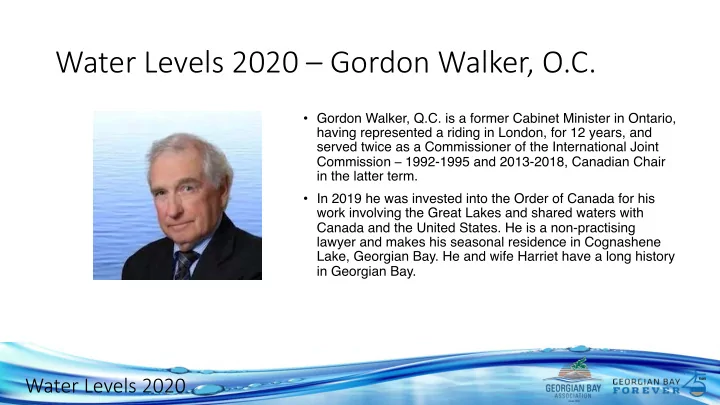
Water Levels 2020 – Gordon Walker, O.C.

  • Gordon Walker, Q.C. is a former Cabinet Minister in Ontario,

having represented a riding in London, for 12 years, and served twice as a Commissioner of the International Joint Commission – 1992-1995 and 2013-2018, Canadian Chair in the latter term.

  • In 2019 he was invested into the Order of Canada for his

work involving the Great Lakes and shared waters with Canada and the United States. He is a non-practising lawyer and makes his seasonal residence in Cognashene Lake, Georgian Bay. He and wife Harriet have a long history in Georgian Bay.

Water Levels 2020

slide-2
SLIDE 2

Water Levels 2020 – Pierre Béland

  • Dr. Pierre Béland is the Canadian Sec7on Chair of the Interna7onal Joint

Commission.

  • Dr. Béland is a scien7st in environmental biology and toxicology, best

known as an expert on the conserva7on of beluga whales and was a founder and research scien7st with the St. Lawrence Na7onal Ins7tute

  • f Ecotoxicology.
  • Dr. Béland has served for ten years as a Commissioner for BAPE, has

previously headed the Fisheries Ecology Research Center with the Department of Fisheries and Oceans Canada, and was a paleoecologist with the Na7onal Museum of Nature.

  • Prior to joining the IJC, he owned and managed a company

manufacturing equipment for research and management of aqua7c and marine ecosystems, and was a Director of AquaForum. Addi7onally, Dr. Béland has chaired for various environmental agencies and hosted a TV series on the environment.

Water Levels 2020

slide-3
SLIDE 3

GBA/GBF Water Levels Symposium 2020: Afternoon Session

Opening remarks by: Pierre Béland Canadian Chair, International Joint Commission October 24, 2020

20-10-23

slide-4
SLIDE 4

125

The International Joint Commission

Two main functions:

* Rules on Applications for structures affecting boundary or transboundary waters and issues Orders of Approval for

  • peration of these projects

* Investigates issues referred by governments (References) and makes non-binding recommendations

slide-5
SLIDE 5
  • Education and Outreach
  • Continue to rely on the best-available science
  • Recognize limitation
  • Balance of interests
  • Promote resilience

20-10-23

126

Key Messages

slide-6
SLIDE 6
  • E. What improvements could be made to coordina?on between control boards

and their coordina?on with other water levels control structures in the system to beYer address extreme high and low water levels?

i. Sample Ques?ons from Registrants a. In 1993 the IJC developed four ac7on plans to mi7gate high water - why aren’t they using any of them?

  • b. Can regulated parts of the Great Lakes-St. Lawrence System be beFer regulated to
  • ffset middle lakes shoreline degrada7on?

c. A decision was made to reduce the September ouulow from Lake Superior...who controls this and why has it taken so long?

  • ii. The IJC only controls 2 water level control structures. There are numerous informa7on

products available through a variety of agencies, but the specific purpose of the data in each leads it to be presented without considera7on of an unini7ated consumer’s perspec7ve. Experts can understand the in7ma7ons, the public oMen does not.

a. What did we learn from the morning session that might provide some insight into poten7al coordina7on improvements?

  • b. Would it be produc7ve/possible to expand the membership and mandate of the

Interna7onal Lake Superior Board of Control to improve coordina7on?

Water Levels 2020

slide-7
SLIDE 7

Speakers:

Erika Klyszejko, Engineering Advisor with the Canadian Sec7on of the Interna7onal Joint Commission in OFawa, ON. Rick Layzell, Execu7ve Director, Boa7ng Ontario

Water Levels 2020

  • E. What improvements could be made to coordina?on between control boards

and their coordina?on with other water levels control structures in the system to beYer address extreme high and low water levels?

slide-8
SLIDE 8

Coordination within the Great Lakes– St. Lawrence River System

October 24, 2020 Erika Klyszejko, IJC Engineering Advisor

slide-9
SLIDE 9

130

IJC Control Boards

slide-10
SLIDE 10
  • The IJC acts as a quasi-judicial body by deciding whether certain types of projects,

such as dams, diversions or bridges, can be built or undertaken in rivers or lakes that flow along or across the interna7onal boundary.

  • If the IJC approves a project, it issues an Order of Approval.

– Consistent with its rule of procedure, the IJC will hold a hearing or hearings at which all persons interested are en7tled to be heard. – In cases where the opera7on of the project must meet certain condi7ons, such as flow requirements through a dam, the IJC appoints a board to monitor compliance with the Order of Approval on an ongoing basis.

Applica?ons & Orders of Approval

slide-11
SLIDE 11

Levels Reference Study

  • Following a period of record-high water levels in the

mid-80s, the IJC received a reference from governments.

  • Levels Reference Study Board completed its report in

1993 and provided a number of recommenda7ons, including recommenda7ons for a review of IJC’s Lake Superior regula7on plan.

  • Annex 6 of the report specifically focuses on

Crisis Condi7on Responses

  • The IJC provided its recommenda7ons to governments

later in 1993;

  • The IJC recommended that no further considera?on

be given to mul?-lake regula?on as a means of reducing flood damage.

  • It also stated no defini?ve conclusion can be

reached regarding the use of diversion un7l the poten7al impacts within and outside the Great Lakes – St. Lawrence River basin are determined.

slide-12
SLIDE 12

How did we get to Plan 2012?

slide-13
SLIDE 13

How do we coordinate now?

slide-14
SLIDE 14

Industry impacts

slide-15
SLIDE 15

October 2020 survey to 40 Georgian Bay marinas – 14 responses (35%)

  • High water 2017 – 2020 – 100% impacted
  • 10/14 shared detail $745,000 combined
  • Low water 2012 – 2013 – 50% impacted
  • 7/14 shared detail $878,000 combined

10000 40000 85000 150000 25000 300000 50000 5000 35000 50000 113000 10000 40000 350000 200000 150000 150000 50000 100000 150000 200000 250000 300000 350000 400000

Water damage repair costs

slide-16
SLIDE 16

2 4 6 8 Parking / Roads / Ramps Waterfront buildings / Boat Storage Docks

Rising waters impacts

6" rise 12" rise 5 5 6 6 7 Parking / Roads / Ramps Waterfront buildings / Boat Storage Docks

Declining waters impacts

6" drop 12" drop

Infrastructure impact

slide-17
SLIDE 17
  • Insurance impact

Underwriters are removing / restric7ng / increasing rates for flood coverage

  • Shared responsibili7es to mi7gate impact and soMen

‘peaks & valleys’ Industry cannot sustain con7nuing capital requirements Six respondents feel long term future in doubt from water levels

  • We cannot simply ‘move’ a marina

Impact on water access coFagers, all users

  • Open / frequent / understandable communica7ons
slide-18
SLIDE 18

Panel Discussion:

Erika Klyszejko, Engineering Advisor with the Canadian Sec7on of the Interna7onal Joint Commission in OFawa, ON. Rick Layzell, Execu7ve Director, Boa7ng Ontario

  • Dr. Pierre Béland, Canadian Sec7on Chair of the Interna7onal Joint

Commission

Water Levels 2020

  • E. What improvements could be made to coordina?on between control boards

and their coordina?on with other water levels control structures in the system to beYer address extreme high and low water levels?

slide-19
SLIDE 19
  • F. Is there consensus on ac?on that could be taken to improve coordina?on and

ensure that we collec?vely use all available methods to mi?gate future extreme high and low water levels?

  • i. Sample Ques?ons from Registrants
  • a. Are there complementary efforts that can be taken by those other than control

boards (i.e. Ontario Power Genera7on and local and provincial governments)?

  • ii. The IJC has a number of Control Boards with overlapping membership to

implement the regula7ons governing their control structures. The coordina7ng commiFee and GLAM CommiFee provide input to these Boards.

  • a. How can the compe7ng interests of the exis7ng control boards and managers
  • f other water levels control structures be reconciled?
  • b. What will be needed to progress towards beFer coordina7on?

c. Could the IJC recommenda7ons of 2013 to put in place a Great Lakes Water Levels Advisory Board be revisited and provide guidance on how coordina7on improvements could be achieved?

Water Levels 2020

slide-20
SLIDE 20

Speakers:

Erika Klyszejko, Engineering Advisor with the Canadian Sec7on of the Interna7onal Joint Commission in OFawa, ON. Wendy Leger, Canadian Co-Chair, Great Lakes-St. Lawrence River Adap7ve Management CommiFee

Water Levels 2020

  • F. Is there consensus on ac?on that could be taken to improve coordina?on and

ensure that we collec?vely use all available methods to mi?gate future extreme high and low water levels?

slide-21
SLIDE 21

Can we mitigate the impacts of future extreme water levels?

October 24, 2020 Erika Klyszejko, IJC Engineering Advisor

slide-22
SLIDE 22

1964-73 1977-83 1986-93 2000-06 2007-12

143

What have we learned?

slide-23
SLIDE 23
  • Extreme events, high or

low, can not be avoided.

– Even if perfect knowledge

  • f future was possible.
  • AFempts to alleviate

condi7ons in one area are likely to impact another.

What we know from past studies- Limits of regula?on

slide-24
SLIDE 24
  • The 1993 Levels Reference Study Report provided elements of

an emergency preparedness plan.

What we know from past studies- Emergency response measures

  • Prepara7on of such a plan

will require coopera7on and consulta7on among federal, provincial, state and local governments.

slide-25
SLIDE 25
  • Educa7on & outreach to manage

pubic expecta7ons.

  • Visibility, transparency and

accessibility of decision-makers

What we know from past studies- Land-based solu?ons / resiliency

  • Shoreline land use and management

measures are essen7al to alleviate the impacts of fluctua7ng water levels.

  • Flexibility is key to effec7ve local

solu7on.

slide-26
SLIDE 26
  • Established by the IJC in January 2015 for on-going review of lake

regulation plans ​

  • Binational Committee comprised of 16 members from federal, state, and

provincial agencies

Creation of the GLAM Committee

Key questions include:​

  • How well are the impacts of

levels and flows represented by current data and models?​

  • Are water supply conditions

changing?​

  • Are the physical, chemical,

biological, and/or socio-economic conditions changing?​

  • Can water level management be

improved?​

slide-27
SLIDE 27
  • F. Is there consensus on ac.on that could be taken to improve

coordina.on and ensure that we collec.vely use all available methods to mi.gate future extreme high and low water levels?

  • Could the IJC recommenda7ons of 2013 to put in place a

Great Lakes Water Levels Advisory Board be revisited and provide guidance on how coordina7on improvements could be achieved?

148

slide-28
SLIDE 28

Proposed adaptive management approach as a means

  • f addressing extreme water levels because…
  • Extreme water levels are a concern
  • Conditions are changing
  • Complex issues exist
  • Collaboration and a long-term vision was needed
  • Limited ability to alter lake levels through lake

regulation

149

2013 Adaptive Management Task Team Report

slide-29
SLIDE 29
  • No one organization or jurisdiction is fully responsible for managing impacts of water

levels

  • Much fragmentation, duplication and overlap
  • Limited effort to coordinate approaches and share successful approaches
  • Little focus on long-term implications of climate extremes and planning for uncertain

future

150

Response to Water Level Impacts (2013)

slide-30
SLIDE 30
  • 1. Ongoing review and evaluation of the

effectiveness of the Regulation Plans at meeting their intended objectives; and

  • 2. Collaboration on developing and

evaluating solutions to problems posed by water level conditions that cannot be solved through lake regulation alone.

151

Elements of the Adaptive Management Plan

Lake Michigan Lake Huron

slide-31
SLIDE 31

152

Suggested two new formal groups

Adaptive Management Committee

Levels Advisory Body

slide-32
SLIDE 32

153

Levels Advisory Body

  • Engage existing agencies, organizations,

institutions and collaboratives in a Network fashion to undertake components of AM Plan

  • Identify and leverages support and

resources

  • Influence priorities and programs within

agencies to support AM

  • Understand basin-wide linkages
  • Seek funding opportunities
  • Address other water management and

science questions from the governments related to water levels and flows

Adap?ve Management Pilots (at local and regional scales)

slide-33
SLIDE 33

Advise IJC and Supporting Organizations on:

  • On-going coordinated bi-national hydroclimate monitoring and modelling and

climate change research

  • Coordinated data collection needed to support on-going risk assessment
  • The development or updating of system-wide impact models and linkages

between water quality and quantity

  • Development and evaluation of alternative solutions (beginning at Pilots)
  • Advise on coordinated bi-national information management and distribution and

coordinated outreach and engagement

  • Reviews and updates AM Plan

154

Levels Advisory Body Proposed Roles and Responsibilities through Networks (2013)

slide-34
SLIDE 34

Pilot Concept (2013)

Ø Reduce water level vulnerabilities by bringing together:

  • resource management agencies,
  • stakeholders, and
  • other interest participants

Ø Use existing authorities and resources of agencies within a collaborative process

155

slide-35
SLIDE 35

General Pilot Framework (2013)

  • Build a team
  • Identify and understand problems
  • Describe baseline conditions
  • Build information management system
  • Assess current management regime
  • Evaluate alternative management approaches
  • Select and implement preferred alternatives
  • Monitor performance and adapt based on what is learned

156

slide-36
SLIDE 36

Adaptive Management

Adaptive Management (AM) AM is an idea almost universally supported in theory

Ø Decision is made based on best evidence Ø Monitor key outcomes from the decision

Ø Challenge the decision if the outcomes aren’t as expected

Ø Make necessary adjustments

slide-37
SLIDE 37
  • Great Lakes Levels Advisory Body
  • ~ $4.5 to 5 million per country over 1-3 years (at least 15% expected

through agency support)

  • Plus ~$1.1 M per pilot study

158

Costs of AM Plan (2013)

slide-38
SLIDE 38

It requires an on-going commitment

  • Too often funding is provided for a few years

to support a decision analysis.

  • After the decision, funding stops

It requires collaboration

  • Many programs are managed

within silos It requires predictive modelling to allow outcomes to be tested and measured

  • Many decisions are not tied explicitly enough to
  • utcomes to know whether decisions require

revisiting.

159

A great concept rarely used in practice…

Why is Adaptive Management so hard?

slide-39
SLIDE 39

Panel Discussion: Erika Klyszejko, Engineering Advisor with the Canadian Sec7on of the Interna7onal Joint Commission in OFawa, ON. Wendy Leger, Canadian Co-Chair, Great Lakes-St. Lawrence River Adap7ve Management CommiFee

  • Dr. Pierre Béland, Canadian Sec7on Chair of the Interna7onal Joint Commission

Rick Layzell, CEO, Boa7ng Ontario Associa7on

Water Levels 2020

  • F. Is there consensus on ac?on that could be taken to improve coordina?on and

ensure that we collec?vely use all available methods to mi?gate future extreme high and low water levels?

slide-40
SLIDE 40
  • G. What are next steps for par?cipa?ng individuals and organiza?ons based on

what was learned?

  • i. Sample Ques?ons from Registrants

a. What are the next steps being taken?

  • b. What can par7cular groups do individually and collec7vely

c. There is some impa7ence or skep7cism about ac7ons being taken. How do you answer that?

  • ii. There are growing impacts from global warming impac?ng the sustainability of

stakeholders especially those on the water-land interface.

a. Are new tools necessary to provide region-wide resilience to water levels fluctua7ons?

  • b. What challenges do you see in this emerging new water levels regime?

c. How can previous reports be updated to incorporate this new climate regime?

Water Levels 2020

slide-41
SLIDE 41

Water Levels 2020

  • G. What are next steps for par?cipa?ng individuals and organiza?ons based on

what was learned?

Open Discussion

slide-42
SLIDE 42

Water Levels 2020 - Marilyn Longlade Capreol

Water Levels 2020

  • Early spring of 1949, I was born to Napoleon and Norah Geroux
  • Longlade. My first home was the island behind the Ojibway
  • Island. During the winter months we moved to our mainland

loca7on on the shores of Pointe au Baril.

  • Summers home was always bustling with Grandparents, aun7es,

uncles and many cousins. We would hear the song of languages, both Ojibway and French. Hear the fishing stories each day and/

  • r watch Grandma and aun7es make their quill boxes.
  • Very young we were taught to respect and understand the giMs of

water, wind, animals, plants, the sky that holds beau7ful stars. Our first knowledge and educa7on were done by our parents, grandparents and community. There are no books to this day for this giM of learning. It was and is strictly learned by the teachings.

  • I am very grateful and acknowledge, Mishomis Giiziis

(Grandfather Sun) miinwaa (and) Nokomis Dibik Giiziis (Grandmother Moon). They encourage every living being and walk beside all each day.

slide-43
SLIDE 43

Water Levels 2020

Thank you!

Water Levels 2020